IGF-1 LR3 storage and stability come down to keeping water, oxygen and warmth out. In plain terms, freeze sealed vials dark and dry, and let them warm before opening. Its methionines oxidize, its disulfides can rearrange at high pH, and an Asn-Gly site deamidates. In solution, avoid alkaline buffers and aliquot once.
- The sealed, dry, cold and dark vial is the most stable form of IGF-1 LR3.
- Four methionines make oxidation, driven by oxygen, light, peroxides and metals, a main risk.
- Disulfide exchange among the six cysteines speeds up at high pH and temperature and does not change the mass.
- The Asn-Gly junction at residues 13 and 14 is a deamidation hot spot at neutral to alkaline pH.
- No compendial shelf life exists; stored material is judged by testing it against fresh material.
What is actually in the vial
A sealed vial of IGF-1 LR3 in a freezer is about as stable as this protein gets. Almost everything that damages it needs one of three things the sealed, dry, cold vial keeps out: water, oxygen or warmth. Storage comes down to keeping those out for as long as possible, and knowing which parts of the molecule suffer first when they get in.
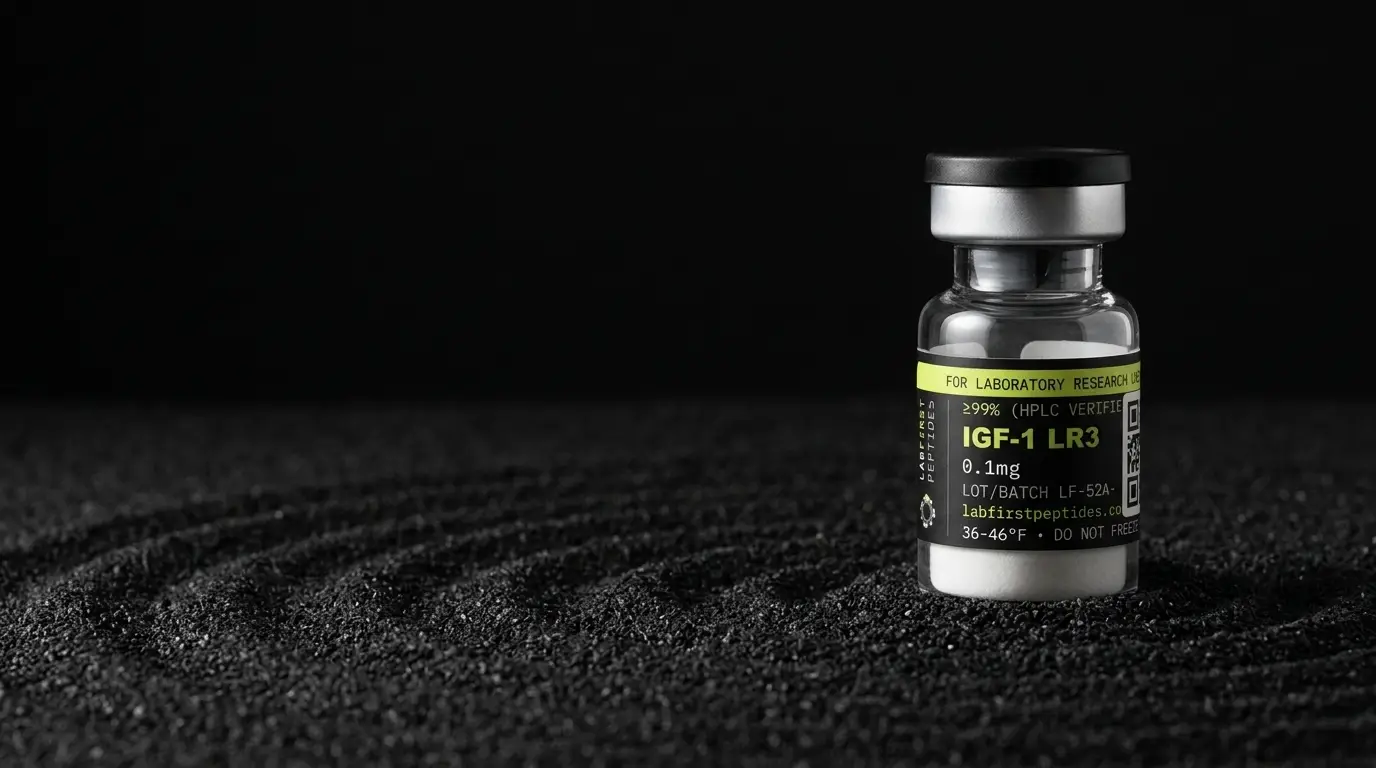
The vial holds a lyophilized solid, either 0.1 mg or 1 mg by label. That solid is mostly the 83-residue analog, plus some water and the counterion left over from purification. The protein inside is folded and held by three disulfide bonds, the pairing given for IGF-1 in UniProt P05019.
Small amounts behave differently from large ones. A 0.1 mg vial holds 100 micrograms spread thinly over glass. Once that is in solution, a meaningful share can stick to the container walls. The 2022 review of protein instability in Pharmaceutics notes that proteins can adsorb to container surfaces and that this can lead to aggregation. At these quantities, loss to surfaces is a storage problem as real as chemical breakdown.
- Store the sealed vial frozen and dark
- Warm to room temperature before opening
- Avoid alkaline buffers for stock storage
- Use low-binding tubes at low concentration
- Aliquot once and thaw each portion once
- Record lot, dates and conditions
How does IGF-1 LR3 degrade?
IGF-1 LR3 degrades mainly by methionine oxidation, disulfide exchange and deamidation at its Asn-Gly site. The sequence tells you where to look. Three features of IGF-1 LR3 matter most, and the Pharmaceutics review describes the chemistry behind each.
| Route | Where in IGF-1 LR3 | What speeds it up | How it shows on a test |
|---|---|---|---|
| Methionine oxidation | Four methionines, two in the extension and two in the IGF-1 portion | Oxygen, oxidants such as peroxides, light, transition metals | Peaks about 16 Da heavier; nearby peaks on HPLC |
| Disulfide exchange | Three disulfides among six cysteines | High pH and temperature | Misfolded forms with the same mass; changes in the HPLC profile |
| Deamidation | The Asn-Gly junction where the extension meets IGF-1 | Neutral to alkaline pH, and the Asn-Gly sequence itself | A 1 Da mass increase; new acidic variants |
| Adsorption and aggregation | The whole protein, worst at low concentration | Contact with container surfaces | Lower than expected concentration; higher-mass species |
The review calls methionine the amino acid most prone to oxidation. It also notes that Asn deamidation happens mostly at Asn-Gly and Asn-Ser sequences and runs faster under neutral or alkaline conditions. IGF-1 LR3 has exactly that Asn-Gly pair at residues 13 and 14, where the extension's last asparagine sits against the first glycine of IGF-1.
How should a sealed vial be stored?
A sealed vial is best kept frozen, dark and closed. In the dry state these reactions slow down a great deal, because most of them need water to move molecules around. Cold slows them further. The usual practice for a sealed lyophilized protein is a freezer, in the dark, with the vial kept closed until it is needed.
Darkness matters for this molecule in particular because light is one of the drivers of methionine oxidation named in the review. An amber box or a closed freezer drawer is enough. Leaving a rack of vials on an open bench under room lighting for an afternoon is the habit to avoid.
The most common way a dry vial takes on water is at opening. A vial taken straight from the freezer and opened in a warm room pulls in humid air, and water condenses on the cold powder. Let the sealed vial come to room temperature first, which takes a few minutes for a small vial, then open it. The same applies every time a vial goes back and forth. If the protein will be used over several sessions, it is better to take it into solution once and store portions than to open the dry vial repeatedly.
Solutions prepared for laboratory assays
Once IGF-1 LR3 is in solution, every route in the table speeds up. A few choices make a real difference.
- Avoid alkaline buffers for storage. Both disulfide exchange and Asn-Gly deamidation run faster at higher pH. Whatever buffer an assay needs, the stock that sits in the freezer does better away from alkaline conditions.
- Keep oxygen and metals down. Use clean, high-grade water and buffers, and fill tubes so there is little headspace. Trace transition metals are one of the oxidation drivers the review lists.
- Think about the container. At low concentration, adsorption to plastic and glass can take a large fraction of the protein. Low-binding tubes, or a carrier protein where the assay allows one, reduce the loss.
- Aliquot, then freeze. Divide the stock into single-use portions so each one is thawed once. Repeated thawing brings repeated exposure to air and handling.
Shipping deserves a word too. A sealed lyophilized vial tolerates a few days in transit with a cold pack far better than any solution would, which is one reason proteins like this are shipped dry. On arrival, check that the seal is intact and the cake or powder looks uniform, then move the vial to the freezer before anything else. A vial that arrives with the solid collapsed, discolored or stuck to the stopper is worth noting in the record and raising with the supplier before it goes into an experiment.
These are laboratory handling points for assay stocks. Our general guide to storing lyophilized peptides covers the principles that apply across the catalog.
Worked example: aliquot arithmetic
Suppose a published certificate for a 1 mg vial reports 80 percent peptide content. That figure is illustrative, not a result for any of our lots.
1 mg × 0.80 = 0.80 mg peptide
Taken into 0.8 mL of assay buffer, that gives a 1.0 mg/mL stock. At about 9,111 g/mol for the folded analog:
1.0 mg/mL ÷ 9,111 g/mol ≈ 110 µM
Split into sixteen aliquots of 50 µL, each holds 50 micrograms of peptide, and each is thawed once for one experiment. Had the calculation used the label's 1 mg instead of 0.80 mg, every aliquot would carry 20 percent less protein than recorded, and every downstream dilution would inherit that error.
Does IGF-1 LR3 have a set shelf life?
No. IGF-1 LR3 has no pharmacopeial monograph and no approved product, so there is no compendial shelf life to point to. A shelf life is the output of a stability study on a specific material in a specific container under specific conditions. A figure printed on a research product without that study behind it is a convention, not a measurement.
What you can do is watch for change. The degradation routes above each leave a mark a laboratory can detect: mass shifts of 16 Da for oxidation and 1 Da for deamidation, new peaks near the main one on HPLC, and a drop in measured concentration from adsorption. Testing a stored aliquot against a fresh one under the same conditions is the direct way to learn whether storage has changed the material. The page on how IGF-1 LR3 identity is confirmed covers what those mass checks look like.
What the storage record should say
For each vial and each stock solution, write down the lot number, the date received, where and at what temperature it was kept, the date it was opened, the buffer and volume used, the aliquot size, and the date each aliquot was thawed. When a result later looks wrong, that record is what separates a storage problem from a problem with the material. The lot number links it back to the IGF-1 LR3 certificate of analysis.
Certificates for our IGF-1 LR3 lots, the 0.1 mg vial (SKU IG01) and the 1 mg vial (SKU IG1), are pending, and this page states no result for any of our lots. A lot's results appear only once the certificate for that lot is published, listed on the certificate index and linked from the IGF-1 LR3 product page.
IGF-1 LR3 is not an FDA-approved drug product and is supplied here as laboratory material only.
FOR LABORATORY AND IN-VITRO RESEARCH USE ONLY. NOT FOR HUMAN OR ANIMAL CONSUMPTION.
What is IGF-1 LR3 studied for?
Published research on IGF-1 LR3 investigates the areas below, which is a different question from what IGF-1 LR3 will do for anyone, a claim about a living system that nothing on this site is sold for.
What it is. Analogue of human insulin-like growth factor 1 with arginine replacing glutamate at position 3 and a thirteen-residue N-terminal extension.
What the research looks at. Used principally as a cell-culture reagent — it is a standard supplement in serum-free and reduced-serum media for industrial and research cell culture — and as a comparator in IGF analogue pharmacology.
How it is thought to work. Binds the IGF-1 receptor. The substitutions markedly reduce affinity for IGF binding proteins, which is the design intent: less sequestration by IGFBPs means more free peptide available to the receptor.
What is not established. No approved product and no human therapeutic data. Reduced IGFBP binding is a property demonstrated in binding assays; that it produces greater biological effect does not follow, and in at least one published comparison it did not.
The full record, including the certificate for the lot in stock, is on the IGF-1 LR3 product page.
Common questions
Why does IGF-1 LR3 need protecting from light?
What is the Asn-Gly site in IGF-1 LR3?
Can the disulfide bonds change during storage?
Why does the small vial lose protein in solution?
More handling guides
Sources
- Instability Challenges and Stabilization Strategies of Pharmaceutical Proteins, Pharmaceutics, 2022. Methionine as the residue most prone to oxidation (oxygen, oxidants, light, transition metals); disulfide exchange favored by high pH and temperature; Asn deamidation fastest in Asn-Gly and Asn-Ser at neutral to alkaline pH; adsorption to container surfaces.
- UniProt P05019, Insulin-like growth factor 1 (human). Mature IGF-1 chain (residues 49 to 118 of the precursor, 70 residues), its sequence, and the three disulfide bonds Cys54-Cys96, Cys66-Cys109 and Cys95-Cys100 in precursor numbering.
- Francis et al., Novel recombinant fusion protein analogues of insulin-like growth factor (IGF)-I, Journal of Molecular Endocrinology, 1992. Describes the Long IGF-I analogues built from the first 11 residues of methionyl porcine growth hormone joined to IGF-I, including Long [Arg3]-IGF-I; PMID 1378742.
- PubChem compound records for L-cysteine (CID 5862) and L-cystine (CID 67678). Cysteine is C3H7NO2S; cystine, two cysteines joined by a disulfide, is C6H12N2O4S2, two hydrogens fewer than two free cysteines.