KLOW storage and stability depend on keeping the sealed lyophilized vial dry, dark and cold, and letting it warm to room temperature before opening. Moisture does more damage than a warmer freezer. With four peptides in one vial, any loss shows up component by component, so date and log every opening and every assay solution.
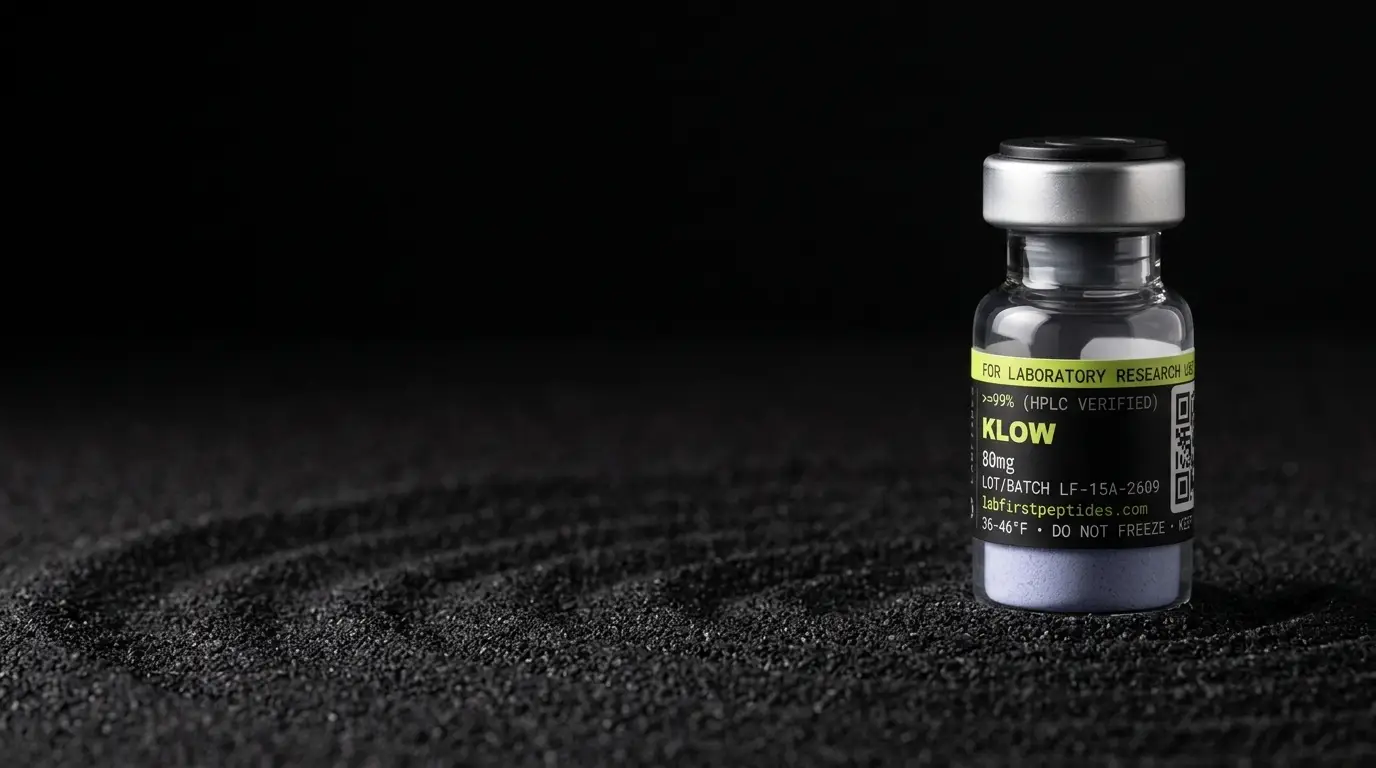
- KLOW is an 80 mg vial of four freeze-dried peptides: BPC-157, GHK-Cu, TB-500 and KPV.
- Moisture drives most peptide degradation routes; cold slows them but does not stop them.
- Each of the four components can degrade at its own rate with no visible change to the powder.
- ICH Q1A(R2) ties a re-test period to a stability study on that material under defined conditions; none is published for KLOW.
- Warming a sealed vial to room temperature before opening prevents condensation getting into the powder.
Why does a dry vial matter?
A dry vial matters because water drives most of the ways a freeze-dried peptide breaks down. Why does a sealed packet of instant coffee stay a loose powder for months, while an open jar left by the kettle turns into a hard lump within weeks? Water from the air. A freeze-dried peptide behaves much the same, only the damage is chemical and you usually cannot see it.
KLOW in this catalog is an 80 mg vial holding four peptides freeze-dried together: BPC-157, GHK-Cu, TB-500 and KPV. The KLOW composition guide covers what each one is. This page covers how the sealed vial and any solution prepared from it for a laboratory assay should be stored and recorded.
The short version is dry, dark, cold, and sealed until it has warmed up. The longer version has one twist that single-compound storage pages do not: with four peptides in one vial, each can degrade at its own rate, and a single glance at the powder tells you nothing about which one has changed.
- Moisture: the main driver, mostly from condensation
- Temperature: changes the rate, not the mechanism
- Freeze-thaw: losses add up and cannot be seen
- Light and oxygen: oxidation, helped along by trace metals
- Surfaces and agitation: aggregation in solution
What degrades a freeze-dried peptide?
Hydrolysis, deamidation, oxidation and aggregation are the main routes, and moisture drives most of them. Manning and colleagues, reviewing protein and peptide stability in Pharmaceutical Research in 2010, sort the problems into chemical instability, where bonds break or change, and physical instability, where molecules stick together or to surfaces. They also treat the aqueous and dried states separately, because a dry solid and a solution fail in different ways and at very different speeds.
| Route | Main driver | Control |
|---|---|---|
| Backbone hydrolysis | Water, heat, pH extremes | Keep the solid dry and sealed |
| Deamidation | Water, heat, neutral to basic pH | Dry storage, cold, short time in solution |
| Oxidation | Oxygen, light, trace metals | Dark storage, minimal headspace |
| Aggregation and adsorption | Solution, surfaces, agitation | Gentle mixing, consistent container material |
| Microbial growth | Solutions held warm | Clean preparation, cold, defined use window |
Cold appears in the controls column over and over, but never as the cause. Temperature changes how fast each route runs. Water is what most of them need in order to run at all.
What changes with four peptides in one vial?
A single-compound vial degrades along one set of routes. A blend degrades along four at once, because each peptide has its own sequence and its own weak points. One component might lose a few percent while the others are untouched, and the powder will look exactly the same.
GHK-Cu adds a component of a different kind. PubChem describes it as a tripeptide of glycine, histidine and lysine that readily forms a complex with copper ions. That makes one of the four ingredients a metal complex rather than a plain peptide, and trace metals are one of the drivers of oxidation in the table above. We have no stability data on how the copper complex interacts with the other three components in a dried blend, and neither, as far as we can find, does the published literature. It is one more reason the storage controls below are conservative.
The practical consequence is that stability for KLOW is a per-component question. A later certificate or an in-house check should report each of the four, and the identity guide explains how that is done.
Conditions by state
| State | Temperature | Light | Relative horizon |
|---|---|---|---|
| Sealed vial, unopened | Minus 20 °C or below, with desiccant | Dark | Longest |
| Sealed vial, working stock | 2 to 8 °C, with desiccant | Dark | Shorter than frozen |
| Vial in transit | Ambient | Dark, insulated | Days |
| Assay solution | 2 to 8 °C | Dark | Days, not months |
| Assay solution, single-use aliquots | Minus 20 °C or below | Dark | Longer, at a cost per thaw |
The horizons are relative on purpose. ICH Q1A(R2) defines a re-test period as the time a substance is expected to stay within its specification when stored under defined conditions. That figure comes out of a stability study on that material in that container. Nobody has published such a study for KLOW, so any fixed shelf life printed for it is a convention. If a certificate gives a re-test date backed by data for that lot, use it. If not, record the window as unestablished and judge the material by its handling history.
The cold vial and the humid room
The most common avoidable damage happens in about ten seconds. A vial comes out of a freezer at minus 20 °C into a room at 22 °C. The glass is well below the dew point of the room air. The moment the stopper lifts, moisture condenses on the inside of the vial and on the powder, and a freeze-dried cake takes it up at once.
Nothing visible changes. The vial goes back in the freezer carrying that water, and the next opening adds more. Weeks later a result drifts and nobody can say why.
The fix is dull and reliable. Let the sealed vial reach room temperature before opening it, every time. For a small vial, twenty to thirty minutes on the bench is typical. Work quickly once it is open, reseal it against fresh desiccant, and note the opening in the log.
Solutions prepared for an assay
Dissolving the powder for a laboratory assay starts a faster clock. The water-driven routes now have all the water they need, surfaces are in contact with a liquid, and any organism introduced during preparation has somewhere to grow. The diluent and its lot number belong in the record. The bacteriostatic water guide covers what that diluent does and does not do for a laboratory stock.
Two habits carry most of the value. Split the solution into single-use aliquots at the moment it is made, so no tube is thawed twice. And label each aliquot then and there, in freezer-proof ink, with an identifier that traces back to the parent solution and the vial lot.
Freeze-thaw losses add up rather than reverse, and a tube on its fifth thaw looks the same as one on its first. Mix by gentle swirling rather than vortexing, since foam creates air-water interface where peptides tend to aggregate.
For a blend there is one extra entry. The concentration of each peptide in the solution depends on the per-component amounts stated on the certificate, not on the 80 mg total, so the log should record which certificate figures the calculation used.
Worked example: aliquot arithmetic
Say a lab dissolves the full vial in 4 mL of diluent for an assay series. Taking the 80 mg total at face value gives:
80 mg ÷ 4 mL = 20 mg/mL of blend
That number describes the blend, not any one peptide in it. To get the concentration of, say, KPV, the lab needs the KPV amount from the certificate for that lot, divided by the same 4 mL. Without that figure the per-peptide concentration is unknown, and the log should say so rather than guess.
If each assay draws 0.5 mL, the solution supports:
4 mL ÷ 0.5 mL = 8 draws
Kept as one tube, the eighth draw comes from material warmed and chilled seven times. Split into eight 0.5 mL aliquots at preparation, each is thawed once. The cost is a rack of tubes and a few minutes of labeling, and for a blend the payoff is larger than usual, since a freeze-thaw loss in any one of four components would show up as a drift nobody can trace.
What the record should say
For each assay solution, the minimum record is the vial lot, the certificate the calculation relied on, the diluent and its lot, the volume added, the resulting concentration of each component, the date and time, where it is stored, and who made it. Aliquots inherit all of it through a shared identifier.
Two rules are worth adopting without exception. Undated containers get discarded rather than guessed at. And a short physical note goes in the log at every opening: cake intact or collapsed, solution clear or cloudy. A note made at the time is evidence. A memory of it later is not.
Our KLOW certificate is not published yet. The KLOW product page will show results only once the certificate for that lot is published, and the KLOW certificate guide explains how to read it when it is.
FOR LABORATORY AND IN-VITRO RESEARCH USE ONLY. NOT FOR HUMAN OR ANIMAL CONSUMPTION.
What is KLOW studied for?
Published research on KLOW investigates the areas below, which is a different question from what KLOW will do for anyone, a claim about a living system that nothing on this site is sold for.
What it is. A brand name for several peptides freeze-dried together in one vial.
What the research looks at. The ingredients appear separately in the research. The blend as sold is a way of packaging them and has not itself been studied.
How it is thought to work. A blend name, not a molecule. Whatever mechanism there is belongs to the separate ingredients, and those are described on their own records.
What is not established. Blend names are not standardised between suppliers, so the same name can mean different ingredients in different amounts. Read the certificate for what is actually in the vial rather than trusting the name.
The full record, including the certificate for the lot in stock, is on the KLOW product page.
Common questions
Does a sealed KLOW vial have to be frozen?
How long does a KLOW solution last in the lab?
Can I tell from the powder whether KLOW has degraded?
Why warm the vial before opening it?
Published certificates for KLOW
Every figure below is read from a report the laboratory issued for that lot; each page carries the PDF and the lab's own verification link.
More handling guides
Sources
- ICH Q1A(R2), Stability Testing of New Drug Substances and Products. Defines the re-test period as the time a substance stays within specification under defined storage conditions, established by stability study.
- Manning MC, Chou DK, Murphy BM, Payne RW, Katayama DS. Stability of protein pharmaceuticals: an update. Pharmaceutical Research, 2010 (Europe PMC record). Review of chemical and physical instability and stabilization in aqueous and dried states.
- PubChem, prezatide copper (CID 71587328), record description. GHK tripeptide that readily forms a complex with copper ions.
- PubChem property table for BPC-157, TB-500, KPV and GHK. Reference identities for the four components.