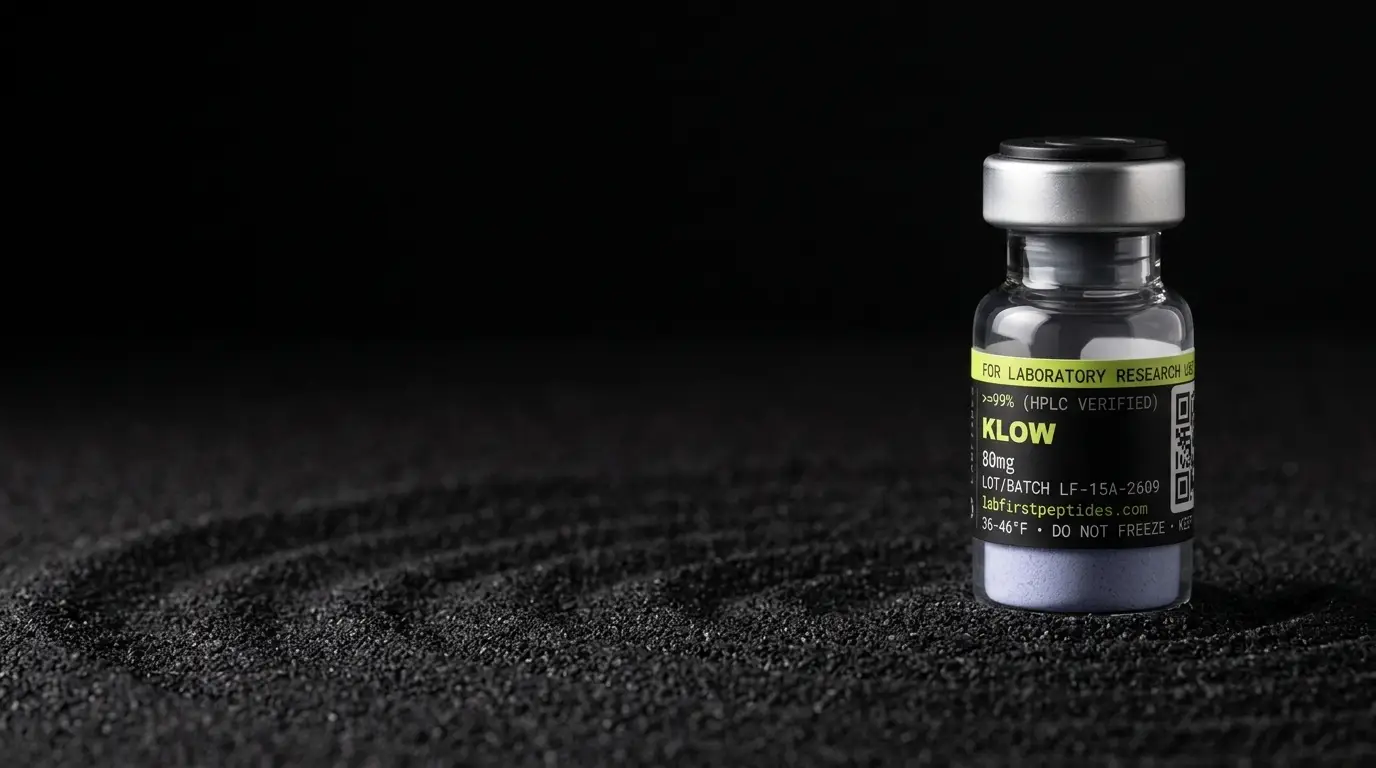
KLOW blend peptides are four peptides freeze-dried into one vial: BPC-157, GHK-Cu, TB-500 and KPV. KLOW is a brand name, not a molecule. Nothing about the name is standard, so two suppliers can both sell KLOW at different ratios and both describe their own product correctly.
- KLOW is a brand name, not a molecule: BPC-157, GHK-Cu, TB-500 and KPV in one vial, 80 mg total in this catalog.
- GLOW is the same idea without KPV: BPC-157, GHK-Cu and TB-500, 70 mg.
- No standards body defines a blend name, so ratios vary between suppliers and both can be accurate.
- A blend certificate should identify each component separately and account for the amounts against the label.
- A single purity percentage for a multi-component vial does not say which component it describes.
- The components appear separately in the published literature. The blend as sold has not been studied.
Four peptides, one vial
Grab a bag of brand-name trail mix and read the front: it names the nuts inside, not how much of each. A named blend works like a bag of that mix, and only the label for that specific bag can tell you the amounts.
KLOW is BPC-157, GHK-Cu, TB-500 and KPV, lyophilized together. The version in this catalog is an 80 mg vial. GLOW is the same idea with three of the four, BPC-157, GHK-Cu and TB-500, at 70 mg. Drop the KPV and the K goes with it, which is where both names come from.
Each of those four has its own record: a sequence, a molecular formula, a mass, and a body of published work that belongs to it alone. GHK-Cu is a copper complex of a tripeptide. KPV is three residues, the tail of a larger hormone. TB-500 is a fragment. BPC-157 is a fifteen-residue synthetic peptide. They are not variations on one theme; they are four different molecules that happen to be sold in one container.
The blend has none of those properties. It has no sequence, no formula and no molar mass, because a mixture does not have them. That sounds pedantic until you try to read a certificate for one.
FOR LABORATORY AND IN-VITRO RESEARCH USE ONLY. This page is about what is in a vial and what its paperwork should say, not about what anyone should do with it.
- Every component named on the label, with the milligrams of each.
- Identity confirmed for each component separately, method printed beside it.
- Amounts accounted for against the label, not one figure for the vial.
- The issuing laboratory named, its code resolving on that laboratory's own site.
- The lot on the paper matching the lot on the vial in your hand.
A blend name is not a specification
There is no standards body for peptide blend names. Nobody registers KLOW. No pharmacopeia carries a monograph defining what an acceptable batch looks like, the way one exists for a single well-characterized substance. The name is a marketing convention that spread because it is convenient, and conventions drift.
So a supplier can put the four components in at any proportion and describe the result as KLOW without saying anything untrue. One vial might be weighted heavily toward BPC-157, another toward GHK-Cu, and both listings can read identically. The total milligram figure on the label is the only quantity most listings commit to, and a total tells you nothing about the split.
This is the first question to ask, and it is not an accusation: what is the ratio, in milligrams per component? A supplier who knows their product answers it immediately. One who cannot answer it has bought a pre-mixed powder and is reselling somebody else's decision.
Why a blend certificate is harder than a single-compound one
For one compound, a certificate answers two separate questions. Is this the right molecule, which is identity, usually by mass spectrometry. And how much of the vial is that molecule, which is purity, usually by HPLC, with the method printed beside the figure. Net peptide content is a third measurement and a good certificate reports it separately, because a vial can be pure and still short of the labeled mass.
A blend asks all of that four times over. A single purity percentage for a vial containing four peptides is close to meaningless: it does not say which peptide the number describes, and it certainly does not confirm that the fourth component is present at all. A blend can be 98% pure in the sense that 98% of the powder is peptide, while one of the four is barely there.
What a reader should look for is each component identified in its own right, and the amounts accounted for against the label. Where that is missing from the paper, the honest reading is that it was not measured. Not that it failed, not that anyone lied. Simply that nobody checked, and the certificate is quiet about it because there was nothing to report.
None of this is a criticism aimed at a particular seller. It is the structural reason blends are harder to document than single compounds, and the reason a blend certificate deserves more reading rather than less.
What the literature does and does not cover
The components appear separately in published work. The blend, as sold, does not. That is worth stating plainly because the marketing around blends often implies otherwise, borrowing the weight of four separate literatures and presenting it as though it belonged to the mixture.
Our own product record for KLOW says exactly this: it is a brand name for several peptides freeze-dried together, whatever mechanism exists belongs to the separate ingredients, and the combination is a way of packaging them rather than a studied entity. The same sentence sits on the GLOW record.
If you want to understand what is in the vial, read the four component records. If you want to know what the combination does, the honest answer available today is that nobody has published it, and a supplier claiming otherwise should be asked for the reference.
Why blends exist at all
Convenience, mostly, and it is worth being straight about that rather than dressing it up. Four compounds in four vials is four reconstitutions, four labels, four lots to track and four certificates to read. One vial is one of each. For a laboratory running a lot of preparations, that is real time saved.
There is a second reason, less flattering and equally real: a blend is harder to price-compare. Four separate products have four visible per-milligram prices, and a buyer can hold them against another supplier line by line. An 80 mg vial with an undisclosed split has one price and no comparison, which suits the seller more than the buyer.
Both things can be true at once. The convenience is genuine and so is the opacity, and which one you are getting depends entirely on whether the ratio is published. That single disclosure turns a blend back into something you can price, check and reorder with confidence, and its absence is the whole of the problem.
It also affects what happens when something is wrong. If a single-compound vial fails identity, you know what failed. If a blend fails, you know one of four things failed, and without per-component data you cannot say which, cannot tell the supplier what to fix, and cannot decide whether the other three were fine.
Our own certificates, and where they stand
It would be easy to write this page as though we had solved the problem. We have not, yet, and saying so is the only position consistent with the rest of it.
Our first lots have been through independent testing. Each certificate posts on its product page as it is published, and until then the page says the result is pending rather than quoting a figure its certificate does not yet back.
For a blend, per-component figures matter more than a single vial-wide number, and that is what to check for on the certificate: identity and purity broken out for each of the four peptides, not one percentage standing in for all of them.
Four questions worth asking before buying any blend
None of them is rude, and all four have short answers if the seller knows their product.
What is the ratio, in milligrams per component, rather than as a percentage of a total? Was each component identified separately, and by which method? Does the certificate name the laboratory that issued it, and does its verification code resolve on that laboratory's own site rather than on the seller's? And does the lot number on the paper match the lot on the vial that arrived?
A supplier who can answer those four has done the work. One who answers with a single purity figure for the whole vial has reported one measurement and left three unanswered, which is not the same as passing them.
There is a fifth question, for the seller rather than the paperwork: who mixed it? A blend can be lyophilized together by the manufacturer of the components, or it can be dry-blended downstream by somebody who bought four powders. Those are different products with different failure modes, and the certificate rarely says which one you are holding.
Common questions
What is in KLOW?
What is the difference between KLOW and GLOW?
Is KLOW a single peptide?
Why does the ratio matter?
Can one purity figure describe a blend?
Published certificates for KLOW
Every figure below is read from a report the laboratory issued for that lot; each page carries the PDF and the lab's own verification link.
More documentation guides
Sources
- PubChem Compound Summary for CID 133697840, GHK-Cu (glycyl-L-histidyl-L-lysine copper complex). An openable record for one component, giving formula and mass. A blend has no equivalent record, which is the point this page turns on.
- U.S. Pharmacopeia, index of official standards texts. Where a monograph would sit if one defined these blends. None does, which is why a blend name carries no specification.