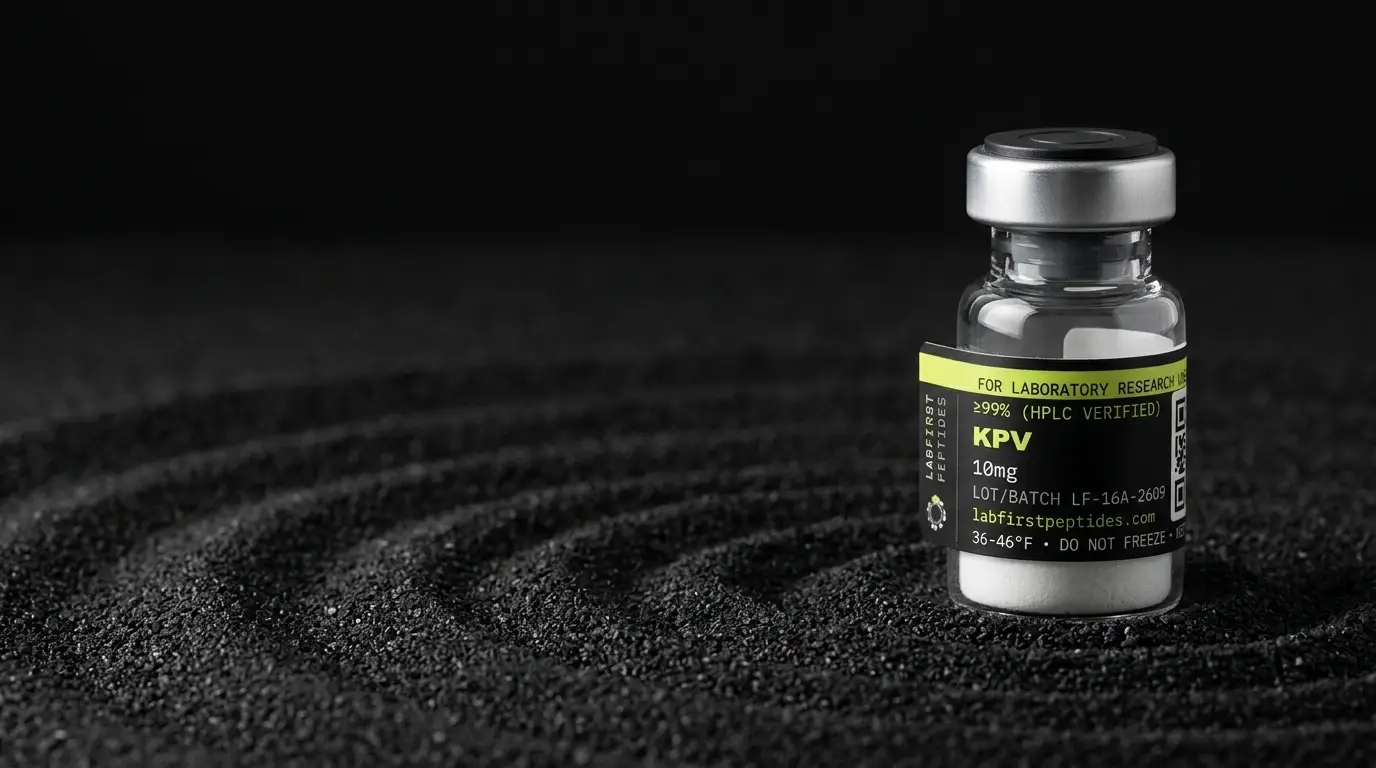
KPV identity is confirmed with a mass reading against 342.43 and a separation that actually holds the peptide on the column. At this size, mass alone is strong evidence. It cannot show the order of the three building blocks, though, so fragmentation data matters more here than most people expect.
- KPV is Lys-Pro-Val, C16H30N4O4, average mass near 342.43, PubChem CID 125672.
- At this size a mass match is close to decisive, unlike on a large peptide.
- Mass cannot fix residue ORDER: three residues have six possible arrangements.
- Retention is the hard part; on a standard C18 the peptide can elute in the solvent front.
- The diketopiperazine degradation product retains even less well than the parent.
- One trifluoroacetate counterion is roughly a quarter of this peptide's mass.
What does identity mean for a tripeptide?
What can you learn about a three-letter word if you only weigh its letters? In plain terms, weighing tells you which letters are there, but not the order they come in. A separate test is needed to read the spelling.
That the molecule in the vial is the one the label names. KPV is lysine-proline-valine, molecular formula C16H30N4O4, average mass near 342.43, cataloged as PubChem CID 125672.
Identity and purity are separate questions, and a certificate answering one has answered half. For a molecule this small the two are established by quite different means, because the mass measurement is trivially easy and the separation is genuinely difficult.
That asymmetry is the theme of this page. Almost everything about identifying KPV is simpler than for a large peptide, except the one part that is harder.
- Observed mass against 342.43, where a single dalton is unmistakable
- Sequence order, which mass cannot fix: six arrangements of three residues
- Fragmentation data, quick and clean at this size
- Column and mobile phase named, because retention is the hard part
- Purity read at 214 nm, and not from the solvent front
- The cyclic degradation product, which retains even less than the parent
- Accession number confirmed at the issuing laboratory
What does the mass result confirm?
That the molecule weighs what KPV weighs. At 342 daltons there is no charge-state envelope to deconvolute and no meaningful measurement scatter to hide inside.
A difference of a single dalton is unmistakable. A missing residue, an extra one, an unremoved protecting group, or a wholly different molecule all show up immediately and unambiguously.
So mass carries more of the identity burden here than it does anywhere else in this catalog. On a 3,358-dalton peptide a mass match is one piece of supporting evidence. On a tripeptide it is close to decisive, with one specific exception.
What can mass not tell you about three residues?
Their order. Mass is a sum, so lysine-proline-valine and valine-proline-lysine weigh exactly the same, and so does every other arrangement of those three residues.
With three residues there are six possible orders. That is a small number, which makes the problem tractable and does not make it disappear.
A synthesis that assembled the right residues in the wrong sequence would pass a mass check without difficulty. It is not a common failure in practice, and it is the one thing the easiest measurement in the panel cannot see, which is worth knowing when a certificate offers mass and nothing else.
How is sequence order established?
By fragmentation. Tandem mass spectrometry breaks the molecule at the peptide bonds and weighs the pieces, and the pattern of fragment masses fixes which residue sits where.
For a tripeptide the resulting spectrum is simple, with few fragments to interpret. That makes the experiment quick and the answer clean, so its absence from a certificate is a choice rather than a technical obstacle.
Amino acid analysis is the other route and it answers a slightly different question. It confirms which residues are present and in what ratio, without fixing their order. Composition plus mass narrows the possibilities considerably; only fragmentation closes them.
Why is retention the difficult part?
Because reversed-phase chromatography holds molecules by hydrophobicity, and a three-residue peptide carrying a lysine has very little to hold on to.
Under ordinary conditions on a standard C18 column, KPV can elute at or near the solvent front. Anything eluting there is separated from nothing, because every other small polar species arrives at the same moment.
A purity figure calculated from that region of a chromatogram is close to meaningless. This is why the column and mobile phase belong on the certificate for this compound: they decide whether the number above them describes a separation or a coincidence.
What do laboratories do to retain it?
Three approaches, and a good certificate names the one used. An ion-pairing additive such as trifluoroacetic acid pairs with the lysine's positive charge, making the peptide behave as a more hydrophobic molecule and holding it on the column.
A polar-endcapped or aqueous-compatible stationary phase is designed to retain small polar analytes that a conventional C18 releases immediately.
Hydrophilic interaction chromatography inverts the mechanism entirely, retaining polar molecules and eluting hydrophobic ones first. It suits this peptide well and is unfamiliar enough that a certificate using it should say so, since a reader comparing retention times across methods would otherwise be comparing nothing.
Which degradation product should the method resolve?
The diketopiperazine. Short peptides can cyclise at the first two residues, forming a stable ring that cleaves away from the rest, and a proline in the second position makes the geometry favorable.
By mass it is easy to spot, since an entire residue has been lost. By chromatography it is harder than the parent: the cyclic dipeptide is small, neutral and polar, so it retains even less well than KPV does.
A method that barely holds the peptide will not hold its degradation product at all. That is a specific, checkable reason to want the separation conditions on the page rather than a general preference for detail.
Why does detection wavelength matter?
KPV contains no tryptophan, tyrosine or phenylalanine, so it has essentially no absorbance at 280 nanometres. The workable wavelength is 214, which responds to the peptide bond itself.
There is a second-order consequence of being small. A tripeptide has only two peptide bonds, so even at 214 the absolute signal per molecule is modest compared with a longer peptide at the same molar concentration.
That affects sensitivity rather than validity. It does mean the wavelength belongs on the certificate, and that a KPV purity figure reported at 280 is quantifying a signal the molecule does not meaningfully produce.
How does the counterion affect the numbers?
Not the identity, considerably the quantity. A mass spectrometer reports the peptide rather than the salt, so the identity result is unchanged by whichever counterion is present.
The balance weighs everything. Trifluoroacetate is about 113 daltons against a peptide of 342, so a single counterion is roughly a quarter of the peptide's mass before any absorbed water is counted.
This is why net peptide content is reported separately from purity, and why the two are not interchangeable on a small peptide. A vial can be genuinely 99 percent pure by area and contain markedly less peptide than its gross weight implies.
The same arithmetic explains why two suppliers can quote what looks like the same product at very different real prices. Neither is necessarily misleading anyone. One is selling gross weight and the other net peptide weight, and on a molecule this light the gap between those two numbers is large enough to change which quote is actually cheaper.
How do you check the report describes your vial?
Confirm the accession or verification number at the issuing laboratory rather than with the seller. The laboratory holds the record; a seller holds a copy of a document. If the number resolves to a different lot, a different product, or nothing, the analysis is not evidence about your material.
Then match the lot number on the report to the vial. Rigorous analysis attached to the wrong batch is not rigour, and that mismatch is more common than falsified results.
Reports for material supplied here resolve through the certificate verification page, and the sizes carried appear on the KPV product record.
What should you ask a supplier about identity?
Three questions. What was the observed mass. What column and mobile phase produced the purity figure. And was any fragmentation or composition work done to fix the sequence order.
The middle question is the one specific to a molecule this small, and it is the one a thin certificate cannot answer. A purity number with no conditions beside it may have been calculated from a peak in the void volume.
How to read the rest of the document is covered in the certificate guide.
What is the regulatory position?
International guidance on analytical validation defines what makes a method fit for purpose: specificity, accuracy, precision, and a demonstration that it separates the target from other components. For KPV the specificity clause is the demanding one, because a method that does not retain the analyte cannot demonstrate separation from anything.
There is no FDA-approved product containing KPV and no United States pharmacopeial monograph defining an acceptable batch, so the specification is the supplier's own.
What a research certificate can honestly establish is what a named laboratory measured, on a named lot, by named methods.
FOR LABORATORY AND IN-VITRO RESEARCH USE ONLY. NOT FOR HUMAN OR ANIMAL CONSUMPTION. NOT FOR PERSONAL, MEDICAL, DIAGNOSTIC, THERAPEUTIC, OR RECREATIONAL USE.
What is KPV studied for?
Published research on KPV investigates the areas below, which is a different question from what KPV will do for anyone, a claim about a living system that nothing on this site is sold for.
What it is. A man-made three-building-block peptide, the tail end of the hormone alpha-MSH.
What the research looks at. It appears in animal and cell research on inflammation.
How it is thought to work. It matches the last three building blocks of alpha-melanocyte-stimulating hormone. Published work covers melanocortin-related signalling in cells and animals, and the details are not settled.
What is not established. No approved product. As a three-building-block piece it does not do everything the whole hormone does, and should not be described as if it did.
The full record, including the certificate for the lot in stock, is on the KPV product page.
Common questions
What mass should KPV show on a certificate?
Can mass spectrometry confirm the order of the three residues?
Why do the column conditions matter on a KPV certificate?
What degradation product should the method resolve?
Does the counterion affect the identity result?
Published certificates for KPV
Every figure below is read from a report the laboratory issued for that lot; each page carries the PDF and the lab's own verification link.
More documentation guides
Sources
- PubChem Compound Summary for CID 125672, Lys-Pro-Val. The openable record giving the molecular formula C16H30N4O4 and the average mass near 342.43 that an identity result is read against.
- ICH Q2(R2), Validation of Analytical Procedures . Defines specificity, including the requirement that a method separate the target from other components, which a separation eluting in the void volume cannot demonstrate.
- FDA guidance, Q6B Specifications: Test Procedures and Acceptance Criteria. Sets out identity, purity and content as separate attributes and why a purity result is inseparable from the analytical conditions that produced it.
- Finnrick independent verification portal. Third-party lookup used to confirm a certificate resolves to the lot it claims to describe, rather than confirming a document with the seller who supplied it.