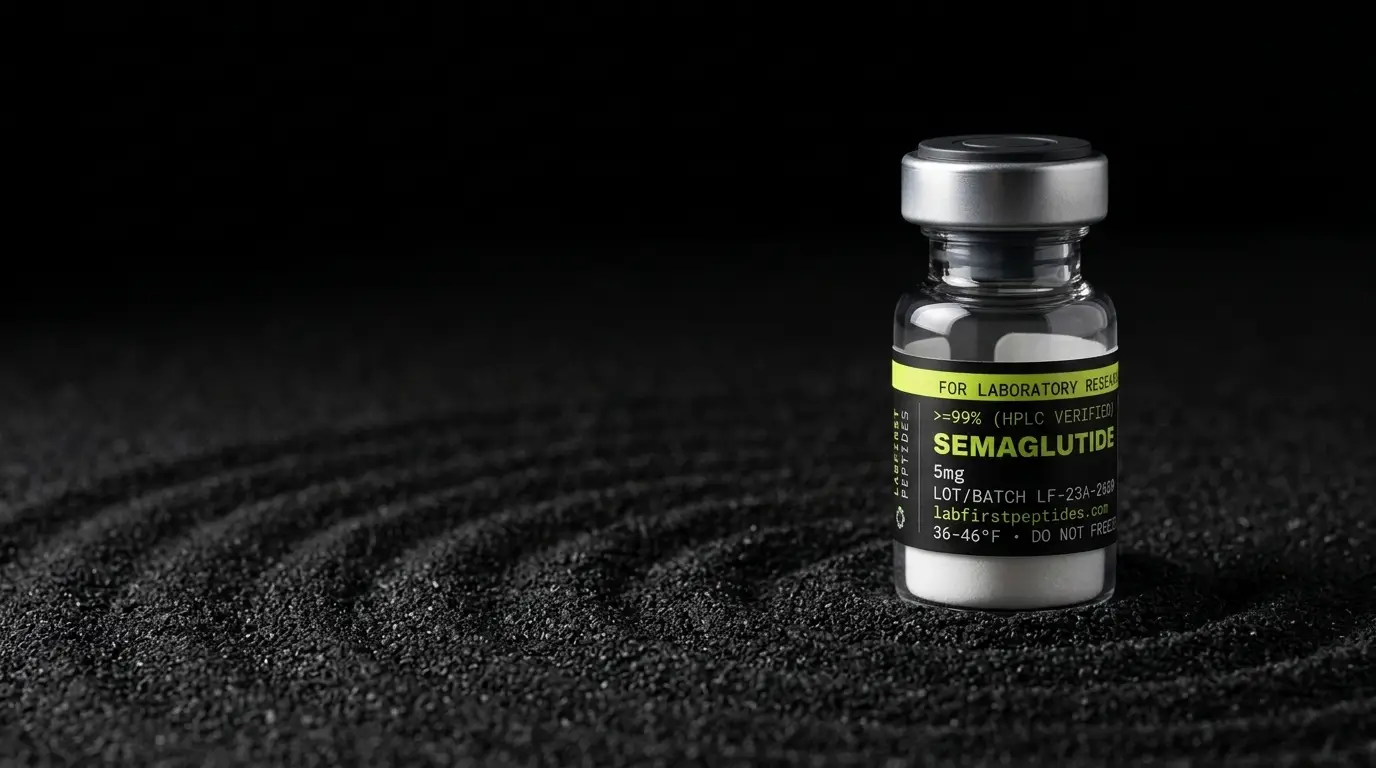
Semaglutide is a peptide that works on the GLP-1 receptor (formula C187H291N45O59, average mass 4,114 g/mol, CAS 910463-68-2). Semaglutide is sold here for laboratory research in 5 sizes (5mg to 30mg), from $55.00 a vial. It is not an FDA-approved medicine. Research use only, and never for people or animals.
Semaglutide specifications
| Product name | Semaglutide |
|---|---|
| Also sold as | Semaglutide peptide, GLP-1 analogue, sema, sema peptide |
| Formula | C187H291N45O59 |
| Average mass | 4,114 g/mol |
| CAS number | 910463-68-2 |
| Physical form | Freeze-dried powder, a solid cake in a sealed vial |
| Appearance | White to off-white cake |
| Sizes on this page | 5mg · 10mg · 15mg · 20mg · 30mg |
| Purity specification | ≥99% by RP-HPLC. The number for the lot you receive is whatever its own certificate says. |
| Identity check | Mass spectrometry, read against the mass this compound should have |
| Net content | Weighed per lot and reported separately from purity |
| Lot documentation | 2 of 5 sizes have a published Kovera Labs certificate (10mg, lot LF-23B-2609; 30mg, lot LF-23E-2609); the other 3 are in testing |
| Storage | Sealed, cold and out of the light |
| Ships from | Santa Ana, California by USPS with tracking on every order, same business day on verified in-stock orders placed before 12 PM Pacific |
| Intended use | Laboratory research only. Not for human or animal use. |
What is Semaglutide, and what is it used for?
Semaglutide is a man-made peptide that works on the GLP-1 receptor. Approved prescription medicines contain this same ingredient. What is sold here is laboratory material and is not a medicine and not for human or animal use.
Semaglutide is also listed and searched as Semaglutide peptide, GLP-1 analogue, sema, sema peptide, semaglutide research peptide. They all mean the same compound. Supplier lists write it as Semaglutide peptides or peptide Semaglutide as well; every one of those is this record. A name is not a test, which is why the lot record further down counts for more than the wording on a label.
Chemically: molecular formula C187H291N45O59, average mass 4114 g/mol (PubChem CID 56843331). Those figures are what the identity test on a certificate is read against.
Frequently mistyped as semaglutid, semaglutude, semiglutide. Those spellings reach this same record.
A peptide that works on the GLP-1 receptor.
A copy of the body’s own GLP-1, changed so it lasts far longer. Two changes do that: a fatty acid chain that lets it ride on albumin in the blood, and a swapped building block that stops the DPP-4 enzyme cutting it up. Those two edits are why it stays around for days where natural GLP-1 lasts minutes.
One of the most heavily published peptides in metabolic research, with a large registered clinical record. Approved medicines containing it exist under their own brand names.
What is sold here is a research chemical, not a drug product. Listing it is not an approval, and not a claim that it is equivalent to, as safe as, or a fit substitute for any approved medicine.
Semaglutide for sale: 5mg to 30mg (5 sizes) vials, price per mg
Semaglutide is sold in 5 sizes here, 5mg to 30mg (5 sizes), from $55.00 a vial. Semaglutide cost and Semaglutide price per mg by size are in the table, at each volume tier and on subscription; the per-mg figure under each price is the one that compares across sizes.
Volume and subscription pricing by size
| Size | One vial | 10–19 vials−10% | 20 vials−15% | Subscribe monthly−6% from shipment 2 | Availability |
|---|---|---|---|---|---|
| Semaglutide 5mg | $55.00$11.00/mg | $49.50a vial · $9.90/mg | $46.75a vial · $9.35/mg | $51.70a vial, shipment 2 on · $10.34/mg | Backordered — waitlist |
| Semaglutide 10mg | $70.00$7.00/mg | $63.00a vial · $6.30/mg | $59.50a vial · $5.95/mg | $65.80a vial, shipment 2 on · $6.58/mg | In stock |
| Semaglutide 15mg | $105.00$7.00/mg | $94.50a vial · $6.30/mg | $89.25a vial · $5.95/mg | $98.70a vial, shipment 2 on · $6.58/mg | Backordered — waitlist |
| Semaglutide 20mg | $110.00$5.50/mg | $99.00a vial · $4.95/mg | $93.50a vial · $4.67/mg | $103.40a vial, shipment 2 on · $5.17/mg | Backordered — waitlist |
| Semaglutide 30mgBest per mg | $115.00$3.83/mg | $103.50a vial · $3.45/mg | $97.75a vial · $3.26/mg | $108.10a vial, shipment 2 on · $3.60/mg | In stock |
The 30mg vial works out 45% cheaper per mg than the 10mg. Volume tiers are per size and do not combine across sizes (see bulk pricing). Subscribe & Save takes 6% every month, 4% every 2 months or 2% every 3 months off from shipment 2, two shipments minimum, and stacks on the volume tier: the lowest this record ever bills is $3.06 per mg, twenty 30mg vials on a monthly subscription from shipment 2 onward.
Nothing is added at checkout except the USPS shipping you choose; dispatch and delivery are the same on every order. The cost-per-milligram tool ranks the whole catalog by price per mg.
Where to buy Semaglutide: what to check before you order from anyone
Where to get Semaglutide, and how to buy Semaglutide online
Semaglutide for sale, or Semaglutide peptide for sale, means this page: one record, 5 sizes. You can buy Semaglutide online here with guest checkout, and purchase Semaglutide or order Semaglutide in any size below; verified in-stock orders placed before 12 PM Pacific are dispatched the same day. If the question is where to get Semaglutide or how to get Semaglutide, the answer for a US laboratory is a supplier who publishes the certificate before you pay, which is the first of the five checks that follow.
Before ordering Semaglutide from anyone, us included, run the 5 checks on verifying a certificate; the first is that the report resolves on the laboratory's own site, and a seller who cannot pass them is asking for the trust a certificate exists to replace.
Semaglutide reviews
No customer review of Semaglutide has been published yet, so there is no star rating here; when real ones exist the number will be the arithmetic of what people wrote. Ordered this record? Leave a review. A person reads every one before it appears.
Semaglutide capsules, oral form or sublingual? What this vial is, and is not
Search results for Semaglutide also show capsules, oral form, sublingual products, under listing titles such as semaglutide pills, semaglutide pill, sublingual semaglutide, semaglutide tablets price, oral semaglutide reviews, semaglutide pill form. Those are finished consumer goods made and marketed by other companies, and none of them is what this page sells. This record is freeze-dried Semaglutide in a sealed glass vial, 5mg to 30mg (5 sizes), with a lot certificate, supplied for laboratory work. Its certificate describes that powder, not a capsule, spray or cream, which carry other ingredients and sit under different rules.
Semaglutide vs Tirzepatide and Dulaglutide: different molecules, separate records
Semaglutide vs Tirzepatide, or Tirzepatide vs Semaglutide, is the comparison people search most, with Dulaglutide close behind, and they are not the same thing. Each is a different molecule with a different formula, mass and research record, and each has its own certificate here.
Tirzepatide vs Semaglutide: the same comparison, side by side
| Record | Class | Formula | Avg. mass | Sizes here |
|---|---|---|---|---|
| Semaglutide | A peptide that works on the GLP-1 receptor. | C187H291N45O59 | 4114 | 5mg · 10mg · 15mg · 20mg · 30mg from $55.00 |
| Tirzepatide | A peptide that works on the GIP and GLP-1 receptors at the same time. | C225H348N48O68 | 4813 | 5mg · 10mg · 15mg · 20mg · 30mg · 40mg · 50mg · 60mg · 70mg · 80mg · 90mg · 100mg · 110mg · 120mg from $50.00 |
| Dulaglutide | Recombinant fusion protein: two GLP-1 analogue peptides linked to a modified human IgG4 Fc fragment. | — | — | 5mg · 10mg from $130.00 |
Documentation compared in full: Semaglutide vs Tirzepatide, side by side · Semaglutide vs Dulaglutide, side by side.
Semaglutide guides and documentation
Written to answer the questions that come up around Semaglutide specifically, what its paperwork should show, how it is handled, and how to judge a supplier selling it.
- Buy Semaglutide Peptide: Identity, Purity and Sourcing
- CagriSema Identity Testing: How It Is Confirmed
- CagriSema Storage and Stability in the Laboratory
- Which peptides are FDA approved: eleven drug substances and their records
- Popular peptides, sorted by what the literature actually studies
- Semaglutide certificates of analysis, field by field, and how to check the lot
The full library, grouped by what you came to answer, is in the laboratory guides.
The Semaglutide certificate: lot, purity, identity, and how to verify it
A certificate answers identity, purity and net content as three separate questions, each with the method that produced it and the date it was run, how to read one covers what each field does and does not cover. For Semaglutide that means a mass spectrum landing on 4,114 g/mol for C187H291N45O59, the figure published against PubChem CID 56843331. The cataloged form is Semaglutide, and the identity test resolves to that rather than to a related molecule with a similar name.
| Size | Lot | Identity method | Purity | Endotoxin · sterility · fentanyl | Test date |
|---|---|---|---|---|---|
| 10mg | LF-23B-2609 | LC-MS | 99.656% (RP-HPLC, C18, DAD @ 214 nm) | Pass · pass · not detected | 2026-10-07 |
| 30mg | LF-23E-2609 | LC-MS | 99.789% (RP-HPLC, C18, DAD @ 214 nm) | Pass · pass · not detected | 2026-10-07 |
Testing by Kovera Labs. Every batch tested on or after October 1, 2026 includes endotoxin, sterility and fentanyl screening, in addition to identity, purity and net content. Open the report, then confirm it on the issuing laboratory's own site. If the identifier does not resolve there, or resolves to a different lot than the one printed on your vial, the document is worthless however convincing it looks.
- Certificate for lot LF-23B-2609 · Report PDF · Endotoxin report · Sterility report · Verify at Kovera Labs
- Certificate for lot LF-23E-2609 · Report PDF · Endotoxin report · Sterility report · Verify at Kovera Labs
The lot number on the certificate must match the lot printed on the vial you received. That match is the only thing tying the document to your material. Net content is reported separately from purity, because a vial can be highly pure and still hold less material than its label states.
Is Semaglutide a prescription drug? FDA status, and what this listing is
FDA status, and what this listing is Approved as a prescription medicine, compounding grace period ended 2025
The FDA decided on 21 February 2025 that the semaglutide injection shortage was over. It then gave pharmacies a wind-down, saying it would not act on certain compounding violations until 22 April 2025 for 503A pharmacies and 22 May 2025 for 503B outsourcing facilities. Both dates have passed, so compounded semaglutide is no longer generally allowed outside narrow exceptions.
Status verified 2026-08-25. Check the primary source before relying on this summary.
It is sold as laboratory material under the research-use restriction below. Being listed is not an approval, and not a claim that it is safe, effective or right for any purpose. LabFirst is not a pharmacy or a compounding facility, this vial is not a compounded medicine, and no prescription is involved, because it is not sold for use in anyone. Search results also show compound Semaglutide and Semaglutide compound offers from compounding pharmacies; a compounded Semaglutide is a prescription product prepared for a named patient, and a certificate for this lot says nothing about one.
Sources checked 2026-08-25: American Med Spa Association, FDA announces semaglutide shortage resolved · Alston & Bird, FDA resolves semaglutide shortage
Semaglutide research: what the published studies examine
Status: Approved medicines exist, this material is not one of them. Semaglutide works on the GLP-1 receptor. FDA-approved medicines containing it exist, prescription only, made under pharmaceutical quality rules that a research-chemical supply chain does not copy.
Semaglutide is human GLP-1 with three edits, and each edit does one job. At position 8 a building block called Aib replaces the natural one, which blocks the DPP-4 enzyme from cutting the peptide at its usual spot. At position 26 a fatty acid is attached to a lysine, which makes the peptide cling to albumin in the blood; that slows the kidneys clearing it and shields it from being broken down further.
At position 34 an arginine replaces a lysine so the fatty acid cannot attach in the wrong place. The trade-off was deliberate and measured: its grip on the GLP-1 receptor came out at 0.38 nM, about three times weaker than liraglutide, and that loss was accepted in exchange for the much longer stay in the body that albumin binding buys. One point that often gets missed: the molecule does not cross the blood-brain barrier.
It reaches the brain through a few small regions next to the fluid-filled ventricles where that barrier is leaky, not by spreading through brain tissue generally.
| Reported observation | Model | Source |
|---|---|---|
| Grip on the GLP-1 receptor measured at 0.38 nM, about three times weaker than liraglutide, with a matching increase in how tightly it holds albumin. In mini-pigs, half of a dose was gone after 46.1 hours when given into a vein, and on average it stayed in the body 63.6 hours when given under the skin. That is the basis for once-a-week rather than once-a-day exposure. | receptor binding assays, x-ray crystallography and mini-pig pharmacokinetics | Lau and colleagues, Discovery of the once-weekly glucagon-like peptide-1 (GLP-1) analogue semaglutide, Journal of Medicinal Chemistry (2015)The originating medicinal-chemistry paper, authored at Novo Nordisk. |
| In rats and mice the compound did not cross the blood-brain barrier. It reached the brainstem, the septal nucleus and the hypothalamus through a few regions next to the ventricles where the barrier is incomplete. It switched on activity, measured as c-Fos, in ten brain areas, including some with no GLP-1 receptors of their own such as the lateral parabrachial nucleus. In one small region, the area postrema, it turned up the genes for prolactin-releasing hormone and tyrosine hydroxylase. | rats and mice, with imaging, c-Fos mapping and regional transcriptomics | Gabery and colleagues, Semaglutide lowers body weight in rodents via distributed neural pathways, JCI Insight (2020)Sponsor-led but with academic co-authors in Budapest and Lille. |
Open questions. Semaglutide is the most thoroughly studied molecule in this catalog, and the chemistry and rodent brain-mapping above are about as well described as peptide science gets. Two honest caveats. The link between the spread of brain activity seen in rodents and any particular downstream effect is a proposal supported by mapping, not a proven chain of cause and effect, and the authors present it that way.
And as with the other two incretin compounds here, the clinical record is large and this page does not summarize its results, because those describe a prescribed medicine under a doctor’s care rather than the laboratory material sold on this page. The gap that matters commercially is a different one: an approved product with this name is made to pharmacopeial standards with full release testing behind it, and a research vial carrying the same name is not the same object.
What a specific vial holds is settled by an identity and purity test on that lot.
Each row above describes an observation in the stated model. None of it describes what Semaglutide would do in a person or an animal outside that model, and none of it is a recommendation to use it for anything.
How to store Semaglutide: refrigeration and shelf life
Keep the sealed vial cold and out of the light and it stays as it left the lab. Once it is mixed into a solution, how long it holds up depends on the compound, what it was mixed with, how strong the solution is and how cold it is kept — too many variables for anyone to print one shelf life on a label. So laboratories write the date on whatever they prepare and keep their own record of it.
For solution preparation arithmetic on the bench, concentration, per-graduation values and molarity, use the vial concentration calculator, which opens with the Semaglutide sizes stocked here already loaded. It covers laboratory measurement only and contains no administration guidance.