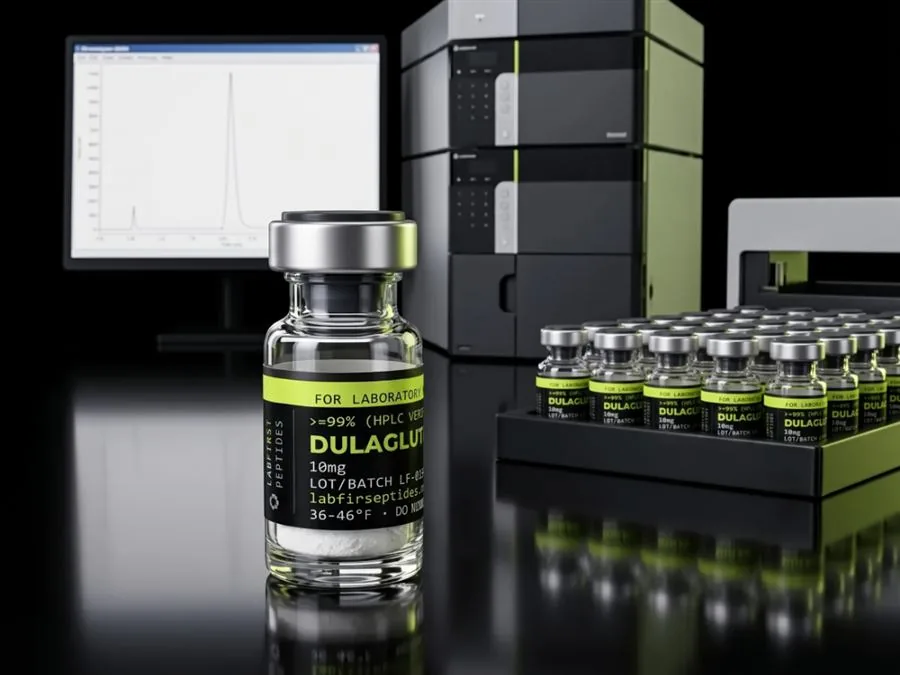
Many peptides are FDA approved, but only as the active ingredient in a named drug product. Examples include leuprolide, octreotide, exenatide, semaglutide, tirzepatide and dulaglutide. The approval belongs to that product. A research peptide sold for lab use is not the approved product, even when the molecule has the same name.
- The FDA approves drug products; a peptide is the active ingredient inside a named product.
- Each prescribing information document carries an Initial U.S. Approval year near the top.
- Examples: leuprolide 1985, octreotide 1988, exenatide 2005, semaglutide 2017, tirzepatide 2022, zilucoplan 2023.
- Section 11, Description, of the label defines the molecule's composition and weight.
- A research peptide sold for laboratory use is not an approved product, even with the same name.
What does this list cover?
This list covers peptide drug substances found in FDA-approved products, with the first US approval year for each. Ask whether a peptide is FDA approved and the honest answer starts with a question back: approved as what? The FDA approves drug products, each one a specific formulation made by a specific applicant under a specific application. The peptide inside is the active ingredient of that product.
This page lists peptide drug substances that sit inside FDA-approved products, with the year of first US approval taken from the product's own prescribing information or from the FDA's Novel Drug Approvals list. It names each molecule and its approval record. It does not describe what any of them are prescribed for, and it is not a guide to their use.
The list is a sample of well-documented examples, not the full set. Peptide drugs have been approved for decades, and a complete inventory would run far longer.
- 1985: leuprolide acetate
- 1988: octreotide
- 2005: exenatide and pramlintide
- 2014: dulaglutide
- 2017: semaglutide
- 2022 to 2023: tirzepatide and zilucoplan
The reference list
| Drug substance | Approved product consulted | How the FDA record describes it | First US approval |
|---|---|---|---|
| Leuprolide acetate | Lupron Depot | Synthetic nonapeptide analog of gonadotropin-releasing hormone | 1985 |
| Octreotide | Bynfezia Pen | Somatostatin analog, C49H66N10O10S2, MW 1019.3 | 1988 |
| Exenatide | Byetta | 39-amino acid peptide amide, 4186.6 Da | 2005 |
| Pramlintide acetate | Symlin | Synthetic 37-amino acid polypeptide, MW 3949.4 | 2005 |
| Tesamorelin | Egrifta SV | 44-amino acid sequence of human GRF with a hexenoyl moiety, 5135.9 Da | 2010 |
| Dulaglutide | Trulicity | Two-chain GLP-1 analog Fc-fusion protein, about 63 kDa | 2014 |
| Semaglutide | Ozempic | C187H291N45O59, 4113.58 g/mol | 2017 |
| Bremelanotide | Vyleesi | Synthetic cyclic heptapeptide, 1025.2 (free base) | 2019 |
| Setmelanotide | Imcivree | 8-amino acid cyclic peptide analog of alpha-MSH, 1117.3 Da | 2020 |
| Tirzepatide | Mounjaro | Listed as a novel drug approval, May 13, 2022 | 2022 |
| Zilucoplan | Zilbrysq | Listed as a novel drug approval, October 17, 2023 | 2023 |
Years for the first nine come from the "Initial U.S. Approval" line in each product's prescribing information on DailyMed. The last two come from the FDA's Novel Drug Approvals pages for 2022 and 2023, which give the exact date.
How do you read an approval record?
Every current prescribing information document opens with a highlights box, and near its top is a line reading "Initial U.S. Approval" followed by a year. That year belongs to the active ingredient's first approval in the United States, which can be earlier than the particular product you are reading about. It is the quickest way to date a molecule's approval from a primary source.
Section 11 of the same document, titled Description, is where the molecule is defined: its sequence or composition, its formula and its molecular weight. The descriptions in the table above are drawn from that section. When two sources disagree about what a peptide is, the Description section of the approved label is the record that governs the approved product.
The FDA's yearly Novel Drug Approvals pages list each new molecular entity approved that year, with the drug name, active ingredient and approval date. They cover only first-time approvals, so a new formulation of an older molecule will not appear there.
From nine residues to a protein
The word peptide stretches a long way in this list. Leuprolide is nine residues. Octreotide weighs about 1,019 by its label. Exenatide and pramlintide are chains of 39 and 37 amino acids, and tesamorelin carries 44.
Dulaglutide sits at the far end. Its label describes two identical chains, each a GLP-1 analog joined by a peptide linker to the Fc portion of a modified human IgG4 heavy chain, with an overall weight of about 63 kilodaltons. That is a protein, and it is made in cell culture rather than by chemical synthesis.
Size matters for anyone comparing documentation. A small synthetic peptide's identity rests mostly on a mass and a sequence. A fusion protein needs protein methods, which is the subject of our dulaglutide identity guide.
Salt forms on the record
Several names on the list carry the word acetate, and that is part of the approved description, not decoration. Peptides with basic groups are commonly handled as salts, and the label says which one.
The pramlintide label gives its formula as the peptide plus a variable number of acetic acid molecules, between three and eight. The bremelanotide label does the same with one to two acetates, and quotes its molecular weight of 1025.2 for the free base. The tesamorelin formula carries about seven acetates. Leuprolide's chemical name in its label ends with acetate (salt).
For anyone comparing documents, the practical point is that a molecular weight means little until you know whether it describes the free peptide or a salt. A research certificate should say the same thing its approved-product counterpart does: which form the stated mass refers to.
Made by synthesis, fermentation or cell culture
The approved labels also say how each molecule is made, and the answers differ. Pramlintide and bremelanotide are described as synthetic, and leuprolide as a synthetic nonapeptide. The semaglutide label describes production through yeast fermentation, followed by the chemical modifications that give the molecule its structure. Dulaglutide is produced in Chinese hamster ovary cell culture.
How a molecule is made shapes the impurities it can carry. The ICH Q6B guideline on biotechnological products lists impurities that come from the production process itself, such as host cell proteins and host cell DNA, alongside product-related variants such as aggregates. A chemically synthesized peptide has no host cell to leave anything behind, so its impurity list looks different. That is why the testing on a certificate should match the kind of molecule, and why a protein and a nine-residue peptide are not checked the same way.
None of this tells you anything about a research material with the same name. The approved label describes the approved product's process only. A research lot's process, and therefore its impurity profile, is whatever its own certificate shows.
Is a research peptide the approved product?
A vial labeled with one of these names and sold for laboratory research is not the approved product. Approval attaches to the product described in the application: its manufacturer, its process, its formulation and its specifications. A research material shares a molecule name with it and nothing else that the approval covers.
That distinction is the core of how research peptides are sold lawfully in the US. Our guide to whether peptides are legal explains how intended use decides a product's status, and the RUO peptide guide explains what a research-use-only label restricts and what it does not certify.
It also works in the other direction. A peptide that has no approved product at all, however often it is discussed, is not FDA approved in any form. Our pages on retatrutide approval status and GHK-Cu cover two examples.
How can you check a name yourself?
- Search the name on DailyMed, the National Library of Medicine's label database. A result with prescribing information means an approved product exists.
- Open the prescribing information and read the "Initial U.S. Approval" line near the top.
- Read section 11, Description, for the molecule's definition.
- For approvals since the late 2010s, cross-check the FDA's Novel Drug Approvals page for the year.
If DailyMed returns nothing, that is not proof on its own, since spelling variants and salt forms can hide a match. Try the name with and without a salt, such as acetate, before concluding there is no approved product.
Nothing in these records describes a research material, and no research lot inherits any part of an approval. The list above is a chemistry and regulatory reference only.
Where this site fits
We supply peptides for laboratory and in-vitro research. Some share names with molecules on this list. None of our materials is an FDA-approved drug product, none is made or tested under any product's approval, and we make no claim that any is equivalent to an approved product.
What we publish for our materials is documentation: identity, purity and handling. Certificates are pending for our lots, and a lot's results appear on the certificate index only once its certificate is published.
FOR LABORATORY AND IN-VITRO RESEARCH USE ONLY. NOT FOR HUMAN OR ANIMAL CONSUMPTION.
Common questions
Is semaglutide FDA approved?
What was the first year listed for a peptide in this reference?
Where do I find a peptide's FDA approval year?
Does a research peptide become approved if it matches the sequence?
More laboratory guides
Sources
- LUPRON DEPOT (leuprolide acetate) prescribing information, DailyMed. Initial U.S. Approval 1985; synthetic nonapeptide GnRH analog.
- BYNFEZIA PEN (octreotide) prescribing information, DailyMed. Initial U.S. Approval 1988; formula and molecular weight.
- BYETTA (exenatide) prescribing information, DailyMed. Initial U.S. Approval 2005; 39-amino acid peptide amide, 4186.6 Da.
- SYMLIN (pramlintide acetate) prescribing information, DailyMed. Initial U.S. Approval 2005; synthetic 37-amino acid polypeptide.
- EGRIFTA SV (tesamorelin) prescribing information, DailyMed. Initial U.S. Approval 2010; 44-amino acid GRF sequence with hexenoyl moiety.
- TRULICITY (dulaglutide) prescribing information, DailyMed. Initial U.S. Approval 2014; Fc-fusion protein of about 63 kDa.
- OZEMPIC (semaglutide) prescribing information, DailyMed. Initial U.S. Approval 2017; formula and molecular weight.
- VYLEESI (bremelanotide) prescribing information, DailyMed. Initial U.S. Approval 2019; synthetic cyclic heptapeptide.
- IMCIVREE (setmelanotide) prescribing information, DailyMed. Initial U.S. Approval 2020; 8-amino acid cyclic peptide analog of alpha-MSH.
- FDA, Novel Drug Approvals for 2022. Mounjaro (tirzepatide), approved May 13, 2022.
- FDA, Novel Drug Approvals for 2023. Zilbrysq (zilucoplan), approved October 17, 2023.
- ICH Q6B, Specifications: Test Procedures and Acceptance Criteria for Biotechnological/Biological Products. Process-related impurities from cell substrates (host cell proteins, host cell DNA) and product-related variants such as aggregates.