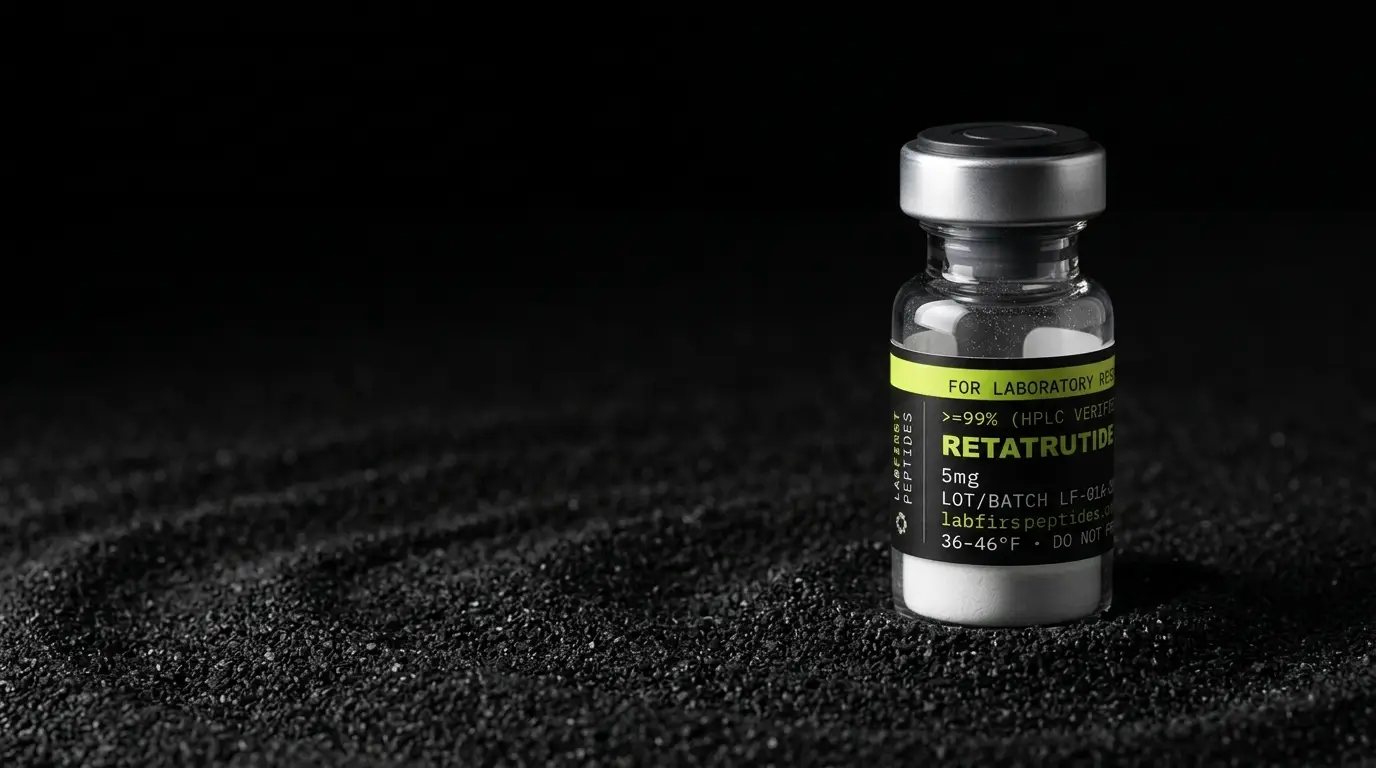
Retatrutide's FDA approval status is simple: it has no approval for any use. It is an investigational new drug in Phase 3 trials run by Eli Lilly under the code LY3437943. Lilly has said it intends to file for approval in early 2027. Filing is not approval, and a regulator can refuse.
- Retatrutide has no FDA approval for any use as of the date this page was last verified.
- It is an investigational new drug in Phase 3, developed by Eli Lilly under the code LY3437943.
- It acts at three receptors at once: GIP, GLP-1 and glucagon.
- Lilly has said it intends to file for FDA approval in the first three months of 2027.
- Filing is not approval. A regulator can refuse an application supported by positive trials.
- Material sold as a research chemical is not a drug product and is not part of any trial.
What this guide covers
In plain terms, a drug in trials is like a car still on the test track. It has not been cleared for the road. Filing is asking for that clearance, and the answer can still be no.
Retatrutide's status fits in three words: not approved, investigational, Phase 3. This page explains what each of those words does, who runs the program and what it is called, why we link the trial registry instead of summarizing it, what a research chemical is against that status, and what a filing sets in motion. Then it gives you a step-by-step way to check the status yourself on any given morning, the red flags to watch for on a listing, the same question asked about the compounds sold beside retatrutide, and a bottom line.
Material sold as a research chemical is not a drug product and is not part of any trial.
FOR LABORATORY AND IN-VITRO RESEARCH USE ONLY. NOT FOR HUMAN OR ANIMAL CONSUMPTION.
- Preclinical: laboratory and animal work. Complete.
- Phase 1 and 2: first human studies, safety and amount finding. Complete.
- Phase 3: the last stage of testing. Where retatrutide is now.
- Filing: the company asks the FDA to review. Lilly has said early 2027.
- Review and decision: approve, refuse, or ask for more. Not reached.
What do the three words mean?
Not approved. Investigational. Phase 3. Each of those does work the others do not.
Not approved means the FDA has authorized retatrutide for nothing at all: no condition, no formulation, no population. There is no label, because a label is a thing an approval creates.
Investigational is a legal category rather than a verdict on the molecule. An investigational new drug may lawfully be given to a person in the United States only inside an authorized study, under a protocol, with a monitor and reporting obligations. The word says where it may be used, not how promising it is.
Phase 3 describes how far the program has got. It is the last stage of testing before a company may ask for anything, and reaching it is a real milestone. It is not an approval, a near-approval, or a guarantee of one. Compounds have failed at Phase 3, and regulators have refused applications that arrived with positive trials behind them.
Who runs the program, and what is it called?
Eli Lilly developed retatrutide under the internal code LY3437943, which is the name most of the literature uses. It acts at three receptors at once, GIP, GLP-1 and glucagon, and that is what separates it from the single and dual agonists that came before it. Semaglutide works at one of those. Tirzepatide works at two.
The Phase 3 program is called TRIUMPH and its studies are registered publicly. NCT05882045 covers participants with obesity and cardiovascular disease. NCT07035093 covers obesity or overweight with chronic low back pain. Both are linked at the foot of this page, and both are better opened than taken on anyone's summary, including this one.
Lilly reported positive headline results during 2026 and has said it intends to file for FDA approval in the first three months of 2027.
Why does this page not tell you what the trials found?
The registry entries are public. We link them instead of summarizing them, and the reason deserves stating rather than leaving you to infer.
Those results describe what happened to patients taking a supervised medicine, at a measured amount, under a doctor, inside a trial with exclusion criteria, a safety monitor and a stopping rule. Reprinting them beside a vial sold for laboratory use borrows medical evidence to sell something that is not sold for medical use. It is the oldest move in this market and it is done with a straight face on hundreds of product pages.
The status of a program is a public fact anyone can verify in a minute. What the program found belongs to the people who ran it and to the patients who took part. Pointing at the record is the whole of what a supplier can honestly do.
What does "research chemical" mean against that status?
A research chemical is material sold for laboratory and in-vitro work. It is not a drug product. It is not dispensed against a prescription, it carries no label in the regulatory sense, and its sale is not an authorization of anything by anyone.
That distinction matters most where the language blurs, and with an investigational compound it blurs easily. A molecule in Phase 3 has a real clinical file behind it, written by a serious company, and that file is easy to gesture at. The gesture is the problem. A supplier listing retatrutide is selling a chemical; the trials are not that supplier's evidence, the trial material is not that supplier's material, and a listing that reads as though they were is making a claim it has not earned.
The same applies to us. Our product record for retatrutide carries the regulatory position and the trial links, and it carries no statement about what the compound does for anyone, because that is not something this business is in a position to say.
What does a filing actually set in motion?
"Files in early 2027" gets quoted as though it were a release date, so here is the rest of the path.
A company submits an application. The FDA first decides whether to accept it for review, which is a filing decision rather than a scientific one, and can take a couple of months. Once accepted, the review runs on a published clock, with a target date for a decision. Advisory committee meetings may be convened along the way, and inspections of manufacturing sites happen in parallel. At the end the agency approves, refuses, or issues a letter setting out what it wants resolved first.
That last outcome is the one people forget. It is not a rejection in the ordinary sense and it is not an approval either; it is a list, and the list can take a year to answer. A compound can be a year past its filing announcement and no closer to a label than it was.
So the useful question is never "when will it be approved". It is "what is the current status in the registry and in Drugs@FDA today", and that has a checkable answer on any given morning.
How to check the status yourself: step by step
Two public sources settle it, and neither takes long. A press release answers it not at all.
- Open the registry entries. ClinicalTrials.gov carries the registered studies with their phase, status and sponsor. Start with NCT05882045 and NCT07035093, linked in the sources below, and read the phase and status fields on the record itself.
- Search Drugs@FDA. That database carries approvals. If retatrutide were approved, it would appear there with a label, and it does not.
- Read the words in any announcement carefully. "Filed", "submitted", "accepted for review" and "approved" are four different events, separated by months and by the possibility of refusal. Headlines routinely collapse them, and a supplier repeating a headline may be repeating the collapse.
- Check the date on the regulatory line. Our regulatory line for retatrutide carries the date it was last verified. Read that date before trusting the sentence above it, on our page or anyone else's.
- Go back to the two sources if the date is old. This is a status that moves, which is the awkward part of publishing a page about it. The registry and Drugs@FDA are current; a page is only as current as its last check.
Red flags on a retatrutide listing
- Trial results printed beside the vial. Patient outcomes from a supervised study are not evidence about a research chemical, and a page that uses them that way has borrowed what it does not own.
- A filing date presented as a release date. Filing starts a review. It does not end one, and the agency can refuse or send back a list.
- No regulatory position on the page at all. It is the easiest thing for a seller to leave out and one of the hardest for a buyer to establish, which is exactly why it should be there.
- A regulatory line with no date and no source. Without a verified-on date and a link to the record, you cannot tell whether the sentence is current.
- "Filed" and "approved" used as if they meant the same thing. They are months apart and one of them may never happen.
- Wording that implies the trial material and the listed material are the same. They are not. The trial material belongs to the sponsor's program; a listing is selling a chemical.
The same question, asked about the compounds beside it
Retatrutide is not a special case, it is just the one people ask about most this year.
Tirzepatide and semaglutide are approved medicines sold by their manufacturers under their own labels, and research material bearing those names is not those products. BPC-157 sits in Category 2 of the FDA's 503A bulk drug substances list, placed there in September 2023, which means it may not be used in pharmacy compounding. Several of the bioregulators rest on an evidence base that is largely one research group, and our records say so on the page rather than in a footnote.
The pattern across all of them is the same. Regulatory position is the easiest thing for a seller to leave out and one of the hardest things for a buyer to establish, which is exactly why it should sit on the product page, dated, with a link to the record it came from. A page that tells you a compound is investigational is not talking you out of anything. It is telling you what you are looking at.
One practical consequence for anyone comparing suppliers. A listing that states the regulatory position plainly, with a date and a source, is not being cautious at your expense. It is showing you the one fact that decides what the material is, and a competitor who leaves it out has not made their product better, only their page shorter.
Bottom line
Retatrutide has no FDA approval for any use. It is an investigational new drug in Phase 3, run by Eli Lilly as LY3437943, and Lilly has said it intends to file in the first three months of 2027. A filing is a request, and the answer can be no, or a list. Check ClinicalTrials.gov and Drugs@FDA rather than a headline, and read the verified-on date before the sentence it sits under. Our Retatrutide peptide page carries that dated line; the certificate index is where you verify a certificate of analysis, and our research compliance page states the position this whole site works from.
Common questions
Is retatrutide FDA approved?
When could retatrutide be approved?
Can I legally buy retatrutide?
What does investigational mean?
Does reaching Phase 3 mean approval is close?
Published certificates for Retatrutide
Every figure below is read from a report the laboratory issued for that lot; each page carries the PDF and the lab's own verification link.
More procurement guides
Sources
- ClinicalTrials.gov: NCT05882045, retatrutide in participants with obesity and cardiovascular disease. The registered Phase 3 entry, giving sponsor, phase and status from the registry rather than from a press release.
- ClinicalTrials.gov: NCT07035093, retatrutide in participants with obesity or overweight and chronic low back pain. A second registered Phase 3 study in the same program.
- Drugs@FDA, the approved drug products database. Where an approval would appear if one existed. Searching it is how a reader checks this page instead of trusting it.