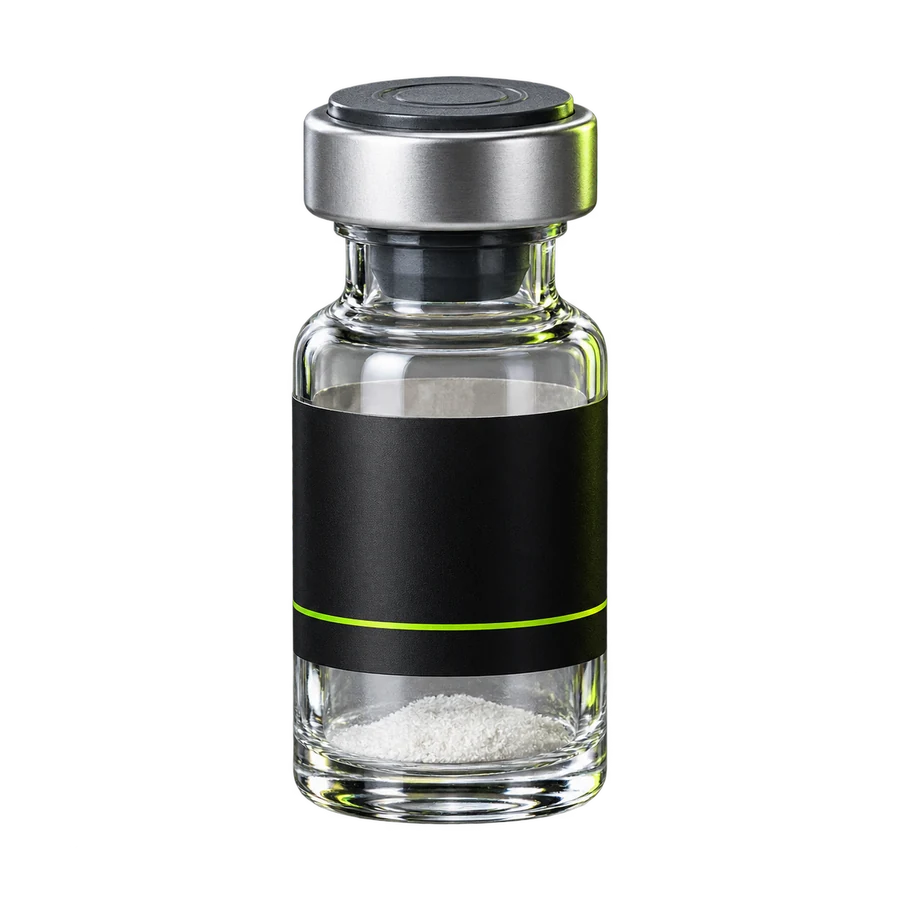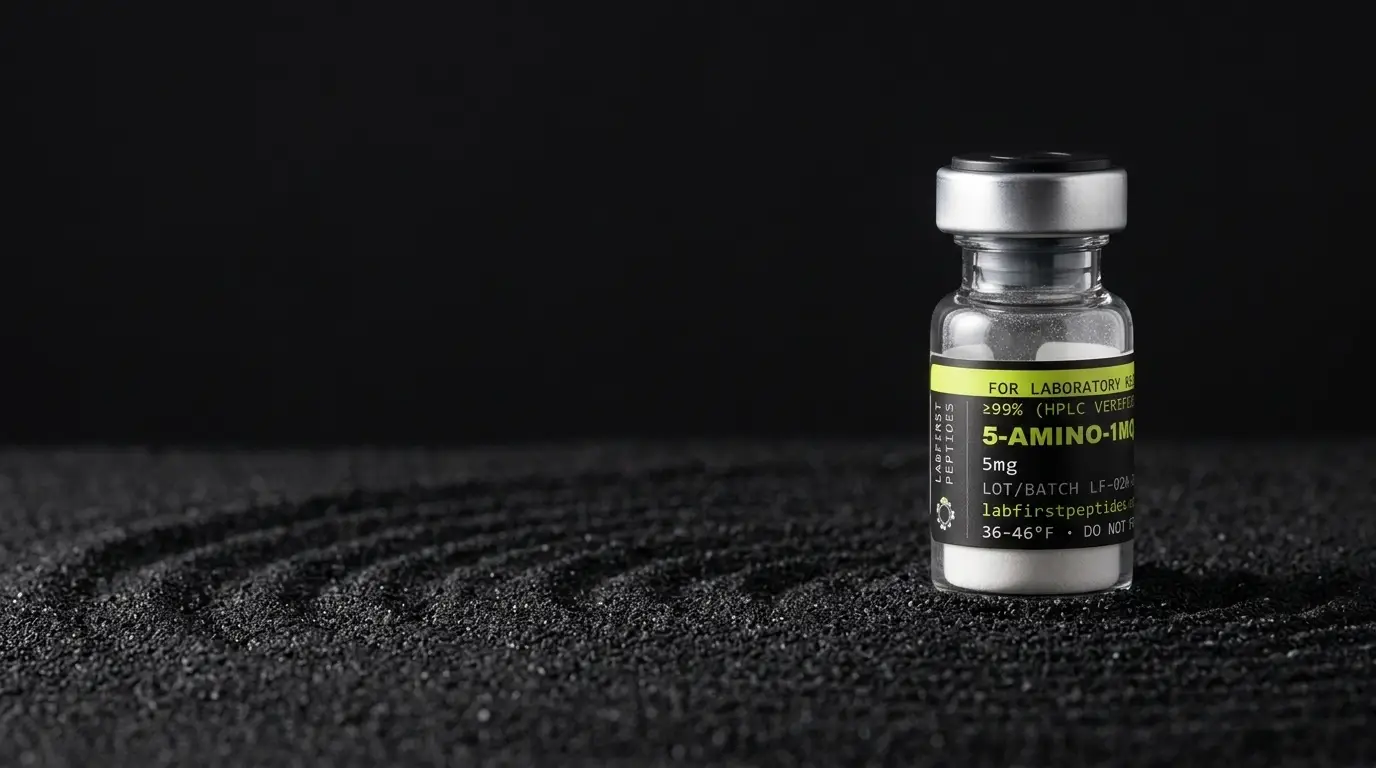
5-AMINO-1MQ is a small molecule, a methylquinolinium salt, not a peptide (formula C10H11N2+, average mass 159.21 g/mol, CAS 685079-15-6). 5-AMINO-1MQ is sold here for laboratory research in 2 sizes (5mg to 50mg), from $55.00 a vial. It is not an FDA-approved medicine. Research use only, and never for people or animals.
5-AMINO-1MQ specifications
| Product name | 5-AMINO-1MQ |
|---|---|
| Also sold as | 5-amino-1-methylquinolinium, 5 amino 1MQ peptide |
| Formula | C10H11N2+ |
| Average mass | 159.21 g/mol |
| CAS number | 685079-15-6 |
| Physical form | Freeze-dried powder, a solid cake in a sealed vial |
| Appearance | Colored cake, this compound carries its own color rather than being dyed |
| Sizes on this page | 5mg · 50mg |
| Purity specification | ≥99% by RP-HPLC. The number for the lot you receive is whatever its own certificate says. |
| Identity check | Mass spectrometry, read against the mass this compound should have |
| Net content | Weighed per lot and reported separately from purity |
| Lot documentation | Lot numbers assigned for 1 of 2 sizes; each lot's certificate posts here when Kovera Labs reports it |
| Storage | Sealed, cold and out of the light |
| Ships from | Santa Ana, California by USPS with tracking on every order, same business day on verified in-stock orders placed before 12 PM Pacific |
| Intended use | Laboratory research only. Not for human or animal use. |
What is 5-AMINO-1MQ, and what is it used for?
5-AMINO-1MQ is also listed and searched as 5-amino-1-methylquinolinium, 5 amino 1MQ peptide. They all mean the same compound. Supplier lists write it as 5-AMINO-1MQ peptides or peptide 5-AMINO-1MQ as well; every one of those is this record. A name is not a test, which is why the lot record further down counts for more than the wording on a label.
Chemically: molecular formula C10H11N2+, average mass 159.21 g/mol (PubChem CID 950107). The figures above are for the cation alone. The material is supplied as a salt of that cation, and the counter-ion is named on the lot certificate.
A small molecule, a methylquinolinium salt, not a peptide.
Described in the research as a blocker of an enzyme called NNMT, which sits in the pathway that handles nicotinamide.
It appears in enzyme and cell-biology research on NNMT and nicotinamide, mostly in cells and animals.
No approved product. Being a small molecule rather than a peptide, it dissolves, stores and tests differently from the rest of this catalog, and its certificate should be read on small-molecule terms.
5-AMINO-1MQ for sale: 5mg and 50mg vials, price per mg
5-AMINO-1MQ is sold in 2 sizes here, 5mg and 50mg, from $55.00 a vial. 5-AMINO-1MQ cost and 5-AMINO-1MQ price per mg by size are in the table, at each volume tier and on subscription; the per-mg figure under each price is the one that compares across sizes.
Volume and subscription pricing by size
| Size | One vial | 10–19 vials−10% | 20 vials−15% | Subscribe monthly−6% from shipment 2 | Availability |
|---|---|---|---|---|---|
| 5-AMINO-1MQ 5mg | $55.00$11.00/mg | $49.50a vial · $9.90/mg | $46.75a vial · $9.35/mg | $51.70a vial, shipment 2 on · $10.34/mg | Backordered — waitlist |
| 5-AMINO-1MQ 50mg | $90.00$1.80/mg | $81.00a vial · $1.62/mg | $76.50a vial · $1.53/mg | $84.60a vial, shipment 2 on · $1.69/mg | Backordered — waitlist |
Volume tiers are per size and do not combine across sizes (see bulk pricing). Subscribe & Save takes 6% every month, 4% every 2 months or 2% every 3 months off from shipment 2, two shipments minimum, and stacks on the volume tier: the lowest this record ever bills is $8.79 per mg, twenty 5mg vials on a monthly subscription from shipment 2 onward.
Nothing is added at checkout except the USPS shipping you choose; dispatch and delivery are the same on every order. The cost-per-milligram tool ranks the whole catalog by price per mg. The certificate walked through field by field: Where to Buy 5-Amino-1MQ: Five Checks Before You Order.
Where to buy 5-AMINO-1MQ: what to check before you order from anyone
Where to get 5-AMINO-1MQ, and how to buy 5-AMINO-1MQ online
5-AMINO-1MQ for sale, or 5-AMINO-1MQ peptide for sale, means this page: one record, 2 sizes. You can buy 5-AMINO-1MQ online here with guest checkout, and purchase 5-AMINO-1MQ or order 5-AMINO-1MQ in any size below; verified in-stock orders placed before 12 PM Pacific are dispatched the same day. A 5-AMINO-1MQ supplier, vendor or source worth using will show you the lot number and where its certificate can be verified.
Before ordering 5-AMINO-1MQ from anyone, us included, run the 5 checks on verifying a certificate; the first is that the report resolves on the laboratory's own site, and a seller who cannot pass them is asking for the trust a certificate exists to replace.
5-AMINO-1MQ reviews
No customer review of 5-AMINO-1MQ has been published yet, so there is no star rating here; when real ones exist the number will be the arithmetic of what people wrote. Ordered this record? Leave a review. A person reads every one before it appears.
5-AMINO-1MQ capsules or oral form? What this vial is, and is not
Search results for 5-AMINO-1MQ also show capsules, oral form products, under listing titles such as 5-amino-1mq capsules, 5 amino 1mq oral, 5-amino-1mq powder, 5-amino-1mq 50mg vial, 5 amino 1mq oral bioavailability, 5 amino 1mq 60 capsules. Those are finished consumer goods made and marketed by other companies, and none of them is what this page sells. This record is freeze-dried 5-AMINO-1MQ in a sealed glass vial, 5mg and 50mg, with a lot certificate, supplied for laboratory work. Its certificate describes that powder, not a capsule, spray or cream, which carry other ingredients and sit under different rules.
5-AMINO-1MQ vs MOTS-c (Human) and NAD+: different molecules, separate records
5-AMINO-1MQ vs MOTS-c, or MOTS-c vs 5-AMINO-1MQ, is the comparison people search most, with NAD+ close behind, and they are not the same thing. Each is a different molecule with a different formula, mass and research record, and each has its own certificate here. Nad mots c 5 amino 1mq blend is searched too; no such blend is sold here, each is its own record with its own certificate, and a certificate for a blend from anyone else reports on the mixture, not on either compound alone.
MOTS-c vs 5-AMINO-1MQ: the same comparison, side by side
| Record | Class | Formula | Avg. mass | Sizes here |
|---|---|---|---|---|
| 5-AMINO-1MQ | A small molecule, a methylquinolinium salt, not a peptide. | C10H11N2+ | 159.21 | 5mg · 50mg from $55.00 |
| MOTS-c (Human) | A 16-building-block peptide whose recipe is written in mitochondrial DNA. | C101H152N28O22S2 | 2174.6 | 10mg · 20mg · 40mg from $60.00 |
| NAD+ | Nicotinamide adenine dinucleotide, a helper molecule rather than a peptide. | C21H27N7O14P2 | 663.4 | 100mg · 500mg · 1000mg from $40.00 |
Documentation compared in full: 5-AMINO-1MQ vs MOTS-c, side by side · 5-AMINO-1MQ vs NAD+, side by side.
5-AMINO-1MQ guides and documentation
Written to answer the questions that come up around 5-AMINO-1MQ specifically, what its paperwork should show, how it is handled, and how to judge a supplier selling it.
- 5-Amino-1MQ certificate of analysis, field by field, and how to check one at the lab
- How 5-Amino-1MQ Identity Is Confirmed in the Laboratory
- 5-Amino-1MQ Storage and Stability: What the Data Covers
- Where to buy 5-Amino-1MQ: how to vet the supplier and check the lot
The full library, grouped by what you came to answer, is in the laboratory guides.
The 5-AMINO-1MQ certificate: lot, purity, identity, and how to verify it
A certificate answers identity, purity and net content as three separate questions, each with the method that produced it and the date it was run, how to read one covers what each field does and does not cover. The figure usually quoted for 5-AMINO-1MQ is 159.21 g/mol for C10H11N2+, from PubChem CID 950107, and it does not describe what is in this vial. The figures above are for the cation alone. The material is supplied as a salt of that cation, and the counter-ion is named on the lot certificate. So the mass on the lot certificate is the one to read; a listing that quotes the published figure for this material is quoting the wrong molecule.
5-AMINO-1MQ certificates post here and in the certificate index when Kovera Labs reports on the lot.
Solution arithmetic for the bench, with no administration guidance: the vial concentration calculator, preset to 5-AMINO-1MQ.
Is 5-AMINO-1MQ legal? FDA status, and what this listing is
FDA status, and what this listing is Not an FDA-approved drug product
The FDA has not approved this compound for anything, and nothing in this catalog is a medicine.
Status verified 2026-08-25. Check the primary source before relying on this summary.
Whether 5-AMINO-1MQ is legal depends on what it is being used for and where. It is sold as laboratory material under the research-use restriction below. Being listed is not an approval, and not a claim that it is safe, effective or right for any purpose.
5-AMINO-1MQ research: what the published studies examine
Status: No FDA-approved application. This compound is sold as laboratory material. Where research on it has been published, it sits at the animal, cell or early-human stage, and this record does not summarize what it found. A supplier is not a neutral judge of evidence about its own catalog.
5-amino-1-methylquinolinium is not a peptide. It is a small molecule that blocks an enzyme called NNMT, and it sits in this catalog because of who buys it rather than because of its chemistry. NNMT tags nicotinamide with a methyl group, using SAM as the source of that group. Both halves of that reaction matter. It uses up nicotinamide, which is a building block for NAD, and it uses up SAM, the cell’s main supplier of methyl groups.
NNMT is overactive in liver and white fat in obesity, so the proposal is that blocking it leaves more NAD and more SAM inside the cell and changes how fat tissue handles energy. The particular chemical scaffold with an amine group on it was chosen so the molecule can get through a cell membrane, which is a real design constraint here because the enzyme is inside the cell.
| Reported observation | Model | Source |
|---|---|---|
| Versions of the molecule carrying an amine group crossed membranes readily, both on their own and via transporters, and did not block related enzymes or the pathway that recycles NAD. In cultured fat cells they lowered the enzyme’s product, raised NAD and SAM, and cut fat building. In mice made obese by diet, a strong version reduced body weight, white fat mass, fat cell size and blood cholesterol, without changing how much the mice ate. | artificial membrane and Caco-2 permeability assays, cultured adipocytes, and diet-induced obese mice | Neelakantan and colleagues, Selective and membrane-permeable small molecule inhibitors of nicotinamide N-methyltransferase reverse high fat diet-induced obesity in mice, Biochemical Pharmacology (2017)The founding paper for this compound class. Note that food intake did not change, which is what distinguishes the proposed mechanism from an appetite effect. |
| A separate NNMT blocker program produced a lead compound that lowered the enzyme’s product in mouse blood, liver and fat, and improved blood sugar handling in obese mice. Notably, the blood sugar improvement ALSO showed up in mice bred without NNMT at all, which the authors say points to an effect going beyond blocking that enzyme. | enzyme assays, co-crystal structure, diet-induced obese mice, and NNMT knockout mice | Ruf and colleagues, Novel tricyclic small molecule inhibitors of nicotinamide N-methyltransferase for the treatment of metabolic disorders, Scientific Reports (2022)The knockout result is a genuine complication: an effect present without the target suggests off-target activity in the readout. |
| A 2024 review of NNMT as a target for metabolic disease concludes that how it actually works remains unclear, and states plainly that as of publication no clinical trials focused on NNMT had been recorded. | review of the target literature | Sun and colleagues, Nicotinamide N-methyltransferase (NNMT): a novel therapeutic target for metabolic syndrome, Frontiers in Pharmacology (2024) |
Open questions. The target is credible and the animal and cell work is decent quality, which is more than can be said for several compounds sold in this category. What does not exist is human data: a 2024 review of the field found no recorded clinical trials of NNMT blocking at all. Everything known comes from cells and mice.
The knockout result in the second study deserves more weight than it usually gets, because an effect that survives in animals with no target left implies the readout is not purely about the target. There is a structural caveat too: blocking NNMT raises SAM, the cell’s universal methyl-group supplier, and methylation is not one pathway. It touches DNA, the proteins DNA wraps around, brain chemicals and much else, and nobody has characterized what shifting that pool does long term.
Finally, most published work uses close relatives from the same chemical series rather than 5-amino-1MQ itself, so even the animal evidence is partly by association.
Each row above describes an observation in the stated model. None of it describes what 5-AMINO-1MQ would do in a person or an animal outside that model, and none of it is a recommendation to use it for anything.
How to store 5-AMINO-1MQ: refrigeration and shelf life
Keep the sealed vial cold and out of the light and it stays as it left the lab. Once it is mixed into a solution, how long it holds up depends on the compound, what it was mixed with, how strong the solution is and how cold it is kept — too many variables for anyone to print one shelf life on a label. So laboratories write the date on whatever they prepare and keep their own record of it.
For solution preparation arithmetic on the bench, concentration, per-graduation values and molarity, use the vial concentration calculator, which opens with the 5-AMINO-1MQ sizes stocked here already loaded. It covers laboratory measurement only and contains no administration guidance.