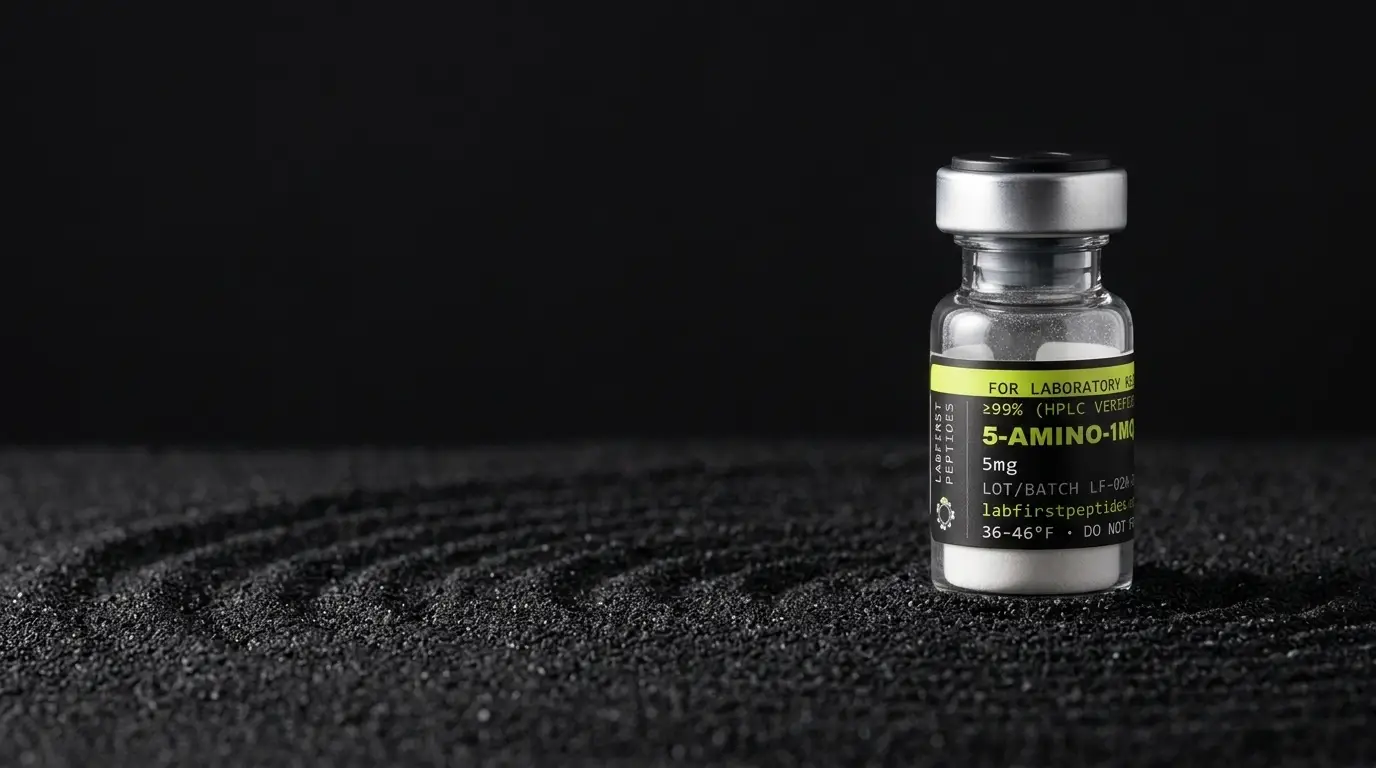
A 5-Amino-1MQ certificate of analysis is a small-molecule report, not a peptide one. Read it in order. Check the lot identifier against the vial and note the test date. Then look for structure by NMR and identity by mass near 159.21 for the cation. Next come HPLC purity, the counterion, residual solvents and water, then the issuing laboratory.
- 5-amino-1MQ is a small molecule, not a peptide, so it needs a different analytical panel.
- The cation is C10H11N2 with an average mass near 159.21, PubChem CID 950107.
- That formula is a CATION, so the material is supplied as a salt and the counter-ion must be named.
- NMR is the primary structural tool here, because mass cannot distinguish isomers.
- Residual solvents by gas chromatography belong on a small-molecule certificate.
- Melting point is genuine evidence for a crystalline solid and meaningless for a peptide.
Why is this certificate different from the others?
Think of it like inspecting a bicycle instead of a car. Both checks confirm the thing is what it claims to be, but they use different tools. A small-molecule report and a peptide report differ in the same way.
Because 5-amino-1MQ is not a peptide. Almost everything else in this catalogue is a chain of amino acids, and the analytical panel used for those does not transfer to a small organic molecule.
A peptide certificate reports mass, area purity at 214 nanometres, net peptide content and a counterion. A small-molecule certificate reports structure by nuclear magnetic resonance, purity by chromatography, residual solvents, and elemental composition.
If you receive a certificate for this compound that looks exactly like a peptide certificate, that is worth a question. The laboratory may have applied a template rather than a method suited to what was in the vial.
- Lot number on the report against the lot number on the vial
- Structure by NMR, the primary tool for a small organic molecule
- Identity by mass near 159.21 for the cation alone
- Counter-ion named, because a cation cannot be supplied by itself
- Purity by HPLC at a wavelength chosen for the quinolinium chromophore
- Residual solvents by gas chromatography, and water content
- Accession number confirmed at the issuing laboratory
What is actually in the vial?
A quaternary ammonium salt. The active portion is 5-amino-1-methylquinolinium, molecular formula C10H11N2 as a cation, average mass near 159.21, catalogued as PubChem CID 950107.
Note the charge. That formula describes a cation, a permanently positively charged ion, not a neutral molecule. A cation cannot exist alone in a bottle, so the material is supplied as a salt paired with a negatively charged counter-ion.
Which counter-ion it is paired with is therefore part of the product identity rather than a detail. The certificate should name it, and the total molecular weight of what you weigh out is the cation plus that counter-ion, not 159.21.
Why does NMR matter more here than for a peptide?
Because for a small organic molecule it is the primary structural tool, where for a peptide it is a specialist extra.
Nuclear magnetic resonance reports on the environment of individual hydrogen and carbon atoms, so a proton spectrum effectively maps the molecule: how many hydrogens sit in each distinct position, and what is next to what. For a molecule with ten carbons that is a nearly complete structural description.
Peptides are usually too large and repetitive for that approach to be routine, which is why peptide identity leans on mass and separation instead. For 5-amino-1MQ, a certificate without an NMR result has omitted the measurement that would most directly confirm what the compound is.
What does the mass result add?
Confirmation of the molecular formula, cheaply and quickly. At 159 daltons the measurement is trivial for any modern instrument.
What it cannot do is distinguish isomers. Molecules with the same formula and different arrangements weigh exactly the same, and for small aromatic compounds isomers are a realistic concern rather than a theoretical one: the position of an amino group on a ring can move without changing a single atom.
This is precisely the gap NMR fills. Mass says the atoms are right; the proton spectrum says they are arranged correctly. Together they are strong evidence, and mass alone on a small molecule is weaker evidence than most buyers assume.
Why do residual solvents appear on this certificate and not a peptide one?
Because small molecules are made by organic synthesis and purified by crystallisation or extraction, both of which use volatile organic solvents that can remain in the final solid.
Residual solvents are measured by gas chromatography, usually with headspace sampling, and international guidance classifies solvents by concern with limits attached.
Peptides made by solid-phase synthesis have their own solvent story, but the field appears far less often on a peptide certificate. Its presence here is a sign the laboratory treated the material as what it is. Its absence is not automatically a failure, and it does mean an entire category of possible impurity went unmeasured.
How is purity measured, and at what wavelength?
By high performance liquid chromatography, as for a peptide, but with a different detection rationale. Peptides are read at 214 nanometres because that responds to the peptide bond, and 5-amino-1MQ has no peptide bonds at all.
What it does have is a quinolinium ring system, an extended aromatic structure that absorbs strongly in the ultraviolet at its own characteristic wavelengths.
So the sensible detection wavelength is one chosen for this chromophore, and the certificate should state it. A wavelength copied from a peptide method is a sign of a template rather than a method, and the resulting number may be far less sensitive than it should be.
What does the counterion field mean here?
More than it does on a peptide certificate. On a peptide the counterion is a residue of purification. Here it is a structural necessity, because a permanently charged cation must be paired with something.
Different salt forms of the same cation are different substances with different molecular weights, different solubility and different physical behaviour. Two vials containing the same cation as different salts are not interchangeable by weight.
So a certificate that does not name the counter-ion has left out information you need to weigh the material correctly. This is not pedantry: the arithmetic converting a weighed mass to an amount of active cation depends entirely on which salt it is.
What about melting point and appearance?
Both are more informative here than on a peptide certificate, which is an unusual thing to be able to say.
A crystalline small molecule has a characteristic melting point, and a sharp melt at the expected temperature is real evidence of both identity and purity, since impurities depress and broaden it. Peptides are amorphous solids and do not melt cleanly, so the field is meaningless for them and genuinely useful here.
Appearance follows the same logic. A defined crystalline solid has an expected colour and habit, and a deviation is a signal rather than a curiosity.
How do you read the certificate field by field?
Lot number first, against the vial, and nothing further until they match. Then the dates, where a test date should follow the fill date.
Then structure by NMR, identity by mass, purity by HPLC with the wavelength and column stated, the counter-ion named, residual solvents, water content, and melting point where reported. Appearance last.
Each result needs its method beside it. A number with no method is an assertion rather than a measurement, and on a compound where the correct method differs from the catalogue's usual one, the method line is doing more work than usual.
What does the certificate not cover?
Everything after the sample was drawn. Storage temperature, light exposure, how long the container has been open and how it was handled are all outside it.
Quaternary ammonium salts are frequently hygroscopic, so moisture uptake after opening is a real possibility that changes the weight without changing anything visible.
Handling belongs with the storage record rather than the test report, and reading a certificate as though it covered both is the common mistake here as everywhere else.
How do you verify the document is genuine?
Confirm the report at the issuing laboratory rather than with the seller. An independent laboratory issues each certificate against an accession number that resolves on its own site. If the number resolves to a different product, a different lot, or nothing, the document does not describe your material.
Certificates with the verification key removed deserve particular suspicion, and this is not a hypothetical concern in this market. A PDF is easy to edit; a third-party lookup is not.
Lot reports for material supplied here resolve through the certificate verification page, and the sizes carried appear on the 5-amino-1MQ product record.
What is the regulatory position?
There is no FDA-approved drug product containing 5-amino-1MQ and no United States pharmacopoeial monograph defining what an acceptable batch is. The specification a lot is released against is the supplier's own.
What a research certificate can honestly establish is narrower and still useful: what a named laboratory measured, on a named lot, on a named date, by named methods. For this compound the methods clause carries particular weight, because the right panel differs from the one most suppliers in this market run by default.
Material described here is supplied for laboratory use only, and nothing in this guide describes use in a person or an animal.
FOR LABORATORY AND IN-VITRO RESEARCH USE ONLY. NOT FOR HUMAN OR ANIMAL CONSUMPTION. NOT FOR PERSONAL, MEDICAL, DIAGNOSTIC, THERAPEUTIC, OR RECREATIONAL USE.
What is 5-AMINO-1MQ studied for?
Published research on 5-AMINO-1MQ investigates the areas below, which is a different question from what 5-AMINO-1MQ will do for anyone, a claim about a living system that nothing on this site is sold for.
What it is. A small molecule, a methylquinolinium salt, not a peptide.
What the research looks at. It appears in enzyme and cell-biology research on NNMT and nicotinamide, mostly in cells and animals.
How it is thought to work. Described in the research as a blocker of an enzyme called NNMT, which sits in the pathway that handles nicotinamide.
What is not established. No approved product. Being a small molecule rather than a peptide, it dissolves, stores and tests differently from the rest of this catalogue, and its certificate should be read on small-molecule terms.
The full record, including the certificate for the lot in stock, is on the 5-AMINO-1MQ product page.
Common questions
Is 5-amino-1MQ a peptide?
What molecular mass should the certificate show?
Why does NMR matter for this compound?
Why do residual solvents appear on this certificate?
Why is melting point useful here but not for peptides?
More documentation guides
Sources
- PubChem Compound Summary for CID 950107, 5-amino-1-methylquinolinium. The openable record for the cation, giving the formula C10H11N2 and average mass near 159.21, and showing the permanent positive charge that requires a counter-ion.
- ICH Q2(R2), Validation of Analytical Procedures . Defines specificity, accuracy and precision for identity and assay procedures, and is the basis for requiring that each certificate result names the method that produced it.
- FDA guidance, Q3A(R) Impurities in New Drug Substances. Sets out how impurities in a synthesised small-molecule substance are identified, reported and qualified, which is the framework a small-molecule certificate is read against rather than the peptide one.
- Finnrick independent verification portal. Third-party lookup used to confirm a certificate resolves to the lot it claims to describe, rather than confirming a document with the seller who supplied it.