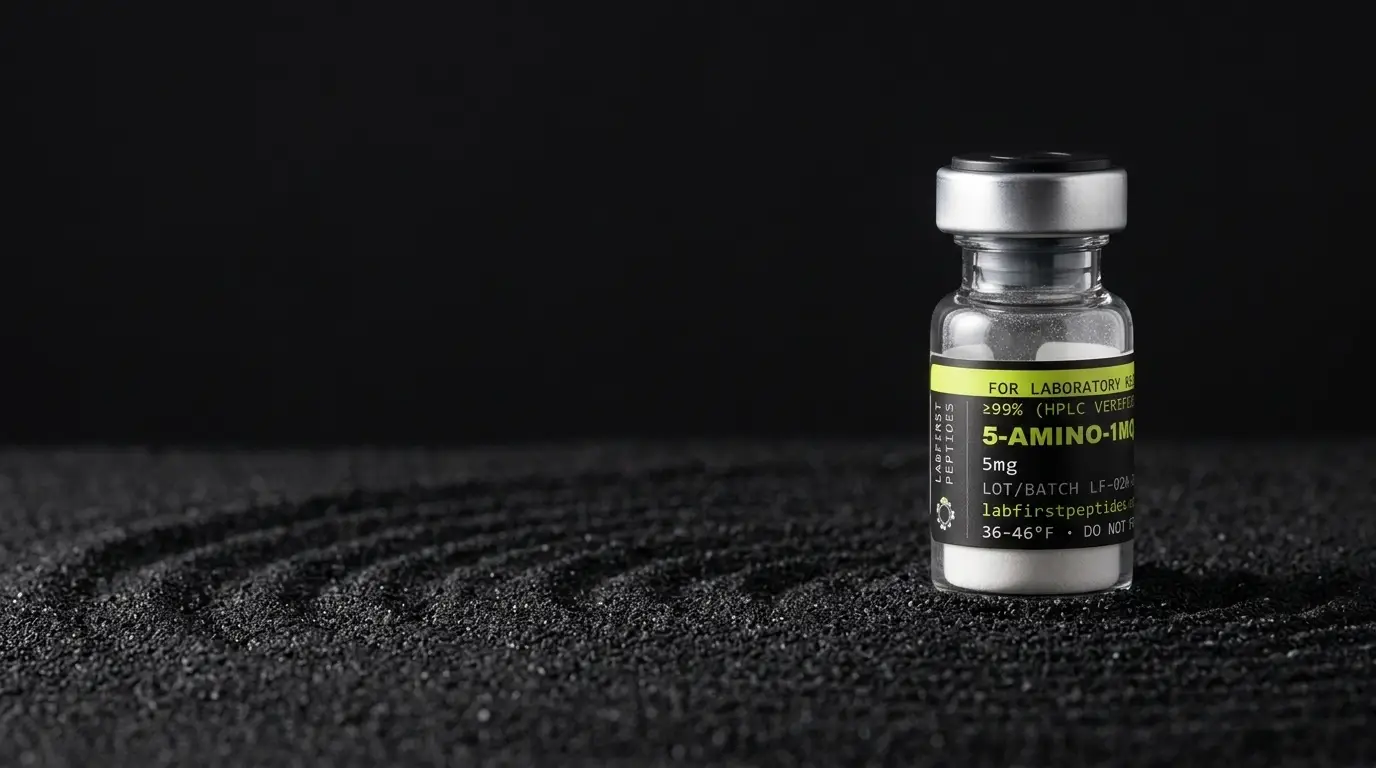
5-Amino-1MQ identity is confirmed mainly by nuclear magnetic resonance (NMR), not by mass. That is because it is a small molecule, and mass cannot tell isomers apart. A mass near 159.21 still confirms the formula of the cation. The counter-ion has to be named separately, because a charged ion is never supplied on its own.
- This is a small molecule, so NMR rather than mass is the primary identity tool.
- The cation is C10H11N2, average mass near 159.21, PubChem CID 950107.
- Mass cannot distinguish isomers: moving the amino group changes no atom.
- The counter-ion is part of the identity, because a charged cation is never supplied alone.
- Elemental analysis weighs everything, unlike a chromatographic purity figure.
- Purity reported at 214 nm suggests a reused peptide method rather than a suitable one.
Why is identity established differently here?
In plain terms, mass is like weighing a set of building blocks, while NMR shows how the blocks are put together. Two different arrangements of the same atoms weigh the same, so only the arrangement check can tell them apart.
Because 5-amino-1MQ is a small organic molecule and everything else in this catalogue is a peptide. The two are confirmed by different instruments for good reasons.
A peptide is a long chain assembled from known building blocks, so its mass is a strong constraint: get one residue wrong and the total shifts by a large, diagnostic amount. Identity therefore leans on mass and separation.
A small molecule is a specific arrangement of a modest number of atoms. Its mass constrains the formula and says very little about the arrangement, which is where the real question lies. So the primary tool changes, and a certificate that has not changed with it is running the wrong panel.
- Mass near 159.21 confirms the formula of the cation
- NMR confirms the arrangement, which mass cannot address
- Ring substitution pattern distinguishes this isomer from alternatives
- Counter-ion named and measured, because the material is a salt
- Elemental analysis weighs everything, unlike chromatographic purity
- Residual solvents by gas chromatography, a separate instrument again
- Accession number confirmed at the issuing laboratory
What is the compound, exactly?
A quaternary ammonium cation. The active portion is 5-amino-1-methylquinolinium, formula C10H11N2 as a cation, average mass near 159.21, catalogued as PubChem CID 950107.
The name encodes the structure. A quinoline ring system, a methyl group on the ring nitrogen which is what makes it permanently charged, and an amino group at position five.
That position number is the part that matters analytically. Moving the amino group to a different position on the same ring gives a different compound with an identical molecular formula and an identical mass, which is exactly the kind of error mass spectrometry cannot detect.
What does the mass result establish?
The molecular formula, quickly and reliably. At 159 daltons any modern instrument gives an unambiguous answer, and high-resolution measurement can distinguish formulae that differ by fractions of a dalton.
That rules out a great deal: a different compound entirely, an incomplete reaction product, a molecule with an extra or missing group.
What it cannot rule out is an isomer, and for a substituted aromatic ring isomers are a realistic concern rather than a theoretical one. The five-amino compound and a compound with the amino group elsewhere on the ring contain identical atoms and weigh identically. Mass alone treats them as the same substance.
How does NMR settle the arrangement?
By reporting on individual atoms rather than the molecule as a whole. In a proton spectrum every hydrogen appears at a position determined by its chemical environment, and the pattern of how those signals split reveals which hydrogens are adjacent to which.
On an aromatic ring that is decisive. The hydrogens remaining on the ring after substitution have a characteristic pattern that depends on where the substituent sits, so the spectrum distinguishes the five-amino isomer from its alternatives directly.
Carbon spectra add to this, and two-dimensional experiments connect the two. For a ten-carbon molecule the result is close to a complete structural proof, which is why NMR is the primary identity tool for compounds of this size.
Why is the counter-ion part of the identity?
Because a permanently charged cation cannot be supplied on its own. Electrical neutrality requires something negative alongside it, so the material in the container is a salt.
Different salts of the same cation are genuinely different substances. They have different molecular weights, different solubilities, sometimes different crystal forms and different hygroscopicity.
The practical consequence is arithmetic. Converting a weighed mass into an amount of the active cation requires the molecular weight of the whole salt, so a certificate that does not name the counter-ion has withheld a number needed to use the material correctly. On a peptide certificate the counterion is a purification residue; here it is half the compound's definition.
How is the counter-ion measured?
By methods aimed at ions rather than at organic molecules. Ion chromatography is the usual route, separating and quantifying anions directly.
Elemental analysis is the complementary approach. Measuring the proportions of carbon, hydrogen and nitrogen in the solid and comparing them against the calculated values for a proposed salt is a genuine test of whether the material is that salt.
Elemental analysis has a property worth appreciating: it weighs everything. Unlike a chromatographic purity figure, which only sees what elutes and absorbs, it accounts for the whole sample, so a large discrepancy points at inorganic content or solvent that a chromatogram would never have shown.
What does the chromatographic purity add?
A measure of how much of the detectable material is the target. The separation is by high performance liquid chromatography, as for a peptide, but the detection rationale is different.
Peptides are read at 214 nanometres because that responds to the peptide bond, and this molecule has none. It carries a quinolinium ring system instead, an extended aromatic structure with strong absorbance at its own characteristic wavelengths.
A certificate should state which wavelength was used. One reporting purity at 214 for this compound has probably reused a peptide method, and the resulting figure may be much less sensitive to the impurities that actually matter.
What impurities is the method looking for?
Three broad classes. Synthesis intermediates and by-products, which are structurally related and may respond similarly on the detector. Isomers, which are the hardest case and the reason NMR carries the identity burden.
Degradation products are the third, and for this compound they are likely to be oxidation products of the aromatic amine, which tend to be coloured and detectable at low levels.
Residual solvents sit outside all of this and need gas chromatography, because they are volatile and would not survive a liquid chromatography run in a way that reports them. A complete picture needs more than one instrument, which is the small-molecule version of the orthogonality principle.
What makes evidence orthogonal for a small molecule?
The same principle as for a peptide, applied to different instruments. Two methods are orthogonal when they can fail independently.
Mass and NMR are genuinely orthogonal: one counts atoms, the other maps their arrangement, and a molecule that satisfies both is well characterised. Chromatographic purity and elemental analysis are orthogonal in another direction, because one sees only what elutes and absorbs while the other weighs everything present.
A certificate carrying mass and a purity percentage has established that something of the right formula is most of what is in the container. That is real and it is not a structural proof.
How do you check the report describes your container?
Confirm the accession or verification number at the issuing laboratory rather than with the seller. The laboratory holds the record; a seller holds a copy of a document. If the number resolves to a different lot, a different product, or nothing, the analysis is not evidence about your material.
Then match the lot number on the report to the container. Rigorous analysis attached to the wrong batch is not rigour, and that mismatch is more common than falsified results.
Reports for material supplied here resolve through the certificate verification page, and the sizes carried appear on the 5-amino-1MQ product record.
What should you ask a supplier about identity?
Three questions. Was an NMR spectrum recorded, and can it be provided. Which counter-ion is present and what is the molecular weight of the salt. And at what wavelength was the purity measured.
The first is the one that matters most and the one most likely to go unanswered. For a small molecule, NMR is the measurement that confirms the structure, and a supplier who has only a mass and a purity figure has not established which isomer is in the container.
How to read the rest of the document is covered in the certificate guide.
What is the regulatory position?
International guidance on analytical validation defines what makes an identity method fit for purpose: specificity, accuracy, precision, and a demonstration that the method distinguishes the target from what else might plausibly be present. For a substituted aromatic compound, isomers are exactly what is plausibly present, and mass spectrometry cannot satisfy that clause alone.
There is no FDA-approved product containing 5-amino-1MQ and no United States pharmacopoeial monograph, so no official standard defines which tests a batch must pass. The specification is the supplier's own.
What a research certificate can honestly establish is what a named laboratory measured, on a named lot, by named methods.
FOR LABORATORY AND IN-VITRO RESEARCH USE ONLY. NOT FOR HUMAN OR ANIMAL CONSUMPTION. NOT FOR PERSONAL, MEDICAL, DIAGNOSTIC, THERAPEUTIC, OR RECREATIONAL USE.
What is 5-AMINO-1MQ studied for?
Published research on 5-AMINO-1MQ investigates the areas below, which is a different question from what 5-AMINO-1MQ will do for anyone, a claim about a living system that nothing on this site is sold for.
What it is. A small molecule, a methylquinolinium salt, not a peptide.
What the research looks at. It appears in enzyme and cell-biology research on NNMT and nicotinamide, mostly in cells and animals.
How it is thought to work. Described in the research as a blocker of an enzyme called NNMT, which sits in the pathway that handles nicotinamide.
What is not established. No approved product. Being a small molecule rather than a peptide, it dissolves, stores and tests differently from the rest of this catalogue, and its certificate should be read on small-molecule terms.
The full record, including the certificate for the lot in stock, is on the 5-AMINO-1MQ product page.
Common questions
Why is NMR the primary identity tool for this compound?
What can the mass result not tell you?
Why does the counter-ion have to be named?
What does elemental analysis add?
Should purity be measured at 214 nanometres?
More documentation guides
Sources
- PubChem Compound Summary for CID 950107, 5-amino-1-methylquinolinium. The openable record giving the formula C10H11N2 and average mass near 159.21, and showing the ring substitution pattern that distinguishes this isomer from its alternatives.
- ICH Q2(R2), Validation of Analytical Procedures . Defines specificity, including that a method must distinguish the target from closely related substances. For a substituted aromatic compound, isomers are what is plausibly present.
- FDA guidance, Q3A(R) Impurities in New Drug Substances. Sets out how synthesis by-products, isomers and degradation products in a small-molecule substance are identified and reported, which is the impurity framework this compound falls under.
- Finnrick independent verification portal. Third-party lookup used to confirm a certificate resolves to the lot it claims to describe, rather than confirming a document with the seller who supplied it.