AHK-Cu identity is confirmed in two halves. First, the peptide is checked by mass against the free tripeptide, near 354.41. Second, the copper is checked by its distinctive two-isotope signature. Spectroscopy then has to show the copper is actually bound to the peptide, not just sitting in the same sample.
- Identity has three parts: the peptide, the copper, and whether the copper is bound.
- The reference figures describe the FREE tripeptide, C15H26N6O4 near 354.41, CID 7408502.
- Copper's two isotopes give a doublet two units apart in about a seven-to-three ratio.
- A copper assay measures how much; only the isotope pattern shows it is in the molecule.
- GHK-Cu differs by 14 mass units, because alanine is larger than glycine.
- Chromatographic purity describes the peptide only and is silent on the metal.
Why does identity have two halves here?
In plain terms, it is like checking a pair of earrings. You confirm the earring is right, that the stone is there, and that the stone is set in the earring rather than loose in the box.
Because the product has two components. AHK-Cu is a tripeptide with a copper ion bound to it, and confirming one says nothing about the other.
The peptide is alanyl-histidyl-lysine, molecular formula C15H26N6O4, average mass near 354.41, catalogued as PubChem CID 7408502. That record describes the free peptide without copper.
So establishing identity means answering three questions rather than one: is the peptide correct, is copper present, and is that copper actually attached to the peptide. Most certificates in this market answer the first, some answer the second, and few address the third.
- Peptide mass against the free tripeptide near 354.41
- Copper content by a named metals method: how much
- The copper isotope doublet: proof the metal is in the molecule
- Visible spectroscopy: independent evidence of coordination
- Peptide-to-copper ratio, which a percentage alone cannot give
- GHK-Cu excluded by 14 mass units
- Accession number confirmed at the issuing laboratory
What does the copper isotope signature prove?
That copper is part of the species being weighed, which is the question a separate copper assay cannot answer.
Copper occurs naturally as two stable forms two mass units apart, in a ratio of roughly seven to three. That is a large and distinctive imbalance, quite unlike the smooth isotope pattern of an organic molecule made of carbon, hydrogen, nitrogen and oxygen.
Any molecule containing one copper atom therefore shows a characteristic doublet rather than a single peak, with the smaller partner sitting two units higher at around forty percent of the main signal. Seeing that pattern at the expected mass is strong evidence the metal is in the molecule rather than beside it.
Why is that better evidence than a copper assay?
Because the two questions are different. A metals method such as inductively coupled plasma analysis atomises the entire sample and measures total copper. It answers how much, precisely and reliably.
It cannot distinguish copper bound to the peptide from copper present as a separate salt mixed in with it. Both contribute identically to the total.
The isotope pattern is observed on an intact molecular ion, so it reports on copper that travelled through the instrument as part of the molecule. That is a statement about structure rather than about composition, and it is the difference between a compound and a mixture with the right ingredients.
What does spectroscopy add?
Independent evidence of coordination, arrived at by a completely different route. Copper bound to nitrogen atoms in a peptide absorbs visible light at wavelengths characteristic of that coordination environment.
Free copper salts absorb differently, and the free peptide barely absorbs in the visible at all. So an ultraviolet and visible spectrum showing the expected band is real evidence of the intended structure.
Its value is orthogonality. Mass spectrometry and visible spectroscopy fail for entirely different reasons, so a complex confirmed by both is confirmed in a way that neither alone achieves. This is the same principle applied throughout this library, using instruments that rarely appear on a peptide certificate.
How is GHK-Cu excluded?
By mass, comfortably. GHK-Cu is the same class of copper tripeptide complex with a glycine where this compound has an alanine.
Alanine carries one more carbon and two more hydrogens than glycine, so the peptides differ by 14 mass units. On molecules of this size that is a wide, unambiguous separation that any competent instrument resolves.
Both are carried in this catalogue and both are blue solids, so nothing visual distinguishes them. Unlike several pairs described elsewhere in this library, though, the analytical distinction here is genuinely easy, and a mix-up is a labelling problem rather than an analytical one.
What is stoichiometry and why does it belong on the certificate?
The ratio of peptide to metal in the compound. A defined complex has a defined stoichiometry, and that ratio is part of what the substance is.
Copper content alone is a percentage that can be satisfied in more than one way. The same percentage could arise from the intended complex, or from a different ratio, or from correct complex plus a little free copper salt.
Combining the copper measurement with peptide content gives the ratio, and only that ratio distinguishes those cases. A certificate reporting copper percentage without the peptide content it should be compared against has given you half an equation.
Does the complex behave normally in a mass spectrometer?
Less predictably than a plain peptide, which is worth expecting rather than being surprised by. Electrospray ionisation works by putting charge on molecules, and a complex already containing a charged metal centre behaves differently from a neutral peptide.
Coordination complexes can also lose the metal during ionisation, so a spectrum may show the free peptide alongside, or instead of, the intact complex.
That means a spectrum showing free peptide is not automatically evidence the sample had dissociated before analysis. Distinguishing a real finding from an artefact of the instrument requires the analyst to know the compound, which is another reason the method line on a metal complex certificate deserves attention.
What does the chromatographic purity describe?
The peptide portion only, and this is the most common misreading of a certificate for a material like this.
A purity figure from an HPLC run says how much of the detected peptide material was the target peptide. It says nothing about copper content, nothing about coordination, and nothing about stoichiometry.
So a sample can be excellent by peptide purity and wrong as a product. Purity and copper are two independent axes here, and a certificate presenting a high figure on one while silent on the other has described half the material while looking complete.
What role does colour play in identification?
A genuine one, uniquely in this catalogue. Every other compound here is a white or off-white powder whose appearance field carries almost no information.
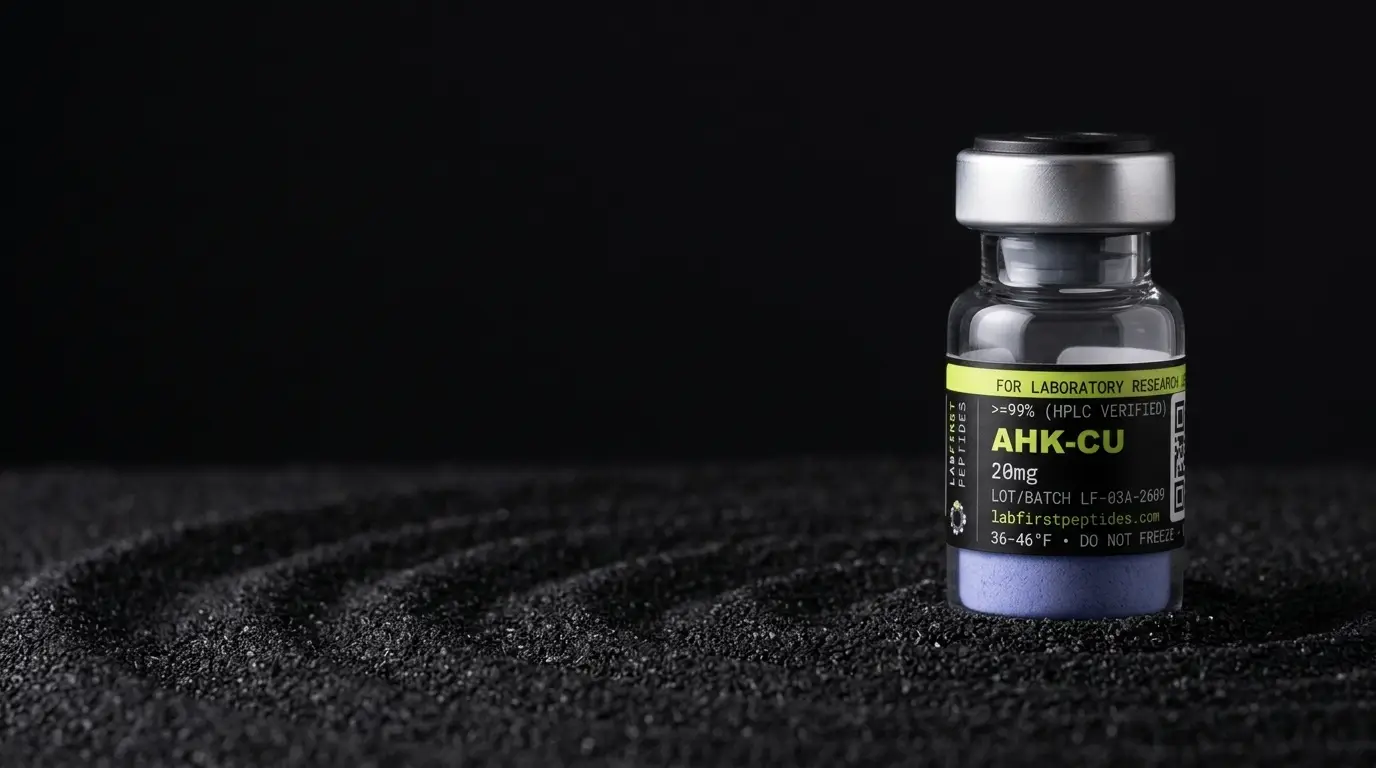
This complex is coloured, and it is coloured precisely because the copper is coordinated in the way intended. The colour is a direct consequence of the structure being claimed.
That does not make colour a substitute for analysis. A material of roughly the right colour could still have the wrong stoichiometry or a peptide impurity. It does mean the appearance line is worth reading here, and that a pale or off-hue solid raises a real question before any instrument is involved.
How do you check the report describes your container?
Confirm the accession or verification number at the issuing laboratory rather than with the seller. The laboratory holds the record; a seller holds a copy of a document. If the number resolves to a different lot, a different product, or nothing, the analysis is not evidence about your material.
Then match the lot number on the report to the container. Rigorous analysis attached to the wrong batch is not rigour, and that mismatch is more common than falsified results.
Reports for material supplied here resolve through the certificate verification page, and the sizes carried appear on the AHK-Cu product record.
What should you ask a supplier about identity?
Three questions, and they map onto the three halves of the problem. What was the peptide mass, and does the figure refer to the free peptide or the complex. What was the copper content and by which method. And what evidence exists that the copper is coordinated rather than simply present.
The third is the one that separates suppliers who understand this material from those treating it as a peptide with an unusual colour. A plain answer of none is honest and informative; an evasive one is informative in a different way.
How to read the rest of the document is covered in the certificate guide.
What is the regulatory position?
International guidance on analytical validation defines what makes an identity method fit for purpose: specificity, accuracy, precision, and a demonstration that the method distinguishes the target from what else might plausibly be present. For a metal complex the plausible alternative includes the same elements in the wrong arrangement.
There is no FDA-approved product containing AHK-Cu and no United States pharmacopoeial monograph, so no official standard specifies a required copper content, an acceptable ratio, or what coordination evidence must be supplied.
What a research certificate can honestly establish is what a named laboratory measured, on a named lot, by named methods.
FOR LABORATORY AND IN-VITRO RESEARCH USE ONLY. NOT FOR HUMAN OR ANIMAL CONSUMPTION. NOT FOR PERSONAL, MEDICAL, DIAGNOSTIC, THERAPEUTIC, OR RECREATIONAL USE.
What is AHK-Cu studied for?
Published research on AHK-Cu investigates the areas below, which is a different question from what AHK-Cu will do for anyone, a claim about a living system that nothing on this site is sold for.
What it is. A three-building-block peptide (alanine, histidine, lysine) joined to copper.
What the research looks at. A smaller body of cell-culture work than GHK-Cu, on copper-peptide chemistry and skin structure.
How it is thought to work. A close relative of GHK-Cu, differing at the first building block. Like GHK-Cu it grips copper, and the copper-carrying form is what has been studied.
What is not established. No approved product, and a noticeably thinner evidence base than its better-known relative. The two get marketed as interchangeable; the published record does not support treating them that way.
The full record, including the certificate for the lot in stock, is on the AHK-Cu product page.
Common questions
What is the copper isotope signature?
Why is that better than a copper assay?
How is AHK-Cu distinguished from GHK-Cu?
Can a mass spectrometer lose the copper during analysis?
Does the chromatographic purity cover the copper?
More documentation guides
Sources
- PubChem Compound Summary for CID 7408502, Ala-His-Lys. The openable record for the free tripeptide, giving the molecular formula C15H26N6O4 and average mass near 354.41 that a certificate for the copper complex must be distinguished from.
- NIST Atomic Weights and Isotopic Compositions. The reference source for the natural abundance of copper's two stable isotopes, which is what produces the characteristic doublet used as evidence the metal is in the molecule.
- ICH Q2(R2), Validation of Analytical Procedures . Defines specificity, including that a method must distinguish the target from what is plausibly present, which for a metal complex includes the same elements in the wrong arrangement.
- Finnrick independent verification portal. Third-party lookup used to confirm a certificate resolves to the lot it claims to describe, rather than confirming a document with the seller who supplied it.