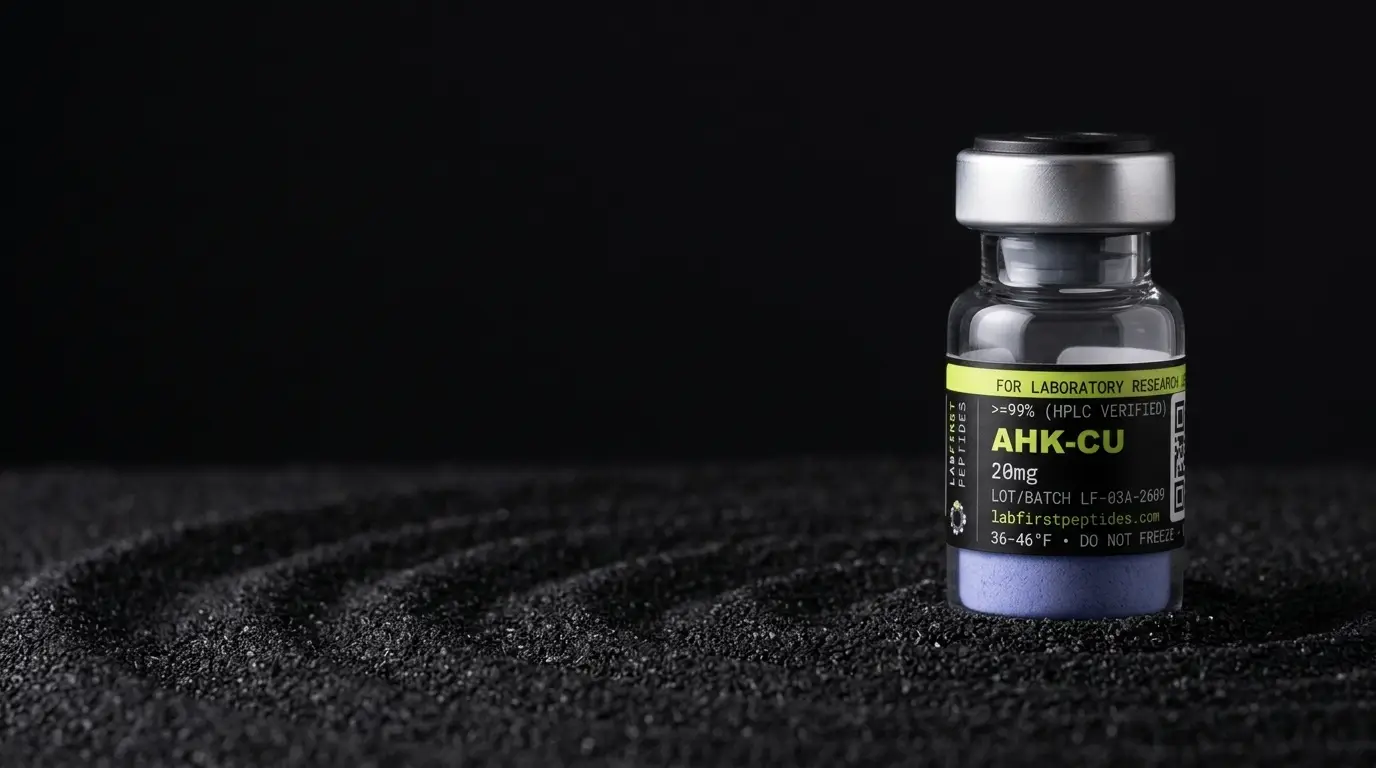
An AHK-Cu certificate of analysis is a lot-specific test report for a metal complex, not a plain peptide. Read it in order. Start with the lot identifier and the test date. Then check peptide identity and copper content by a metals method. After that come purity by HPLC, water and appearance. Last, check which laboratory issued the report.
- The product is a copper complex; the copper is part of it, not a contaminant.
- The reference figures describe the FREE tripeptide: C15H26N6O4, 354.41, CID 7408502.
- Copper content needs a metals method, which says nothing about whether it is bound.
- Coordination is shown by visible absorbance, which is why the complex is coloured.
- Copper's two isotopes give a doublet two units apart in about a seven-to-three ratio.
- Purity and copper content are independent axes; one figure describes half the product.
Why is this certificate different from a plain peptide one?
Think of it like a report on a key and its keyring. It has to confirm the key is right, that the ring is there, and that the two are actually joined. Here the peptide is the key and the copper is the ring.
Because the product is a metal complex rather than a peptide alone. AHK-Cu is a tripeptide bound to copper, and the copper is part of the product rather than a contaminant.
That adds a whole question a peptide certificate never asks. As well as confirming the peptide, the document has to establish how much copper is present and that it is genuinely coordinated to the peptide rather than sitting alongside it as a separate salt.
A certificate for this material that reports only peptide identity and purity has covered the peptide and said nothing about the metal, which is half the product.
- Lot number on the report against the lot number on the vial
- Peptide identity, and whether the figure is the free peptide or the complex
- Copper content by a named metals method
- Evidence of coordination: visible absorbance, not just copper presence
- The copper isotope doublet, two units apart in a seven-to-three ratio
- Peptide-to-copper ratio, which distinguishes a compound from a mixture
- Accession number confirmed at the issuing laboratory
What do the figures on file actually describe?
The free tripeptide, and this trips people up. The reference record is alanyl-histidyl-lysine, molecular formula C15H26N6O4 with an average mass near 354.41, catalogued as PubChem CID 7408502.
That is the peptide without copper. The product supplied is the copper complex, which weighs more and behaves differently.
So a buyer comparing a certificate against a database entry will find they disagree, and the copper is the explanation rather than a fault. A certificate that states plainly which form each figure refers to prevents an entirely reasonable misreading.
How is copper content measured?
By a metals method rather than by anything used on peptides. Inductively coupled plasma techniques are the usual route: the sample is atomised in a plasma and the copper quantified directly, either by the light it emits or by mass.
Atomic absorption is the older alternative and answers the same question.
What none of these say is whether the copper is bound. They measure how much is present. Establishing that it is coordinated to the peptide rather than merely mixed with it needs different evidence, which is the subject of the next section and the thing most often missing.
How do you know the copper is actually bound?
By spectroscopy, and by colour. A copper ion coordinated to a peptide absorbs visible light in a way free copper salts and the free peptide do not, which is why these complexes are coloured at all.
Ultraviolet and visible spectroscopy records that absorbance, and the position of the band is characteristic of the coordination environment. A spectrum consistent with a peptide-bound copper is real evidence of complexation.
This is the one certificate in the catalogue where appearance is genuinely analytical rather than decorative. A material of the expected colour has copper coordinated as intended. A pale or off-colour solid raises a question that no purity percentage answers.
What does the copper isotope pattern tell you?
That copper is present in the molecule being weighed, which is a stronger statement than it sounds. Copper occurs naturally as two stable forms, one two mass units heavier than the other, in a roughly seven-to-three ratio.
Any molecule containing a single copper atom therefore shows two peaks two units apart in that proportion, rather than one peak. It is a distinctive signature and it is difficult to fake or to confuse with anything else.
Its diagnostic value is direct. A mass spectrum showing that doublet is evidence copper is part of the species measured. A spectrum showing a single clean peak where the complex should be is evidence it is not.
How do you read the certificate field by field?
Lot number first, against the vial. Then dates, where a test date should follow the fill date and a print date carries no analytical meaning.
Then peptide identity by mass, with the certificate saying whether the figure refers to the free peptide or the complex. Copper content by a named metals method. Evidence of coordination, whether spectroscopic or from an isotope pattern. Purity by HPLC. Water. Appearance, which here means colour and is worth reading.
Each result needs its method beside it. For this product that includes which instrument measured the copper, because a peptide laboratory and a metals laboratory are not always the same place.
What is the peptide-to-copper ratio, and why does it matter?
It is the number that says whether the complex is what it claims to be. A defined complex has a defined stoichiometry: a set number of peptide molecules per copper atom.
Copper content on its own is a percentage. Combined with the peptide content it gives a ratio, and that ratio either matches the intended structure or it does not.
Material with the right copper percentage but the wrong ratio is not the intended complex, and material carrying excess unbound copper salt would raise the measured copper without improving anything. The ratio is the field that distinguishes a defined compound from a mixture that contains the right elements.
How is GHK-Cu excluded?
By mass, and the margin is comfortable. GHK-Cu is the same kind of copper tripeptide complex with glycine where this one has alanine.
Alanine carries one extra carbon and two extra hydrogens compared with glycine, so the two peptides differ by 14 mass units. On molecules of this size that is a large, unambiguous gap.
Both are sold in this catalogue and both are blue solids that look alike, so the label is the only thing distinguishing them by eye. The analytical distinction, unlike some in this library, is easy for any competent measurement.
What does the purity figure mean here?
Less than it does for a plain peptide, and it needs reading carefully. Chromatographic purity describes the peptide portion: how much of the detected peptide material was the target.
It says nothing about the copper. A sample could be excellent by peptide purity and carry the wrong amount of metal, or carry metal that is not coordinated.
So for this product purity and copper content are two independent axes, and a certificate reporting a high figure on one while omitting the other has described half the material. That division is the single most useful thing to hold in mind when reading a metal complex certificate.
The practical question to put to a supplier follows from that. Ask for the copper content and the peptide purity as two separate numbers, and ask which method produced each. A laboratory that treats this material as a metal complex will answer without hesitation. One that treats it as a peptide with an unusual colour may only have half the data.
What does the certificate not cover?
Everything after the sample was drawn. Storage temperature, light, humidity and how the vial has been handled are all outside it.
For this material the specific risk is the complex coming apart. Copper coordination depends on conditions, and a change that frees the metal from the peptide leaves both components present while the compound itself is gone.
Colour is the accessible warning here, which is unusual and welcome. Handling belongs with the storage record rather than the test report.
How do you verify the document is genuine?
Confirm the report at the issuing laboratory rather than with the seller. An independent laboratory issues each certificate against an accession number that resolves on its own site. If the number resolves to a different product, a different lot, or nothing, the document does not describe your material.
Certificates with the verification key removed deserve particular suspicion, and this is not hypothetical in this market. A PDF is easy to edit; a third-party lookup is not.
Lot reports for material supplied here resolve through the certificate verification page, and the sizes carried appear on the AHK-Cu product record.
What is the regulatory position?
There is no FDA-approved drug product containing AHK-Cu and no United States pharmacopoeial monograph defining what an acceptable batch is. The specification a lot is released against is the supplier's own.
For a metal complex that absence matters more than usual, because no external standard defines the required copper content, the acceptable ratio, or what evidence of coordination must be supplied.
Material described here is supplied for laboratory use only, and nothing in this guide describes use in a person or an animal.
FOR LABORATORY AND IN-VITRO RESEARCH USE ONLY. NOT FOR HUMAN OR ANIMAL CONSUMPTION. NOT FOR PERSONAL, MEDICAL, DIAGNOSTIC, THERAPEUTIC, OR RECREATIONAL USE.
What is AHK-Cu studied for?
Published research on AHK-Cu investigates the areas below, which is a different question from what AHK-Cu will do for anyone, a claim about a living system that nothing on this site is sold for.
What it is. A three-building-block peptide (alanine, histidine, lysine) joined to copper.
What the research looks at. A smaller body of cell-culture work than GHK-Cu, on copper-peptide chemistry and skin structure.
How it is thought to work. A close relative of GHK-Cu, differing at the first building block. Like GHK-Cu it grips copper, and the copper-carrying form is what has been studied.
What is not established. No approved product, and a noticeably thinner evidence base than its better-known relative. The two get marketed as interchangeable; the published record does not support treating them that way.
The full record, including the certificate for the lot in stock, is on the AHK-Cu product page.
Common questions
What mass should an AHK-Cu certificate show?
How is copper content measured?
How do you know the copper is coordinated rather than just present?
What is the copper isotope signature?
How is AHK-Cu told apart from GHK-Cu?
More documentation guides
Sources
- PubChem Compound Summary for CID 7408502, Ala-His-Lys. The openable record for the free tripeptide, giving the molecular formula C15H26N6O4 and average mass near 354.41, which is the figure a certificate for the copper complex must be distinguished from.
- NIST Atomic Weights and Isotopic Compositions. The reference source for the natural abundance of copper's two stable isotopes, which is what produces the characteristic doublet described above.
- ICH Q2(R2), Validation of Analytical Procedures . Defines specificity, accuracy and precision for identity and assay procedures, and is the basis for requiring that the copper result name the method that produced it.
- Finnrick independent verification portal. Third-party lookup used to confirm a certificate resolves to the lot it claims to describe, rather than confirming a document with the seller who supplied it.