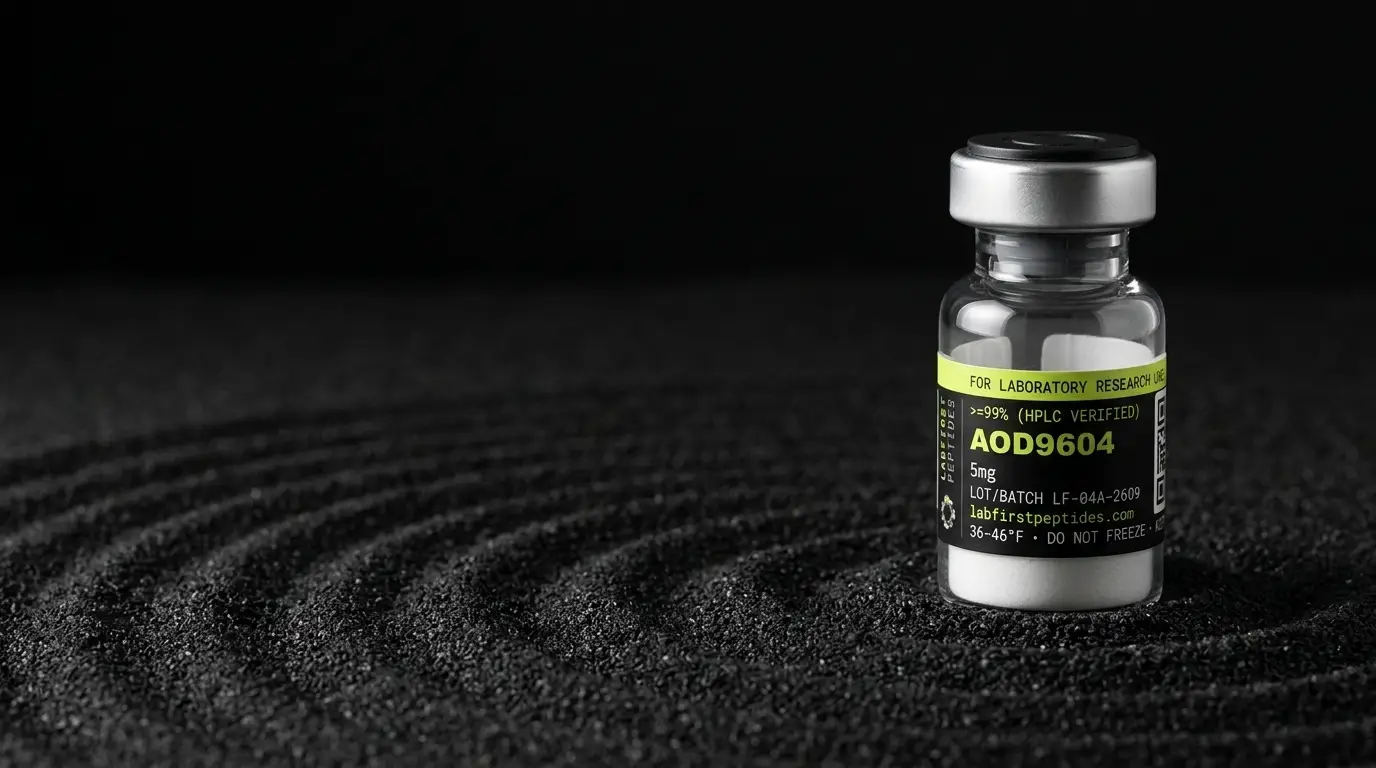
For AOD9604 storage and stability, keep the lyophilized powder sealed and frozen. In solution, keep it refrigerated, and keep it dark in both states. The disulfide bond matters most for handling. Disulfide exchange runs faster as pH rises, and trace metals speed it up. The result is dimers, where two molecules join, rather than fragments.
- Sealed and frozen as powder, refrigerated in solution, dark in both states.
- The disulfide is a reactive linkage, so the characteristic failure is exchange rather than breakage.
- Dimerisation makes a LARGER species, an unusual direction for peptide degradation.
- Disulfide exchange runs through a thiolate, so higher pH accelerates it sharply.
- Trace copper and iron catalyse it, arriving from glassware, water and buffers.
- Dimers are unmistakable by mass and usually resolved chromatographically.
How should AOD9604 be stored?
A peptide chain can carry a small chemical clasp that holds it in shape. In dry frozen powder the clasp stays put, but in solution it can swap partners with a neighboring molecule, the way a dancer might switch hands mid-song, and that is how two molecules end up joined as a dimer.
Sealed and frozen as lyophilized powder, refrigerated once a solution exists, and dark in both states.
The dry form is the stable one. Freeze-drying removes the water that hydrolysis needs, and a sealed vial below freezing is the condition every retest date assumes.
What makes this compound different from a plain linear peptide is that it carries a disulfide bond, and disulfide chemistry has its own rules. Those rules matter most once a solution exists, which is where the rest of this page concentrates.
- Sealed and frozen as lyophilized powder, in the dark
- The disulfide is reactive: exchange, not breakage, is the failure
- Higher pH drives it, because the reaction runs through a thiolate
- Trace copper and iron catalyse it, arriving from glassware and buffers
- A trace of reducing agent can seed a large amount of dimerisation
- Dimers weigh twice the monomer, so this failure is at least visible
Why does the disulfide bond change the storage question?
Because it is a reactive linkage rather than an inert one. A disulfide is two sulfur atoms joined together, and that bond can be broken, re-formed, and re-formed in the wrong place.
Most peptide degradation is destructive: a bond breaks and the molecule is smaller. Disulfide chemistry is different because it is an exchange. The molecule is not destroyed, it is rearranged into a different molecule with the same parts.
The practical consequence is that this peptide's characteristic failure is not fragmentation but dimerisation, where two molecules join through their sulfurs. That is a bigger species rather than a smaller one, which is an unusual direction for peptide degradation to run.
What accelerates disulfide exchange?
Higher pH, above all. The reaction proceeds through a thiolate, the deprotonated form of a free sulfur, and raising pH produces more of it. Alkaline conditions are markedly worse than mildly acidic ones, and this is the single most useful thing to know about handling the compound in solution.
Trace metal contamination is the second factor. Metals such as copper and iron catalyse the oxidation chemistry that drives exchange, and they arrive from glassware, water and buffer components rather than from the peptide.
Temperature and time do what they always do. None of this proceeds meaningfully in a dry sealed powder at low temperature, which is why the storage instruction is what it is.
Why do reducing agents matter even when you add none?
Because contamination is enough. A trace of a reducing agent left on glassware, or present in a buffer component, can open the disulfide bond.
Once open, the free sulfurs are available to pair with anything, including the sulfur of a neighbouring molecule. So a small amount of reduction can seed a much larger amount of dimerisation.
That makes clean glassware and freshly prepared buffers more than good practice for this compound. It is the same logic as trace metals: the thing that starts the chemistry does not have to come from the peptide, and it does not have to be present in any great quantity.
Would the routine panel see dimerisation?
Yes, and this is genuinely good news worth stating plainly, because several other compounds in this catalog have degradation routes their certificates cannot see.
A dimer weighs roughly twice the monomer, which is an enormous and unmistakable difference to a mass spectrometer. It is also a much larger molecule, so a chromatographic separation typically resolves it clearly.
So unlike an isomeric rearrangement or a stereochemical error, this failure announces itself to ordinary methods. If a supplier has run any competent analysis on a degraded lot, the dimer is something they would have seen.
Which other routes apply?
Hydrolysis first, which needs water and is why the lyophilized form is stable and a solution is not. Moisture ingress remains the fault that undoes the rest of your care.
Deamidation is the second, converting susceptible residues over time and running faster in solution and at higher pH.
Notice that higher pH appears in all three answers on this page: disulfide exchange, deamidation and, indirectly, hydrolysis. For this peptide, pH control in solution is not one consideration among several. It is the consideration.
What does a retest date actually mean?
It describes an unopened container held under the conditions printed beside it, derived from stability data: units stored at defined temperature and humidity, pulled on a schedule, tested against the release specification.
The date is conditional on those conditions. A vial that spent a week on a warm bench is no longer described by it, and nothing about it looks different.
It is also not a cliff. Material past a retest date is not established as failing, it is outside the evidence, and the honest response is to test rather than assume in either direction. A pharmaceutical expiry is a stronger claim made under rules research-grade material is not made under.
What happens once the vial is opened?
The moisture clock starts and the certificate stops describing the contents. Lyophilized peptide is hygroscopic, and opening a cold vial in a warm room draws condensation onto the powder. Letting the vial reach room temperature first costs nothing and removes the problem.
Air matters here in a specific way. Oxygen participates in the oxidation chemistry that drives disulfide exchange, so headspace air is not a neutral filler for this compound in the way it is for a peptide with no sulfur at all.
Moisture also quietly makes the certificate's net content figure optimistic, because the powder now weighs more per unit of peptide than it did at test.
What does stability testing not capture?
Everything after dispatch. A stability study tests unopened units under controlled conditions, so its results describe an ideal a working vial stops matching at first entry.
Transit is the least documented stretch. A parcel can sit in a hot vehicle for a day or freeze overnight and none of it appears on paperwork. For a dry powder the chemical risk is modest; the mechanical risk to the closure is not.
The buffer a solution is made up in is the gap specific to this compound, and it is entirely outside any stability protocol. Its pH and its trace metal content decide how fast the disulfide chemistry runs, and neither is a property of the material you were sold.
What should make you stop using a vial?
Powder that has caked hard or changed color. Caking is the visible form of moisture ingress and the most useful signal a vial gives without equipment.
In solution, cloudiness or visible particulate. For a peptide that dimerises, haze can be the visible end of a process that started as a small amount of exchange, so it deserves more weight here than as a general precaution.
A closure that has lifted, cracked or no longer sits flush counts even when the contents look untouched. Unlike some compounds in this catalog, the underlying chemistry here is at least detectable if you choose to look, which makes testing a real option rather than a gesture.
How does storage relate to the certificate?
They split the timeline and neither covers the other half. A certificate reports what was measured on a sample drawn at one moment, and the certificate guide covers how to read one field by field. Storage evidence covers what happened afterwards.
The split has a favorable edge here for once. Because dimerisation is visible to ordinary methods, re-testing a suspect lot is genuinely informative rather than reassuring by default.
Lot reports for material supplied here resolve through the certificate verification page, and the sizes carried are on the AOD9604 product record.
What is the regulatory position?
Stability expectations for finished pharmaceutical products are set out in international guidance defining storage conditions, sampling intervals and the testing that supports a shelf-life claim. That framework governs drug products made for human use.
There is no FDA-approved product containing AOD9604 and no United States pharmacopeial monograph defining an acceptable batch, so no official standard requires a dimer limit or a disulfide confirmation.
A supplier can honestly report the conditions a lot was held under and what was measured. The useful question stays narrow: what conditions, what measurement, what date.
FOR LABORATORY AND IN-VITRO RESEARCH USE ONLY. NOT FOR HUMAN OR ANIMAL CONSUMPTION. NOT FOR PERSONAL, MEDICAL, DIAGNOSTIC, THERAPEUTIC, OR RECREATIONAL USE.
What is AOD9604 studied for?
Published research on AOD9604 investigates the areas below, which is a different question from what AOD9604 will do for anyone, a claim about a living system that nothing on this site is sold for.
What it is. A man-made peptide matching the tail end of human growth hormone.
What the research looks at. It appears in a limited set of animal and early human studies about that piece of the hormone.
How it is thought to work. A piece of the hormone rather than the whole thing, and it does not carry growth hormone’s full range of effects. The published accounts of how it works are not settled.
What is not established. No approved drug product. Supplier copy routinely credits it with the pharmacology of whole growth hormone, which the primary research does not support.
The full record, including the certificate for the lot in stock, is on the AOD9604 product page.
Common questions
Why does pH matter so much for AOD9604?
How do trace metals affect this peptide?
What does dimerisation mean for this compound?
Would a certificate detect a dimer?
Do reducing agents matter if I never add one?
More documentation guides
Sources
- PubChem Compound Summary for CID 71300630, AOD-9604. The openable record giving the molecular formula C78H123N23O23S2, whose two sulfurs are the cysteines whose disulfide chemistry governs the handling described above.
- ICH Q2(R2), Validation of Analytical Procedures . Defines what makes an analytical result valid and reproducible, and is the basis for treating a stability figure without a named method and stated conditions as unverifiable.
- FDA guidance, Q6B Specifications: Test Procedures and Acceptance Criteria. Sets out how disulfide structure and aggregate content are specified and tested as attributes distinct from chemical purity, which is the framework a dimer limit would sit in.