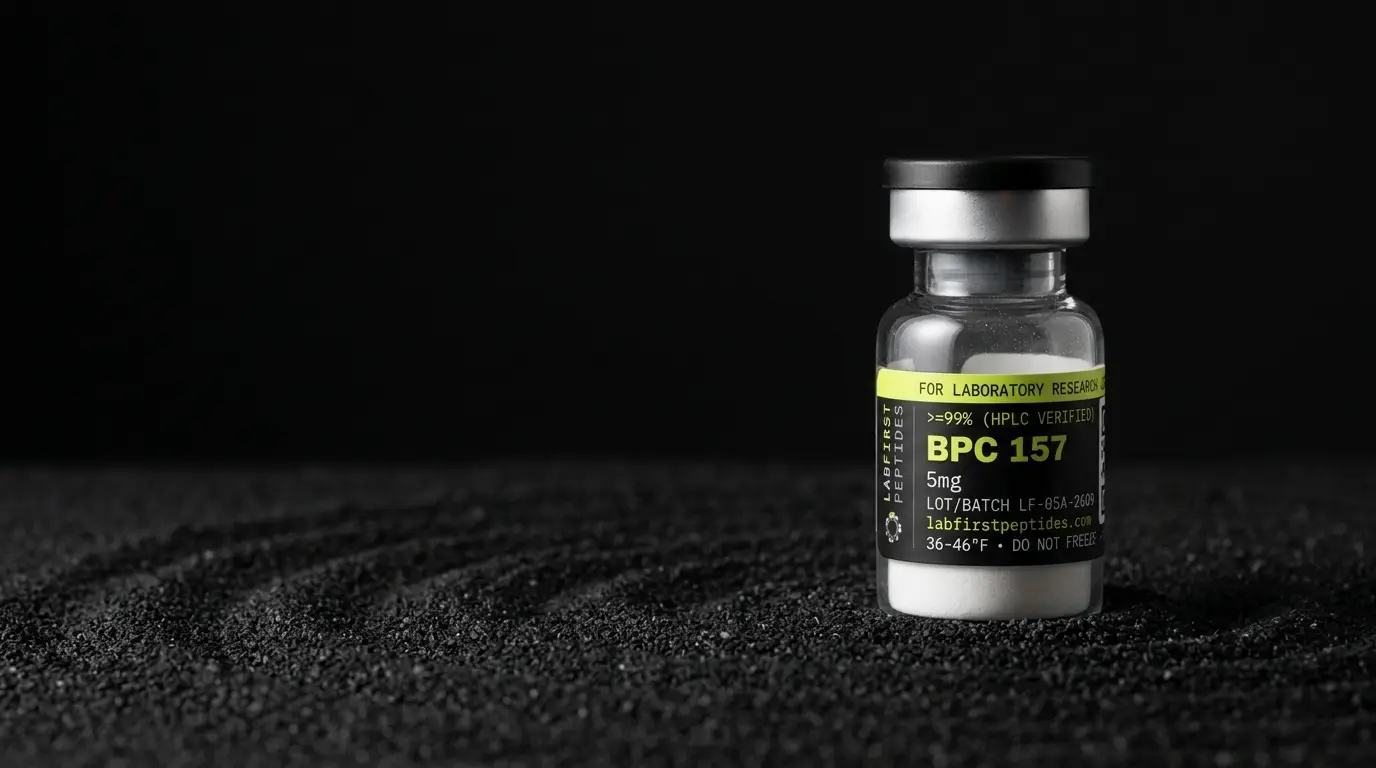
BPC 157 identity testing matches the measured mass of the material to the expected mass of its fifteen-residue sequence. That result is read alongside how the sample behaves on the chromatography column. A purity percentage only says how much of the sample is one substance. The mass evidence is what says that substance is BPC 157.
- Area-percent purity is a homogeneity measurement and carries no information about what the main chromatographic peak is.
- BPC 157 is a fifteen-residue peptide with formula C62H98N16O22, average mass just over 1419.5 g/mol and monoisotopic mass 1418.70 Da.
- Electrospray certificates usually quote charge states, with the doubly protonated ion near m/z 710.4.
- Sequence order, stereochemistry and aspartate isomerization are all mass-silent, so a matching mass alone is not a complete identity case.
- No USP or NF monograph exists for BPC 157, so every acceptance criterion on a certificate is the supplier's own.
- The FDA removed BPC 157 from 503A Category 2 in April 2026 after the supporting nomination was withdrawn, a procedural change that approved nothing.
Purity and identity are different questions
Think of it like checking a delivery. Purity tells you the box holds only one kind of item. Identity testing tells you it is the item you ordered.
The number a listing leads with is a purity percentage, and it is the most misread figure in the research-peptide trade. Area-percent purity comes off a chromatogram: of everything that eluted from the column and absorbed at the detection wavelength, this fraction sat under the main peak. That is a statement about homogeneity. It says the sample is mostly one thing. It does not say what the thing is.
A vial of the wrong peptide entirely can produce a spotless purity figure. So can a well-made sample of something cheaper than what the label claims. Homogeneity and identity are independent properties, and a certificate that reports 99% with no identity data has answered only half the question, the cheaper half.
The identity half is established by measurement against the molecule's known properties, chiefly its mass, corroborated by its chromatographic behavior. None of this is exotic. The ICH guidance on specifications for biological and biotechnological substances treats identity as its own test with its own methods, separate from purity, and the same logic scales down to a research-grade pentadecapeptide. What follows is what those measurements are for BPC 157 specifically, what agreement between observed and theoretical values actually proves, and where the proof stops.
- Purity percentage alone: says nothing about identity
- Retention time matching reference material: corroborating
- Observed mass matching the theoretical value: the anchor
- LC-MS with mass measured on the integrated peak: strong routine evidence
- MS/MS sequence ladder plus chiral analysis: full characterization
The molecule the tests are looking for
BPC 157 is a synthetic pentadecapeptide, fifteen residues in a fixed order: Gly-Glu-Pro-Pro-Pro-Gly-Lys-Pro-Ala-Asp-Asp-Ala-Gly-Leu-Val. The sequence is a fragment of a larger gastric protein described in the research literature, which is where the name Body Protection Compound comes from. The molecular formula indexed on PubChem, describing the free acid, is C62H98N16O22, giving an average mass just over 1419.5 g/mol and a monoisotopic mass of 1418.70 Da.
The formula carries a small internal check worth knowing. Fifteen residues contribute fifteen backbone nitrogens; the lysine side chain adds one more; sixteen in total, which matches the N16 in the formula and is consistent with a free-acid C-terminus. A supplier document quoting a different formula, or a mass that assumes an amidated terminus, is describing a different molecule, and mismatches of exactly this kind turn up often enough in this market to be worth thirty seconds of arithmetic.
One more fact frames everything downstream: no compendial monograph exists for BPC 157. USP and NF define what an acceptable article of many substances is; for this one they are silent. There is no official set of acceptance criteria, so every specification on a certificate is the supplier's own, and identity is confirmed against calculated values and reference material rather than against a pharmacopeial standard. Confirmation is still entirely possible. The quality of the evidence just becomes the whole story.
Mass spectrometry, the primary evidence
Electrospray ionization mass spectrometry is the workhorse. The peptide picks up one or more protons in the source and appears in the spectrum at mass-to-charge values of (M + nH)/n, so one molecule shows up as a family of peaks, one per charge state. For a molecule this size the doubly and triply charged ions usually dominate the spectrum.
| Measurement | Value | Where it appears |
|---|---|---|
| Average mass | 1419.5 g/mol | Formula-weight calculations and catalog listings |
| Monoisotopic mass | 1418.70 Da | What high-resolution instruments report |
| [M+H]+ | m/z 1419.71 | Singly protonated ion, often weak for a peptide this size |
| [M+2H]2+ | m/z 710.36 | The ion most certificates quote |
| [M+3H]3+ | m/z 473.91 | Commonly present at lower intensity |
An observed mass within instrument tolerance of these values establishes that the dominant species in the vial has the elemental composition of BPC 157. That is load-bearing evidence, and a certificate should print the observed number beside the theoretical one so the agreement can be checked rather than taken on faith.
It is worth being exact about what a matching mass does not establish. Any peptide built from the same fifteen residues in a different order has the same mass. Stereochemistry is invisible: a D-amino acid substituted during synthesis changes nothing a mass spectrometer can see. Sequence order is settled by tandem mass spectrometry, where the backbone is fragmented and the fragment ladder is read against the expected series. Full characterization packages include that work; routine lot release frequently does not, and a certificate should say which of the two it is reporting.
Chromatography read alongside the mass
Reversed-phase HPLC contributes two things, and only one of them is the purity number. Under a defined method, meaning a stated column, gradient, temperature and detection wavelength, retention time is a reproducible property of the molecule. A lot that elutes where the reference material elutes, and where previous lots eluted, is behaving like the same substance. Where a reference standard is on hand, co-injection is the sharper version of the test: spike the sample with reference, and a single taller peak says the two co-elute, while a shoulder or a split says they do not.
The purity figure comes from the same trace, as the integrated area of the main peak against the total. Which is exactly why the two measurements belong together. The chromatogram says the sample is dominated by one species and quantifies how dominant; the mass spectrum says what that species weighs. Each alone has a blind spot. Read together, the mass is anchored to the very peak the purity claim is about.
The strongest routine configuration is LC-MS on a single instrument, where the column eluent feeds the mass spectrometer directly and the mass is measured on the peak as it elutes. A certificate reporting HPLC from one run and mass spectrometry from another is still evidence; it is a weaker chain of custody between the two claims, and with LC-MS now commonplace there is little reason for a buyer to accept the weaker version without asking why.
What the standard package still cannot see
Several failure modes pass straight through a matching mass and a clean chromatogram, and they are worth naming because they define where extra testing earns its cost.
Aspartate isomerization is the quiet one for this sequence. BPC 157 carries adjacent aspartates in its Asp-Asp-Ala-Gly stretch, and aspartate converts to isoaspartate through a succinimide intermediate with no change in mass at all. The peptide degradation literature documents the route thoroughly. An aged or badly handled lot can hold isoaspartate the spectrum cannot see; a good chromatographic method sometimes resolves it as a shoulder on the main peak, which is one more reason the trace deserves as much attention as the mass number. The general chemistry of how stored peptides fail is covered in the storage and stability guide. Racemization is similar: a D-aspartate swapped for the L form is mass-silent and invisible to standard reversed-phase methods, and settling it takes chiral amino acid analysis, specialist work that no routine certificate includes.
The identity package also says nothing about composition beyond the peptide itself. A lyophilized solid carries water and counterion, so the gross mass in the vial and the mass of actual peptide differ; a vial labeled by gross fill at eighty percent peptide content holds a fifth less peptide than the label suggests, which matters to any calculation built on the label figure and to the real price per milligram, something the cost-per-milligram tool makes visible. Endotoxin and sterility are separate assays again. Identity testing answers one question well. It was never designed to answer the others.
Reading the certificate
Certificate literacy for identity comes down to a short list of checks, all of them possible before any money moves.
- The observed mass is a number, printed beside the theoretical value. A certificate that says MS: conforms or Identity: pass has replaced evidence with a verdict, and verdicts are free to type.
- The chromatogram is present as an actual trace, with method conditions stated and the retention time and integration legible. A purity percentage floating free of any trace is a claim, and reused traces are a known trick: two lots from the same seller with pixel-identical chromatograms mean neither document should be trusted.
- The lot number on the certificate matches the vial in hand. A certificate that cannot be tied to a specific lot describes nothing.
- The testing laboratory is named, and independent third-party testing counts for more than a supplier testing its own material, for reasons that need no elaboration.
None of this requires an analytical background, which is the point. Producing the measurements takes instruments; checking whether the measurements are actually present takes ten minutes with the document open. The BPC 157 product record carries the lot documentation for material sold here, and the quality standard sets out what testing every lot receives and who performs it.
Regulatory position
No FDA-approved product contains BPC 157, and no USP or NF monograph defines an acceptable article of it. It is supplied as a research chemical, with the quality of any given lot resting entirely on the documentation behind it.
Its compounding status has moved more than once, which is why the dates matter. The FDA placed BPC 157 in Category 2 of the 503A bulk drug substances list, the category for substances that may present significant safety risks, effective with the agency's update of 29 September 2023. In April 2026 the agency removed it from Category 2 after the nomination supporting the listing was withdrawn. Removal from a risk category is a procedural change, not an approval, and it created no lawful route to human use. Substances related to BPC 157 were before the Pharmacy Compounding Advisory Committee again on 23 July 2026.
Status verified 25 August 2026.
FOR LABORATORY AND IN-VITRO RESEARCH USE ONLY. NOT FOR HUMAN OR ANIMAL CONSUMPTION. NOT FOR PERSONAL, MEDICAL, DIAGNOSTIC, THERAPEUTIC, OR RECREATIONAL USE.
What is BPC 157 studied for?
Published research on BPC 157 investigates the areas below, which is a different question from what BPC 157 will do for anyone, a claim about a living system that nothing on this site is sold for.
What it is. A man-made fifteen-amino-acid peptide, based on a protein found in stomach juice.
What the research looks at. It appears in animal and cell-culture research on tissue and blood-vessel biology. Almost everything published is animal or cell work.
How it is thought to work. Nobody has settled how it works. Cell and animal studies report effects on blood-vessel growth signals and on several growth-factor pathways, but no single receptor has been pinned down as its target and the studies do not agree on one model.
What is not established. No FDA-approved product contains BPC 157, and no USP or NF standard defines what an acceptable batch is. Human evidence is close to nonexistent. Any figure printed on a research vial is the supplier’s number, not an official one.
The full record, including the certificate for the lot in stock, is on the BPC 157 product page.
Common questions
Can a purity percentage confirm what a peptide is?
What mass values should a BPC 157 certificate show?
Why does the spectrum show a peak near 710 instead of 1419?
Does a matching mass guarantee the material is good?
Is there an official monograph or standard for BPC 157?
Published certificates for BPC 157
Every figure below is read from a report the laboratory issued for that lot; each page carries the PDF and the lab's own verification link.
More documentation guides
Sources
- PubChem compound record for BPC 157. Indexed molecular formula C62H98N16O22 and the mass values an observed measurement is compared against.
- ICH Q6B, Specifications: Test Procedures and Acceptance Criteria for Biotechnological/Biological Products. The framework treating identity as its own specification, established by methods distinct from purity assays.
- FDA 503A bulk drug substances list and Pharmacy Compounding Advisory Committee records. Category 2 placement effective 29 September 2023, removal in April 2026 after the nomination was withdrawn, and the 23 July 2026 committee session.
- Robinson and Robinson. Molecular clocks: deamidation of asparaginyl residues in peptides. Proceedings of the National Academy of Sciences 98(3):944-949 . Basis for the isomerisation discussion: asparagine deamidation proceeds through a succinimide intermediate that resolves to isoaspartate, and this paper measures the sequence dependence of that rate across 306 peptides.