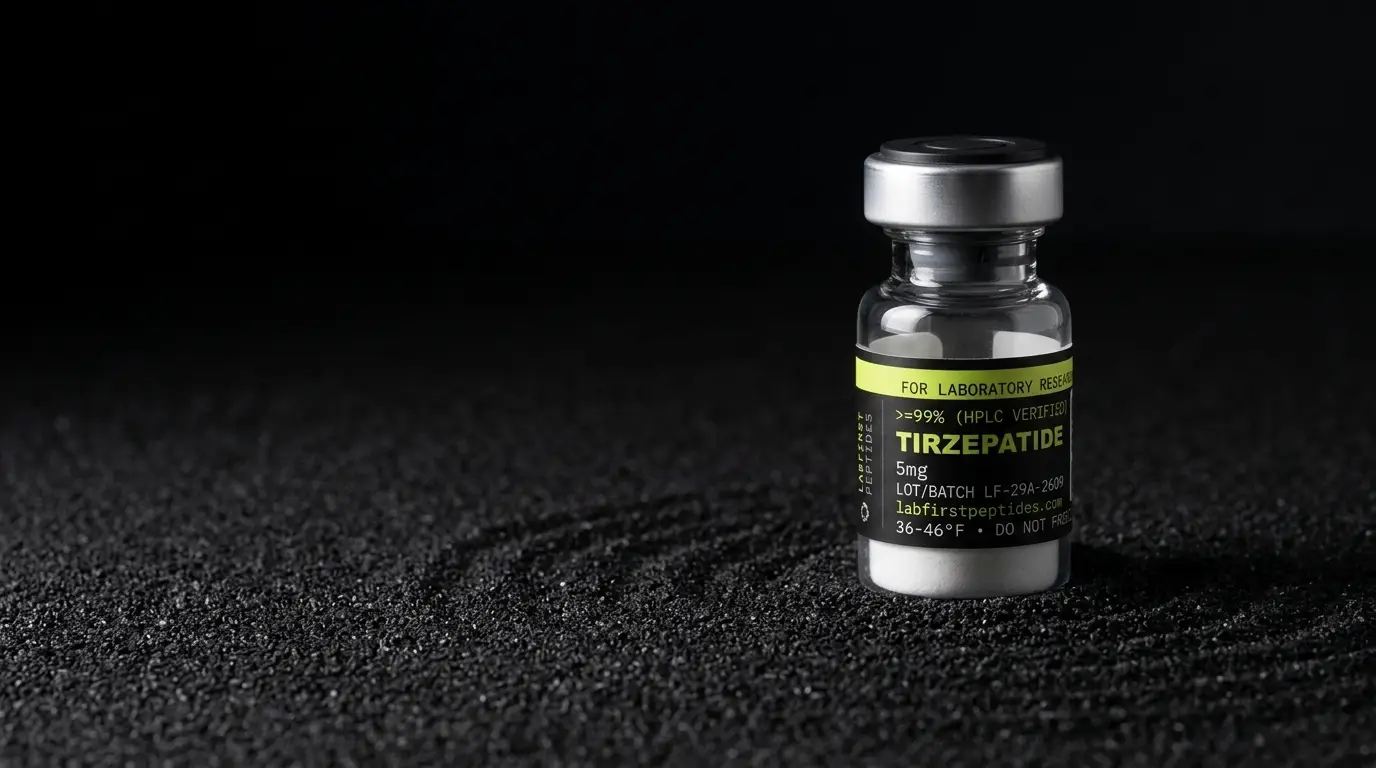
For tirzepatide storage and stability, keep the lyophilized powder dry, sealed, cold, dark and desiccated. Water is the variable that matters most. The largest avoidable loss usually happens in the thirty seconds a cold vial spends open in a humid room, long before any freezer setting becomes relevant.
- Storage figures published for approved tirzepatide medicines describe sterile aqueous solutions and do not transfer to a lyophilized research powder.
- Moisture, not freezer temperature, is the dominant degradation driver for a dry peptide.
- Letting a sealed vial reach room temperature before opening prevents the condensation uptake that is the most common avoidable handling error.
- Tirzepatide is a 39-residue linear peptide with Aib at positions 2 and 13 and a C20 fatty diacid on Lys20; the lipid chain makes it interface-active.
- Freeze-thaw damage to a prepared solution is cumulative, irreversible and not visible on inspection.
The storage advice you have read probably describes a different material
Think of it like a cold can taken out of the fridge on a summer day. Water beads on it within seconds. Open a cold vial in a humid room and the same thing happens to the powder inside.
Almost every storage figure circulating for tirzepatide traces back to the labeling for finished prescription medicines. Those products are sterile aqueous solutions, formulated with excipients, filled under pharmaceutical quality systems and assigned an expiry from stability studies run on that exact formulation. A vial of lyophilized powder is a different physical state with different failure modes, and the numbers do not transfer.
The distinction is not pedantry. A solution is already past the step that dry powder is protected from. Its degradation clock started at the fill line. Dry powder sits in a much slower regime until someone adds water, at which point it joins the same clock, without the excipients or the controls that a licensed formulation carries. Any page that quotes a refrigerated shelf life for a research powder is reading from the wrong document.
What follows is the chemistry that actually governs the powder in front of you, and where the honest limits of that knowledge sit.
- Moisture — the dominant driver, and the one condensation delivers
- Temperature — a rate modifier, not the mechanism
- Oxygen and light — oxidation of susceptible residues
- Interfaces and agitation — aggregation of a lipidated molecule
- Freeze-thaw — cumulative, irreversible, invisible
What degrades, and what drives it
Peptides fail along a small number of well-characterized routes. Which ones matter for a given sequence depends on the residues present and on how the material is held. The review literature on lyophilized protein and peptide instability is mature; Butreddy and colleagues cataloged the stresses and the mechanisms in a 2020 survey that remains a reasonable map of the territory.
| Route | What drives it | At risk | Practical control |
|---|---|---|---|
| Backbone hydrolysis | Water activity, temperature, pH once in solution | Any amide bond | Keep the solid dry and sealed against a desiccant |
| Deamidation | Water, temperature, pH above roughly 6 | Asparagine and glutamine side chains | Dry storage; cold; buffer choice once dissolved |
| Oxidation | Headspace oxygen, light, trace metal ions | Methionine, tryptophan, cysteine | Dark storage, cold, minimal headspace |
| Aggregation | Air-water interface, agitation, high concentration | Amphiphilic and lipid-conjugated molecules especially | Swirl rather than vortex; do not foam a solution |
| Surface adsorption | Contact with glass and some plastics | Lipidated peptides at low concentration | Container material chosen and documented per protocol |
Note what is absent from that list: freezer temperature by itself. Cold slows every one of these routes, which is why cold storage works, but temperature is a rate modifier rather than the mechanism. Moisture is the mechanism. A vial held at room temperature and genuinely dry will usually outlast a vial held at minus twenty and repeatedly exposed to humid air.
What tirzepatide's structure adds to the picture
Tirzepatide is a linear peptide of 39 residues with two features that bear directly on handling. It carries the non-coded residue α-aminoisobutyric acid at positions 2 and 13, and a C20 fatty diacid conjugated through a linker to the lysine at position 20. The C-terminus is amidated.
The lipid chain is the part worth thinking about. A fatty diacid conjugate makes the molecule amphiphilic, and amphiphilic molecules concentrate at interfaces. In practice that means the air-water boundary in a partly filled vial is a real site of loss, and vigorous mixing that whips air into a solution does more damage than the same energy applied as a gentle swirl. It also means adsorption to container surfaces is a plausible route for material to disappear at low concentrations, which is the sort of loss that shows up as an inexplicably weak result rather than as visible degradation.
The Aib substitutions were introduced to resist enzymatic cleavage. They are not a shield against chemical degradation, and treating peptidase resistance as general stability is a common mistake. Nothing in the sequence makes the material tolerant of water, heat or oxygen.
Storage conditions by physical state
| State | Temperature | Light | Relative horizon | Why |
|---|---|---|---|---|
| Sealed powder, unopened | Minus 20 °C or below, desiccated | Dark | Longest | Every degradation route is slowed and water is excluded |
| Sealed powder, working stock | 2 to 8 °C | Dark | Shorter than frozen | Adequate where the vial is used within a defined window |
| Powder in transit | Ambient | Dark, insulated | Days | Dry solid tolerates short excursions far better than solution |
| Prepared aqueous solution | 2 to 8 °C | Dark | Days, not months | Hydrolysis and deamidation are now running |
| Solution, single-use aliquots | Minus 20 °C or below | Dark | Longer, with a cost per thaw | Freeze-thaw cycling drives aggregation |
The horizons are deliberately relative. Assigning a specific number of months to a research powder would require stability data generated on that lot, in that container, under those conditions. Suppliers who publish a confident figure without that study behind it are quoting a convention, not a measurement. The lot's own certificate is the only document entitled to carry a date, and where it does not, the honest position is that the window is unestablished.
Condensation is the failure nobody records
Take a vial from a minus twenty freezer into a room at 22 °C and sixty percent relative humidity. The glass is far below the dew point. Water condenses on every cold surface it can reach, including the inside of the vial the moment the seal is broken, and a lyophilized cake is hygroscopic enough to take that water up immediately.
The material looks unchanged. Nothing about the appearance of a slightly damp cake announces itself, and the next person to open the vial has no way to know it happened. Then the vial goes back to the freezer with water now inside it, and the cycle repeats.
The control is unglamorous: let the sealed vial reach room temperature before the seal is broken, every time, without exceptions for being in a hurry. Twenty to thirty minutes on the bench is usually enough for a small vial. Work quickly once it is open, reseal against a desiccant, and log the excursion if your protocol tracks them.
Residual moisture is not simply a contaminant to drive to zero, incidentally. Work by Lo Presti and colleagues on lyophilizate formulations found that raising residual moisture from one percent to around two percent improved stability in the system they studied, through water's role in replacing hydrogen bonds the sugar matrix could not. That is a formulation finding rather than a storage instruction, and it is a good reminder that the intuitive rule of drier-is-always-better is an approximation.
Once it is in solution
Adding diluent starts a faster clock. Hydrolysis and deamidation need water and now have it, the amphiphilic character of the molecule has an interface to act on, and any microbial contamination introduced at preparation has a medium to grow in. This is the point at which storage stops being a passive question.
Two practices do most of the work. Split the solution into single-use aliquots at the moment of preparation, so that no container is thawed more than once. And date every aliquot, in a form that survives the freezer, at the time it is made rather than later.
Freeze-thaw is the cost people underestimate. Each cycle carries the solution through the concentration and interface changes that accompany ice formation, and aggregation is cumulative and irreversible. A solution thawed nine times is not the same material as a solution thawed once, and no visual inspection will separate them.
Worked example: aliquot arithmetic
A 10 mg vial brought into 2 mL of diluent gives a concentration of:
10 mg ÷ 2 mL = 5 mg/mL
Suppose each assay run takes 0.2 mL. From a single container that is:
2 mL ÷ 0.2 mL = 10 draws
Held as one container, the tenth draw comes from material that has been warmed and re-chilled nine times. Divided into ten 0.2 mL aliquots at preparation, each is thawed once. The work costs a few minutes and one rack of tubes, and it removes nine freeze-thaw cycles from the last sample in the series.
The vial concentration calculator handles the arithmetic for other vial sizes and diluent volumes, and the molarity calculator converts to molar terms where a protocol calls for it. Both cover laboratory measurement only.
What the record should say
Storage discipline that is not written down is not reproducible. At minimum the record for a prepared solution carries the source lot identifier, the diluent and its lot, the volume added, the resulting concentration, the date and time of preparation, and the initials of whoever made it. Aliquots inherit that record through a shared identifier.
The reason is practical rather than bureaucratic. When a result comes out wrong, the first question is whether the material was what the protocol assumed. A record that ties the sample back through the aliquot to the solution to the lot to the certificate answers that in a minute. A record that does not means repeating the work.
Regulatory position
Tirzepatide is a dual GIP and GLP-1 receptor agonist. FDA-approved medicines containing tirzepatide exist and are available only on prescription, manufactured under pharmaceutical quality systems that a research-chemical supply chain does not replicate.
The FDA declared the tirzepatide injection shortage resolved on 19 December 2024. With the shortage over, the agency's temporary enforcement discretion for compounded tirzepatide ended on 19 February 2025 for 503A compounding pharmacies and 19 March 2025 for 503B outsourcing facilities. Research-grade material has never been a lawful route to human use at any point in that timeline.
Status verified 25 August 2026.
FOR LABORATORY AND IN-VITRO RESEARCH USE ONLY. NOT FOR HUMAN OR ANIMAL CONSUMPTION. NOT FOR PERSONAL, MEDICAL, DIAGNOSTIC, THERAPEUTIC, OR RECREATIONAL USE.
What is Tirzepatide studied for?
Published research on Tirzepatide investigates the areas below, which is a different question from what Tirzepatide will do for anyone, a claim about a living system that nothing on this site is sold for.
What it is. A peptide that works on the GIP and GLP-1 receptors at the same time.
What the research looks at. There is a large published clinical record: how it behaves at the receptors, how the body handles it, and the measurements its sponsor registered its trials to take. Approved medicines containing it exist under their own brand names.
How it is thought to work. It switches on both the GIP receptor and the GLP-1 receptor. Working on two rather than one is the design feature that separates it from the GLP-1-only drugs.
What is not established. What is sold here is a research chemical, not a drug product. Listing it is not an approval, and not a claim that it is equivalent to, as safe as, or a fit substitute for any approved medicine.
The full record, including the certificate for the lot in stock, is on the Tirzepatide product page.
Common questions
Does lyophilized tirzepatide have to be frozen?
What should I do if a vial arrives warm?
How long is a prepared solution usable?
Does light exposure actually matter for a dry powder?
Can a thawed solution be refrozen?
Is research-grade material the same as the prescription medicine?
Published certificates for Tirzepatide
Every figure below is read from a report the laboratory issued for that lot; each page carries the PDF and the lab's own verification link.
Related guides: storage and stability
Sources
- Butreddy et al., International Journal of Biological Macromolecules, 2020. Review of stresses, stabilization mechanisms and analytical techniques for lyophilized protein therapeutics; supports the degradation-route table and the primacy of solid-state storage.
- Lo Presti et al., Molecular Pharmaceutics, 2025. Residual moisture and sugar size in lyophilizates; supports the finding that raising residual moisture from 1% toward 2% improved stability in the system studied.
- FDA drug shortage determination for tirzepatide injection, 19 December 2024. Supports the shortage-resolution date and the subsequent 19 February and 19 March 2025 compounding discretion end dates.