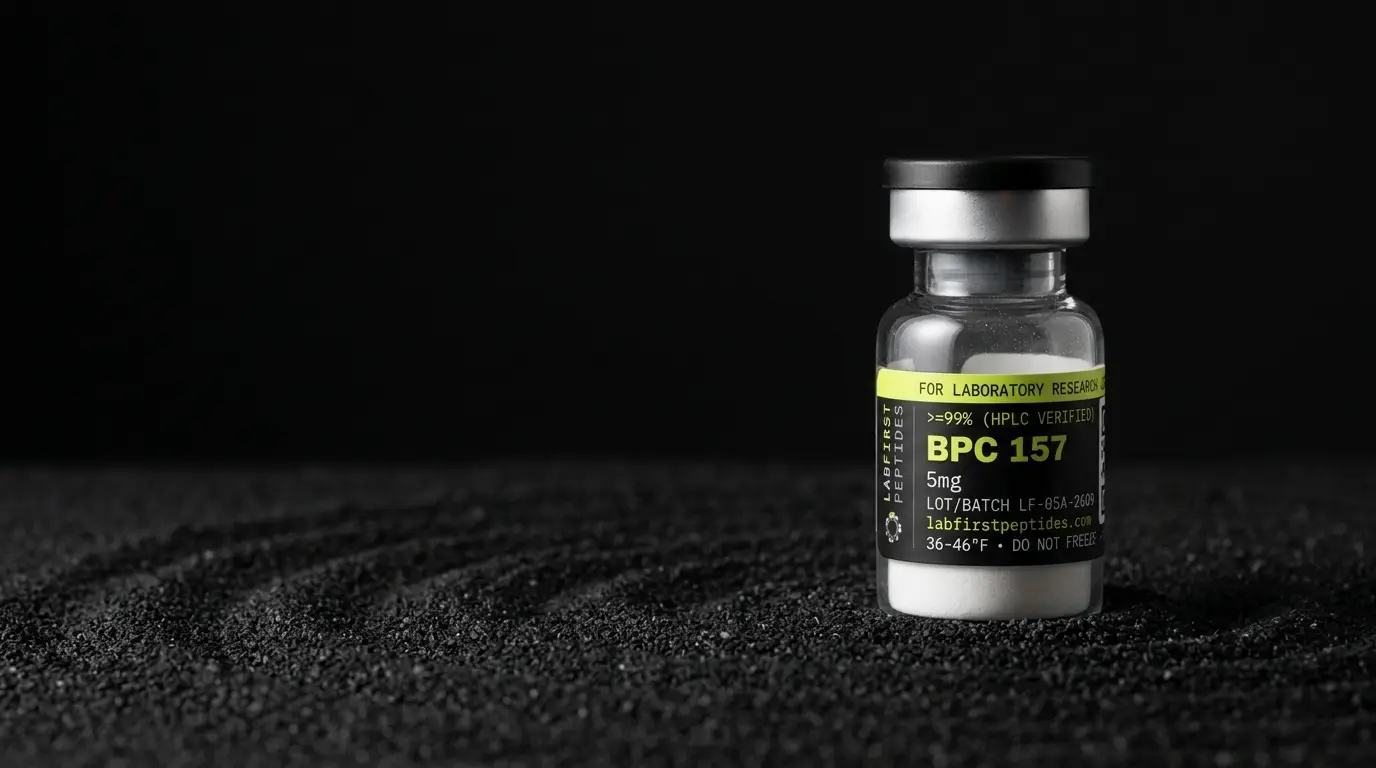
For BPC 157 storage and stability, the dry powder lasts best sealed, dry, dark and cold. Its sequence lacks the residues that drive oxidation and deamidation. So moisture and pH-dependent aspartate chemistry matter most. Once dissolved in unbuffered water, the material lasts days, not months.
- BPC 157 is a 15-residue synthetic peptide, Gly-Glu-Pro-Pro-Pro-Gly-Lys-Pro-Ala-Asp-Asp-Ala-Gly-Leu-Val, with a mass near 1419 Da.
- The sequence contains no Cys, Met, Trp, Asn or Gln, so oxidation and classical deamidation are largely unavailable routes.
- Aspartate residues at positions 10 and 11 make hydrolysis and isoaspartate formation the pH-sensitive routes that remain.
- Moisture, not freezer setting, is the dominant driver of solid-state loss; equilibrate sealed vials to room temperature before opening.
- No aromatic residues means RP-HPLC purity is read near 214 to 220 nm, never at 280 nm.
- BPC 157 has no marketing authorisation as a medicine and sits in FDA Category 2 of the 503A bulk drug substances review.
The sequence sets the limits
BPC 157 is a synthetic pentadecapeptide with the sequence Gly-Glu-Pro-Pro-Pro-Gly-Lys-Pro-Ala-Asp-Asp-Ala-Gly-Leu-Val, molecular formula C62H98N16O22, and a mass near 1419 Da. The name is short for body protection compound, a protein described in human gastric juice; the peptide corresponds to a partial sequence of that protein and is produced by solid-phase synthesis rather than isolated from anything. Some laboratory material is supplied as an arginate salt, which dissolves more readily than the free peptide. That is a different substance on the label and should be recorded as such.
Three features of the sequence decide how the material behaves on a bench. There is no cysteine, no methionine and no tryptophan, so the oxidation routes that dominate most peptide stability discussions have almost nothing to act on here. There is no asparagine and no glutamine, so classical deamidation is off the table too. What is present is a pair of adjacent aspartate residues at positions 10 and 11, and aspartate chemistry is slow, pH sensitive and entirely real.
A fourth feature matters for analysis rather than storage. The sequence carries no aromatic residues, so nothing in it absorbs usefully at 280 nm. RP-HPLC assays for this peptide read the backbone amide in the 214 to 220 nm region, which makes the method more sensitive to mobile-phase and solvent absorbance than a tryptophan-containing peptide would be. If a certificate of analysis reports purity by peak area at 280 nm, someone has filled in a template without looking at the molecule.
- Moisture uptake by the cake — the dominant solid-state driver
- Backbone hydrolysis near Asp10 and Asp11 — pH dependent, faster in solution
- Isoaspartate formation via succinimide — slow, favored at neutral to alkaline pH
- Oxidation — minor here; no Cys, Met or Trp to attack
- Deamidation — unavailable; no Asn or Gln in the sequence
Which degradation routes actually apply
Generic peptide stability advice assumes a molecule with oxidisable side chains and at least one amide-bearing residue. Apply that list to BPC 157 and most of it drops away. The routes that remain are fewer, which is helpful, because it narrows what storage conditions are protecting against.
| Route | Relevance here | What drives it | Practical control |
|---|---|---|---|
| Backbone hydrolysis | Applies to any amide bond; aspartate residues accelerate cleavage of neighbouring bonds under acidic conditions | Water activity, temperature, pH in solution | Keep the solid dry and sealed against desiccant; control pH once dissolved |
| Aspartate isomerisation to isoaspartate | Plausible at Asp10 and Asp11 via the succinimide intermediate | Neutral to mildly alkaline pH, temperature, water | Dry storage; avoid alkaline diluents; cold solutions |
| Deamidation | Not available; no Asn or Gln in the sequence | — | No control needed |
| Oxidation | Minor; no Cys, Met or Trp. Trace-metal-catalysed damage at lysine or the backbone is possible but slow | Headspace oxygen, light, metal ions | Dark storage, minimal headspace |
| N-terminal cyclisation (diketopiperazine) | Reported for peptides with proline close to the N-terminus; the Gly-Glu-Pro start makes it worth watching, though I have not seen it characterized for this sequence specifically | Temperature, moisture, pH | Cold, dry, sealed; look for a small early-eluting impurity by LC-MS |
| Aggregation and adsorption | Low aggregation propensity; the peptide is short, hydrophilic and unstructured. Surface adsorption at very low concentration is the real version of this problem | Container material, dilute solutions | Choose and document container material; avoid needlessly dilute working stocks |
| Microbial growth | Solution only | Non-sterile technique, warm storage | Preserved diluent, refrigeration, single-use aliquots |
Notice that freezer temperature is not itself a mechanism. Cold slows every route in the table, which is why cold storage works, but it is a rate modifier. Water is the mechanism. A sealed, genuinely dry vial on a shelf at 20 °C will normally outlast a vial that lives at minus twenty and gets opened cold once a week.
Conditions by physical state
| State | Temperature | Light | Relative horizon | Why |
|---|---|---|---|---|
| Sealed powder, unopened | Minus 20 °C or below, desiccated | Dark | Longest | Water excluded, every route slowed |
| Sealed powder, opened working stock | 2 to 8 °C, desiccated | Dark | Shorter than frozen | Acceptable where the vial is consumed inside a defined window and opened warm |
| Powder in transit | Ambient | Dark, insulated | Days | Dry solid tolerates short excursions; this is why material ships lyophilized |
| Prepared aqueous solution | 2 to 8 °C | Dark | Days | Hydrolysis and aspartate chemistry are now running at solution rates |
| Solution, single-use aliquots | Minus 20 °C or below | Dark | Longer, at a cost per thaw | Extends the window without repeated warm handling of one container |
The horizons stay relative on purpose. A specific shelf life is a claim that requires stability data generated on that lot, in that container closure, under those conditions, on a schedule of the kind ICH Q1A(R2) describes. No such study exists for most research-grade material. Where a supplier prints twenty-four months on a research powder without a study behind it, that is a convention borrowed from somewhere else. The lot certificate is the only document with standing to carry a date, and if it does not, the honest position is that the window is unestablished.
How do you store BPC-157?
Sealed and frozen for the lyophilized powder, refrigerated once it is in solution, and dark in both states. That is the short answer, and the rest of this page is the reasoning behind it.
The powder is the stable form. Freeze-dried peptide held below freezing in its unopened vial, away from light and moisture, is the condition every retest date on a certificate assumes. Refrigeration rather than freezing is acceptable for shorter periods and is the usual compromise for a vial in regular use.
Two habits do more damage than temperature. Letting a cold vial warm in room air draws condensation onto the powder, and repeated freeze-thaw cycles stress the material more than a single longer period at a slightly higher temperature. Both are handling faults rather than storage faults, and neither appears on any document.
Does BPC-157 need to be refrigerated?
In solution, yes. As a sealed lyophilized powder, refrigeration is the minimum and freezing is better.
The distinction matters because the two physical states behave differently. Freeze-dried powder has had the water removed, and water is what most degradation routes need, so the dry form tolerates conditions the wet form does not. Once a solution exists the clock runs faster, and cold slows it rather than stopping it.
What refrigeration cannot do is repair a vial that has already been mishandled, and it is no substitute for a certificate. A lot with no analytical record is not made trustworthy by being kept cold.
Condensation is the loss nobody writes down
Take a vial from a minus twenty freezer into a room at 22 °C and sixty percent relative humidity. The glass is well below the dew point. Water condenses on every cold surface it can reach, and the instant the seal is broken that includes the inside of the vial and the cake itself. A lyophilized peptide cake is porous and hygroscopic; it takes up that water immediately and without any visible sign.
The vial then goes back into the freezer with water inside it, and the next person to open it inherits a slightly wetter cake than the one on the certificate. Repeat that ten times over a few months and the difference is no longer trivial, though nothing in the appearance of the material announces it.
The control is dull and works. Let the sealed vial equilibrate to room temperature before breaking the seal, every time, including when you are in a hurry. Twenty to thirty minutes on the bench suits a small vial; put a timer on it rather than guessing. Work quickly once open, reseal against fresh desiccant, and log the excursion if your protocol tracks them.
One caveat on the drier-is-better instinct. The lyophilization literature has repeatedly found that residual moisture interacts with the excipient matrix rather than acting as a simple poison, and in some formulations a small amount of retained water stabilizes rather than degrades. That is a formulation result, not a storage instruction, and it does not license leaving vials open. It does mean the goal is a controlled, documented moisture level rather than zero.
Once it is in solution
Adding diluent starts a faster clock. Hydrolysis now has abundant water, aspartate isomerisation has a mobile environment, and anything introduced during preparation has a medium to grow in. Most of what follows is decided in the first two minutes of preparation rather than by the storage temperature afterwards.
Diluent choice deserves more thought than it usually gets. Unbuffered water gives a solution whose pH is set by the peptide itself and by whatever the glass and the atmosphere contribute; with one glutamate, two aspartates and one lysine in the sequence, that pH is neither predictable nor stable across dilutions. Since both hydrolysis and the succinimide route are pH dependent, a buffered diluent at a defined and recorded pH removes a variable that unbuffered water leaves floating. Where a preserved diluent is called for, bacteriostatic water contributes benzyl alcohol at around 0.9 percent, which is a co-solvent with its own effects on chromatography and on any downstream assay. Record it as part of the matrix, not as an afterthought.
Mixing technique matters less for this peptide than for a lipidated one. BPC 157 is not surface-active in the way a fatty-acid conjugate is, so the interfacial aggregation risk is lower. Even so, there is no reason to whip air into a vial. Add diluent down the vial wall, swirl gently, and give the cake time to dissolve rather than forcing it.
Then split the solution into single-use aliquots at the moment of preparation. Freeze-thaw damage accumulates and does not reverse, and no visual inspection separates a solution on its first thaw from one on its sixth.
Worked example: concentration and aliquot arithmetic
A 5 mg vial brought into 2 mL of diluent gives:
5 mg ÷ 2 mL = 2.5 mg/mL
If each assay run takes 0.2 mL, a single container supplies:
2 mL ÷ 0.2 mL = 10 draws
Held as one container, the tenth draw comes from material that has been warmed and re-chilled nine times. Divided into ten 0.2 mL aliquots at preparation, every draw is a first thaw. The cost is a rack of tubes and five minutes of labeling.
Expressed in molar terms, a 2.5 mg/mL solution of a peptide near 1419 g/mol is roughly 1.76 mmol/L. That conversion is worth doing on paper once, because assay concentrations are usually specified molar and mass-based errors of an order of magnitude are easy to make and hard to spot afterwards. The vial concentration calculator handles other vial sizes and diluent volumes. It covers laboratory measurement only.
What the record should say
Storage discipline that is not written down is not reproducible. For a prepared solution, the minimum record carries the source lot identifier, the salt form, the diluent and its lot, the volume added, the resulting concentration in both mass and molar terms, the pH if buffered, the preparation date and time, and the initials of whoever did it. Aliquots inherit all of that through one shared identifier written on each tube in something that survives a freezer.
The reason is practical. When a result comes out strange, the first question is whether the material was what the protocol assumed. A record that traces the sample through the aliquot to the solution to the lot to the certificate answers that in about a minute. A record that does not means repeating the experiment.
On the certificate itself: for BPC 157, look for identity by mass spectrometry with the observed mass matching the expected monoisotopic or average mass, purity by RP-HPLC with the detection wavelength stated, the peptide content or net peptide figure as distinct from chromatographic purity, and the counterion. Synthetic peptides purified by preparative RP-HPLC commonly carry trifluoroacetate, which can be a substantial fraction of the vial mass and will shift your real concentration if you assume the label mass is all peptide. Our quality standard sets out what we expect a lot document to contain.
What is the shelf life of BPC-157?
A research vial carries a retest date rather than a shelf life, and the two are not the same claim. A retest date marks the point where the supplier stops asserting the result without measuring again. It is the edge of the evidence, not a cliff the material falls off.
That date is conditional on the storage conditions printed beside it. A vial held outside those conditions is no longer described by its own date, and nothing about it looks different.
A pharmaceutical expiry is a stronger claim, made under manufacturing rules that research-grade material is not made under. Treating one as the other is the most common misreading of a research certificate.
Regulatory position
BPC 157 has no marketing authorisation as a drug in the United States or the European Union. In 2023 the FDA placed BPC 157 in Category 2 of its review of bulk drug substances nominated for use in compounding under section 503A, the category for substances that raise significant safety risks. The World Anti-Doping Agency lists BPC 157 by name under S0, non-approved substances, on its Prohibited List, with effect from the 2022 list onward.
Research-grade material is supplied against a certificate of analysis covering identity and purity. That is a narrower claim than pharmaceutical release, and it has never been a lawful route to human use.
Status verified 26 August 2026.
FOR LABORATORY AND IN-VITRO RESEARCH USE ONLY. NOT FOR HUMAN OR ANIMAL CONSUMPTION. NOT FOR PERSONAL, MEDICAL, DIAGNOSTIC, THERAPEUTIC, OR RECREATIONAL USE.
For the compound record, formula, mass and current lot documentation, see the BPC 157 product record.
What is BPC 157 studied for?
Published research on BPC 157 investigates the areas below, which is a different question from what BPC 157 will do for anyone, a claim about a living system that nothing on this site is sold for.
What it is. A man-made fifteen-amino-acid peptide, based on a protein found in stomach juice.
What the research looks at. It appears in animal and cell-culture research on tissue and blood-vessel biology. Almost everything published is animal or cell work.
How it is thought to work. Nobody has settled how it works. Cell and animal studies report effects on blood-vessel growth signals and on several growth-factor pathways, but no single receptor has been pinned down as its target and the studies do not agree on one model.
What is not established. No FDA-approved product contains BPC 157, and no USP or NF standard defines what an acceptable batch is. Human evidence is close to nonexistent. Any figure printed on a research vial is the supplier’s number, not an official one.
The full record, including the certificate for the lot in stock, is on the BPC 157 product page.
Common questions
Does lyophilized BPC 157 have to be kept frozen?
Is BPC 157 more stable than other research peptides?
How long does a prepared solution last?
Which diluent should be recorded for a BPC 157 solution?
Why does a certificate of analysis for BPC 157 report purity at 214 nm rather than 280 nm?
Does the trifluoroacetate counterion affect storage?
How long does lyophilized BPC 157 last?
Does BPC 157 expire?
Is the date on a research vial the same kind of claim as a pharmaceutical expiry?
Does lyophilized BPC 157 need a freezer?
Can a BPC 157 solution be refrozen after thawing?
Why does the certificate show less than 10 mg of peptide in a 10 mg vial?
Published certificates for BPC 157
Every figure below is read from a report the laboratory issued for that lot; each page carries the PDF and the lab's own verification link.
Related guides: storage and stability
Sources
- PubChem compound record for BPC 157 (National Library of Medicine). Establishes the 15-residue sequence, molecular formula and mass used throughout, and the absence of cysteine, methionine, tryptophan, asparagine and glutamine.
- ICH Q1A(R2), Stability Testing of New Drug Substances and Products. Defines what evidence a shelf-life claim requires; supports the position that undocumented month figures on research powders are conventions rather than measurements.
- Manning, Chalmers and Randolph, Pharmaceutical Research, 2010 review on stability of protein pharmaceuticals. General authority for the degradation-route framework, including aspartate isomerisation via the succinimide intermediate and the role of water activity in solid-state stability.
- FDA evaluation of bulk drug substances nominated for use in compounding under section 503A (2023 determinations). Supports placement of BPC 157 in Category 2, substances raising significant safety risks, and the absence of any approved product.