Store lyophilized peptides sealed, desiccated, dark, and cold: minus twenty Celsius or below for archive stock, two to eight for a working vial in active rotation. Keep water out above all else, let a cold vial reach room temperature before opening it, and date every event on the label.
- A lyophilized peptide stores well because its amorphous matrix is rigid below the glass transition temperature; absorbed moisture lowers that temperature and restarts the chemistry.
- Moisture does more damage than freezer choice: a sealed desiccated vial at 2 to 8 °C beats one at minus twenty that is opened cold every week.
- Frost-free freezers cycle warm during automatic defrost, so long-term stock belongs in a manual-defrost or laboratory unit, boxed, at the back of a shelf.
- A cold vial must reach room temperature before its seal is broken, or condensation delivers water straight onto the hygroscopic cake.
- No shelf-life figure attaches to a research lot without a stability study on that lot, so the laboratory's own storage record is usually the only stability document the material has.
- Dissolution ends the slow regime: dating, aliquoting and the solution clock start the moment diluent goes in.
What freeze-drying leaves in the vial
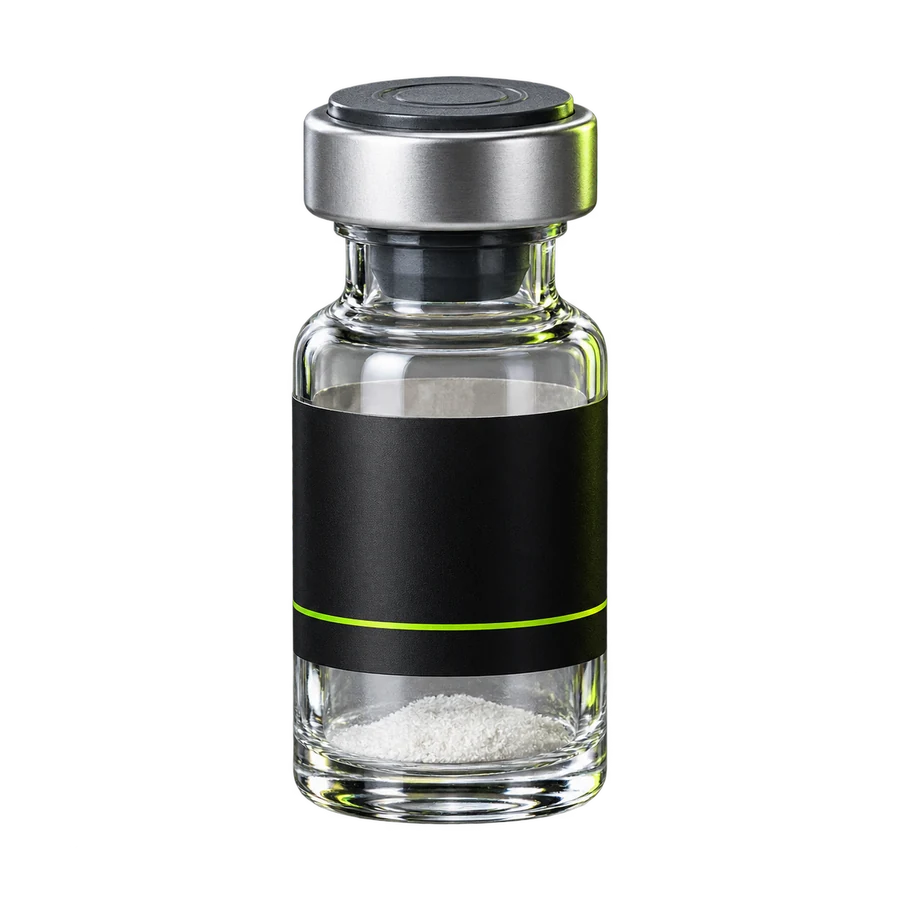
A lyophilized peptide has been frozen and then dried by sublimation, the ice drawn off under vacuum so the water leaves without ever passing through liquid again. What remains is an amorphous solid, usually a small white cake or a loose fine powder, sometimes formulated with a bulking agent such as mannitol or trehalose and sometimes nothing except the peptide itself. Residual moisture is typically in the low single digits by weight, and a certificate of analysis worth the name states the figure, measured by Karl Fischer titration.
The reason this state stores well is molecular mobility, or rather the lack of it. Below its glass transition temperature the amorphous matrix is rigid, diffusion nearly stops, and the reactions that consume a dissolved peptide slow to a crawl. Storage practice for a lyophilizate is one job described five different ways: hold the material below that transition and keep water away from it. Water counts against the vial twice, because it feeds hydrolysis directly and because absorbed moisture plasticises the glass, lowering the transition temperature until a cake that was stable at freezer temperature no longer is. This is also why compounds ship as powder rather than as solution: the supplier is shipping the slow regime.
A slumped, shrunken or glassy cake is what that failure looks like after the fact. By the time collapse is visible, the storage question has already been answered badly.
- Inspect closure and cake at arrival; log lot, date, condition
- Cross-check the lot against its certificate before filing
- File boxed, desiccated and dark; back of the freezer, never the door
- Warm sealed to room temperature before every opening
- On dissolution: record diluent, volume, concentration, date, initials
The variables a storage protocol controls
Solid-state peptide degradation runs on a short list of drivers, and the review literature on lyophilized protein instability maps them well. Each has a control that costs almost nothing, and each control produces something a record can capture.
| Variable | What it drives | Control | What the record shows |
|---|---|---|---|
| Moisture | Hydrolysis and deamidation; plasticises the cake | Sealed vial, desiccant in the storage box, equilibrate before opening | Desiccant change dates, opening log |
| Temperature | The rate of every route at once | Minus 20 °C or below for archive stock; 2 to 8 °C for a working vial | Freezer location, excursion log |
| Light | Oxidation of methionine, tryptophan and cysteine residues | Amber glass or an opaque secondary box | Container type noted at receipt |
| Oxygen | Oxidation, jointly with light and trace metals | Minimal headspace, sound closure, minimal time open | Closure condition at each opening |
| Warm cycling | Collapse if the cake passes its glass transition; condensation on re-entry | Steady frozen storage; no casual freezer exits | Excursion log |
Ranking matters. Temperature gets the attention because freezers have dials, and moisture does the damage because nothing about a slightly damp cake announces itself. A vial held sealed and desiccated at 2 to 8 °C is in better shape than one stored at minus twenty and opened cold once a week. The same hierarchy is worked through for a specific lipidated compound in the tirzepatide guide, where interfaces add a further variable once the material is in solution.
Choosing a temperature tier
Three tiers cover nearly every situation. Archive stock, meaning sealed vials that will not be touched for months, belongs at minus 20 °C or below, boxed and desiccated. A working vial in active rotation can live at 2 to 8 °C, where it escapes the condensation risk of repeated freezer exits. Transit is its own tier: a dry solid tolerates ambient days in a way no solution does, which is why a warm arrival is a note in the record rather than an automatic loss. Minus eighty, common in institutional settings, is fine as well, with the caveat that a colder vial needs longer on the bench before it can be opened safely.
Two details about the freezer itself earn their space here. Frost-free domestic units hold their setpoint by cycling above it during automatic defrost, several times a day in some models, so a vial stored in one rides a slow temperature wave the display never shows. A manual-defrost or laboratory freezer avoids the cycling entirely. And position matters inside any unit: the door shelf swings warmest with every opening, so peptide boxes go at the back of a shelf, not in the door.
Sharing a freezer with routine kitchen-grade traffic is the quieter version of the same problem, because every opening is a warm-air event. A dedicated box, labeled and mapped, at the back of the least-visited freezer is the cheap version of a controlled storage unit, and it works.
Opening a cold vial
The most common avoidable handling error is condensation uptake. A vial leaves the freezer, the seal comes off while the glass is still below the dew point, room air delivers water straight onto a hygroscopic cake, and the vial goes back into storage wetter than it left. The material looks unchanged. Nothing in the record shows it happened, and the next person to open the vial inherits the moisture without the history.
The control is patience. Let the sealed vial stand at room temperature until the glass is no longer cold, twenty to thirty minutes for a small vial, before the closure is disturbed. Work with it promptly once open, reseal it, and return it to a box with active desiccant. Where a protocol tracks excursions, the time out of storage is the entry.
The physics behind this, and what repeated condensation cycles do to a cake over months, is covered at greater length in the storage and stability guide. The short version is that the freezer cannot protect a vial from what happens to it on the bench.
Judging a vial at arrival
Storage begins at the door, and the first ten minutes decide how much the record is later worth. Check the closure first: an intact crimp and an undisturbed septum are the integrity argument for everything that follows, and a vial with a damaged closure is set aside whatever the contents look like. Then look at the cake. An intact lyophilizate is a coherent plug or a uniform fine powder. Slumping, glassiness, a ring of material fused to the vial wall, or visible droplets are signs of melt-back or a moisture history, and they belong in the receiving note with a photograph taken before anything is moved.
Log the arrival: date, lot number, condition, and the storage location the vial went to. Cross-check the lot against its certificate of analysis before the vial disappears into the freezer, because a certificate mismatch is far easier to raise with a supplier the week the box arrives than a month later. What a shipment should contain and how transit conditions are handled is covered on the shipping page; the storage record simply picks up where the courier's custody ends.
The day water goes in
Dissolution ends the slow regime. The arithmetic itself is one line: a 10 mg vial brought into 2 mL of diluent gives
10 mg ÷ 2 mL = 5 mg/mL
and a 5 mg vial brought into 1 mL lands at the same concentration in half the volume. The vial concentration calculator handles other vial sizes and volumes. What changes at that moment is the clock. Hydrolysis and deamidation now have the water they need, any organism introduced at preparation has a medium, and every storage decision from here runs on days rather than months.
Two solution-side practices carry most of the weight. The choice of diluent decides whether the container can defensibly be entered more than once, a question the bacteriostatic water guide exists to answer. And splitting the solution into single-use aliquots at preparation, each dated as it is made, removes freeze-thaw cycling from every sample after the first. The dry vial's storage record closes with a dissolution entry: date, diluent and its lot, volume added, resulting concentration, initials.
Do peptides need to be refrigerated?
In solution, yes. As sealed lyophilized powder, refrigeration is the minimum and freezing is better for anything held more than a few weeks.
The physical state decides it. Freeze-drying removes the water that most degradation routes require, so a dry sealed powder tolerates conditions a solution does not. Once a peptide is dissolved, cold slows the chemistry without stopping it, and the useful period is measured in weeks rather than years.
The question gets asked so often because the answer sounds like it should be one word. It is not. The same compound has two different answers depending on whether it is wet or dry, and most disagreement about peptide storage is really two people describing different states.
What the storage record contains
None of the above is reproducible unless it is written down, and the record is short enough that there is no excuse. For each vial: lot number, date received, receiving condition, storage location, date first opened, and every excursion the protocol tracks. For the storage unit: a freezer map naming which box holds what, and desiccant change dates. Labels are written in freezer-proof marker at the time of the event, never reconstructed later from memory. An undated vial is treated as unusable at any age, which is the rule that makes all the other entries happen.
The habit pays for itself the first time a result comes out wrong. A complete record answers in a minute whether the material was held as the protocol assumed; an incomplete one converts a storage question into repeated work. No shelf-life figure attaches to a research lot unless a stability study was run on that lot under stated conditions, so the record of how a vial was actually kept is usually the only stability document the material will ever have. Suppliers hold up their end of the same chain with lot-level documentation, which is what the quality standard describes.
FOR LABORATORY AND IN-VITRO RESEARCH USE ONLY. NOT FOR HUMAN OR ANIMAL CONSUMPTION. NOT FOR PERSONAL, MEDICAL, DIAGNOSTIC, THERAPEUTIC, OR RECREATIONAL USE.
Common questions
Do lyophilized peptides need to be frozen?
How long can a lyophilized peptide sit at room temperature?
Does a frost-free freezer damage stored peptides?
How can you tell whether a stored vial has degraded?
Should vials be stored under nitrogen or vacuum?
Do lyophilized peptides go bad if left at room temperature?
Fridge or freezer for peptide storage?
My order arrived without cold packs. Is that a problem?
How long does a prepared peptide solution keep in the refrigerator?
Does the refrigerator door shelf count as 2 to 8 °C?
Does a sealed lyophilized peptide have to go in the fridge?
Is a freezer better than a refrigerator for peptide powder?
Related guides: storage and stability
Sources
- Wang, W. Lyophilization and development of solid protein pharmaceuticals. International Journal of Pharmaceutics 203(1-2):1-60 . Primary basis for this article: a book-length review of lyophilization stresses, excipient protection, and the instability routes of solid peptide and protein preparations.
- ICH Q1A(R2), the stability-testing guideline in its current adopted revision, Stability Testing of New Drug Substances and Products. Defines the controlled storage-condition regimes under which stability claims are generated, and the reason an unstudied research lot carries no shelf-life figure.
- Wang, W. Lyophilization and development of solid protein pharmaceuticals. International Journal of Pharmaceutics 203(1-2):1-60 . Basis for the glass-transition and moisture discussion — the same review covers collapse temperature and the plasticising effect of residual water on a lyophilized cake.