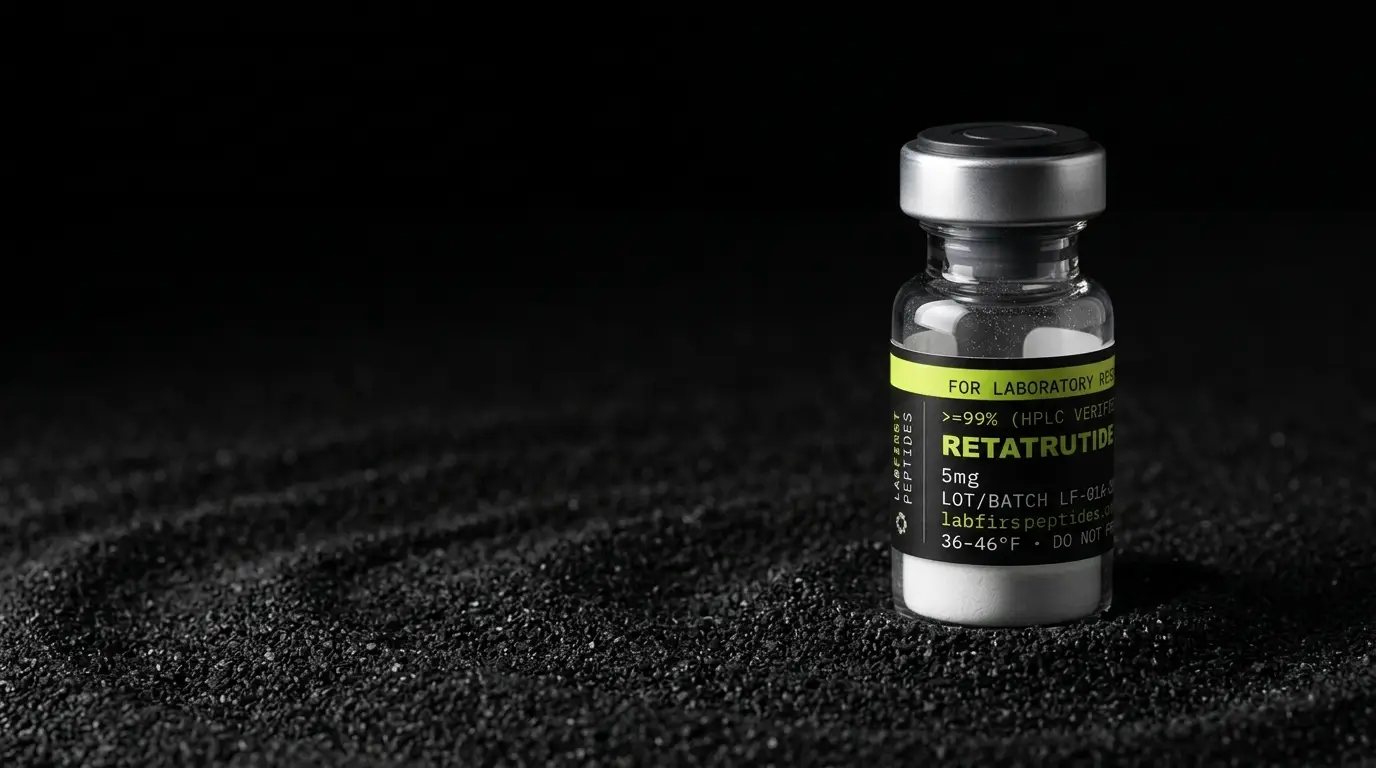
For retatrutide storage and stability, keep the lyophilized powder sealed, dry, cold and dark. Moisture is the variable that matters most. No approved product label exists to borrow figures from, so lot-specific supplier stability data is the only dated authority. Once a solution is prepared, a faster degradation clock starts, and single-use aliquots become the sensible default.
- No approved medicine containing retatrutide exists, so no labeled shelf life or compendial storage figure exists either.
- Water drives most degradation routes in a lyophilized peptide; temperature mainly sets the rate.
- Letting a sealed vial reach room temperature before opening prevents condensation uptake, the most common avoidable handling error.
- Retatrutide's C20 fatty diacid makes it interface-active, so agitation, foam and partly filled containers are real sites of loss.
- Freeze-thaw damage to a prepared solution accumulates invisibly, which is what single-use aliquots exist to prevent.
- Retatrutide is in phase 3 development under the TRIUMPH program and remains investigational as of 25 August 2026.
What this guide covers
This guide covers what breaks down a stored retatrutide vial, how to hold it in each physical state, and the record that makes a stored vial mean something months later. In plain terms, freeze-dried powder is like instant coffee in a sealed jar. Kept dry, it holds up for a long time, but let damp air in and it starts to clump and change. Mixing it into a liquid starts a much shorter clock.
Storage guidance for most incretin-family peptides gets cribbed from the labeling of an approved medicine. Retatrutide does not offer that shortcut. There is no approved product anywhere, no package insert, no compendial monograph, and no published expiry study on a licensed formulation. Every dated figure attached to research-grade retatrutide comes from a supplier's own stability program or from convention, and the two are worth telling apart before either is trusted. A confident shelf life quoted with no study behind it is a marketing number.
That leaves two honest anchors. The first is the general chemistry of lyophilized peptides, which is well mapped and applies to this molecule the way it applies to any other. The second is lot-specific documentation: a certificate of analysis with a manufacture date, and whatever real-time or accelerated stability data the supplier can actually produce for the lot in hand. The retatrutide product record is where that paperwork should live for material bought here.
- An intact seal and a desiccant — water excluded is the whole game
- Cold and dark — rate control on every degradation route
- Room-temperature equilibration before opening — no condensation uptake
- Single-use aliquots once dissolved — one thaw per container
- A date on every container — undated means discarded
What degrades a lyophilized peptide?
Peptide degradation runs along a short list of routes, and which ones matter for a given molecule depends on the residues present and the conditions around them. The review literature on instability in lyophilized peptides and proteins is mature enough to treat as settled ground, and it supports a compact map.
| Route | What drives it | At risk | Practical control |
|---|---|---|---|
| Backbone hydrolysis | Water activity; temperature and pH once dissolved | Any amide bond | Keep the solid dry and sealed against a desiccant |
| Deamidation | Water and temperature; pH once in solution | Asparagine and glutamine residues | Dry storage; cold, briefly held solutions |
| Oxidation | Headspace oxygen, light, trace metal ions | Tryptophan, methionine, cysteine where present | Dark storage, minimal headspace, cold |
| Aggregation | Air-water interface, agitation, freeze-thaw | Amphiphilic and lipidated molecules especially | Swirl, never shake; no foaming; one thaw per container |
| Surface adsorption | Container walls at low concentration | Lipidated peptides | Record the container material; avoid serial transfers |
Temperature is deliberately absent as a route of its own. Cold slows all five, which is why freezers earn their keep, but the mechanism in almost every practical failure is water. A dry vial at room temperature will generally outlast a frozen vial that gets opened cold and damp every week, which is the single most counterintuitive fact in peptide storage and the one this page keeps returning to.
What does retatrutide's structure add?
Retatrutide, developed under the code LY3437943, is an investigational single-chain peptide engineered from the GIP sequence to act at three receptors: GIP, GLP-1 and glucagon. The discovery characterization describes non-coded α-aminoisobutyric acid residues placed in the backbone to resist enzymatic cleavage, a C20 fatty diacid attached through a linker to a lysine side chain, and an amidated C-terminus. The full substitution map is in the primary paper. The feature that matters at the bench is the lipid.
A fatty diacid makes the molecule amphiphilic, and amphiphilic peptides collect at interfaces. The air-water boundary in a partly filled vial is a real site of loss. So is the container wall at low concentration, where adsorption shows up not as visible change but as an unexplained shortfall in a downstream assay. Both losses scale with agitation, which is why the standing instruction for lipidated peptides is a gentle swirl and never a shake.
Enzyme resistance is sometimes read as general toughness. It is nothing of the kind. The Aib substitutions address peptidases, which are absent from a sealed vial anyway; hydrolysis, deamidation and oxidation proceed on their own schedule regardless of how cleverly the backbone resists proteolysis.
How should retatrutide be stored in each physical state?
| State | Condition | Relative horizon | Why |
|---|---|---|---|
| Sealed powder, long-term | Minus 20 °C or below, desiccated, dark | Longest | Every route is slowed and water is excluded |
| Sealed powder, working stock | 2 to 8 °C, dark | Shorter than frozen | Acceptable where the vial will be opened within a defined window |
| Powder in transit | Ambient, insulated, dark | Days | A dry solid tolerates brief excursions far better than any solution |
| Prepared solution | 2 to 8 °C, dark | Days, not months | Hydrolysis and deamidation now have their reagent |
| Single-use aliquots, frozen | Minus 20 °C or below | Longer, one thaw each | Freeze-thaw damage is per-cycle and cumulative |
The horizons stay relative on purpose. Attaching a month count to a research powder would require stability data generated on that lot, in that container, under those conditions, and for retatrutide there is no compendial or labeled figure to fall back on when that study has not been run. No monograph exists for this compound; whatever windows circulate come from supplier stability programs and should be read that way. Where a supplier publishes a number, ask what sits behind it. Where nothing does, the window is unestablished, and the honest record says so rather than inheriting a guess.
How do you open a cold vial without wetting it, step by step?
Take a vial straight from a freezer at minus twenty into a room at 22 °C and ordinary humidity, and the glass sits well below the dew point. Break the seal in that state and water condenses onto every interior surface, where a hygroscopic lyophilized cake takes it up at once. The cake looks exactly the same afterwards. Nobody records the event because nobody sees it. The vial then goes back to the freezer carrying the one substance cold storage was supposed to keep away from it, and the cycle repeats at the next opening.
The fix costs twenty to thirty minutes of patience:
- Let the sealed vial reach room temperature on the bench before the seal is broken, every time, with no exception for being in a hurry.
- Work quickly once it is open.
- Reseal against a desiccant.
- Note the excursion if the protocol logs them.
Nothing else in retatrutide handling buys as much stability per unit of effort.
What changes once a solution exists?
Adding diluent starts the faster clock. Hydrolysis and deamidation now have water, the lipidated molecule has an interface to work against, and any organism introduced at preparation has a growth medium. Diluent choice decides how defensible repeated entry into the container is; the trade-offs between preserved and plain water are covered in the bacteriostatic water guide, and none of them change the underlying chemistry of the dissolved peptide.
Two practices carry most of the weight from this point. Split the solution into single-use aliquots at the moment of preparation, so that no container is ever thawed twice. And handle it gently: swirling dissolves, shaking foams, and foam is interface, which for an amphiphilic molecule means aggregate. Aggregation is cumulative and irreversible, and nothing visible separates a solution on its first thaw from one on its fifth. The aliquot rack is the only reliable answer to a question that inspection cannot settle.
What should the preparation record say?
A 10 mg vial brought into 2 mL of diluent gives:
10 mg ÷ 2 mL = 5 mg/mL
An assay taking 0.2 mL per run gets ten runs from that volume. Held as one container, the tenth draw comes from material warmed and re-chilled nine times. Split into ten aliquots at preparation, each portion is thawed once, at the cost of a few minutes and a rack of tubes. The vial concentration calculator handles other vial sizes and volumes, and the cost-per-milligram tool puts lot pricing on a comparable footing when deciding how much material to hold in stock at all.
The record for each preparation carries the source lot identifier, the diluent and its lot, the volume added, the resulting concentration, the date and time, and the initials of whoever made it. Aliquots inherit that record through a shared identifier, and every container gets a date written in a form that survives the freezer. An undated vial gets discarded, whatever anyone remembers about it. The point is traceability: when a result looks wrong, the first question is whether the material was what the protocol assumed, and a linked record answers that in a minute where an unlinked one means repeating the work.
How do you store retatrutide?
Sealed and frozen as lyophilized powder, refrigerated in solution, dark in both cases, and away from repeated temperature swings.
The powder is the stable form and the one a retest date describes. A vial in regular use is commonly refrigerated rather than frozen, which trades a little stability for fewer freeze-thaw cycles, and the cycles are the part that does measurable harm.
Condensation is the failure nobody records. Opening a cold vial in a warm room pulls moisture onto the powder, and moisture is what the freeze-drying was for. Letting a vial reach room temperature before opening it costs nothing and removes the problem.
What is retatrutide's regulatory position?
Retatrutide is an investigational triple agonist of the GIP, GLP-1 and glucagon receptors, in phase 3 clinical development under Eli Lilly's TRIUMPH program. No regulator anywhere has approved a medicine containing it. That also means no lawful compounded version exists: the compounding pathways discussed for approved incretin drugs attach to approved active ingredients, and retatrutide is not one.
The absence of an approved product is exactly why no labeled storage figure exists for this molecule and why the lot certificate is the only dated document in the chain. Research-grade material is supplied for laboratory work and has never been a lawful route to human use at any point in the compound's development.
Status verified 25 August 2026.
FOR LABORATORY AND IN-VITRO RESEARCH USE ONLY. NOT FOR HUMAN OR ANIMAL CONSUMPTION. NOT FOR PERSONAL, MEDICAL, DIAGNOSTIC, THERAPEUTIC, OR RECREATIONAL USE.
Bottom line
Retatrutide has no approved product, so no labeled storage figure exists and the lot certificate is the only dated document in the chain. Keep the powder sealed, dry, dark and cold, let a cold vial warm before opening it, split any solution into single-use aliquots, and record every preparation against its lot.
What is Retatrutide studied for?
Published research on Retatrutide investigates the areas below, which is a different question from what Retatrutide will do for anyone, a claim about a living system that nothing on this site is sold for.
What it is. An experimental peptide that works on three incretin receptors at once.
What the research looks at. It shows up in clinical-stage metabolic research under the developer code LY3437943. The published work is about how it behaves at those receptors, how the effect changes with the amount given, and the measurements the sponsor registered its trials to take.
How it is thought to work. It switches on three receptors at the same time: GIP, GLP-1 and glucagon. Everything before it in this family worked on one or two. Hitting all three is why researchers treat it as its own kind of compound rather than a stronger version of what already existed.
What is not established. No regulator has approved it for anything, anywhere. It is still experimental, and nobody has made a finding about whether it is safe, whether it works, or whether it is fit for any purpose outside a registered trial.
The full record, including the certificate for the lot in stock, is on the Retatrutide product page.
Common questions
How long does lyophilized retatrutide last in a freezer?
Does retatrutide have to ship cold?
Can a thawed aliquot be refrozen?
How long does lyophilized retatrutide last in a freezer?
Is retatrutide available as an approved medicine?
Published certificates for Retatrutide
Every figure below is read from a report the laboratory issued for that lot; each page carries the PDF and the lab's own verification link.
Related guides: storage and stability
Sources
- Coskun et al., Cell Metabolism, 2022. Discovery characterization of LY3437943 (retatrutide); supports the triple-receptor pharmacology and the structural description of a GIP-derived backbone with Aib substitutions and a C20 fatty diacid.
- Wang, W. Lyophilization and development of solid protein pharmaceuticals. International Journal of Pharmaceutics 203(1-2):1-60 . Basis for the storage standard: the review covers the stresses of lyophilization and the moisture and temperature factors that govern stability of the dried solid.
- ClinicalTrials.gov registry entries for the phase 3 TRIUMPH program. Supports retatrutide's investigational status and the absence of any approved medicine containing it as of the verification date.