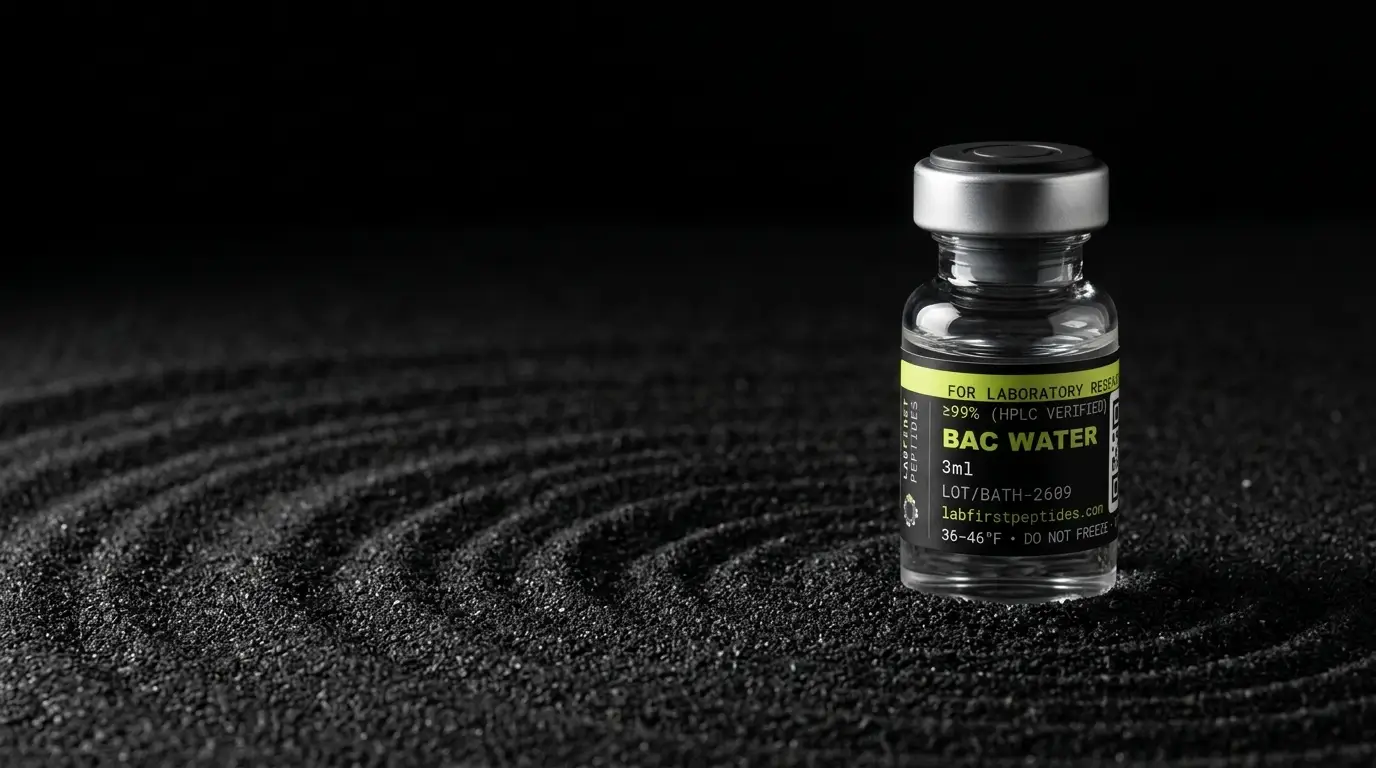
BAC water for peptides is sterile water with 0.9% benzyl alcohol added as a preservative. The alcohol holds back bacterial growth in a vial that will be opened more than once. Plain sterile water has no preservative. A solution made with it is a single-session liquid, not a working stock.
- Bacteriostatic water is sterile water with 0.9% benzyl alcohol; the preservative suppresses bacterial growth from repeated vial entry.
- Bacteriostatic means growth suppression, not sterilization, contaminated technique still contaminates.
- The 28-day discard convention for preserved multi-entry containers originates in USP and CDC practice, not in peptide chemistry.
- Benzyl alcohol can promote aggregation in some peptides; cloudiness is aggregate, and shaking worsens it.
- The preservative addresses microbiology only, chemical degradation of a dissolved peptide proceeds identically in preserved and plain water.
- Sealed shelf life is the manufacturer's printed expiry date and nothing extends it.
- The in-use period starts at first entry and is stated on the container's own labeling.
- Benzyl alcohol at 0.9% is bacteriostatic: it suppresses growth rather than killing what is established.
- Plain sterile water carries no preservative, so a solution prepared with it is a single-session liquid.
- "Reconstitution solution" is a listing term, not a composition. Read what the label says is in it.
- A preserved diluent does not preserve the peptide dissolved in it. Those are two different clocks.
What this guide covers
A jar of jam and a glass of juice look much the same on the counter. The preserved one keeps after it is opened, and the plain one is meant for one sitting. That is the whole difference between bacteriostatic water and sterile water.
The trade collapses three different products into the phrase "mixing water," and most of the confusion around peptide solution preparation starts there. Bacteriostatic water is sterile water containing 0.9% benzyl alcohol. Sterile water for injection is water and nothing else. Normal saline is 0.9% sodium chloride in water, with or without a preservative depending on the presentation. They look identical in the vial. They behave differently the moment a laboratory starts drawing from them across days.
The distinction that matters for research work is the preservative. A lyophilized peptide is stable as a dry solid and starts degrading the moment water hits it, and the water itself becomes a growth medium for any organism introduced by the first draw. Benzyl alcohol exists in the formulation to slow that second problem down. It does nothing about the first.
None of this is exotic. Bacteriostatic Water for Injection is a compendial article with its own USP monograph, and the 0.9% benzyl alcohol concentration is the standard the monograph describes. What the research market sells as BAC water is that same formulation supplied as a laboratory reagent.
This guide covers what benzyl alcohol does and what it cannot do, when plain sterile water is the right call, why a solution sometimes turns cloudy, a worked example of how far one vial of diluent goes, what to check on a listing before buying, storage before and after opening, and why the shelf life and the in-use period are two different clocks. It ends with a bottom line.
- Multiple draws over days, bacteriostatic water
- Single preparation, used once, sterile water
- Frozen single-use aliquots, either
- Compound clouds in preserved water, plain water, aliquoted
- Either way: date the vial at first entry
What does benzyl alcohol do, and what can it not do?
Benzyl alcohol at 0.9% is bacteriostatic, not bactericidal. The name is precise: it suppresses the multiplication of bacteria introduced into the vial, holding the population roughly where it started rather than killing it off. A contaminated draw still contaminates. What the preservative buys is time: the difference between a working solution that tolerates being entered repeatedly over days and one that becomes a culture experiment.
The widely used discard convention for preserved multiple-entry containers is 28 days, which originates in USP guidance and in CDC practice for multiple-entry containers rather than in anything specific to peptides. A laboratory is free to run tighter windows, and many do. The convention is a ceiling, not a promise: it assumes clean technique at every entry, refrigerated storage between uses, and a preservative that is actually present.
What benzyl alcohol cannot do is protect the peptide itself. Chemical degradation (hydrolysis, deamidation, oxidation) proceeds in preserved water exactly as it does in plain water. A solution in BAC water is still a solution, still on the clock, still subject to everything the storage and stability guide describes. The preservative addresses microbiology, not chemistry.
When is plain sterile water the right call?
The decision reduces to one question: will the prepared solution be drawn from more than once?
| Situation | Diluent | Why |
|---|---|---|
| Working stock, multiple draws over days | Bacteriostatic water | The preservative is the only thing making repeated entry defensible |
| Single preparation, used at once, remainder discarded | Sterile water | No repeated entry, so the preservative buys nothing |
| Single-use aliquots frozen at preparation | Either | Each aliquot is entered once; contamination pressure is per-container |
| A compound documented as incompatible with benzyl alcohol | Sterile water, aliquoted | See the incompatibility section below |
The aliquot row deserves the emphasis. Splitting a solution into single-use portions at preparation time removes most of the reason BAC water exists, because no container is ever entered twice. A laboratory that aliquots rigorously can run entirely on plain sterile water and lose nothing except the flexibility to change its mind about portion sizes later.
Why did the solution turn cloudy?
Benzyl alcohol is not inert toward proteins and peptides. The formulation literature documents that it can promote aggregation in some polypeptides: solutions that turn faintly hazy or visibly cloudy after preparation, sometimes immediately, sometimes over hours. The effect is compound-specific and concentration-dependent, and it is the reason several licensed biologic products are supplied with plain diluent and explicit instructions to avoid preserved water.
For research material the practical rule is observational. A solution that goes cloudy in preserved water and clear in plain water is telling you something about that peptide's tolerance for benzyl alcohol, and the answer is plain sterile water and single-use aliquots, not vigorous mixing. Cloudiness is aggregate. Aggregated peptide is not recovered by shaking; agitation generally makes it worse, because aggregation of amphiphilic molecules is driven at the air–water interface and shaking multiplies that interface.
Swirl gently, never shake, regardless of diluent. This is the same interface argument that applies to lipidated compounds generally, and it costs nothing to follow.
How far does one vial of diluent go? A worked example
A 10 mg vial of peptide brought into 2 mL of bacteriostatic water gives:
10 mg ÷ 2 mL = 5 mg/mL
A 30 mL vial of BAC water therefore prepares fifteen such vials:
30 mL ÷ 2 mL = 15 preparations
which is why the diluent is the cheapest line on any order and the last thing worth economizing on. At catalog pricing, the water works out to well under a dollar per preparation. Reusing a diluent vial past its discard window, or stretching a single preserved vial across months of intermittent work, saves cents and puts every downstream result behind a question mark.
Note that the arithmetic is about the diluent vial, not the peptide vial. Each entry into the BAC water vial is an entry like any other: the 28-day convention and clean-technique assumptions apply to it just as they do to the prepared solution. A laboratory tracking discard dates tracks them on both.
The vial concentration calculator handles other vial sizes and volumes, and the cost-per-milligram tool puts the diluent cost in context against the compounds it prepares.
How to check a diluent listing before buying: step by step
Because the diluent is cheap, nobody scrutinizes it, and that makes it the easiest corner for a low-end supplier to cut. The product is only worth buying if four things are true, and all four are checkable from the listing before any money moves.
- The preservative is named and its concentration stated. "Bacteriostatic" on the label with no benzyl alcohol percentage behind it is a marketing word, not a formulation.
- The presentation is sealed. An intact crimp and septum are the entire sterility argument, and a vial that arrives with a compromised closure is discarded regardless of what is in it.
- The vial carries a lot identifier. Water is a manufactured product with a batch history like anything else, and an unlotted vial cannot be tied to any quality record at all.
- The supplier distinguishes bacteriostatic water from sterile water and from saline in its own catalog. A listing that uses the three interchangeably is telling you how much attention the rest of the operation gets.
The same evaluation logic that applies to every compound applies here, scaled to a cheaper product: the claim is only worth what the documentation behind it can support, and a supplier's handling of its cheapest item is a fair preview of its handling of its most expensive one.
How should it be stored before and after opening?
Unopened, bacteriostatic water is stable at controlled room temperature; it is formulated water, not a biologic, and needs no cold chain. Once opened, refrigeration between uses is the sensible default and the discard convention starts counting. Mark the date of first entry on the vial. An unmarked opened vial is undatable, and undatable means discarded. The cost of replacing it rounds to zero against the value of what it prepares.
Two handling notes carry over from general vial practice. First, let refrigerated vials reach room temperature before drawing, for the same condensation reasons that apply to lyophilized material. Second, the septum is the sterility barrier: wipe it before every entry and never leave anything embedded in it. A preserved formulation slows contamination; it does not forgive a compromised closure.
The research-use boundary applies to the diluent exactly as it applies to every compound it prepares. FOR LABORATORY AND IN-VITRO RESEARCH USE ONLY. NOT FOR HUMAN OR ANIMAL CONSUMPTION. NOT FOR PERSONAL, MEDICAL, DIAGNOSTIC, THERAPEUTIC, OR RECREATIONAL USE.
Why are there two clocks, not one?
Bacteriostatic water has a sealed shelf life and an in-use period. Confusing the two is the common error, and it is the reason the same question gets four different answers on four different forums.
The sealed clock is the printed expiry date. It belongs to the manufacturer. It was established for that formulation, in that container, under stated storage conditions, and nothing about how carefully a vial is kept extends it. A vial three months past its date is past its date whatever it looks like, because the date is a statement about the product rather than about its appearance.
The in-use clock starts the moment the closure is first entered. Bacteriostatic water is sterile water with 0.9% benzyl alcohol added, and the alcohol suppresses bacterial multiplication rather than sterilizing anything. Suppression has a duration. The container's labeling states it, and that statement is the answer for the vial on your bench.
Most of the confusion online comes from people quoting one clock at somebody asking about the other. Someone asks how long an opened vial lasts and is told about the expiry date, which is true and not the answer.
Why is there no single number for how long it lasts?
Ask this question in five places and you will get five figures, most of them stated with more confidence than the person had. The reason is not that anyone is lying. It is that the answer genuinely belongs to a specific product, and general advice has to round.
A manufacturer establishes an in-use period by testing: the formulation, in that container, with that closure, entered a set number of times under controlled conditions. Change the closure and the number can change. Change the preservative concentration and it certainly does. Two bottles that look identical on a shelf can carry different statements for reasons that are invisible from outside the glass.
The people who round hardest are the ones selling something. A round number is easier to put in a product description than a sentence pointing at somebody else’s label, and a longer round number sells better than a shorter one. That is worth holding in mind whenever a supplier is more specific about your vial than the manufacturer was.
Our own position is the dull one. We sell the diluent in two sizes, we print what is in it, and for the question of how long an opened container lasts we send you to the label rather than to a figure we invented. It is a worse sentence to read and a better one to rely on.
Bottom line
Bacteriostatic water is sterile water with 0.9% benzyl alcohol, and the preservative does one job: it slows bacterial growth in a vial that will be entered more than once. It does nothing for the peptide dissolved in it. Use it for a working stock drawn from over days, use plain sterile water for single preparations or frozen aliquots, switch to plain water if a compound clouds, and date every vial at first entry. The printed expiry is the manufacturer's clock; the in-use period is the label's, and no forum figure replaces either.
What is BAC Water studied for?
Published research on BAC Water investigates the areas below, which is a different question from what BAC Water will do for anyone, a claim about a living system that nothing on this site is sold for.
What it is. Bacteriostatic water: sterile water with benzyl alcohol added to hold back bacterial growth. Not a peptide and not an active compound.
What the research looks at. A laboratory diluent rather than a subject of research. What matters here is that it is a solvent, and what a solvent is made of affects the stability of whatever gets dissolved in it.
How it is thought to work. The benzyl alcohol stops bacteria multiplying, which is what separates bacteriostatic water from plain sterile water and is why a sealed multi-use container can be entered more than once under laboratory conditions.
What is not established. This record covers the diluent as laboratory material only. Nothing here describes preparing, combining or administering any substance, and a diluent being in the catalog implies no such use.
The full record, including the certificate for the lot in stock, is on the BAC Water product page.
Common questions
Is bacteriostatic water the same as sterile water?
Can saline be used instead of BAC water?
How long does a prepared solution last in bacteriostatic water?
Why did my solution turn cloudy in BAC water?
Does bacteriostatic water need refrigeration?
How much BAC water does one order actually need?
How long is bacteriostatic water good for once opened?
How long is a sealed vial good for?
Does bacteriostatic water expire?
Is bacteriostatic water the same as reconstitution solution?
What is the difference between bacteriostatic and sterile water?
Should bacteriostatic water be refrigerated?
More handling guides
Sources
- USP, Bacteriostatic Water for Injection monograph. Compendial definition and the 0.9% benzyl alcohol preservative concentration.
- CDC injection safety guidance on multi-dose containers. Origin of the 28-day discard convention for preserved multiple-entry vials.
- Effects of benzyl alcohol on aggregation of recombinant human interleukin-1-receptor antagonist in reconstituted lyophilized formulations. Journal of Pharmaceutical Sciences . Basis for treating benzyl alcohol as an active variable rather than an inert preservative: this study measures aggregation in a lyophilized formulation reconstituted with bacteriostatic-strength benzyl alcohol.