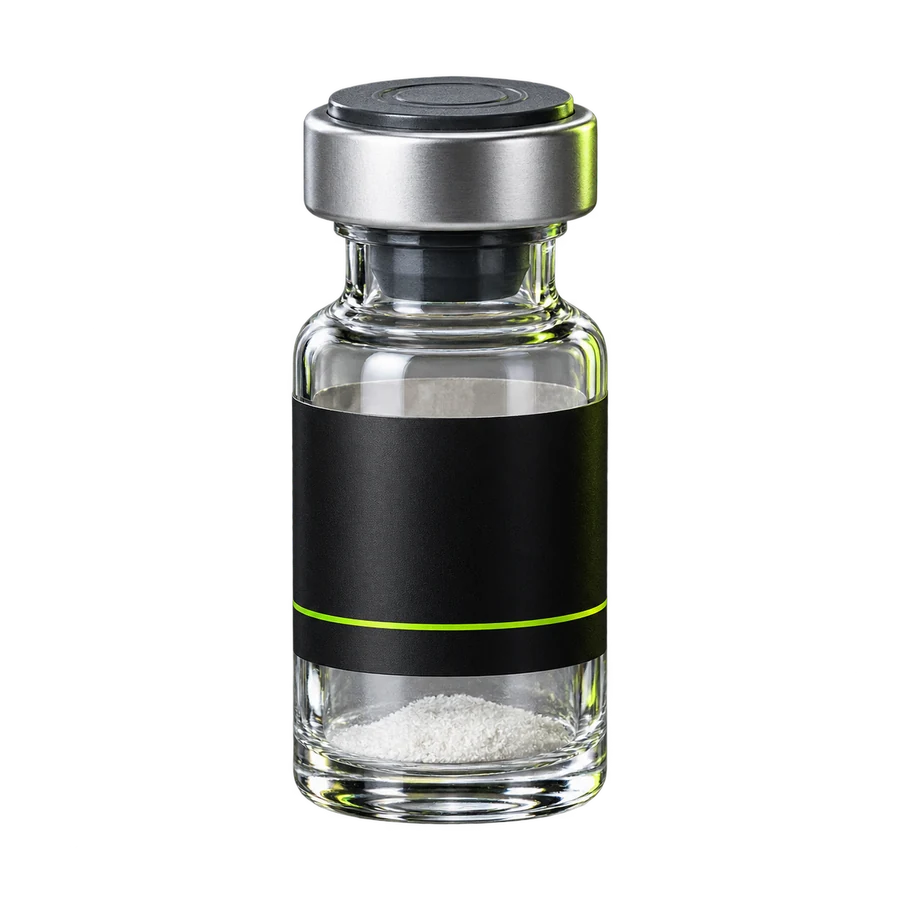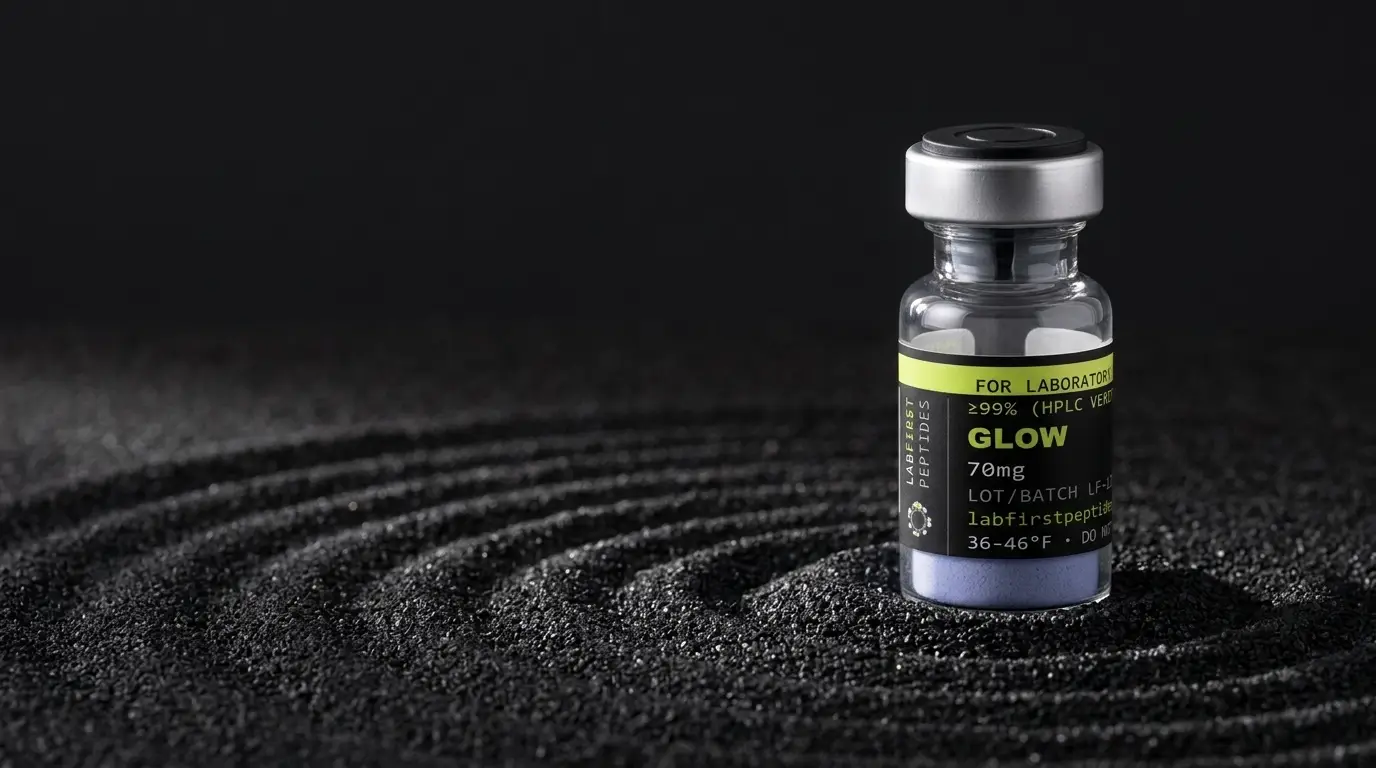
GLOW storage and stability come down to keeping a sealed vial dry, dark and cold, and letting it reach room temperature before opening so water does not condense inside. A laboratory solution made from it degrades far faster than the dry powder. No stability study exists for this blend, so any shelf life on it is a convention.
- GLOW is a 70 mg lyophilized blend of BPC-157, GHK-Cu and TB-500 in one vial.
- ICH Q1A(R2) stress testing covers temperature, humidity, oxidation and light.
- ICH Q1A(R2) defines shelf life by stability data on the product under its labeled conditions; none exists for this blend.
- Condensation when a cold GLOW vial is opened is the most common hidden cause of water damage to the powder.
- A laboratory solution made from GLOW degrades far faster than the sealed dry powder.
- Per-component amounts for GLOW come from the lot certificate, not from dividing the label total.
What sits in the vial
A freeze-dried vial is a bit like instant coffee in a jar with the lid screwed on. Dry, it keeps. Leave the lid off on a steamy day and it cakes, and once water gets in you cannot take it back out.
GLOW is listed in our catalog as SKU GLOW, 70 mg in total, formula BPC-157 / GHK-Cu / TB-500. It arrives as a lyophilized solid: three peptides freeze-dried together, along with the water and counterion any peptide powder carries. The three are different sizes. PubChem gives BPC-157 a molecular weight of 1419.5, the TB-500 fragment 889.0, and free GHK 340.38 before the copper is counted.
Storage for a blend is set by whichever component is least forgiving, since all three share one vial and one set of conditions. This page covers the sealed vial and solutions prepared for laboratory assays. The paperwork side is on the GLOW certificate of analysis page, and what the three molecules are is on how GLOW identity is confirmed.
- Moisture: mostly from condensation on a cold vial
- Temperature: speeds every route
- Oxidation: limited by an intact seal
- Light: kept out by dark storage
- Freeze-thaw: cumulative once in solution
What degrades a peptide powder?
ICH Q1A(R2), the international guideline on stability testing, describes the stresses a drug substance is tested against to learn how it breaks down: raised temperature, high humidity, oxidation and light. Those are the same four levers a laboratory controls when it stores a research peptide.
| Stress | What it does in general terms | Control for a sealed GLOW vial |
|---|---|---|
| Humidity | Gives hydrolysis and other water-driven reactions what they need | Keep sealed, add desiccant, never open cold |
| Temperature | Speeds every degradation route | Cold storage, fewest possible warm excursions |
| Oxidation | Alters susceptible residues | Keep the seal intact; limit air exposure once open |
| Light | Drives photolytic change | Store in the dark or in the outer carton |
Of the four, water is the one that does quiet damage in ordinary labs. Heat is obvious and gets noticed. A few micrograms of condensed water do not.
How should a sealed GLOW vial be stored?
For a vial that will sit for a while, colder and drier is the conservative choice: frozen storage with desiccant, in the dark. For a vial that will be used within a defined working window, refrigerated storage, also dry and dark, is common practice. In transit a dry solid tolerates a few days at ambient temperature far better than any solution would.
We are not giving a number of months for either. ICH Q1A(R2) defines shelf life as the period in which a product is expected to stay within its specification when stored under the conditions on its label, and that period comes out of a stability study on that material in that container. Nobody has published such a study for this blend. A supplier who prints a fixed shelf life on GLOW without one is quoting a habit, and the honest record is that the window is unestablished.
What the vial does have is a certificate for its lot, once that certificate is published on the GLOW product page. If that document carries a retest date backed by data, use it.
On arrival
The first ten minutes after a package lands decide a lot. Check that the seal is intact and the cake looks like a dry solid rather than a smear or a puddle at the bottom of the glass. Compare the lot number on the vial with the paperwork. Then put it straight into its storage location, still sealed, instead of leaving it on a desk for the afternoon.
Resist opening it just to look. A vial opened on arrival and then frozen has already had one exposure to room air, and there was no reason for it. If the lab plans to split one vial across several projects, decide that now and plan a single opening for preparation, rather than several small visits over weeks.
Opening a cold vial
Here is the mistake that causes the most damage and never makes it into a notebook. A vial comes out of the freezer into a room at ordinary temperature and humidity. The glass is colder than the dew point of the room air. The moment the stopper lifts, water condenses on the inside wall and on the dry cake, and a freeze-dried solid takes it up at once.
Nothing visible changes. The vial goes back in the freezer carrying water it did not have before, and the next opening adds a little more. Weeks later a purity result comes back lower than the certificate, and the first suspect is the supplier.
The control is boring and it works. Let the sealed vial warm to room temperature on the bench before breaking the seal, every time. Work quickly once it is open, close it against fresh desiccant, and log the opening. With three peptides in one vial, a single careless opening affects all three at once.
Solutions made for laboratory assays
Once diluent goes in, the clock runs much faster. Water is now everywhere, and every route that needed it is running. A prepared solution is measured in days of working life, not the longer horizon of a dry, sealed solid.
Two practices do most of the good. Split the solution into single-use aliquots at the moment it is made, so no tube is thawed twice. Label each one then and there with the parent lot and the preparation date. Repeated freezing and thawing causes losses that add up and cannot be seen by looking at the tube.
The diluent is part of the record too. For GLOW it matters more than usual, because one of the three components is a copper complex. A buffer or additive that binds metal ions can compete for that copper, so the choice of solvent should be written down along with its own lot number. The GHK-Cu storage guide covers the copper complex on its own, and the notes on bacteriostatic water describe what that diluent's paperwork should include.
Worked example: aliquot arithmetic
Say a laboratory brings the 70 mg vial into 3.5 mL of diluent for an assay series. On the label mass alone:
70 mg ÷ 3.5 mL = 20 mg/mL total solid
That figure is total solid, not any one peptide. The milligrams of each component are stated on the lot certificate, and the working concentration of each has to be calculated from those figures, corrected for net peptide content where the certificate reports it. The label total cannot be divided three ways by guesswork.
If each assay run draws 0.25 mL:
3.5 mL ÷ 0.25 mL = 14 draws
Held as one tube, the last draw comes from solution warmed and chilled thirteen times. Split into fourteen aliquots at preparation, each is thawed once.
What the storage record should say
A short record on arrival makes the certificate useful later. Write down the lot number as printed on the vial, the date received and the state of the seal, the storage location and temperature, and each opening with its date. For solutions, add the diluent and its lot, the volume, the preparation date and the aliquot labels.
With that record, an odd result months later can be traced to a vial, a lot and a certificate in one step. Without it, even a perfect certificate describes material nobody can connect to the tube in the rack. The certificate index is where a lot's published report can be matched to the number you wrote down.
Regulatory position
GLOW is a blend name with no pharmacopeial monograph and no published stability study. The FDA page on bulk drug substances that may present significant safety risks in compounding lists BPC-157, GHK-Cu (for injectable routes of administration) and Thymosin beta-4, fragment (LKKTETQ), also known as TB-500, among nominations that were withdrawn.
Status checked September 29, 2026.
FOR LABORATORY AND IN-VITRO RESEARCH USE ONLY. NOT FOR HUMAN OR ANIMAL CONSUMPTION.
What is GLOW studied for?
Published research on GLOW investigates the areas below, which is a different question from what GLOW will do for anyone, a claim about a living system that nothing on this site is sold for.
What it is. A brand name for several peptides freeze-dried together in one vial.
What the research looks at. The ingredients appear separately in the research. The blend as sold is a way of packaging them and has not itself been studied.
How it is thought to work. A blend name, not a molecule. Whatever mechanism there is belongs to the separate ingredients, and those are described on their own records.
What is not established. Blend names are not standardised between suppliers, so the same name can mean different ingredients in different amounts. Read the certificate for what is actually in the vial rather than trusting the name.
The full record, including the certificate for the lot in stock, is on the GLOW product page.
Common questions
How should a sealed GLOW vial be stored?
What is the shelf life of GLOW?
Why does opening a cold vial matter so much?
How long does a GLOW solution last in the lab?
Does the copper in GHK-Cu change how GLOW solutions are handled?
Published certificates for GLOW
Every figure below is read from a report the laboratory issued for that lot; each page carries the PDF and the lab's own verification link.
More handling guides
Sources
- ICH Q1A(R2), Stability Testing of New Drug Substances and Products. Stress testing on temperature, humidity (75% RH or greater), oxidation and photolysis; definition of shelf life under labeled storage conditions.
- PubChem Compound Summary for CID 9941957, BPC-157. Molecular weight 1419.5.
- PubChem Compound Summary for CID 62707662 (TB-500, Ac-LKKTETQ). Molecular weight 889.0.
- PubChem Compound Summary for CID 73587, glycyl-L-histidyl-L-lysine. Free GHK, molecular weight 340.38.
- FDA, Certain bulk drug substances for use in compounding that may present significant safety risks. Lists BPC-157, GHK-Cu (injectable routes) and the LKKTETQ fragment among withdrawn nominations.