GLOW identity is confirmed by finding each of its three peptides separately. Mass spectrometry should show a mass matching BPC-157 near 1418.7 Da, TB-500 near 888.5 Da and the stated form of GHK-Cu, each reported on its own line. One conforming result for the whole vial does not confirm the blend.
- GLOW identity means confirming BPC-157, TB-500 and GHK-Cu separately in one sample.
- Reference monoisotopic masses from PubChem: BPC-157 1418.704 Da, TB-500 888.492 Da, free GHK 340.186 Da.
- PubChem lists more than one GHK copper form, so the certificate must state which one it tested for.
- TB-500 as Ac-LKKTETQ corresponds to positions 18 to 24 of UniProt P62328 counting the initiator methionine.
- ICH Q2(R2) expects identification methods to show specificity, which for a blend means telling the three apart.
- Intact mass confirms composition, not sequence order or amount.
Three names, one tube
How do you prove three different things are in one small tube of white powder? You cannot see them, and you cannot pick them out with tweezers. You need a test that sorts the powder by what each molecule weighs, then check that three expected weights show up.
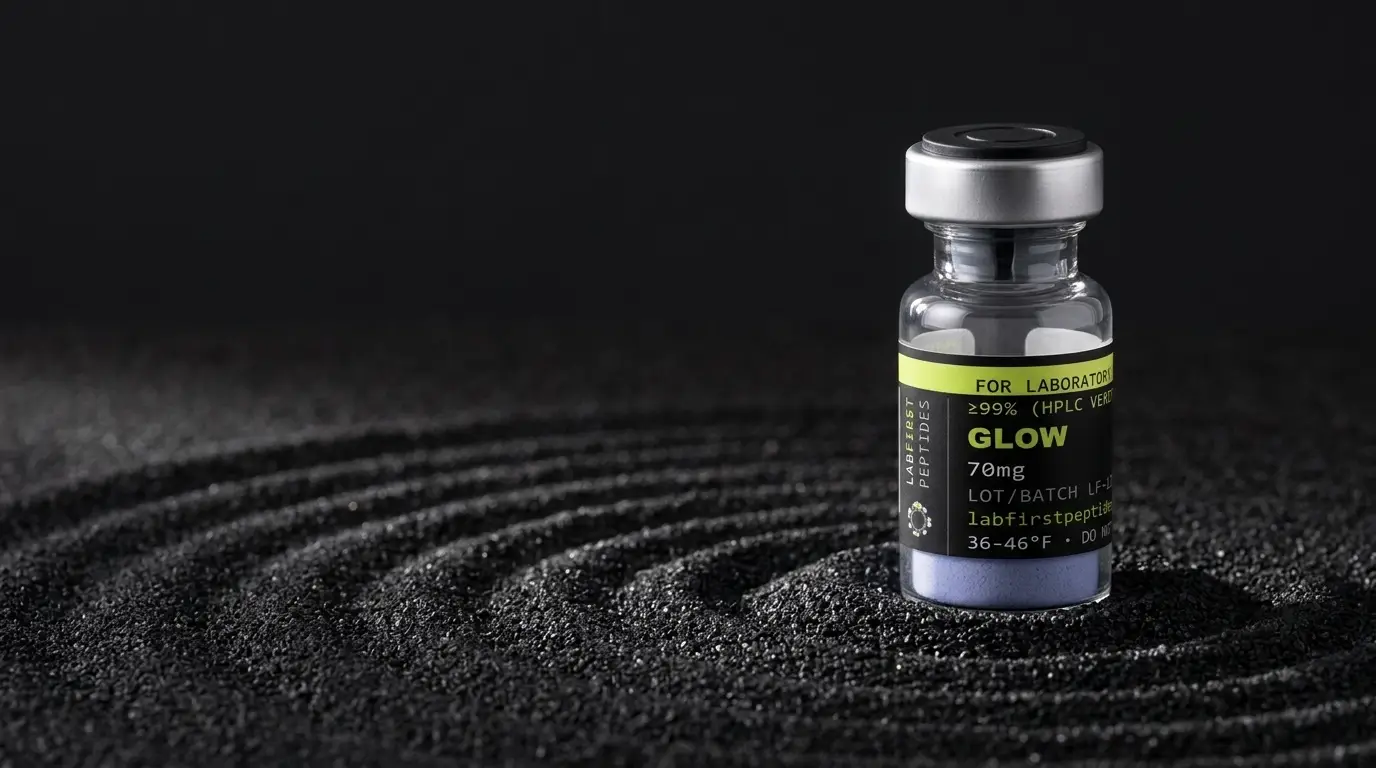
That is identity testing for GLOW in one sentence. The vial, listed in our catalog as SKU GLOW at 70 mg with the formula BPC-157 / GHK-Cu / TB-500, holds three separate molecules. Identity means showing that each of them is there and is the molecule its name claims. It is a separate question from how pure each one is and from how much of each the vial holds, which the GLOW certificate of analysis page covers.
For a single peptide, identity is one result. For GLOW it is three, and the rest of this page is about keeping them apart.
- Blend name on the label: a claim only
- One purity figure: says nothing about which molecules
- Three retention times: supporting evidence
- Three intact masses, one per component: working identity
- Copper result beside the GHK mass: confirms the complex
- Fragmentation data: sequence-level proof
Why does a purity figure prove nothing about identity?
A purity percentage from HPLC says what share of the detected material came out as the main peak or peaks. It does not say what those peaks are. A vial of the wrong peptide, made cleanly, can post an excellent purity number.
ICH Q2(R2), the international guideline on validating analytical procedures, treats specificity as a test expected for identification methods: the procedure has to respond to the intended analyte and not to other substances that might be present. In a blend, the other substances are the two sibling peptides. A method that cannot tell BPC-157 from TB-500 from GHK-Cu, measured together, has not confirmed any of them.
Retention time on a column is supporting evidence at best. Three peaks at the times a reference standard produced is encouraging, and it is still only a position on a time axis. Mass is what ties a peak to a formula.
The three target masses
PubChem gives the reference values each observed mass should be compared against.
| Component | Formula | Monoisotopic mass (Da) | PubChem CID |
|---|---|---|---|
| BPC-157 | C62H98N16O22 | 1418.704 | 9941957 |
| TB-500 (Ac-LKKTETQ) | C38H68N10O14 | 888.492 | 62707662 |
| GHK, free peptide | C14H24N6O4 | 340.186 | 73587 |
| GHK with one copper, cation | C14H23CuN6O4+ | 402.108 | 71587328 |
Electrospray mass spectrometry usually records ions carrying one or more added protons, so the raw spectrum shows mass-to-charge values rather than these neutral masses directly. A report should state the charge state it used, or give a deconvoluted mass, so a reader can connect the peak to the table.
Worked through for the smallest case: a singly protonated free GHK ion sits near 340.186 plus one proton, about 341.19. If a certificate prints 341 and calls it GHK-Cu, it has found the peptide and not the copper complex.
Checking the arithmetic yourself
You do not need an instrument to test whether the numbers on a certificate hang together. You need the table above and a calculator. A proton adds about 1.007 to the mass, and an ion carrying two protons shows up at its total mass divided by two.
For TB-500 the singly charged ion should sit near:
888.492 + 1.007 = 889.50
and the doubly charged ion near:
(888.492 + 2 × 1.007) ÷ 2 = 445.25
For BPC-157, which is larger, the doubly charged ion is often the one worth looking for:
(1418.704 + 2 × 1.007) ÷ 2 = 710.36
If a certificate lists observed values and says which charge states they are, each one should land within instrument tolerance of a figure like these. If it lists a value that fits none of the three components in any plausible charge state, ask what it is. And if it lists fewer values than there are components, one of them was either not looked for or not found, and the report should say which.
This takes five minutes and catches a surprising share of copied or careless paperwork, because a reused spectrum from another product will not produce numbers that fit GLOW.
The copper question
GHK-Cu is the component that makes GLOW harder to confirm than the other two. It is a tripeptide holding a copper ion, and the copper is part of what the name claims.
PubChem does not settle on a single form. It carries a 1:1 copper cation record at 402.92 molecular weight, a record titled GHK-Cu at C28H48CuN12O8, which is two peptides around one copper at 744.3, and others besides. Each has a different target mass. So a certificate has to state which form it is claiming before its mass can mean anything.
A second trap: in some mass spectrometry conditions a metal complex can lose its metal. Seeing only the free GHK mass does not prove the copper was never there, and it does not prove it was. That is why a sound GHK-Cu identity result pairs the peptide mass with a copper measurement, reported as its own line. The GHK-Cu identity guide covers the single-compound version of this in more depth.
Which TB-500 is meant
TB-500 is sold under one name for more than one molecule. The form in the table above is the acetylated seven-residue fragment Ac-LKKTETQ, PubChem CID 62707662. It is a piece of thymosin beta-4.
UniProt's entry for human thymosin beta-4, P62328, lists a 44-residue sequence that starts with the initiator methionine, with an N-acetylserine at position 2. In that numbering the LKKTETQ stretch sits at positions 18 to 24. The full-length protein is several times heavier than the fragment, so a mass result settles immediately which of the two a report describes.
For GLOW the certificate should name the TB-500 form it is testing for and print that target mass. If it does not, a reader cannot tell whether the observed signal is the expected one.
What does a mass match not prove?
An intact mass confirms composition, meaning the right atoms in the right total. It does not confirm order. Two peptides built from the same residues arranged differently weigh the same, and intact mass cannot separate them. Sequence-level proof needs fragmentation data, where the peptide is broken in the instrument and the pieces are matched to the expected sequence.
Most research certificates stop at intact mass, and for routine work that is a reasonable line to draw. It is still worth knowing where the line is. A report that says sequence confirmed should be backed by fragmentation data, and one that shows only an intact mass has confirmed a formula.
For a blend there is one more limit. Mass spectrometry finds what is present and is poor at saying how much. A strong BPC-157 signal next to a faint GHK signal does not mean the vial is mostly BPC-157, because different peptides ionize with different efficiency. Amounts come from a quantitative method, reported separately.
Reading the identity section of a GLOW certificate
A complete identity section for GLOW has three lines, one per component, each with a theoretical mass, an observed mass and the method. The GHK-Cu line states its form and is accompanied by a copper result. The TB-500 line names the fragment or the full-length protein. And the lot number above it matches the vial.
We do not quote identity results for our own GLOW lots on this page. A lot's certificate is posted on the GLOW product page once it is published, and the certificate index lists everything issued so far. How the sealed vial should be kept while you wait for, or work from, that paperwork is on the GLOW storage and stability page.
Regulatory position
No pharmacopeial monograph defines GLOW, so its identity is tested against the component records rather than a compendial standard. The FDA page on bulk drug substances that may present significant safety risks in compounding lists BPC-157, GHK-Cu (for injectable routes of administration) and Thymosin beta-4, fragment (LKKTETQ), also known as TB-500, among nominations that were withdrawn.
Status checked September 29, 2026.
FOR LABORATORY AND IN-VITRO RESEARCH USE ONLY. NOT FOR HUMAN OR ANIMAL CONSUMPTION.
What is GLOW studied for?
Published research on GLOW investigates the areas below, which is a different question from what GLOW will do for anyone, a claim about a living system that nothing on this site is sold for.
What it is. A brand name for several peptides freeze-dried together in one vial.
What the research looks at. The ingredients appear separately in the research. The blend as sold is a way of packaging them and has not itself been studied.
How it is thought to work. A blend name, not a molecule. Whatever mechanism there is belongs to the separate ingredients, and those are described on their own records.
What is not established. Blend names are not standardised between suppliers, so the same name can mean different ingredients in different amounts. Read the certificate for what is actually in the vial rather than trusting the name.
The full record, including the certificate for the lot in stock, is on the GLOW product page.
Common questions
How is GLOW identity confirmed?
Why is GHK-Cu the hardest part of GLOW to confirm?
Does a mass match prove the sequence is right?
Can a mass spectrum show how much of each peptide is in GLOW?
Published certificates for GLOW
Every figure below is read from a report the laboratory issued for that lot; each page carries the PDF and the lab's own verification link.
More documentation guides
Sources
- PubChem Compound Summary for CID 9941957, BPC-157. Formula C62H98N16O22, monoisotopic mass 1418.704.
- PubChem Compound Summary for CID 62707662 (TB-500, Ac-LKKTETQ). Formula C38H68N10O14, monoisotopic mass 888.492.
- PubChem Compound Summary for CID 73587, glycyl-L-histidyl-L-lysine. Free GHK, C14H24N6O4, monoisotopic mass 340.186.
- PubChem Compound Summary for CID 71587328, prezatide copper. 1:1 copper cation, C14H23CuN6O4+, molecular weight 402.92.
- PubChem Compound Summary for CID 133697840, GHK-Cu. Two-peptide copper record, C28H48CuN12O8, molecular weight 744.3.
- UniProt P62328, Thymosin beta-4 (human). 44-residue sequence including initiator methionine, N-acetylserine at position 2, LKKTETQ at positions 18 to 24.
- ICH Q2(R2), Validation of Analytical Procedures (2023). Specificity as a validation test for identification procedures.
- FDA, Certain bulk drug substances for use in compounding that may present significant safety risks. Lists BPC-157, GHK-Cu (injectable routes) and the LKKTETQ fragment among withdrawn nominations.