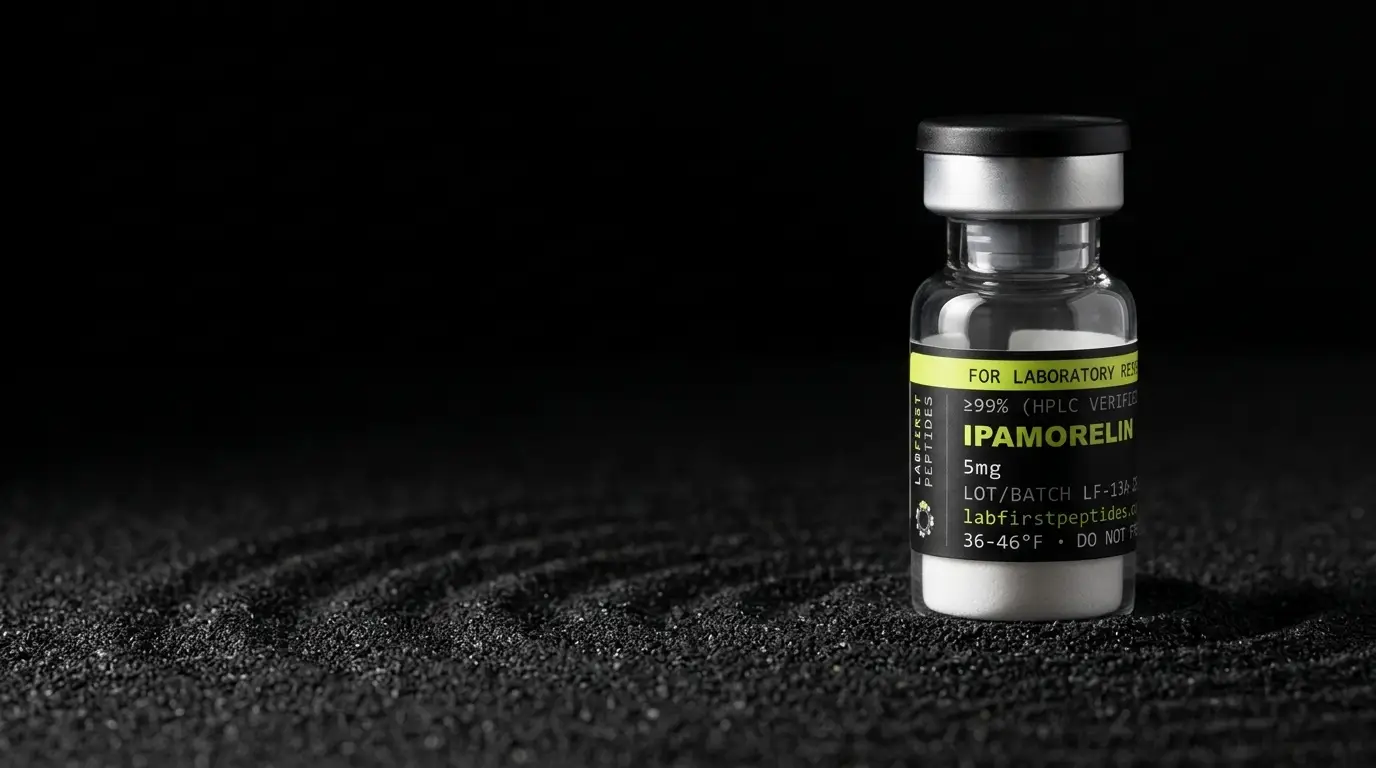
An ipamorelin certificate of analysis is a test report for one lot. Read it in order. Match the lot number to the vial and check the test date. Then look at mass near 711.9, the amide check, purity with the chart, chiral purity, net peptide content, and the lab that issued it.
- Ipamorelin is C38H49N9O5, average mass near 711.9, PubChem CID 9831659.
- It contains alpha-aminoisobutyric acid, which is not a standard protein amino acid.
- Two residues are in the D configuration, and mass spectrometry cannot see chirality at all.
- The C-terminal amide is a one-dalton check: the free acid weighs about one more.
- 2-naphthylalanine gives a strong chromophore, so 280 nm is a usable second wavelength.
- No FDA-approved product and no pharmacopeial monograph define a chiral purity limit.
What does an ipamorelin certificate actually certify?
A certificate of analysis covers one batch and nothing else. Put simply, it is a receipt: it tells you what was checked on that batch and when, and it says nothing about any other batch.
It records what a named laboratory measured on a sample drawn from one lot, on one date, by named methods. It is evidence about that sample rather than a warranty about the vial on your bench.
Two documents get confused constantly. A specification sheet lists limits the product is supposed to meet, carries no lot number and no results, and describes an intention. A certificate carries both because it describes an event.
If the page has no lot number on its face it is the first kind of document whatever the heading claims. For this compound there is a second reason to want a real certificate, and it concerns stereochemistry.
- Lot number on the report against the lot number on the vial
- Identity: observed mass against an average near 711.9
- C-terminal amide confirmed, since the free acid weighs about one more
- Purity at 214 nm, with 280 nm available as a second view
- Chiral purity, which mass spectrometry cannot establish at all
- Net peptide content, counterion and water by Karl Fischer
- Accession number confirmed at the issuing laboratory
How do you read it field by field?
Lot number first, against the vial, and nothing further until they match. Then dates: the test date should follow the fill date, and a print date carries no analytical weight.
Then the results. Identity by mass spectrometry. The C-terminal amide confirmed rather than assumed. Purity by reversed-phase HPLC with the chromatogram attached. Chiral purity, where the report carries it. Net peptide content. Counterion. Water. Appearance last.
Every result needs a method beside it. Purity by area percent, by net peptide content and by amino acid analysis are three different numbers for one vial and they do not agree with each other.
What mass should the identity result show?
Ipamorelin is a pentapeptide with the molecular formula C38H49N9O5 and an average mass near 711.9, cataloged as PubChem CID 9831659.
The sequence is unusual and worth knowing, because it explains most of what follows. It contains alpha-aminoisobutyric acid, an amino acid that does not occur in ordinary proteins, and two residues in the D configuration rather than the L configuration that natural peptides use.
None of that changes how the mass is measured. At 712 daltons the measurement is straightforward, with no charge-state envelope to deconvolute and no meaningful scatter to hide a missing residue.
Why does the C-terminal amide matter?
Because it is a one-dalton question that a certificate can answer and frequently does not. Ipamorelin ends in an amide group rather than a free carboxylic acid.
If the amide is missing, whether from incomplete synthesis or from hydrolysis in storage, the molecule becomes the free acid and weighs about one dalton more. On a 712-dalton peptide a mass spectrometer resolves that difference without difficulty.
So the identity result is quietly doing two jobs, exactly as it does for a cyclic peptide. It confirms the chain assembled and it confirms the C-terminus is the right chemical group. A certificate printing the observed mass lets a reader check both. One saying identity confirmed lets them check neither.
What can mass spectrometry not see here?
Chirality, and for this compound that is the most important sentence on the page. Two of ipamorelin's residues are deliberately in the D configuration.
A D-amino acid and its L counterpart are mirror images. They contain exactly the same atoms in exactly the same arrangement, differing only in three-dimensional handedness, so they weigh precisely the same.
A mass spectrometer therefore cannot tell a correctly built ipamorelin from one where a D residue was accidentally installed as L. The masses are identical to any number of decimal places. The molecules are different, and no amount of mass accuracy will separate them.
How is chiral purity established?
By a method built for the question. The usual route is to hydrolyse the peptide into free amino acids and analyze those on a chiral stationary phase, which separates D from L because the phase itself is handed.
The other route is a chiral separation of the intact peptide, which is harder to develop and gives a more direct answer.
Neither appears on most research certificates. That is a real limit rather than a scandal: chiral analysis is specialised and adds cost. It is worth knowing that a certificate without it has established the molecule weighs the right amount and has not established that it is the right stereoisomer.
Does the unnatural residue complicate anything?
It complicates amino acid analysis more than it complicates identification. Alpha-aminoisobutyric acid is not one of the twenty residues a standard amino acid analysis method is calibrated for.
A laboratory running a routine composition panel may not report it, or may report it as an unidentified peak. That is a limitation of the method rather than a finding about the material, and a report that quietly omits a residue it could not measure is easy to misread.
The residue is also why this peptide resists some enzymatic degradation that an ordinary sequence would not, which matters biologically rather than in a sealed vial.
Can purity be measured at 280 nanometres here?
Yes, unusually for this catalog. Ipamorelin contains 2-naphthylalanine and phenylalanine, both aromatic, and the naphthalene ring is a strong chromophore.
That gives a laboratory a genuine second detection wavelength. Peptides are normally read at 214 nanometres, which responds to the peptide bond and detects everything; 280 responds only to aromatic residues and therefore detects a subset.
Running both is informative rather than redundant. An impurity that appears at 214 but not at 280 lacks an aromatic residue, which says something real about what it is. Most peptides in this catalog cannot offer that cross-check because they have no chromophore at all.
What is net peptide content, and why does it change the price?
A synthetic peptide ships as a salt carrying a counterion from purification, usually trifluoroacetate or acetate, plus water absorbed because lyophilized peptide is hygroscopic.
The consequence is arithmetic. A vial labeled 10 milligrams may hold 10 milligrams of powder of which a real fraction is salt and water. Net peptide content of 80 percent means 8 milligrams of peptide, and two suppliers quoting the same price for the same nominal size are not selling the same amount.
Ask which basis the label uses. The cost per milligram comparison ranks the catalog on one basis so two quotes can be compared honestly.
What do the water and counterion fields tell you?
Water is measured by Karl Fischer titration, which is specific to water. Loss on drying reports everything volatile and reads high when residual solvent is present, so the two numbers are not interchangeable.
Counterion identity is worth reading. Trifluoroacetate is the usual residue of preparative HPLC and is not inert in every experimental context; acetate is produced by an extra exchange step. Ipamorelin carries a lysine, so there is a positive charge for a counterion to pair with.
Both feed the net content arithmetic and together explain most of the gap between a high area purity and a lower net peptide figure.
How do you verify the document is genuine?
Confirm the report at the issuing laboratory rather than with the seller. An independent laboratory issues each certificate against an accession number that resolves on its own site. If the number resolves to a different product, a different lot, or nothing, the document does not describe your material however professional it looks.
Certificates with the verification key removed deserve particular suspicion, and this is not hypothetical in this market. A PDF is easy to edit; a third-party lookup is not.
Lot reports for material supplied here resolve through the certificate verification page, and the sizes carried appear on the ipamorelin product record.
What is the regulatory position?
There is no FDA-approved drug product containing ipamorelin and no United States pharmacopeial monograph defining what an acceptable batch is. The specification a lot is released against is the supplier's own.
For a peptide built from D-amino acids and an unnatural residue that absence matters more than usual, because there is no official standard defining how stereochemical purity should be demonstrated or what limit applies.
What a research certificate can honestly establish is what a named laboratory measured, on a named lot, by named methods. Material described here is supplied for laboratory use only.
FOR LABORATORY AND IN-VITRO RESEARCH USE ONLY. NOT FOR HUMAN OR ANIMAL CONSUMPTION. NOT FOR PERSONAL, MEDICAL, DIAGNOSTIC, THERAPEUTIC, OR RECREATIONAL USE.
What is Ipamorelin studied for?
Published research on Ipamorelin investigates the areas below, which is a different question from what Ipamorelin will do for anyone, a claim about a living system that nothing on this site is sold for.
What it is. A man-made five-building-block peptide that makes the pituitary release growth hormone.
What the research looks at. Characterised by Raun and colleagues in 1998, and present in the growth-hormone releaser research ever since.
How it is thought to work. It works on the ghrelin receptor. Its build is deliberately defensive: an unusual building block at one end, two others flipped into their mirror-image form, a bulky side chain, and a capped tail. It contains none of the four building blocks that normally react with oxygen or break down, so the usual routes of decay simply are not there.
What is not established. No approved product and no official standard. Its unusual chemical toughness is a fact about storage, not a statement about what it does in any living thing.
The full record, including the certificate for the lot in stock, is on the Ipamorelin product page.
Common questions
What molecular mass should an ipamorelin certificate show?
Why does the C-terminal amide matter on the certificate?
Can mass spectrometry confirm the D-amino acids are correct?
How is chiral purity actually measured?
Can ipamorelin purity be read at 280 nanometres?
More documentation guides
Sources
- PubChem Compound Summary for CID 9831659, Ipamorelin. The openable record giving the molecular formula C38H49N9O5 and average mass near 711.9, and showing the D-configuration residues and the C-terminal amide discussed above.
- ICH Q2(R2), Validation of Analytical Procedures . Defines specificity, including the requirement that a method distinguish the target from closely related substances, which for a chiral molecule is the clause mass spectrometry cannot satisfy.
- FDA guidance, Q6B Specifications: Test Procedures and Acceptance Criteria. Sets out how identity, purity and content are constructed as separate attributes, and why stereochemical identity is specified separately where it applies.
- Finnrick independent verification portal. Third-party lookup used to confirm a certificate resolves to the lot it claims to describe, rather than confirming a document with the seller who supplied it.