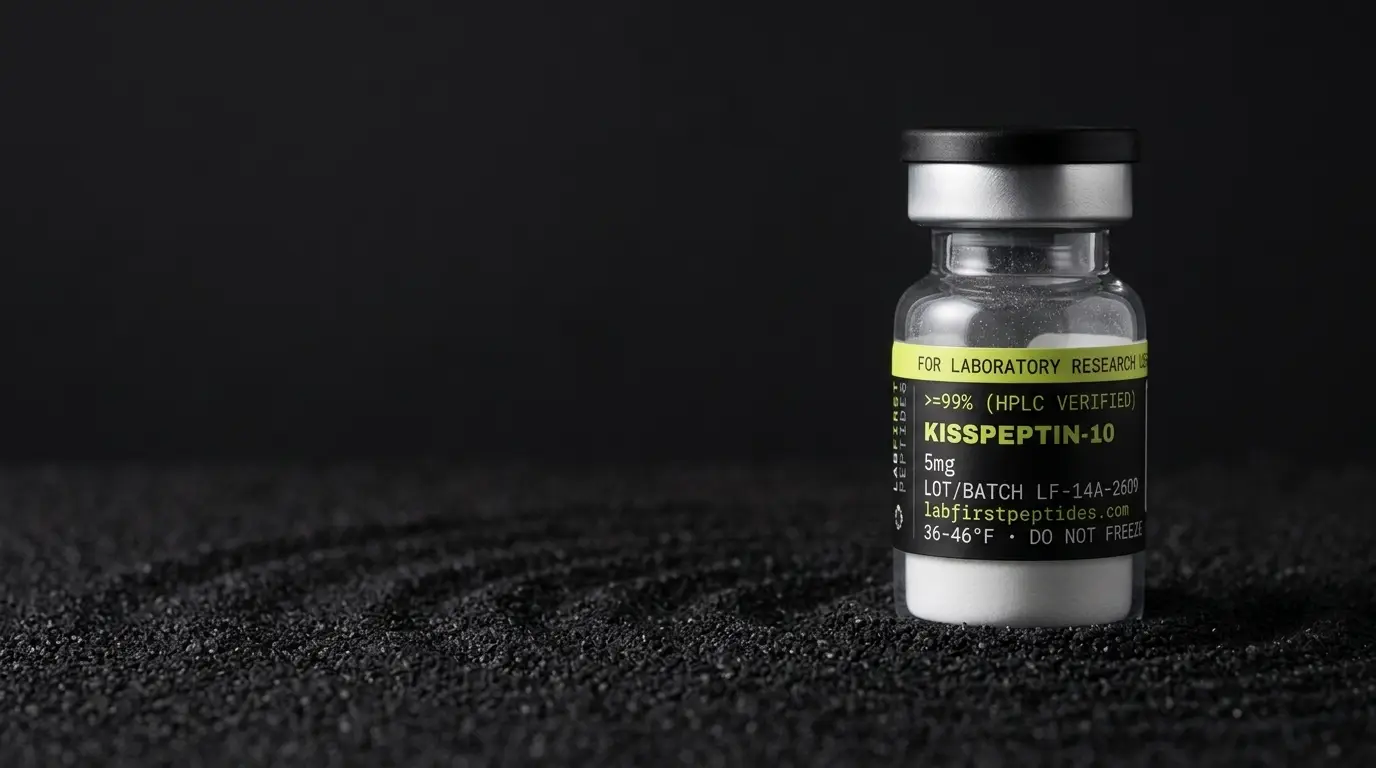
Kisspeptin-10 identity is confirmed with mass spectrometry near 1302.4. The hard part is that three different sites can each add the same one dalton. The mass shows that something changed, but only fragmentation shows which of the three it was. That is why sequence-level data matters for this peptide.
- Kisspeptin-10 is C63H83N17O14, average mass near 1302.4, PubChem CID 25240297.
- Three sites give the same one-dalton shift, because all convert an amide to an acid.
- A single mass says something changed and cannot say which of the three.
- Fragmentation localises the change to a region and is the method that resolves it.
- Amino acid analysis is blind here: hydrolysis performs the same conversion itself.
- The 280 nm wavelength is useful generally and does not separate these three.
What does identity mean for this peptide?
That the molecule in the vial is the one the label names, with its two asparagines intact and its terminal amide still an amide. Kisspeptin-10 is a decapeptide, molecular formula C63H83N17O14, average mass near 1302.4, cataloged as PubChem CID 25240297.
Establishing the sequence is the easy part at this size. A mass measurement excludes missing residues, extra ones and truncation without difficulty.
The harder part is that three separate positions can each change in a way that adds exactly one dalton, so a single number cannot say which, or whether more than one occurred.
- Observed mass near 1302.4 excludes deletions and truncation
- A one-dalton gain has three possible sources on this molecule
- Deamidation at either asparagine, or loss of the terminal amide
- Fragmentation localises the change to a region
- A resolving separation gives the proportion, not just the fact
- Amino acid analysis is blind: hydrolysis makes the same conversion
- Accession number confirmed at the issuing laboratory
What does the mass result establish?
The molecular formula, cleanly. At 1,302 daltons the measurement is comfortable, with a simple charge pattern and no meaningful scatter to hide a discrepancy.
A missing residue shifts the mass by between roughly 57 and 186 daltons depending which one, and an unremoved protecting group by considerably more. Both are unmistakable.
What a single mass cannot do is distinguish a peptide that is one dalton heavy because an asparagine deamidated from one that is one dalton heavy because the terminal amide hydrolysed. They are different molecules with the same weight.
Why does a one-dalton shift have three explanations?
Because all three reactions do the same thing chemically: they convert an amide into a carboxylic acid, replacing an NH with an O.
Deamidation does it at an asparagine side chain, and this peptide has two of those. Hydrolysis does it at the C-terminal amide, which is the third site.
The net atomic change is identical in each case, so the mass afterwards is identical too. Three structurally distinct molecules, one measurement, no way to tell them apart by weight. Most peptides in this catalog have one such site or none, which is what makes this one worth a page of its own.
How does fragmentation resolve it?
By breaking the molecule into pieces and weighing each. Tandem mass spectrometry cleaves along the backbone, and the resulting fragment masses locate a change to a region rather than leaving it in the total.
A fragment containing the first asparagine that reads one dalton heavy places the change there. One containing only the C-terminus places it at the amide instead.
That is the difference between knowing the molecule gained a dalton and knowing where. For a peptide with three candidate sites the second is the only answer that identifies which compound you actually hold, and it is why fragmentation earns its place on this certificate where it might be optional elsewhere.
Can the separation distinguish them?
Often, and imperfectly. Each product differs from the parent by a small charge change, and each is at a different position in the sequence, so their shapes and retention differ slightly from one another as well as from the parent.
A well-developed method can therefore show several small resolved peaks rather than one. An ordinary gradient will show a single main peak with everything inside it.
What a separation gives that a mass does not is a proportion. Knowing that two percent of the material has changed is a different and more actionable fact than knowing that some has, and only a resolving method provides it.
Worth noting what that proportion is actually for. A trace of a deamidated form is an ordinary finding in a synthetic peptide and not a reason to reject a lot. A large proportion is a different matter entirely, and without a resolving method there is no way to tell which situation you are in, because both look like a single clean peak.
What do the aromatic residues contribute?
A real second wavelength. Tryptophan and tyrosine both absorb at 280 nanometres, where most peptides in this catalog give almost no signal.
Reading purity at both 214 and 280 gives two views of one separation. A peak visible at 214 but absent at 280 contains neither aromatic residue, which places it as a fragment rather than a variant of the intact molecule.
The deamidated and hydrolysed forms all retain both aromatics, so they appear at both wavelengths. The second wavelength is genuinely useful for other questions and does not resolve this one, which is worth knowing rather than assuming it helps everywhere.
What does composition analysis add?
Less than it appears to for the specific problem, and something real for others. Amino acid analysis hydrolyses the peptide and quantifies the freed residues.
Deamidation converts asparagine into aspartic acid, and standard acid hydrolysis converts asparagine into aspartic acid as well. So the analysis cannot tell an already-deamidated residue from an intact one, because its own sample preparation performs the same conversion.
That is a genuine and slightly elegant limitation worth understanding. Composition analysis remains useful for confirming the residue inventory and for a peptide content figure by weight, and it is blind to precisely the change this peptide is most likely to have undergone.
What does a mis-identified peptide look like here?
Not usually like a different compound. The realistic failures are the three one-dalton products, a truncated chain, or genuinely correct material that is substantially salt by weight.
The one-dalton products are the ones that matter, because they are the most likely and the hardest to see. A vial could contain a meaningful proportion of them and pass every routine check.
None of this makes certificates worthless. It makes the method list the thing to read, because the methods define which of these failures the document was capable of detecting in the first place.
How do you check the report describes your vial?
Confirm the accession or verification number at the issuing laboratory rather than with the seller. The laboratory holds the record; a seller holds a copy of a document. If the number resolves to a different lot, a different product, or nothing, the analysis is not evidence about your material.
Then match the lot number on the report to the vial. Rigorous analysis attached to the wrong batch is not rigour, and that mismatch is more common than falsified results.
Reports for material supplied here resolve through the certificate verification page, and the sizes carried appear on the Kisspeptin-10 product record.
What should you ask a supplier about identity?
Three questions. What was the observed mass, as a number. Was any fragmentation data collected. And was the purity method developed to resolve the deamidated and hydrolysed forms.
The second and third are both specific to this peptide's problem, and a plain no to either is a fair answer. What is not fair is a purity figure offered as though it had addressed a question the method never approached.
How to read the rest of the document is covered in the certificate guide.
How does this compare with the rest of the catalog?
It sits in the harder half, though for a reason different from its neighbours. DSIP has an isomer that weighs exactly the same as the parent. Ipamorelin has stereochemistry no mass method can see.
Kisspeptin-10's problem is neither invisibility nor identity of mass. Its changes are visible, at one dalton, and the difficulty is ambiguity: three explanations for one observation.
That is a more tractable problem than the other two, because fragmentation resolves it and fragmentation is a standard technique. Whether anyone ran it is the only question, which makes this a documentation problem more than an analytical one.
What is the regulatory position?
International guidance on analytical validation defines what makes an identity method fit for purpose: specificity, accuracy, precision, and a demonstration that the method distinguishes the target from what else might plausibly be present. Here that means three products differing by one dalton each.
There is no FDA-approved product containing Kisspeptin-10 and no United States pharmacopeial monograph, so no official standard requires those forms to be measured or sets a limit.
What a research certificate can honestly establish is what a named laboratory measured, on a named lot, by named methods.
FOR LABORATORY AND IN-VITRO RESEARCH USE ONLY. NOT FOR HUMAN OR ANIMAL CONSUMPTION. NOT FOR PERSONAL, MEDICAL, DIAGNOSTIC, THERAPEUTIC, OR RECREATIONAL USE.
What is Kisspeptin-10 studied for?
Published research on Kisspeptin-10 investigates the areas below, which is a different question from what Kisspeptin-10 will do for anyone, a claim about a living system that nothing on this site is sold for.
What it is. A man-made peptide ten building blocks long, the tail end of kisspeptin.
What the research looks at. A substantial body of reproductive-hormone research covering the KISS1 receptor and brain-hormone signalling.
How it is thought to work. It works on the KISS1 receptor. Kisspeptin signalling is a well-described part of basic reproductive biology.
What is not established. No approved drug product contains this fragment. The underlying biology being well described is a statement about the field, not about anything in a vial.
The full record, including the certificate for the lot in stock, is on the Kisspeptin-10 product page.
Common questions
What mass should Kisspeptin-10 show on a certificate?
Why do three different changes give the same mass?
How does fragmentation help?
Does amino acid analysis detect deamidation?
Does reading at 280 nanometres help distinguish them?
More documentation guides
Sources
- PubChem Compound Summary for CID 25240297, Kisspeptin-10. The openable record giving the molecular formula C63H83N17O14 and average mass near 1302.4, and showing the two asparagines and the terminal amide that create the ambiguity described above.
- ICH Q2(R2), Validation of Analytical Procedures . Defines specificity, including that a method must distinguish the target from closely related substances, which here means three products each one dalton heavier.
- FDA guidance, Q6B Specifications: Test Procedures and Acceptance Criteria. Sets out peptide mapping and fragmentation among the identity tests expected where a mass alone cannot localise a change, alongside rather than instead of intact mass.
- Finnrick independent verification portal. Third-party lookup used to confirm a certificate resolves to the lot it claims to describe, rather than confirming a document with the seller who supplied it.