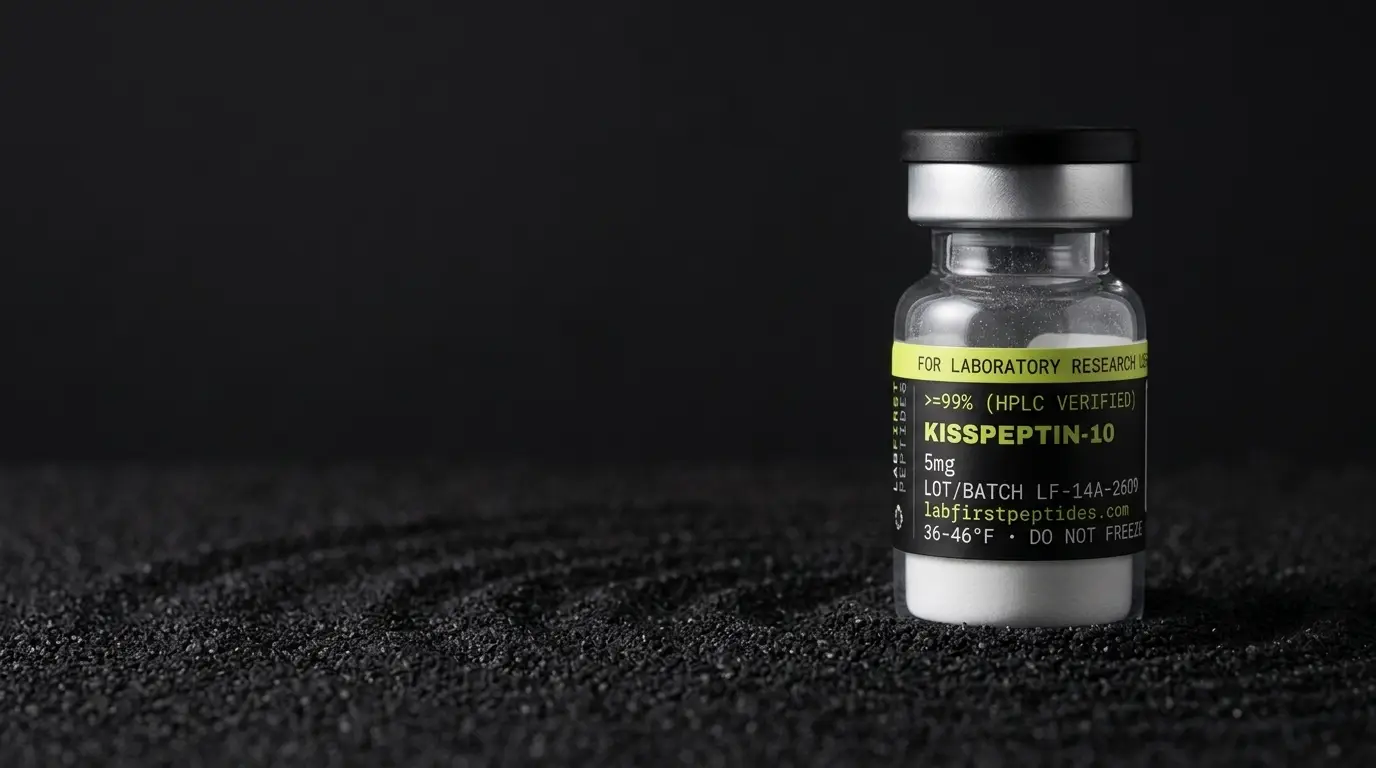
For Kisspeptin-10 storage and stability, keep the dry powder sealed, frozen and dark, and keep any solution in the fridge. Three sites can each add one dalton: two asparagines and the end amide. All three need water, and all three speed up as pH rises.
- Sealed and frozen as powder, refrigerated in solution, dark in both states.
- Three sites can each add one dalton: two asparagines and the terminal amide.
- All three need water and all three accelerate as pH rises, so one precaution covers them.
- The residue following an asparagine decides how fast that site reacts.
- Tryptophan makes light a genuine variable and yields several products, not one.
- None of the one-dalton changes is visible in the vial by any means.
How should Kisspeptin-10 be stored?
In plain terms, dry powder is like dry pasta and a solution is like cooked pasta. The dry form keeps for a long time. Once water is added, the clock starts running faster.
Sealed and frozen as lyophilized powder, refrigerated once a solution exists, and dark in both states.
The dry form is the stable one. Every route this peptide can take needs water, so removing the water by freeze-drying is what makes a sealed vial stable, and that is the condition every retest date assumes.
What distinguishes this compound is not the instruction but the number of ways it can go wrong. Three separate positions in the molecule can each produce a change of about one dalton, and all three are driven by the same conditions.
- Sealed and frozen as lyophilized powder, in the dark
- Three sites each add one dalton: two asparagines and the terminal amide
- All three need water, so the dry sealed vial is where they stop
- All three accelerate as pH rises, so one precaution covers them
- Tryptophan makes light a real variable rather than a formality
- Caking and yellowing are visible; the one-dalton changes are not
What are the three one-dalton routes?
Two asparagine residues, each of which can deamidate, converting an amide side chain into an acid and adding about one dalton. And the C-terminal amide, which can hydrolyse to a free acid for the same net gain.
Three positions, one arithmetic outcome. That is unusual: most peptides in this catalog have one characteristic liability, or none.
It matters for storage because the probability of at least one of them occurring is higher than for a peptide with a single site. Nothing about any of them is visible, and a mass measurement afterwards cannot say which one happened.
What conditions drive them?
Water first, then pH, then temperature, and the ordering is the same for all three.
Deamidation proceeds through an intermediate that forms more readily as pH rises, so alkaline conditions are markedly worse than mildly acidic ones. Amide hydrolysis follows the same direction.
That convergence is the practical gift here. Three different reactions with one shared set of conditions means one set of precautions covers all of them: keep it dry, keep it cold, and if a solution is prepared do not leave it warm or push it alkaline.
Are the two asparagine sites equally vulnerable?
No, and the difference is structural rather than random. Deamidation requires the backbone to fold so the following residue's nitrogen can reach the asparagine side chain.
The smaller the residue that follows, the less stands in the way and the faster the reaction. A bulky neighbour slows it considerably.
So one site in a sequence can be substantially faster than another, and a peptide's overall rate is dominated by its fastest site. Knowing that is why sequence context, rather than a simple count of asparagines, is what determines how careful the handling needs to be.
Why does light matter here?
Because of the tryptophan. Of the common amino acids it is the one most readily degraded by light, and this peptide carries one.
Its indole ring absorbs ultraviolet strongly, which is what gives a usable signal at 280 nanometres and equally what makes photochemistry possible. The property that helps the analyst is the one that damages the material.
Tryptophan photodegradation produces several species rather than one, so it appears as a scatter of small peaks rather than a named impurity. Amber glass or the original carton removes the variable entirely and costs nothing.
Does the tyrosine add anything?
A little, in both directions. Tyrosine also absorbs at 280 nanometres, contributing to the signal there alongside the tryptophan.
It is oxidisable as well, though considerably less readily than tryptophan, so it is a secondary consideration rather than a primary one.
Its practical relevance is that this peptide's 280 nanometre response comes from two residues rather than one. A degradation product that has lost or altered the tryptophan may still absorb there through the tyrosine, so the ratio between the two wavelengths shifts rather than disappearing, which is a subtler signal than a peak vanishing.
What does a retest date actually mean?
It describes an unopened container held under the conditions printed beside it, derived from stability data: units stored at defined temperature and humidity, pulled on a schedule, tested against the release specification.
The date is conditional on those conditions. A vial that spent a week on a warm bench is no longer described by it, and nothing about it looks different.
It is also not a cliff. Material past a retest date is not established as failing, it is outside the evidence, and testing is the honest response rather than assuming in either direction. A pharmaceutical expiry is a stronger claim made under rules research-grade material is not made under.
What happens once the vial is opened?
The moisture clock starts and the certificate stops describing the contents. Lyophilized peptide is hygroscopic, and opening a cold vial in a warm room draws condensation straight onto the powder.
Letting the vial reach room temperature before opening costs nothing and removes the problem. For this compound the payoff is triple, because water is the shared requirement of all three of its routes.
Light exposure begins at first entry too, since a vial open on a lit bench is being illuminated. Working promptly and returning it to the carton is the whole of the technique.
What does stability testing not capture?
Everything after dispatch. A stability study tests unopened units under controlled conditions, so its results describe an ideal a working vial stops matching at first entry.
Transit is the least documented stretch. A parcel can sit in a hot vehicle for a day or freeze overnight and none of it appears on paperwork.
There is a subtler gap for this peptide. If the stability method could not resolve the three one-dalton products from the parent, the study measured a purity figure that would have looked healthy throughout even had they formed. A protocol is only as informative as the method inside it.
What should make you stop using a vial?
Powder that has caked hard or shifted in color. Color deserves attention because tryptophan degradation products are frequently colored, so yellowing is a real signal rather than a cosmetic one.
In solution, cloudiness or visible particulate. A clear solution that has hazed has something in it that was not there before.
None of these will reveal the one-dalton changes, which produce no color, no haze and no visible difference of any kind. That asymmetry is precisely why storage conditions matter more than inspection for this compound.
The proportionate habit is a look before every use, knowing what it can and cannot catch. Powder texture and color, the closure sitting flush, the solution clear. That covers moisture and the oxidative routes. It covers none of the deamidation, which is why the freezer and the carton are doing the real work rather than the inspection.
How does storage relate to the certificate?
They split the timeline and neither covers the other half. A certificate reports what was measured on a sample drawn at one moment, and the certificate guide covers how to read one field by field. Storage evidence covers what happened afterwards.
The split is sharper here than for most compounds. All three liabilities develop after release, so a clean certificate describes material that had not yet had the opportunity to change.
Lot reports for material supplied here resolve through the certificate verification page, and the sizes carried are on the Kisspeptin-10 product record.
What is the regulatory position?
Stability expectations for finished pharmaceutical products are set out in international guidance defining storage conditions, sampling intervals and the testing that supports a shelf-life claim. That framework governs drug products made for human use.
There is no FDA-approved product containing Kisspeptin-10 and no United States pharmacopeial monograph defining an acceptable batch, so no official standard requires the deamidated or hydrolysed forms to be measured or sets a limit for them.
A supplier can honestly report the conditions a lot was held under and what was measured. The useful question stays narrow: what conditions, what measurement, and could the method have seen what this sequence is most likely to do.
FOR LABORATORY AND IN-VITRO RESEARCH USE ONLY. NOT FOR HUMAN OR ANIMAL CONSUMPTION. NOT FOR PERSONAL, MEDICAL, DIAGNOSTIC, THERAPEUTIC, OR RECREATIONAL USE.
What is Kisspeptin-10 studied for?
Published research on Kisspeptin-10 investigates the areas below, which is a different question from what Kisspeptin-10 will do for anyone, a claim about a living system that nothing on this site is sold for.
What it is. A man-made peptide ten building blocks long, the tail end of kisspeptin.
What the research looks at. A substantial body of reproductive-hormone research covering the KISS1 receptor and brain-hormone signalling.
How it is thought to work. It works on the KISS1 receptor. Kisspeptin signalling is a well-described part of basic reproductive biology.
What is not established. No approved drug product contains this fragment. The underlying biology being well described is a statement about the field, not about anything in a vial.
The full record, including the certificate for the lot in stock, is on the Kisspeptin-10 product page.
Common questions
Why does Kisspeptin-10 have three degradation routes?
Are the two asparagine sites equally vulnerable?
What conditions should be avoided?
Why does this peptide need to be kept dark?
Would I see that the peptide had changed?
More documentation guides
Sources
- PubChem Compound Summary for CID 25240297, Kisspeptin-10. The openable record giving the molecular formula C63H83N17O14, and showing the asparagine residues, terminal amide and tryptophan that set the handling described above.
- ICH Q2(R2), Validation of Analytical Procedures . Defines what makes an analytical result valid and reproducible, and is the basis for treating a stability figure whose method could not resolve the likely degradants as uninformative.
- 21 CFR 211.84, Testing and approval or rejection of components and containers. Sets sampling and testing expectations for containers and closures, supporting the treatment of closure integrity as part of the product rather than packaging around it.