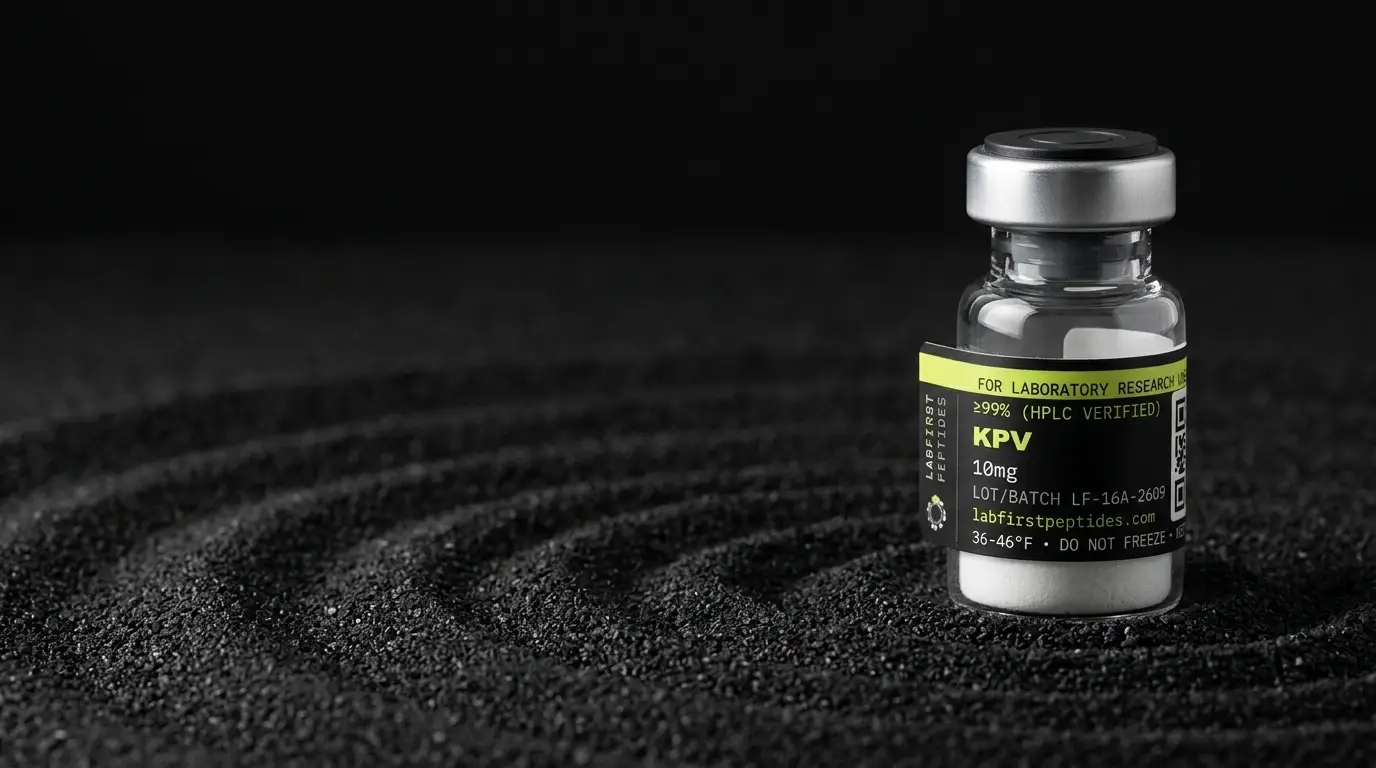
A KPV certificate of analysis is a test report for one lot. Read it in order. Match the lot number to the vial and check the test date. Then look at mass near 342.43, purity with the chart and column conditions, net peptide content, counterion, water, and the lab that issued it.
- KPV is Lys-Pro-Val, C16H30N4O4, average mass near 342.43, PubChem CID 125672.
- Identity is easy at this size; almost everything else is harder because the molecule is small.
- A tripeptide can elute in the solvent front on a standard C18 column, separating from nothing.
- Trifluoroacetate weighs about 113 against a peptide of 342, roughly a quarter of its mass.
- Net peptide content is the decisive field on a small-peptide certificate.
- No aromatic residues means no meaningful absorbance at 280 nm.
What does a KPV certificate actually certify?
One batch, one set of tests, one date: that is the whole reach of a certificate of analysis. Imagine a receipt for that batch alone. It tells you what was checked and when, and it says nothing about any other batch.
It records what a named laboratory measured on a sample drawn from one lot, on one date, by named methods. It is evidence about that sample and not a warranty about the vial on your bench.
Two documents get confused constantly. A specification sheet lists limits the product is supposed to meet, carries no lot number and no results, and describes an intention. A certificate carries both because it describes an event.
If the page has no lot number on its face it is the first kind of document, whatever the heading says.
- Lot number on the report against the lot number on the vial
- Identity: observed mass against an average near 342.43
- Column and mobile phase conditions, because retention is the hard part
- Purity at 214 nm, and not in the solvent front
- Counterion share, which is roughly a quarter of the peptide mass
- Net peptide content, the decisive field on a small peptide
- Accession number confirmed at the issuing laboratory
How do you read it field by field?
Lot number first, against the vial, and nothing further until they match. Then dates: the test date should follow the fill date, and a print date carries no analytical weight.
Then the results. Identity by mass spectrometry. Purity by HPLC, with the chromatogram and, for this compound especially, the column and mobile phase conditions. Net peptide content. Counterion. Water. Appearance last.
The conditions matter more here than for most peptides. A tripeptide is small and polar enough that whether it was retained on the column at all depends on how the separation was set up, and a purity figure from a method where the peptide barely retained is not a meaningful number.
What mass should the identity result show?
KPV is the tripeptide lysine-proline-valine, molecular formula C16H30N4O4, average mass near 342.43, cataloged as PubChem CID 125672.
At 342 daltons this is a very small peptide, and the measurement is correspondingly easy. There is no charge-state envelope to deconvolute and no ambiguity from measurement scatter. The instrument reports a number and the number either matches or it does not.
Identity is the easiest thing to establish about KPV. Almost every other analytical question about it is harder than usual, and the reason is the same in each case: it is small.
Why is a tripeptide hard to hold on a column?
Because reversed-phase chromatography separates by hydrophobicity, and a three-residue peptide carrying a lysine has very little to grip with.
A larger peptide has enough hydrophobic surface to interact with the stationary phase and be retained. KPV is small, polar and positively charged, so on a standard C18 column under ordinary conditions it can elute almost immediately, close to or within the solvent front.
Material that elutes in the solvent front is not separated from anything. Impurities that are also small and polar come off at the same moment, and a purity figure calculated from that region of the chromatogram is measuring very little.
What does a laboratory do about that?
Change the method rather than accept the number. There are three usual approaches and a certificate should say which was used.
An ion-pairing additive such as trifluoroacetic acid pairs with the positive charge on the lysine, making the peptide effectively more hydrophobic and increasing retention. A polar-endcapped or aqueous-compatible column holds small polar analytes that a standard C18 will not. Or the separation mode changes entirely, to hydrophilic interaction chromatography, which retains polar compounds by the opposite mechanism.
Each produces a workable separation. What none of them survives is being left out of the certificate, because a reader then cannot tell whether the reported purity came from a real separation or from a peak sitting in the void volume.
Why does the counterion matter so much here?
Proportion, and this is the single most important commercial fact about a small peptide. A counterion has a fixed mass regardless of what it is paired with.
Trifluoroacetate weighs about 113. KPV weighs about 342. So a single trifluoroacetate counterion is roughly a quarter of the mass of the peptide it is attached to, before any water is counted.
On a 3,000-dalton peptide the same counterion is a few percent and easy to ignore. On a tripeptide it is not ignorable at all, and a vial sold by gross weight can contain markedly less peptide than the label suggests. This is the field to read first on a small-peptide certificate.
What is net peptide content, and why is it decisive for KPV?
It states what fraction of the powder is actually peptide, the rest being counterion, residual water and any inorganic content.
For a tripeptide the gap between gross and net is wider than buyers expect, for the arithmetic reason above. A vial labeled 50 milligrams sold on gross weight may hold appreciably less than 50 milligrams of peptide once the counterion share is subtracted.
Ask which basis the label uses, because both gross and net are legitimate fill bases and only one is comparable between vendors. The cost per milligram comparison ranks the catalog on one basis, which is the only way two quotes can be compared honestly.
What does the purity figure leave out?
Anything that does not absorb at the detection wavelength or does not elute in the region being integrated. KPV contains no tryptophan, tyrosine or phenylalanine, so it has essentially no absorbance at 280 nanometres.
The workable wavelength is 214, which responds to the peptide bond. With only two peptide bonds in the molecule the absolute signal is modest, so sensitivity is lower than for a longer peptide at the same concentration.
That is not a defect in the method, it is a property of a three-residue molecule. It does mean a certificate should state the wavelength, and a KPV purity figure reported at 280 is measuring something the molecule does not meaningfully produce.
What do the water and appearance fields tell you?
Water is measured by Karl Fischer titration, which is specific to water. Loss on drying reports everything volatile and reads high when residual solvent is present, so the two numbers are not interchangeable.
Water matters proportionally more on a small peptide for the same reason the counterion does. A given mass of absorbed moisture is a larger share of a light molecule's powder than of a heavy one's.
Appearance should read as a white to off-white lyophilized powder. It is the least informative line on the certificate and earns its place only as a cheap cross-check a buyer can make against their own vial without equipment.
What does the certificate not cover?
Everything after the sample was drawn. Storage temperature, light, how long the vial has been open and how many times it has been entered are all outside it.
Lyophilized peptide is hygroscopic, and a vial opened in a humid room takes on water that changes the net content arithmetic without changing anything visible. The number was true when measured and is now slightly generous.
Handling belongs with the storage record rather than the test report, and reading a certificate as though it covered both is the common mistake.
How do you verify the document is genuine?
Confirm the report at the issuing laboratory rather than with the seller. An independent laboratory issues each certificate against an accession number that resolves on its own site. If the number resolves to a different product, a different lot, or nothing, the document does not describe your material however professional it looks.
Certificates with the verification key removed deserve particular suspicion, and this is not a hypothetical concern in this market. A PDF is easy to edit; a third-party lookup is not.
Lot reports for material supplied here resolve through the certificate verification page, and the sizes carried appear on the KPV product record.
What is the regulatory position?
There is no FDA-approved drug product containing KPV and no United States pharmacopeial monograph defining what an acceptable batch is. The specification a lot is released against is the supplier's own, which is worth stating plainly rather than working around.
What a research certificate can honestly establish is narrower and still useful: what a named laboratory measured, on a named lot, on a named date, by named methods. For this compound the methods clause carries unusual weight, because the separation conditions decide whether the purity figure means anything.
Material described here is supplied for laboratory use only, and nothing in this guide describes use in a person or an animal.
FOR LABORATORY AND IN-VITRO RESEARCH USE ONLY. NOT FOR HUMAN OR ANIMAL CONSUMPTION. NOT FOR PERSONAL, MEDICAL, DIAGNOSTIC, THERAPEUTIC, OR RECREATIONAL USE.
What is KPV studied for?
Published research on KPV investigates the areas below, which is a different question from what KPV will do for anyone, a claim about a living system that nothing on this site is sold for.
What it is. A man-made three-building-block peptide, the tail end of the hormone alpha-MSH.
What the research looks at. It appears in animal and cell research on inflammation.
How it is thought to work. It matches the last three building blocks of alpha-melanocyte-stimulating hormone. Published work covers melanocortin-related signalling in cells and animals, and the details are not settled.
What is not established. No approved product. As a three-building-block piece it does not do everything the whole hormone does, and should not be described as if it did.
The full record, including the certificate for the lot in stock, is on the KPV product page.
Common questions
What molecular mass should a KPV certificate show?
Why is a tripeptide difficult to separate?
How do laboratories retain small peptides?
Why does the counterion matter more for KPV than for a large peptide?
Can KPV purity be measured at 280 nanometres?
Published certificates for KPV
Every figure below is read from a report the laboratory issued for that lot; each page carries the PDF and the lab's own verification link.
More documentation guides
Sources
- PubChem Compound Summary for CID 125672, Lys-Pro-Val. The openable record for KPV, giving the molecular formula C16H30N4O4 and the average mass near 342.43 that an identity result is read against.
- ICH Q2(R2), Validation of Analytical Procedures . Defines specificity for an assay, including the requirement that the method separate the target from other components, which is the clause a solvent-front elution fails.
- FDA guidance, Q6B Specifications: Test Procedures and Acceptance Criteria. Sets out how identity, purity and content are reported as separate attributes, and why a purity result is inseparable from the conditions that produced it.
- Finnrick independent verification portal. Third-party lookup used to confirm a certificate resolves to the lot it claims to describe, rather than confirming a document with the seller who supplied it.