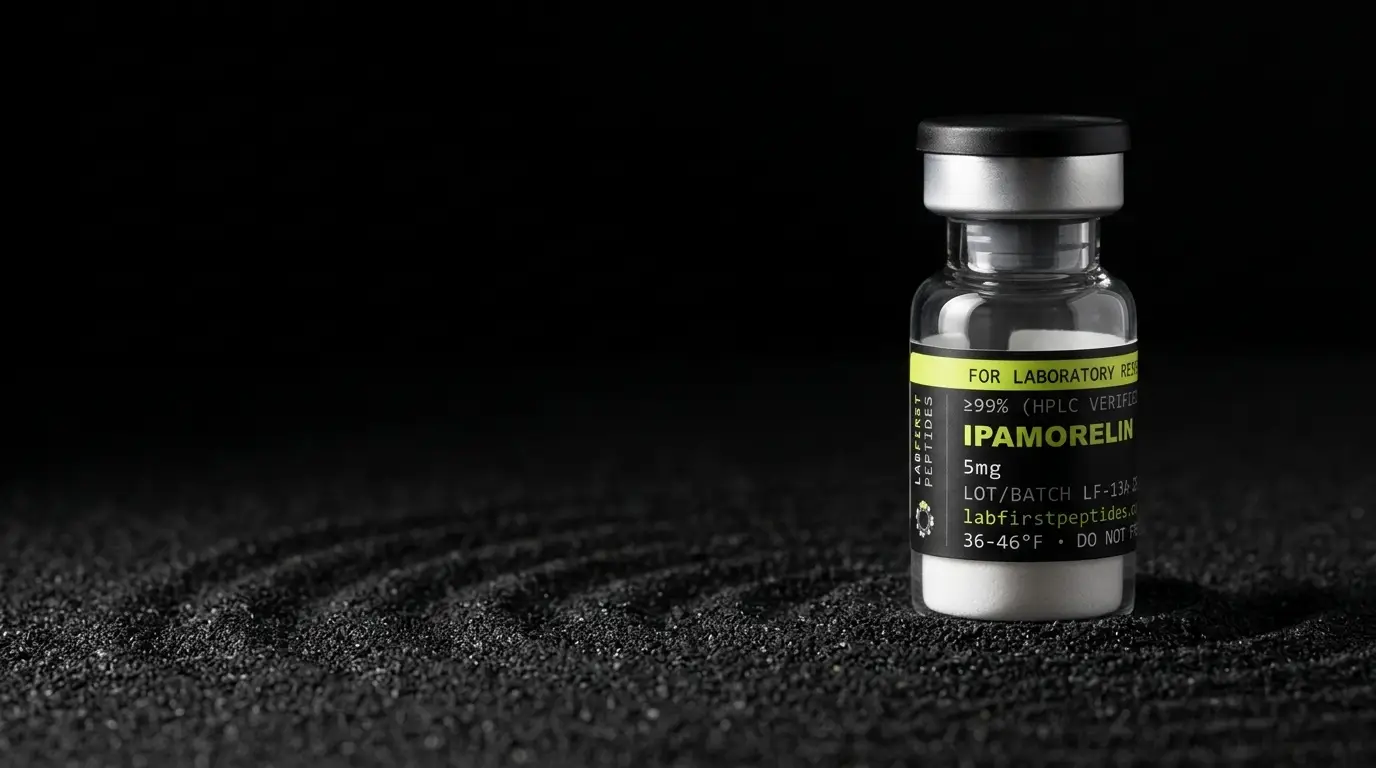
For ipamorelin storage and stability, keep the dry powder sealed, frozen and dark, and keep any solution in the fridge. Its unusual building blocks resist enzymes, which matters in biological samples but not in a sealed vial. In the vial, the real risks are moisture and loss of the end amide.
- Sealed and frozen as powder, refrigerated in solution, dark in both states.
- D-amino acids resist ENZYMES, which is irrelevant in a sealed vial with no enzymes present.
- Hydrolysis and C-terminal amide loss are the routes that actually apply, and both run on water.
- The free acid form weighs about one dalton more and is invisible without a mass measurement.
- No sulfur in C38H49N9O5 means no methionine, so oxidation is milder than for Semax.
- Aromatic side chains are the reason dark storage still earns its place.
How should ipamorelin be stored?
In plain terms, dry powder is like dry pasta and a solution is like cooked pasta. The dry form keeps for a long time. Once water is added, the clock starts running faster.
Sealed and frozen as lyophilized powder, refrigerated once a solution exists, and out of light in both states.
The dry form is the stable one. Freeze-drying removes the water that hydrolysis needs, and a sealed vial below freezing in the dark is the condition every retest date assumes.
Refrigeration rather than freezing suits a vial in regular use, trading a little stability for fewer temperature cycles. Light is worth taking seriously here because the molecule carries aromatic side chains, and aromatic rings are where photochemistry starts.
- Sealed and frozen as lyophilized powder, in the dark
- D-amino acids resist enzymes, and a sealed vial contains none
- Hydrolysis and amide loss are the real routes, and both need water
- Open the vial at room temperature to avoid condensation
- The free acid form is one dalton heavier and otherwise invisible
- Caked powder or a hazy solution ends the vial
Do the D-amino acids make it more stable?
Against enzymes, considerably. Against chemistry, not at all, and the distinction is the one most listings blur.
Ordinary peptidases evolved to recognize L-amino acids. A residue in the D configuration is the mirror image and does not fit the enzyme's active site, so a chain containing D residues resists enzymatic cleavage that would destroy an all-L sequence quickly.
That advantage exists in a biological matrix, where enzymes are present. In a sealed vial on a shelf there are no enzymes at all, so it contributes nothing to storage stability. Hydrolysis by water, oxidation and every other chemical route work identically on D and L residues.
What does the unnatural residue contribute?
The same kind of protection from the same direction. Alpha-aminoisobutyric acid is not a standard protein amino acid, and its presence in the chain gives an enzyme another feature it was not built to process.
It also has a structural effect. The residue constrains the backbone's flexibility, favoring particular conformations, which is part of why the molecule behaves as it does biologically.
Neither property helps a vial in a freezer. This is worth saying plainly because peptide listings frequently describe enzymatic resistance as though it were shelf stability, and buyers reasonably conclude the material needs less care than it does.
Which degradation routes actually apply?
Three, and none of them involves an enzyme. Hydrolysis needs water, which is why lyophilized material is stable and a solution is not, and why moisture ingress is the fault that undoes the rest of your care.
Loss of the C-terminal amide is the route specific to this molecule. The amide can hydrolyse to a free carboxylic acid, which produces a different compound weighing about one dalton more.
Oxidation is the third, and it is milder here than for a peptide carrying a methionine. There is no sulfur in C38H49N9O5, so the most oxidation-prone residue is absent, though aromatic side chains are not entirely inert to light and oxygen.
Why does amide loss matter more than it sounds?
Because one dalton on a 712-dalton molecule is a small number describing a real change. The amide and the free acid are different compounds with different properties.
It is also silent. The powder looks identical, the color does not change, and a purity method that does not resolve the acid form from the parent will count both inside the main peak.
The good news is that it is easy to detect when someone looks. A mass spectrometer separates 712 from 713 without difficulty, so a certificate reporting the observed mass gives a reader the evidence directly. One reporting identity confirmed does not.
What does a retest date actually mean?
It describes an unopened container held under the conditions printed beside it, derived from stability data: units stored at defined temperature and humidity, pulled on a schedule, tested against the release specification.
The date is conditional on those conditions. A vial that spent a week on a warm bench is no longer described by it, and nothing about the vial looks different.
It is also not a cliff. Material past a retest date is not established as failing, it is outside the evidence, and the honest response is to test rather than assume in either direction. A pharmaceutical expiry is a stronger claim made under rules research-grade material is not made under.
What happens once the vial is opened?
The moisture clock starts and the certificate stops describing the contents. Lyophilized peptide is hygroscopic, and opening a cold vial in a warm room draws condensation straight onto the powder.
Letting the vial reach room temperature before opening costs nothing and removes the problem. For this compound the payoff is direct: water is what drives both backbone hydrolysis and the loss of the C-terminal amide.
Moisture also quietly makes the certificate's net content figure optimistic, because the powder now weighs more per unit of peptide than it did at test. The number was accurate and is now slightly generous.
Does the container matter as much as the temperature?
Close to it. The vial and its closure are what exclude moisture and air, and the storage claim depends on both holding.
A stopper pierced repeatedly, or with a blunt needle, may not reseal cleanly. That admits humid air into a vial whose entire rationale is that it does not get in, and the powder looks unchanged for some time afterwards.
Light transmission matters because of the aromatic residues. Amber glass solves it and so does the original carton, and the carton is free.
What does stability testing not capture?
Everything after dispatch. A stability study tests unopened units under controlled conditions, so its results describe an ideal a working vial stops matching at first entry.
Transit is the least documented stretch. A parcel can sit in a hot vehicle for a day or freeze overnight, and none of it appears on paperwork. For a dry powder the chemical risk from that is modest; the mechanical risk to the closure is not, and a stressed seal can look perfect.
Handling is the other gap. Freeze-thaw cycles, a solution left warm while work is in progress, a vial standing open on a humid bench. All real, all common, none of it in the data.
What should make you stop using a vial?
Powder that has caked or changed color. Caking is the visible form of moisture ingress, and for a peptide whose main routes both run on water it is the signal that matters.
In solution, cloudiness or visible particulate. A solution that has hazed has something in it that was not there before, and no document accounts for it.
A closure that has lifted, cracked or no longer sits flush counts even when the contents look untouched. What none of these will show is amide loss, which is invisible, and that is exactly why storage conditions matter more than inspection.
The habit worth building is a look before every use rather than a test after a surprise. Powder texture, color, the closure sitting flush, the solution clear. It takes seconds, needs no equipment, and catches the class of problem that arises between the laboratory that wrote the certificate and the bench where the vial is actually used.
How does storage relate to the certificate?
They split the timeline and neither covers the other half. A certificate reports what was measured on a sample drawn at one moment, and the certificate guide covers how to read one field by field. Storage evidence covers what happened afterwards.
The split has a specific edge here. Amide hydrolysis happens after release, driven by moisture, so a clean mass result at test says nothing about whether it has happened since.
Lot reports for material supplied here resolve through the certificate verification page, and the sizes carried are on the ipamorelin product record.
What is the regulatory position?
Stability expectations for finished pharmaceutical products are set out in international guidance defining storage conditions, sampling intervals and the testing that supports a shelf-life claim. That framework governs drug products made for human use.
There is no FDA-approved product containing ipamorelin and no United States pharmacopeial monograph defining an acceptable batch, so a research certificate does not carry pharmacopeial weight. A supplier can honestly report the conditions a lot was held under and what was measured; presenting that as a drug product shelf life would overstate it.
The useful question stays narrow: what conditions, what measurement, what date.
FOR LABORATORY AND IN-VITRO RESEARCH USE ONLY. NOT FOR HUMAN OR ANIMAL CONSUMPTION. NOT FOR PERSONAL, MEDICAL, DIAGNOSTIC, THERAPEUTIC, OR RECREATIONAL USE.
What is Ipamorelin studied for?
Published research on Ipamorelin investigates the areas below, which is a different question from what Ipamorelin will do for anyone, a claim about a living system that nothing on this site is sold for.
What it is. A man-made five-building-block peptide that makes the pituitary release growth hormone.
What the research looks at. Characterised by Raun and colleagues in 1998, and present in the growth-hormone releaser research ever since.
How it is thought to work. It works on the ghrelin receptor. Its build is deliberately defensive: an unusual building block at one end, two others flipped into their mirror-image form, a bulky side chain, and a capped tail. It contains none of the four building blocks that normally react with oxygen or break down, so the usual routes of decay simply are not there.
What is not established. No approved product and no official standard. Its unusual chemical toughness is a fact about storage, not a statement about what it does in any living thing.
The full record, including the certificate for the lot in stock, is on the Ipamorelin product page.
Common questions
Do the D-amino acids make ipamorelin more stable in storage?
Does ipamorelin need to be frozen?
What is amide hydrolysis and why does it matter?
Does ipamorelin oxidise?
What does caked ipamorelin powder mean?
More documentation guides
Sources
- PubChem Compound Summary for CID 9831659, Ipamorelin. The openable record giving the molecular formula C38H49N9O5, whose absence of sulfur supports the oxidation discussion, and showing the C-terminal amide whose loss is described above.
- ICH Q2(R2), Validation of Analytical Procedures . Defines what makes an analytical result valid and reproducible, and is the basis for treating a stability figure without a named method and stated conditions as unverifiable.
- 21 CFR 211.84, Testing and approval or rejection of components and containers. Sets sampling and testing expectations for containers and closures, supporting the treatment of closure integrity as part of the product rather than packaging around it.