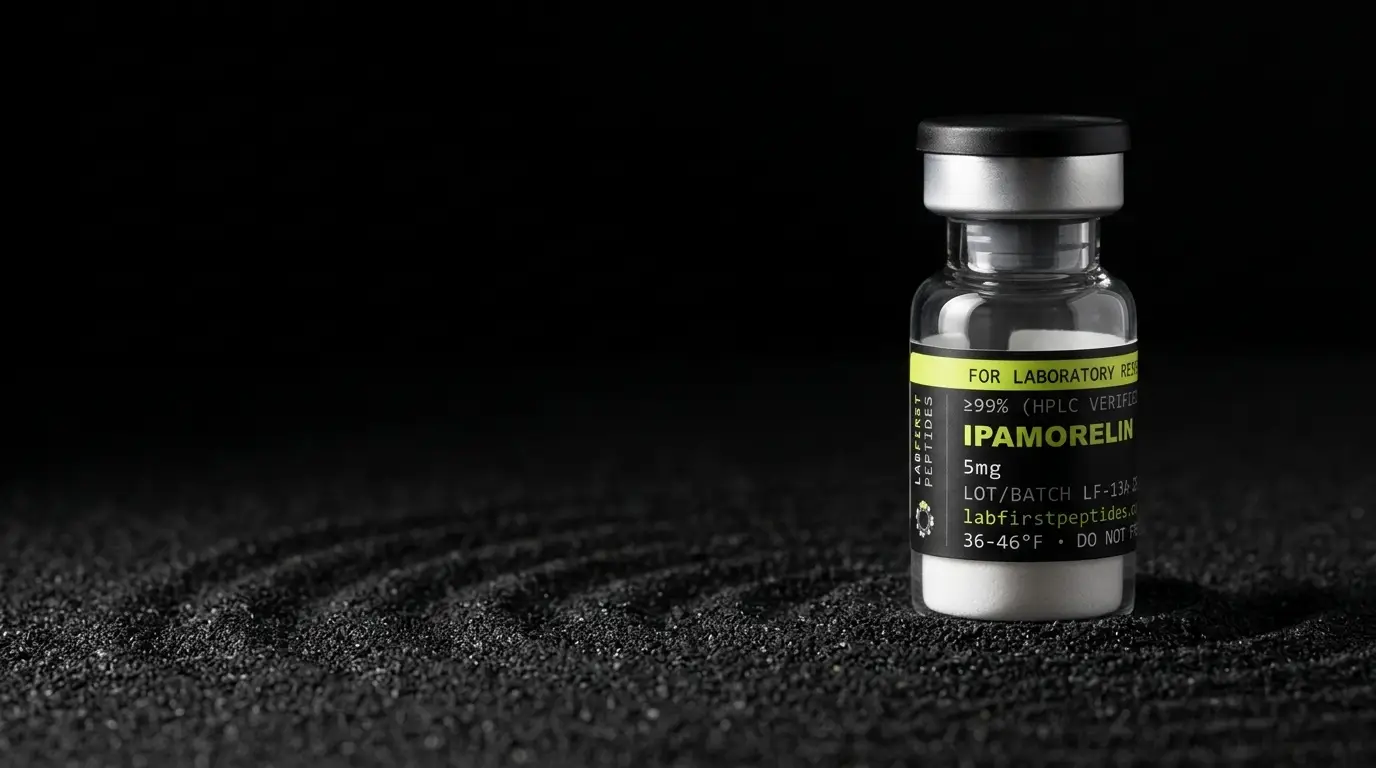
Ipamorelin identity is confirmed with a mass reading near 711.9, a check that the end amide is still intact, and a separation read at two wavelengths. The weak spot is handedness. Two of its building blocks are the D form, and mass spectrometry cannot tell left from right at all.
- Ipamorelin is C38H49N9O5, average mass near 711.9, PubChem CID 9831659.
- The mass also confirms the C-terminal amide: the free acid weighs about one dalton more.
- Chirality is invisible to mass spectrometry, because mirror images weigh the same.
- A standard reversed-phase column does not reliably separate stereoisomers.
- Alpha-aminoisobutyric acid may be silently omitted by routine amino acid analysis.
- 2-naphthylalanine gives a strong chromophore, so 214 and 280 nm offer two views.
What does identity mean for this peptide?
That the molecule in the vial is the one the label names. Ipamorelin is a pentapeptide, molecular formula C38H49N9O5, average mass near 711.9, cataloged as PubChem CID 9831659.
Identity and purity are different questions, and a certificate answering one has answered half. For most peptides identity is the easier of the two. For this one it is the harder, because the molecule is defined by features a routine panel cannot measure.
Two of its five residues are in the D configuration and one is not a standard protein amino acid at all. Both facts are central to what the compound is, and neither shows up in a mass.
- Observed mass against an average near 711.9
- C-terminal amide confirmed: the free acid weighs about one more
- RP-HPLC separation read at 214 nm, with 280 nm as a second view
- Stereochemistry, which mass spectrometry cannot address at all
- Chiral analysis on a handed stationary phase, where the report carries it
- Composition, checking the unnatural residue was actually measured
- Accession number confirmed at the issuing laboratory
What does the mass result confirm?
That the assembled molecule weighs what ipamorelin weighs. At 712 daltons the measurement is comfortable: a simple charge pattern rather than a broad envelope, and no meaningful scatter to hide a discrepancy inside.
A missing residue, an extra one, a truncated chain or an unremoved protecting group all shift the mass by amounts the instrument resolves immediately.
So the mass rules out a large class of synthesis failures efficiently. What it cannot do is distinguish molecules that contain the same atoms arranged the same way, and this peptide has two of those distinctions built into its definition.
How does the mass confirm the C-terminal amide?
By one dalton. Ipamorelin terminates in an amide rather than a free carboxylic acid, and if that amide is absent the molecule is the free acid, weighing about one more.
On a 712-dalton peptide that is a clean, unambiguous difference. The two species are easily separated on a mass spectrometer and often poorly separated on a column, so the mass is doing work the chromatogram may not.
This is why the observed mass belongs on the certificate as a number. Printed as a figure it lets a reader check both that the chain assembled and that the C-terminus is the right chemical group. Printed as the words identity confirmed it lets them check neither.
Why is chirality invisible to mass spectrometry?
Because a D-amino acid and its L counterpart are mirror images. They contain identical atoms connected in an identical order, differing only in three-dimensional handedness.
Mass depends on which atoms are present, not on how they are arranged in space. So the D form and the L form weigh exactly the same, to any number of decimal places a mass spectrometer can report.
The consequence is direct. A synthesis that accidentally installed an L residue where a D was intended produces a different molecule with an identical mass, and every mass-based check will pass it. That is not a flaw in the instrument. It is the wrong instrument for that question.
Does chromatography separate stereoisomers?
Not on an ordinary column. A standard reversed-phase stationary phase is not itself handed, so it interacts with both mirror images the same way and they elute together.
A diastereomer, which is what a peptide becomes when one of several chiral centers is inverted, can sometimes be resolved on a conventional column because the overall shape differs. That is a possibility rather than a guarantee, and it depends on the method having been developed with the separation in mind.
Relying on it accidentally is the risk. A method that happens not to resolve the inverted isomer will report it inside the main peak, and the purity figure will look better than the material is.
What does chiral analysis actually involve?
Two routes. The usual one hydrolyses the peptide back to its free amino acids and analyses those on a chiral stationary phase, which separates D from L because the phase itself is handed. It answers whether the right proportions of each configuration are present.
The more direct route develops a chiral separation of the intact peptide. That is harder, and it answers the sharper question of whether this molecule is the intended stereoisomer.
Neither is routine on a research certificate. Chiral analysis is specialised and adds cost, and its absence is a limit rather than a scandal. It is worth knowing that a certificate without it has confirmed the composition and not the configuration.
What does the unnatural residue do to composition analysis?
It can quietly fall out of the answer. Alpha-aminoisobutyric acid is not among the twenty residues a routine amino acid analysis is calibrated for.
A standard panel may not report it, or may report it as an unidentified peak. Either way, a composition result that silently omits a residue it could not measure is easy to misread as a complete inventory.
This matters for this compound specifically. The unnatural residue is part of what makes it ipamorelin rather than some other pentapeptide, so a composition check that skipped it has not confirmed the thing a reader most wants confirmed.
Why does having a chromophore help?
Because it provides a genuine second view of the same separation. Ipamorelin contains 2-naphthylalanine and phenylalanine, and the naphthalene ring absorbs strongly in the ultraviolet.
Peptides are normally read at 214 nanometres, which responds to the peptide bond and therefore detects everything with a backbone. Reading at 280 detects only what carries an aromatic ring.
Comparing the two is informative. A peak present at 214 but absent at 280 has no aromatic residue, which says something concrete about what that impurity is. Most peptides in this catalog cannot offer that cross-check, because they have nothing absorbing at 280 at all.
What does a mis-identified peptide look like here?
Rarely like an obvious fake. The plausible failures are the free acid form described above, a truncated chain, a stereoisomer with one inverted center, or genuinely correct material that is substantially salt by weight.
The stereoisomer is the one this compound is unusually exposed to, because it is built from D residues on purpose. A peptide made entirely from L-amino acids would have no such failure mode available, since there would be nothing to invert.
None of this makes certificates worthless. It makes the method list the thing to read, because the methods define which of these failures the document was capable of detecting.
How do you check the report describes your vial?
Confirm the accession or verification number at the issuing laboratory rather than with the seller. The laboratory holds the record; a seller holds a copy of a document. If the number resolves to a different lot, a different product, or nothing, the analysis is not evidence about your material.
Then match the lot number on the report to the vial. Rigorous analysis attached to the wrong batch is not rigour, and that mismatch is more common than falsified results.
Reports for material supplied here resolve through the certificate verification page, and the sizes carried appear on the ipamorelin product record.
What should you ask a supplier about identity?
Three questions. What was the observed mass, as a number. Was the C-terminal amide confirmed rather than assumed. And was any chiral or composition work done beyond the mass and the chromatogram.
The third is the one specific to this molecule. A peptide defined by its D residues and an unnatural amino acid is a peptide whose identity a routine panel only partly establishes, and a supplier who understands their own product will not find the question unreasonable.
How to read the rest of the document is covered in the certificate guide.
What is the regulatory position?
International guidance on analytical validation defines what makes an identity method fit for purpose: specificity, accuracy, precision, and a demonstration that the method distinguishes the target from what else might plausibly be present. For a chiral molecule, mass spectrometry cannot satisfy that clause by itself.
There is no FDA-approved product containing ipamorelin and no United States pharmacopeial monograph, so no official standard defines how stereochemical purity should be demonstrated or what limit applies. The specification is the supplier's own.
What a research certificate can honestly establish is what a named laboratory measured, on a named lot, by named methods.
FOR LABORATORY AND IN-VITRO RESEARCH USE ONLY. NOT FOR HUMAN OR ANIMAL CONSUMPTION. NOT FOR PERSONAL, MEDICAL, DIAGNOSTIC, THERAPEUTIC, OR RECREATIONAL USE.
What is Ipamorelin studied for?
Published research on Ipamorelin investigates the areas below, which is a different question from what Ipamorelin will do for anyone, a claim about a living system that nothing on this site is sold for.
What it is. A man-made five-building-block peptide that makes the pituitary release growth hormone.
What the research looks at. Characterised by Raun and colleagues in 1998, and present in the growth-hormone releaser research ever since.
How it is thought to work. It works on the ghrelin receptor. Its build is deliberately defensive: an unusual building block at one end, two others flipped into their mirror-image form, a bulky side chain, and a capped tail. It contains none of the four building blocks that normally react with oxygen or break down, so the usual routes of decay simply are not there.
What is not established. No approved product and no official standard. Its unusual chemical toughness is a fact about storage, not a statement about what it does in any living thing.
The full record, including the certificate for the lot in stock, is on the Ipamorelin product page.
Common questions
What mass should ipamorelin show on a certificate?
Why can mass spectrometry not confirm the D-amino acids?
Will an ordinary column separate stereoisomers?
What does chiral analysis involve?
Why does the unnatural residue complicate composition analysis?
More documentation guides
Sources
- PubChem Compound Summary for CID 9831659, Ipamorelin. The openable record giving the molecular formula C38H49N9O5 and average mass near 711.9, and showing the D-configuration residues and C-terminal amide that this page turns on.
- ICH Q2(R2), Validation of Analytical Procedures . Defines specificity, including that a method must distinguish the target from closely related substances. For a chiral molecule that is precisely the clause a mass measurement cannot satisfy.
- FDA guidance, Q6B Specifications: Test Procedures and Acceptance Criteria. Sets out identity, purity and content as separate attributes and why stereochemical identity is specified separately where it applies to the molecule.
- Finnrick independent verification portal. Third-party lookup used to confirm a certificate resolves to the lot it claims to describe, rather than confirming a document with the seller who supplied it.