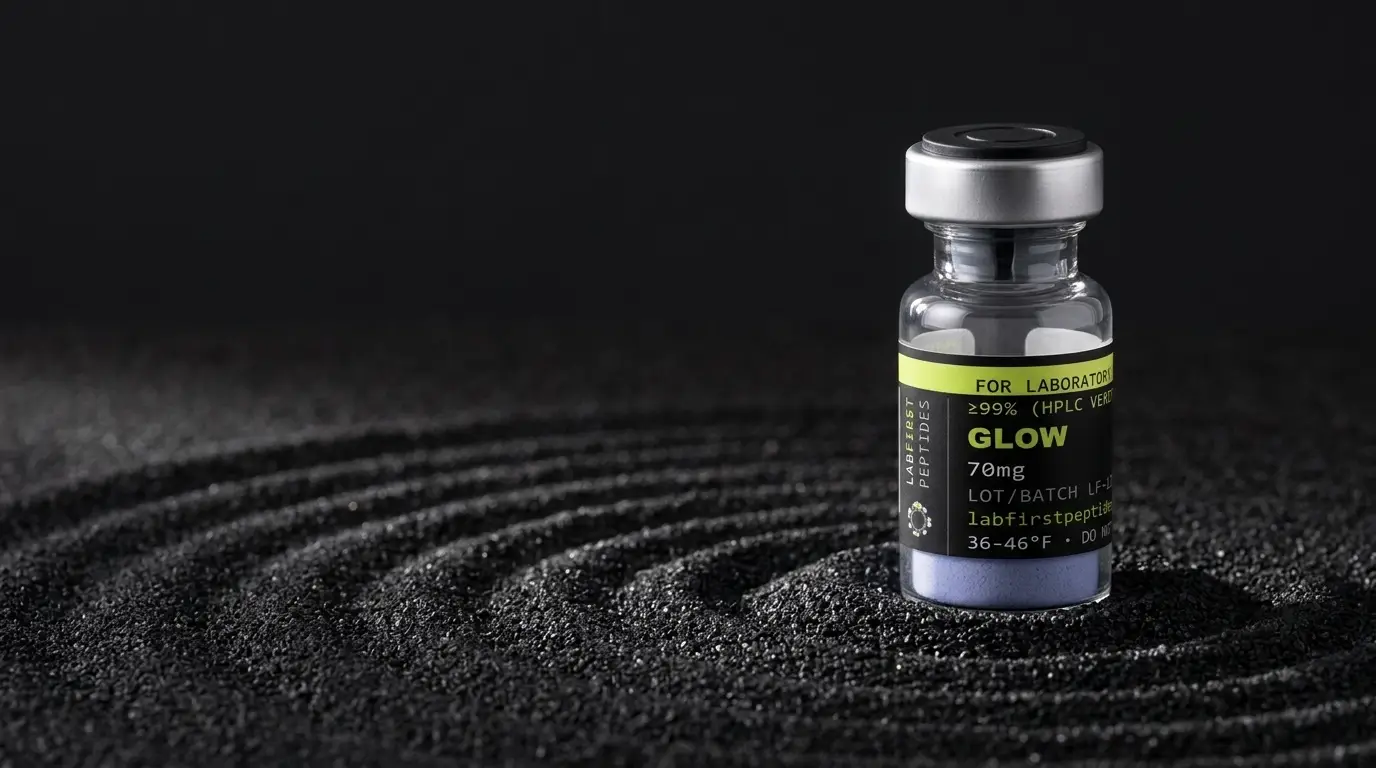
GLOW is a brand name for several peptides freeze-dried together in one vial. GLOW is sold here for laboratory research in 1 size (70mg), from $110.00 a vial. It is not an FDA-approved medicine. Research use only, and never for people or animals.
GLOW specifications
| Product name | GLOW |
|---|---|
| Also sold as | GLOW blend peptide, GLOW 70, GLOW peptides, GLOW peptide |
| Physical form | Freeze-dried powder, a solid cake in a sealed vial |
| Appearance | Colored cake, this compound carries its own color rather than being dyed |
| Sizes on this page | 70mg |
| Purity specification | ≥99% by RP-HPLC. The number for the lot you receive is whatever its own certificate says. |
| Identity check | Mass spectrometry, read against the mass this compound should have |
| Net content | Weighed per lot and reported separately from purity |
| Lot documentation | 1 of 1 size has a published Kovera Labs certificate (70mg, lot LF-12A-2609) |
| Storage | Sealed, cold and out of the light |
| Ships from | Santa Ana, California by USPS with tracking on every order, same business day on verified in-stock orders placed before 12 PM Pacific |
| Intended use | Laboratory research only. Not for human or animal use. |
What is GLOW, and what is it used for?
One vial holding BPC 157, GHK-Cu and TB-500, at the amount of each stated on the label, sold as laboratory material.
GLOW is also listed and searched as GLOW blend peptide, GLOW 70, GLOW peptides, GLOW peptide, GLOW blend, BPC GHK-Cu TB-500 blend. They all mean the same blend. Supplier lists write it as GLOW peptides or peptide GLOW as well; every one of those is this record. A name is not a test, which is why the lot record further down counts for more than the wording on a label.
The vial holds GHK-Cu, BPC 157, TB-500 freeze-dried together. Each component has its own formula and its own record; the certificate for this lot reports on the mixture as sold.
A brand name for several peptides freeze-dried together in one vial.
A blend name, not a molecule. Whatever mechanism there is belongs to the separate ingredients, and those are described on their own records.
The ingredients appear separately in the research. The blend as sold is a way of packaging them and has not itself been studied.
Blend names are not standardized between suppliers, so the same name can mean different ingredients in different amounts. Read the certificate for what is actually in the vial rather than trusting the name.
GLOW for sale: 70mg vials, price per mg
GLOW is sold in 1 size here, 70mg, from $110.00 a vial. GLOW cost and GLOW price per mg by size are in the table, at each volume tier and on subscription; the per-mg figure under each price is the one that compares across sizes.
Volume and subscription pricing by size
| Size | One vial | 10–19 vials−10% | 20 vials−15% | Subscribe monthly−6% from shipment 2 | Availability |
|---|---|---|---|---|---|
| GLOW 70mg | $110.00$1.57/mg | $99.00a vial · $1.41/mg | $93.50a vial · $1.34/mg | $103.40a vial, shipment 2 on · $1.48/mg | In stock |
Volume tiers are per size and do not combine across sizes (see bulk pricing). Subscribe & Save takes 6% every month, 4% every 2 months or 2% every 3 months off from shipment 2, two shipments minimum, and stacks on the volume tier: the lowest this record ever bills is $1.26 per mg, twenty 70mg vials on a monthly subscription from shipment 2 onward.
Nothing is added at checkout except the USPS shipping you choose; dispatch and delivery are the same on every order. The cost-per-milligram tool ranks the whole catalog by price per mg. The certificate walked through field by field: Where to Buy GLOW Peptide: Five Checks Before You Order.
Where to buy GLOW: what to check before you order from anyone
Where to get GLOW, and how to buy GLOW online
GLOW for sale, or GLOW peptide for sale, means this page: one record, 1 size. You can buy GLOW online here with guest checkout, and purchase GLOW or order GLOW in any size below; verified in-stock orders placed before 12 PM Pacific are dispatched the same day. If the question is where to get GLOW or how to get GLOW, the answer for a US laboratory is a supplier who publishes the certificate before you pay, which is the first of the five checks that follow.
Before ordering GLOW from anyone, us included, run the 5 checks on verifying a certificate; the first is that the report resolves on the laboratory's own site, and a seller who cannot pass them is asking for the trust a certificate exists to replace.
GLOW cream or serum, capsules or oral form? What this vial is, and is not
Search results for GLOW also show cream or serum, capsules, oral form products, under listing titles such as copper glow peptide cream, glow peptide serum, glow peptide capsules, glow peptide oral, glow peptide pills, glow peptide pill form. Those are finished consumer goods made and marketed by other companies, and none of them is what this page sells. This record is freeze-dried GLOW in a sealed glass vial, 70mg, with a lot certificate, supplied for laboratory work. Its certificate describes that powder, not a capsule, spray or cream, which carry other ingredients and sit under different rules.
GHK-Cu, BPC 157 and TB-500: the blend, and each on its own
GLOW is a blend name, not a molecule. What the vial holds is the components below, and each of them is documented on its own record with its own certificate. The name is not standardized between suppliers, so two vials called GLOW from two sellers can hold different amounts, which is why the certificate matters more than the label.
| Record | Class | Formula | Avg. mass | Sizes here |
|---|---|---|---|---|
| GLOW | A brand name for several peptides freeze-dried together in one vial. | blend of 3 | — | 70mg from $110.00 |
| GHK-Cu | A three-building-block peptide (glycine, histidine, lysine) joined to copper. | C14H24N6O4 | 340.38 | 50mg · 100mg from $39.00 |
| BPC 157 | A man-made fifteen-amino-acid peptide, based on a protein found in stomach juice. | C62H98N16O22 | 1419.5 | 5mg · 10mg from $55.00 |
| TB-500 | A man-made peptide matching a section of thymosin beta-4. | C38H68N10O14 | 889 | 5mg · 10mg from $54.00 |
Documentation compared in full: GLOW vs GHK-Cu, side by side.
GLOW guides and documentation
Written to answer the questions that come up around GLOW specifically, what its paperwork should show, how it is handled, and how to judge a supplier selling it.
- Glow peptide: what is in a GLOW vial, and why the ratio lives on the certificate
- GLOW certificates of analysis: how to read a report on three peptides at once
- How GLOW identity gets confirmed when one sample holds three peptides
- GLOW storage and stability: keeping a three-peptide vial dry, cold and documented
- Where to buy GLOW Peptide: reading the listing and the lot record
- Where to buy KLOW Peptide: what a blend’s documentation has to cover
The full library, grouped by what you came to answer, is in the laboratory guides.
The GLOW certificate: lot, purity, identity, and how to verify it
A certificate answers identity, purity and net content as three separate questions, each with the method that produced it and the date it was run, how to read one covers what each field does and does not cover.
| Size | Lot | Identity method | Purity | Endotoxin · sterility · fentanyl | Test date |
|---|---|---|---|---|---|
| 70mg | LF-12A-2609 | LC-MS | 99.416% (RP-HPLC, C18, DAD @ 214 nm) | 2026-09-29 |
Testing by Kovera Labs. Every batch tested on or after October 1, 2026 includes endotoxin, sterility and fentanyl screening, in addition to identity, purity and net content. Open the report, then confirm it on the issuing laboratory's own site. If the identifier does not resolve there, or resolves to a different lot than the one printed on your vial, the document is worthless however convincing it looks.
The lot number on the certificate must match the lot printed on the vial you received. That match is the only thing tying the document to your material. Net content is reported separately from purity, because a vial can be highly pure and still hold less material than its label states.
Where the FDA stands on GLOW
FDA status, and what this listing is Not an FDA-approved drug product
The FDA has not approved this compound for anything, and nothing in this catalog is a medicine.
Status verified 2026-08-25. Check the primary source before relying on this summary.
It is sold as laboratory material under the research-use restriction below. Being listed is not an approval, and not a claim that it is safe, effective or right for any purpose.
GLOW research: what the published studies examine
Status: No FDA-approved application. This compound is sold as laboratory material. Where research on it has been published, it sits at the animal, cell or early-human stage, and this record does not summarize what it found. A supplier is not a neutral judge of evidence about its own catalog.
GLOW is a blend name, not a molecule, and it is a supplier invention with no standing in the research. The vial holds GHK-Cu, BPC 157 and TB-500. Nothing has been published on the three given together, and the name itself hints at a cosmetic result that no study supports. What goes into a vial called GLOW is not standardized either, so two vials with that name from two suppliers may not hold the same amounts, or even the same ingredients.
Each component is documented on its own record:
- GHK-Cu, a three-building-block peptide that carries copper; studied in skin repair
- BPC 157, a fifteen-building-block peptide from stomach protein; studied in rodent tendon, muscle and gut injury
- TB-500, a piece of the protein thymosin beta-4; studied in how cells hold their shape and move
Open questions. No study has looked at this combination, and the name is marketing rather than chemistry. Because there is no standard recipe behind it, the only reliable statement about what a GLOW vial holds is whatever the certificate for that specific lot reports. Two compounds together are not simply the sum of the two.
Sharing a vial, they can leave the body by the same route, compete for the same transport, change each other’s stability in solution, or hide each other in a test, and none of that can be predicted from the separate records. There is a practical point too. A test report on a blend has to pick out each ingredient on its own, which is a harder job than testing a single compound, and some labs report only one number for the whole vial.
When comparing suppliers on a blend, the question worth asking is whether the certificate names and measures each ingredient separately or gives one number for the lot.
No published study has examined this combination as sold. Nothing above describes what GLOW would do in a person or an animal, and none of it is a recommendation to use it for anything.
How to store GLOW: refrigeration and shelf life
Keep the sealed vial cold and out of the light and it stays as it left the lab. Once it is mixed into a solution, how long it holds up depends on the compound, what it was mixed with, how strong the solution is and how cold it is kept — too many variables for anyone to print one shelf life on a label. So laboratories write the date on whatever they prepare and keep their own record of it.
For solution preparation arithmetic on the bench, concentration, per-graduation values and molarity, use the vial concentration calculator, which opens with the GLOW sizes stocked here already loaded. It covers laboratory measurement only and contains no administration guidance.