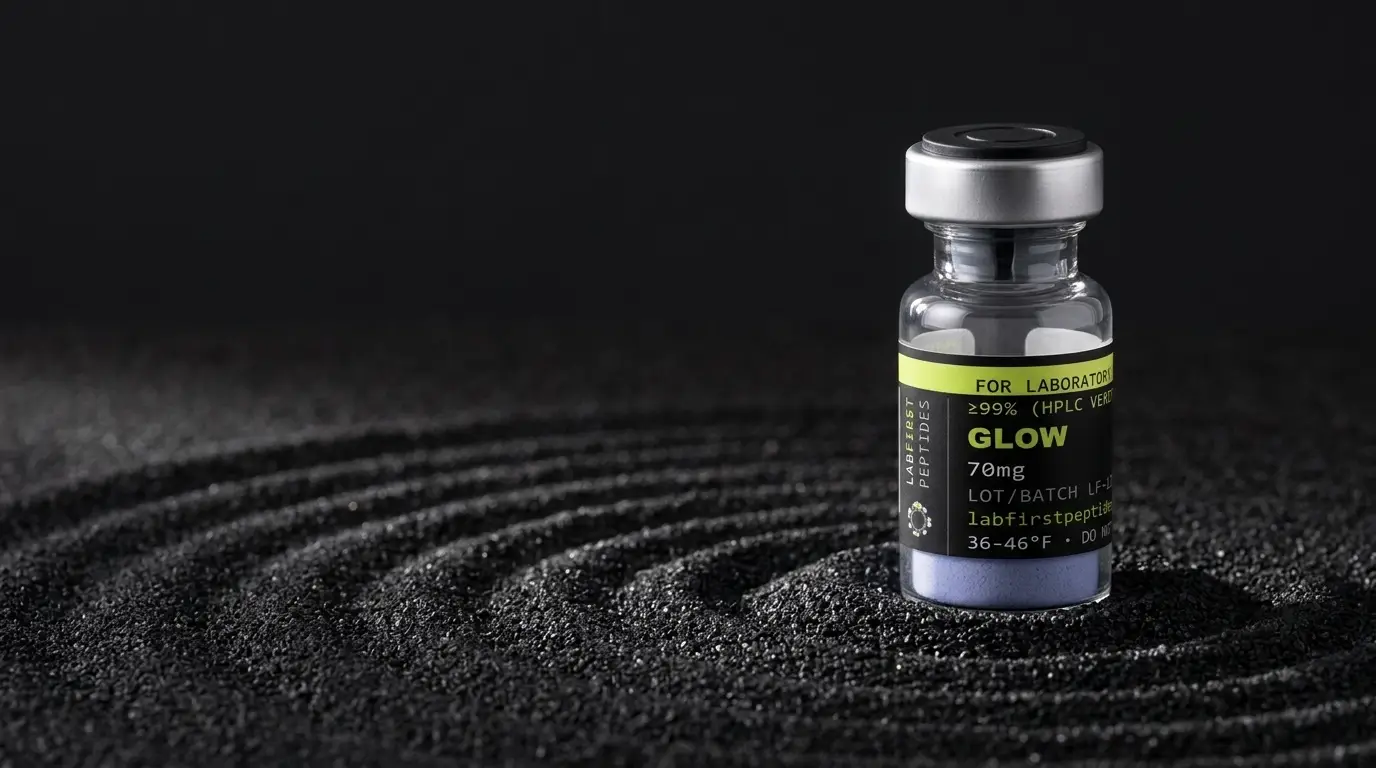
The GLOW blend is three peptides freeze-dried into one 70 mg vial: BPC-157, GHK-Cu and TB-500. GLOW is a blend name, not a molecule, and no standard fixes how much of each goes in. The amount of each component is stated on the certificate for the lot, not in the name.
- GLOW in this catalog is SKU GLOW, 70 mg total, formula BPC-157 / GHK-Cu / TB-500.
- PubChem molecular weights: BPC-157 1419.5, TB-500 (Ac-LKKTETQ) 889.0, free GHK 340.38.
- One milligram is about 0.70 micromoles of BPC-157, 1.12 of TB-500 and 2.94 of free GHK.
- PubChem lists more than one GHK copper form, so the form in a lot is a question for its certificate.
- The per-component amounts are stated on the lot certificate, not on the listing.
- No standard defines the GLOW name, so different suppliers can use different ratios.
Three peptides under one label
Say you pick up a vial marked GLOW, 70 mg. What did you actually buy? Not one substance. You bought three different peptides that were dried together, and a name that tells you which three but not how much of each.
In our catalog GLOW is SKU GLOW, 70 mg in total, with the formula written as BPC-157 / GHK-Cu / TB-500. Our product record describes it plainly as a brand name for several peptides freeze-dried together in one vial. There is no single GLOW molecule, so there is no GLOW formula, no GLOW mass and no GLOW entry in a chemical database. Each component has all of those. The blend has none.
This page is about the three molecules and the arithmetic of mixing them. If you want the listing checks before ordering, the where to buy GLOW guide covers those. The KLOW blend guide covers the four-peptide cousin, which adds KPV.
- Name: tells you the three components only
- Label: 70 mg total solid
- Certificate: milligrams of each component
- Molecular weights: convert mass to molecules
- GHK-Cu form: stated before the math works
The three components
| Component | What it is | Formula | Molecular weight |
|---|---|---|---|
| BPC-157 | A synthetic peptide fifteen building blocks long | C62H98N16O22 | 1419.5 |
| TB-500 | The acetylated seven-residue fragment Ac-LKKTETQ of thymosin beta-4 | C38H68N10O14 | 889.0 |
| GHK-Cu | The tripeptide glycyl-histidyl-lysine holding a copper ion | C14H24N6O4 for the free peptide | 340.38 before copper |
BPC-157 is the largest of the three by a wide margin. TB-500 is a piece cut from a bigger protein: UniProt's entry for human thymosin beta-4 places the LKKTETQ stretch at positions 18 to 24 of the 44-residue sequence, counting the initiator methionine. GHK is tiny, three residues, and it is the only one of the three that carries a metal.
That copper is not a trivial detail. PubChem holds several copper records for GHK, including a 1:1 complex with molecular weight 402.92 and a record titled GHK-Cu with two peptides around one copper, at 744.3. Which form is in a given lot is a question for its certificate.
Why are equal milligrams not equal molecules?
Blend labels are written in milligrams. Chemistry happens in molecules. Because the three components weigh such different amounts per molecule, the same mass of each holds very different numbers of molecules.
Using the PubChem molecular weights, one milligram of each works out to:
BPC-157: 1 mg ÷ 1419.5 g/mol = 0.70 µmol
TB-500: 1 mg ÷ 889.0 g/mol = 1.12 µmol
GHK, free peptide: 1 mg ÷ 340.38 g/mol = 2.94 µmol
So a vial holding equal milligrams of all three would hold roughly four times as many GHK molecules as BPC-157 molecules. Counting the copper makes GHK-Cu heavier per molecule and narrows that gap a little, which is one more reason the form needs stating.
This matters for anyone planning a laboratory assay from a blend. A mass ratio and a molar ratio are different numbers, and the certificate gives mass. Converting it is a short calculation once the per-component milligrams are known, and impossible before.
Where the ratio is written
Our catalog lists GLOW by its total, 70 mg, and does not state the split between the three components on the listing. We are not going to invent one here. The per-component amounts are stated on the certificate for each lot, and that is the only place a ratio can honestly live, because it is the only place where someone measured it.
Once the certificate for a lot is published it appears on the GLOW product page. Until then that page shows the result as pending. The GLOW certificate of analysis page explains how to read the per-component lines, and how GLOW identity is confirmed covers the test that shows all three are there at all.
A total mass on a label is also total solid, not total peptide. Any peptide powder carries water and counterion as well, so the measured peptide content per component will add up to less than 70 mg. That is expected. The certificate should show by how much.
Is GLOW a standard name?
No standards body defines GLOW. No pharmacopeia carries a monograph for it. Our own product record says the name is not standardized between suppliers, so the same name can mean different ingredients in different amounts.
That has a practical edge. Two vials called GLOW from two sellers can both be described accurately and still differ in their split, and occasionally in their ingredients. Comparing them by the name, or by the price per vial, compares nothing. Comparing them by milligrams of each component per dollar compares something real, and needs each seller's certificate to do it.
The research record follows the same pattern. The three components each have their own published record, all of it laboratory and animal work. According to our product record, nothing has been published on the three given together, and the blend as sold is a way of packaging them rather than a studied entity.
How a blend is put together
There are two ways three peptides end up in one vial, and they are different products even when the label is identical.
In the first, the components are dissolved together in a known proportion, filled into vials and freeze-dried as one batch. Every vial in that lot should hold the same split, because they all came out of the same solution. A certificate run on a sample of that lot describes the mix itself.
In the second, three finished powders are weighed out and combined later, sometimes by a business that bought each powder from somewhere else. The ingredients may each have been fine. What nobody has checked, unless someone tested the combined vial, is how evenly they were mixed and how accurately each was weighed into it. Dry powders of different particle size do not always blend evenly, and small fills magnify any weighing error.
The certificate rarely tells you which route was used, so it is fair to ask. A certificate made on the blended lot answers the question that matters. Three separate reports on the three ingredient powders tell you the starting materials were right, and are silent on the vial.
Either way, the dried blend shares one set of conditions. Water, heat or light reaching the vial reach all three components together, which is why the GLOW storage and stability page treats the vial as one unit.
GLOW next to its neighbors
People searching for GLOW often land on nearby products, so it helps to see how they relate. KLOW is GLOW plus KPV, 80 mg in our catalog. GHK-Cu on its own is the single copper tripeptide, sold separately. The GHK-Cu versus GLOW comparison puts the single compound next to the blend, and GLOW versus KLOW does the same for the two blends.
If a study needs one of the three components at a precisely known amount, a single-compound vial is simpler to document than a blend: one identity result, one purity figure, one content figure. The case for a blend is convenience, one vial to track instead of three, and it holds only when the ratio is published.
Questions to ask about any GLOW vial
Four short questions, each with a short answer if the seller knows the product. How many milligrams of each component are in the vial? Was each component identified separately, and by what method? Which form of GHK-Cu is it? And does the lot number on the certificate match the one on the vial?
A single purity figure for the whole vial answers none of them. It is one measurement standing in for at least three, which is not the same as passing three. A seller who can answer all four has done the measuring, and one who cannot has only named the vial.
FOR LABORATORY AND IN-VITRO RESEARCH USE ONLY. NOT FOR HUMAN OR ANIMAL CONSUMPTION.
What is GLOW studied for?
Published research on GLOW investigates the areas below, which is a different question from what GLOW will do for anyone, a claim about a living system that nothing on this site is sold for.
What it is. A brand name for several peptides freeze-dried together in one vial.
What the research looks at. The ingredients appear separately in the research. The blend as sold is a way of packaging them and has not itself been studied.
How it is thought to work. A blend name, not a molecule. Whatever mechanism there is belongs to the separate ingredients, and those are described on their own records.
What is not established. Blend names are not standardised between suppliers, so the same name can mean different ingredients in different amounts. Read the certificate for what is actually in the vial rather than trusting the name.
The full record, including the certificate for the lot in stock, is on the GLOW product page.
Common questions
What is in the GLOW blend?
What is the ratio of BPC-157, GHK-Cu and TB-500 in GLOW?
Why do equal milligrams of each component mean different amounts of molecules?
Is GLOW a single peptide?
How is GLOW different from KLOW?
Published certificates for GLOW
Every figure below is read from a report the laboratory issued for that lot; each page carries the PDF and the lab's own verification link.
More documentation guides
Sources
- PubChem Compound Summary for CID 9941957, BPC-157. Formula C62H98N16O22, molecular weight 1419.5.
- PubChem Compound Summary for CID 62707662 (TB-500, Ac-LKKTETQ). Formula C38H68N10O14, molecular weight 889.0.
- PubChem Compound Summary for CID 73587, glycyl-L-histidyl-L-lysine. Free GHK, C14H24N6O4, molecular weight 340.38.
- PubChem Compound Summary for CID 71587328, prezatide copper. 1:1 GHK copper cation, molecular weight 402.92.
- PubChem Compound Summary for CID 133697840, GHK-Cu. Two-peptide copper record, C28H48CuN12O8, molecular weight 744.3.
- UniProt P62328, Thymosin beta-4 (human). 44-residue sequence with initiator methionine; LKKTETQ at positions 18 to 24.