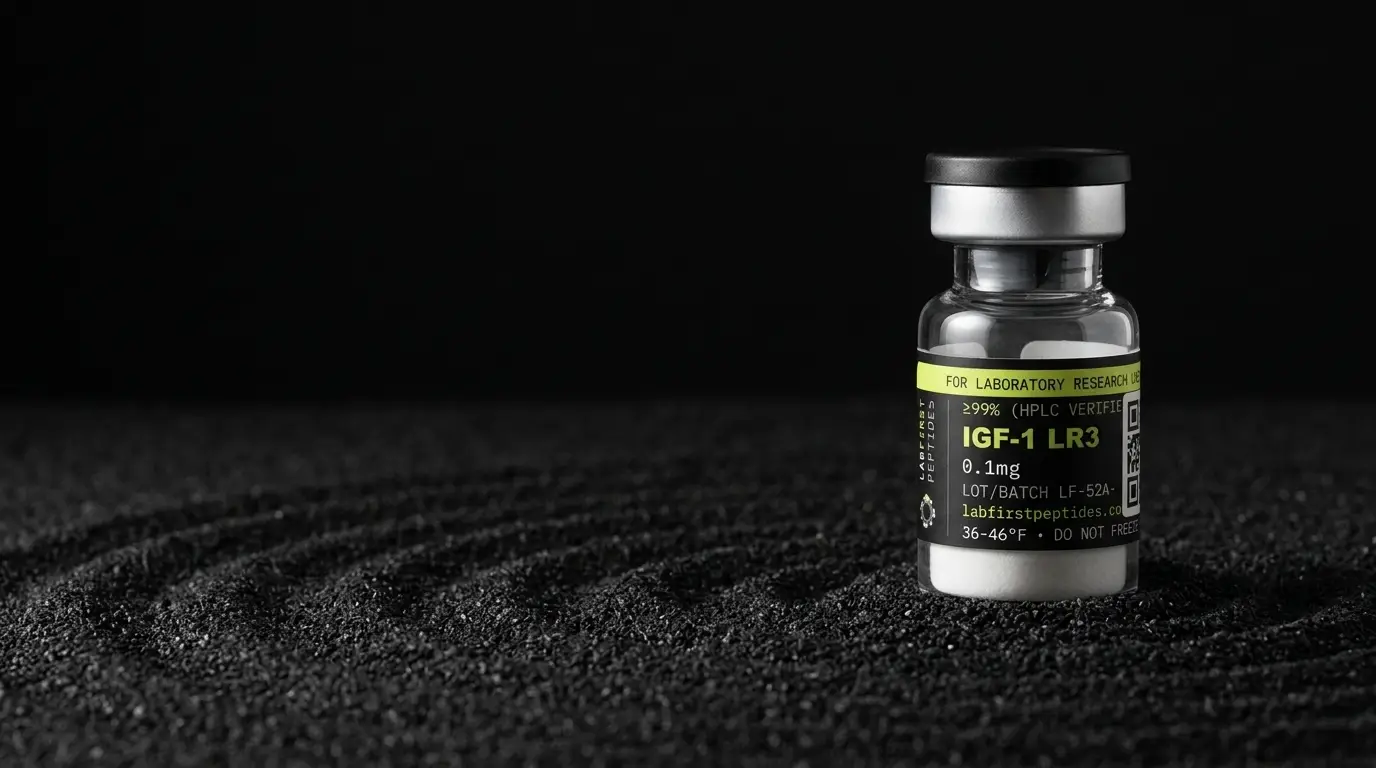
An IGF-1 LR3 certificate of analysis reports tests on one lot. In plain terms, it is the lot's report card. Check that it names the 83-residue analog, gives a mass that counts three disulfide bonds, shows RP-HPLC purity with its conditions and a chromatogram, states peptide content, and carries your vial's lot number.
- IGF-1 LR3 is an 83-residue analog: mature human IGF-1 (70 residues, UniProt P05019) with arginine at position 3 and a 13-residue N-terminal extension.
- The three disulfide bonds lower the mass by about 6 Da compared with the reduced chain.
- A correct intact mass does not prove correct disulfide pairing, because every pairing weighs the same.
- RP-HPLC purity is an area percent under stated conditions and says nothing about water or counterion.
- Peptide content, not labeled mass, gives the true amount of peptide in the vial, which matters most for the 0.1 mg size.
What the certificate is for
A tech opens a new box of IGF-1 LR3, lifts out a vial holding 1 mg of white powder, and sets the certificate beside it. Before anything else, she checks one thing: does the lot number on the paper match the lot number on the vial? If it doesn't, the rest of the page is about some other batch.
That habit is most of what reading a certificate of analysis comes down to. The document reports what a named laboratory measured, on a named lot, on a named date, by named methods. It says nothing about how the material was stored after testing, and it does not cover a different lot, however similar.
For IGF-1 LR3 the stakes are higher than for a short peptide. This is an 83-residue protein held together by three disulfide bonds, supplied in small amounts. A certificate that works well for a five-residue peptide can leave real gaps for a molecule like this, and knowing where those gaps tend to be is the point of this page.
- Molecule: the 83-residue analog, not native IGF-1
- Lot: matches the vial exactly
- Mass: accounts for three disulfides
- Purity: conditions and chromatogram attached
- Content: the real amount of peptide
- Laboratory: report number you can verify
Which molecule should the certificate describe?
IGF-1 LR3 is an analog of human insulin-like growth factor 1, not IGF-1 itself. UniProt entry P05019 gives mature human IGF-1 as a 70-residue chain beginning Gly-Pro-Glu. The analog makes two changes to that chain.
- Glutamic acid at position 3 is replaced with arginine. Francis and colleagues described this substitution in 1992, with reduced binding to IGF-binding proteins as the design rationale.
- A 13-residue extension is added to the N-terminus: Met-Phe-Pro-Ala-Met-Pro-Leu-Ser-Ser-Leu-Phe-Val-Asn. A second 1992 paper from the same group describes the long analogs as built from the first 11 residues of methionyl porcine growth hormone joined to IGF-I.
The result is 13 plus 70, or 83 residues. A certificate should state that sequence, or at minimum name the analog precisely and give a theoretical mass that fits it. A certificate headed only IGF-1, or one giving the mass of native IGF-1, describes a different molecule. The truncated analog IGF-1 DES is different again, and our IGF-1 DES versus IGF-1 LR3 comparison sets the two side by side.
The fields, in order
| Field | What it should say | How you check it |
|---|---|---|
| Product and sequence | IGF-1 LR3 (Long Arg3 IGF-1), 83 residues, the sequence or a clear reference to it | Compare against the parent in UniProt P05019 plus the two changes |
| Theoretical mass | A figure that accounts for three disulfide bonds | Redo the arithmetic below |
| Lot number | An identifier that also appears on the vial | Read the vial |
| Identity | Observed mass by ESI-MS or MALDI-TOF, with the spectrum | Observed against theoretical, within the method's tolerance |
| Purity | RP-HPLC area percent, with wavelength, column, gradient and chromatogram | Look at the trace, not only the number |
| Content | Peptide content as a percent of the solid, with the method | Check that the method is named |
| Dates | Manufacture date and test date, listed separately | Check the order and the gap |
| Issuing laboratory | Name, report number, signatory, accreditation scope | Contact the laboratory yourself |
Completeness matters more than order. A certificate that gives six of these fields with their methods is more useful than one that fills in all eight as bare numbers.
What mass should the identity row show?
The identity row should show a mass that accounts for the three disulfide bonds, and it is almost always a mass measurement. For a molecule this size, electrospray gives a series of multiply charged ions, and the reported mass is worked back from them. MALDI-TOF is the other common method. Either is fine as long as the report says which it used and which ions the mass came from.
You can check the theoretical figure yourself. Summing standard average residue masses over the 83-residue sequence and adding one water gives about 9,117 Da for the fully reduced chain. The UniProt record lists three disulfide bonds in mature IGF-1, and PubChem's cystine formula shows that each disulfide removes two hydrogens. Take off six hydrogens and the folded, disulfide-bonded analog comes to about 9,111 Da by our arithmetic. Your figure may differ by a unit or so depending on the mass table you use.
That six-unit gap matters. A reported mass matching the reduced chain suggests the disulfides are not formed. A mass that matches neither form points to something else: a missing or extra residue, an oxidized methionine, or a different molecule. A certificate giving only a mass for native IGF-1, around 7.6 kDa, has tested or described the wrong thing.
A correct intact mass still does not prove the disulfides pair the right cysteines. With six cysteines there are several ways to pair them into three bonds, and all of them weigh the same. The companion page on how IGF-1 LR3 identity is confirmed covers the methods that address pairing.
What does the purity figure measure?
RP-HPLC purity is the main peak's share of the total integrated peak area. That number depends on the wavelength, the column, the gradient and where integration starts and stops, so a purity figure without those conditions cannot be assessed.
For this analog, a few impurities are worth looking for in the chromatogram. Oxidized forms, where one of the four methionines has picked up an oxygen, often run close to the main peak. Misfolded forms with the wrong disulfide pairing can separate from the correctly folded protein under reversed-phase conditions. Truncated chains are another possibility with a sequence this long. A clean single peak under one gradient is good evidence, and a second orthogonal condition is better.
Remember what the percentage leaves out. Detection at low UV wavelengths responds to the peptide backbone and barely at all to salts, water or counterion. A purity of 98 percent describes the peptide-related material in the vial, not the whole solid. Our general guide on HPLC purity versus identity explains why the two numbers answer different questions.
Content, and the trouble with small vials
A vial labeled 1 mg holds 1 mg of solid. Part of that solid is the peptide, and the rest is water and counterion. Peptide content is the field that tells you how much of the solid is actually peptide.
Take an illustrative certificate reporting 80 percent peptide content. On a 1 mg vial, that means about 0.80 mg of peptide. The other fifth is material the purity figure never sees.
The 0.1 mg vial makes this harder. At 100 micrograms total, the gap between labeled solid and actual peptide is a large share of a very small amount, so the content field matters even more on any certificate for the smaller size.
Lot, dates and the issuing laboratory
The lot identifier on the certificate must be the one printed on the vial. Close is not good enough. Where a supplier fills small vials from a larger batch, ask which lot the certificate covers, the bulk or the fill, and how the two are linked.
Manufacture date and test date should appear separately. A test date years before you received the vial tells you the data were right once, for material that has since been stored somewhere, under conditions the certificate does not describe.
Verification belongs with the laboratory that produced the report, not the seller who passed it on. Take the report number and lot to the laboratory using contact details you found yourself, and ask whether the report exists and covers that lot. If the report carries an accreditation mark, look the laboratory up in the accrediting body's directory and read its scope, since accreditation is granted test by test.
Where our certificates stand
Certificates for our IGF-1 LR3 lots, the 0.1 mg vial (SKU IG01) and the 1 mg vial (SKU IG1), are pending. This page describes how to read one and states no result for any of our lots. A lot's results appear only once the certificate for that lot is published, and the certificate index lists what has been released. The IGF-1 LR3 product page links each size to its lot documentation as it becomes available, and our page on IGF-1 LR3 storage and stability covers what happens to the material after the test date.
IGF-1 LR3 is not an FDA-approved drug product and has no pharmacopeial monograph, so purity and identity claims are made against a supplier-defined specification rather than a compendial standard. It is supplied here as laboratory material only.
FOR LABORATORY AND IN-VITRO RESEARCH USE ONLY. NOT FOR HUMAN OR ANIMAL CONSUMPTION.
What is IGF-1 LR3 studied for?
Published research on IGF-1 LR3 investigates the areas below, which is a different question from what IGF-1 LR3 will do for anyone, a claim about a living system that nothing on this site is sold for.
What it is. Analogue of human insulin-like growth factor 1 with arginine replacing glutamate at position 3 and a thirteen-residue N-terminal extension.
What the research looks at. Used principally as a cell-culture reagent — it is a standard supplement in serum-free and reduced-serum media for industrial and research cell culture — and as a comparator in IGF analogue pharmacology.
How it is thought to work. Binds the IGF-1 receptor. The substitutions markedly reduce affinity for IGF binding proteins, which is the design intent: less sequestration by IGFBPs means more free peptide available to the receptor.
What is not established. No approved product and no human therapeutic data. Reduced IGFBP binding is a property demonstrated in binding assays; that it produces greater biological effect does not follow, and in at least one published comparison it did not.
The full record, including the certificate for the lot in stock, is on the IGF-1 LR3 product page.
Common questions
What theoretical mass should an IGF-1 LR3 certificate show?
Does a matching mass prove the protein is folded correctly?
Why does peptide content matter more for the 0.1 mg vial?
Are certificates published for your IGF-1 LR3 lots?
More documentation guides
Sources
- UniProt P05019, Insulin-like growth factor 1 (human). Mature IGF-1 chain (residues 49 to 118 of the precursor, 70 residues), its sequence, and the three disulfide bonds Cys54-Cys96, Cys66-Cys109 and Cys95-Cys100 in precursor numbering.
- Francis et al., Novel recombinant fusion protein analogues of insulin-like growth factor (IGF)-I, Journal of Molecular Endocrinology, 1992. Describes the Long IGF-I analogues built from the first 11 residues of methionyl porcine growth hormone joined to IGF-I, including Long [Arg3]-IGF-I; PMID 1378742.
- Francis et al., Production and characterization of recombinant IGF-I and potent analogues of IGF-I, Journal of Molecular Endocrinology, 1992. Replacement of glutamic acid at position 3 with arginine or glycine, and reduced binding to IGF-binding proteins as the design rationale; PMID 1311930.
- ICH Q6B, Specifications: Test Procedures and Acceptance Criteria for Biotechnological/Biological Products. Identity tests should rest on unique aspects of molecular structure; where cysteines are expected, free thiols and disulfide bridges should be determined, for example by peptide mapping under reducing and non-reducing conditions or mass spectrometry.
- PubChem compound records for L-cysteine (CID 5862) and L-cystine (CID 67678). Cysteine is C3H7NO2S; cystine, two cysteines joined by a disulfide, is C6H12N2O4S2, two hydrogens fewer than two free cysteines.