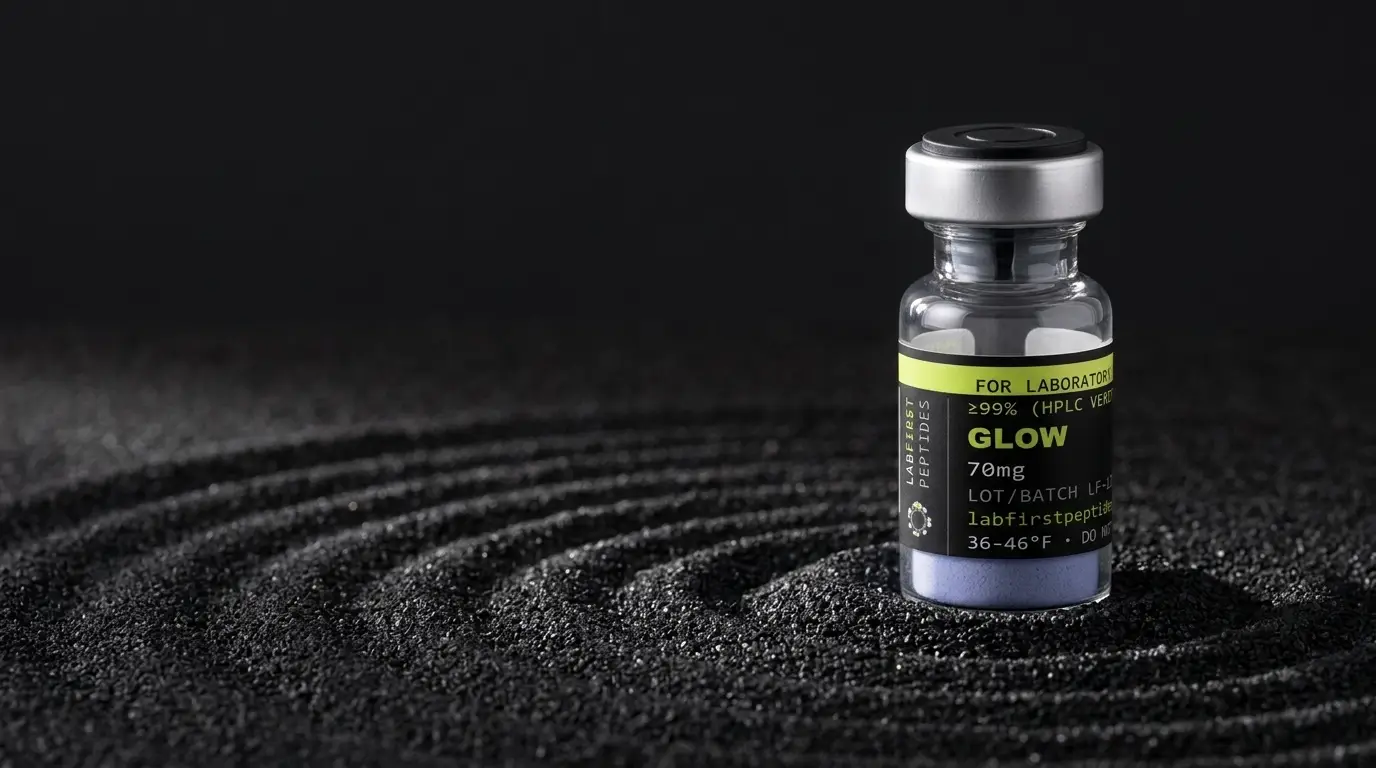
A GLOW certificate of analysis should read like three reports on one page. Check that BPC-157, GHK-Cu and TB-500 each have their own identity result and purity figure with a stated method, that the milligrams of each are accounted for against the 70 mg label, and that the lot matches the vial.
- GLOW in this catalog is SKU GLOW, 70 mg in total, formula BPC-157 / GHK-Cu / TB-500.
- PubChem reference masses: BPC-157 1418.704 Da (CID 9941957), TB-500 888.492 Da (CID 62707662), GHK 340.186 Da (CID 73587).
- PubChem holds more than one GHK copper record, so a certificate must name the form behind its mass.
- A blend certificate needs identity, purity and content for each component, not one figure for the vial.
- The per-component amounts for GLOW are stated on the lot certificate, not on the listing.
- Our GLOW lot results appear on the product page only once the certificate is published.
One page, three molecules
A GLOW vial is one small bottle with three different peptides dried inside it. So its report card has to grade three students, not one. If the paper gives a single mark for the whole bottle, you have no idea which of the three it was describing.
A certificate of analysis is a laboratory's record of what it measured on one lot, on one date, by named methods. For a single peptide that is already a dense document. For GLOW, which our catalog lists as SKU GLOW, 70 mg in total, formula BPC-157 / GHK-Cu / TB-500, every line that would appear once on a single-compound certificate should appear three times, or else say plainly why it does not.
This page walks through the fields in the order worth reading them. The companion pages cover how GLOW identity is confirmed in more depth and GLOW storage and stability. The shorter buyer checklist lives on the where to buy GLOW guide; this page is the long-form reading of the certificate itself.
- Lot number matches the vial
- All three components named, milligrams of each
- One observed mass per component
- Purity per component, method stated
- GHK-Cu form or copper result given
- Issuing laboratory and report number you can check
The three reference masses to have in hand
Before opening the certificate, write down what each component should weigh. PubChem gives these values, and they are the yardstick every identity line gets held against.
| Component | PubChem record | Formula | Monoisotopic mass (Da) | Molecular weight |
|---|---|---|---|---|
| BPC-157 | CID 9941957 | C62H98N16O22 | 1418.704 | 1419.5 |
| TB-500 (Ac-LKKTETQ) | CID 62707662 | C38H68N10O14 | 888.492 | 889.0 |
| GHK, free peptide | CID 73587 | C14H24N6O4 | 340.186 | 340.38 |
| GHK copper complex, 1:1 cation | CID 71587328 | C14H23CuN6O4+ | 402.108 | 402.92 |
The GHK-Cu rows are where people trip. PubChem holds more than one copper record for this tripeptide, including a 1:1 complex and a record titled GHK-Cu with formula C28H48CuN12O8, two peptides to one copper, at 744.3. A certificate should say which form it means. A mass printed with no formula next to it cannot be checked, because you do not know which of these it is supposed to match.
The fields, in reading order
| Field | What a complete entry looks like | What a gap means |
|---|---|---|
| Lot number | Same identifier as printed on the vial | The report describes other material |
| Issuing laboratory | Name, report number, a way to verify | Nobody can confirm the report |
| Composition | All three components named, milligrams of each | The ratio is unknown |
| Identity | One observed mass per component, beside its theoretical value | Unconfirmed components were assumed present |
| Purity | Per component, HPLC method and wavelength stated | A vial-wide figure hides which peptide is short |
| Content | Measured milligrams per component, summed against 70 mg | No real price per milligram of anything |
| Copper | A copper result, or the form of GHK-Cu stated | Complex and plain peptide cannot be told apart |
| Dates | Test date, separate from manufacture date | The age of the data is unclear |
Lot first, every time. A flawless report for a different lot tells you nothing about the vial on your bench, and a mismatch is the most common fault there is.
How should identity be shown for three peptides?
Mass spectrometry is the usual identity test. For GLOW the spectrum of the vial contents should show signals attributable to all three components, and the certificate should list them separately: roughly 1418.7 for BPC-157, 888.5 for TB-500, and a GHK value that matches whichever form the report names.
A single line reading Identity: conforms for the vial is not an identity result for a blend. It may mean the analyst saw one expected mass and stopped. It may mean all three were seen. The paper does not say, and that is the problem.
ICH Q2(R2), the international guideline on validating analytical procedures, lists specificity as a test for identification methods. For a mixture that has a sharp meaning: the method has to tell BPC-157 apart from TB-500 apart from GHK-Cu, in the presence of each other. The identity page goes through how that is done.
Purity and content, per component
Purity by reversed-phase HPLC is a percentage of peak area. On a three-component sample, the chromatogram holds three main peaks plus whatever impurities belong to each. A single purity number for the vial can only mean one of two things: the three main peaks added together as a share of everything, or one peak treated as the whole. Neither tells you whether one ingredient is present at a fraction of its share.
So look for three purity figures, each with the column, gradient and detection wavelength beside it. Then look for content, which is a different question. Purity asks how clean each peptide is. Content asks how many milligrams of each are actually in the vial.
Our catalog lists GLOW as 70 mg total and does not publish a split on the product listing. The per-component amounts belong on the certificate for the lot, and that is where to read them. When they are there, add them up. A total well short of 70 mg is normal for peptide powders, which carry water and counterion as well as peptide, but the certificate should show the numbers that let you see how short.
Dates, and who did the mixing
Two dates belong on the page: when the material was made and when it was tested. They should appear as separate fields. A test date earlier than the manufacture date is a clerical slip at best, and a test date from years ago describes the powder as it was then, not as it is after an unknown stretch of storage.
A blend adds a question a single peptide does not raise. The three components can be combined and freeze-dried together at the start, or three finished powders can be weighed into one vial later by somebody else. Those are different products. In the first case the certificate can describe the combined lot. In the second, a report on each ingredient powder says nothing about how evenly they were mixed or how accurately they were weighed into your vial.
So when a certificate is for GLOW, check that it was run on the blended lot itself. A bundle of three single-compound reports stapled together is useful background and is not the same document. It tells you the ingredients were right before they met, and nothing about the vial you received.
Where our GLOW certificates stand
We do not quote results for any GLOW lot on this page. A certificate for a lot appears on the GLOW product page once it is published, and until then that page says the result is pending. The certificate index lists what has been posted so far.
When one posts, read it with the table above. We would rather you check it line by line than take the headline figure on trust, and the same goes for a certificate from any seller.
Verifying a report with the laboratory
The seller handed you the document, so the seller cannot be the one to confirm it. Take the report number and the lot identifier and contact the issuing laboratory directly, using contact details you looked up yourself. Ask whether that report exists, whether it covers that lot, and whether the figures match.
For a blend, add one more question: were all three components tested, or only some? A laboratory that tested the vial for one component and reported it can issue a perfectly genuine report that still leaves two ingredients unexamined. The report is real; it simply answers less than a reader assumes.
Where a report cannot be verified and the work depends on it, the remaining option is in-house testing. An intact mass on each component and one HPLC run settle most of the questions a certificate is meant to answer.
What are the red flags on a blend certificate?
- No lot number, or one that does not match the vial.
- One identity line for the whole vial.
- One purity percentage for the whole vial, with no method.
- No milligram figure per component.
- A GHK-Cu mass with no formula, so you cannot tell which copper form it refers to.
- A chromatogram with only one main peak on a sample that should show three.
- No issuing laboratory, or no report number to check.
One of these can be an oversight. Several together describe a document that was made to look complete rather than to be read.
Regulatory position
GLOW is a blend name, not a registered substance, and no pharmacopeial monograph defines it. The FDA page on bulk drug substances that may present significant safety risks in compounding lists BPC-157, GHK-Cu (for injectable routes of administration) and Thymosin beta-4, fragment (LKKTETQ), also known as TB-500, among nominations that were withdrawn.
Status checked September 29, 2026.
FOR LABORATORY AND IN-VITRO RESEARCH USE ONLY. NOT FOR HUMAN OR ANIMAL CONSUMPTION.
What is GLOW studied for?
Published research on GLOW investigates the areas below, which is a different question from what GLOW will do for anyone, a claim about a living system that nothing on this site is sold for.
What it is. A brand name for several peptides freeze-dried together in one vial.
What the research looks at. The ingredients appear separately in the research. The blend as sold is a way of packaging them and has not itself been studied.
How it is thought to work. A blend name, not a molecule. Whatever mechanism there is belongs to the separate ingredients, and those are described on their own records.
What is not established. Blend names are not standardised between suppliers, so the same name can mean different ingredients in different amounts. Read the certificate for what is actually in the vial rather than trusting the name.
The full record, including the certificate for the lot in stock, is on the GLOW product page.
Common questions
What should a GLOW certificate of analysis include?
Is one purity percentage enough for GLOW?
Why do GHK-Cu masses differ between certificates?
Does LabFirst publish GLOW test results?
How do I check that a GLOW certificate is genuine?
Published certificates for GLOW
Every figure below is read from a report the laboratory issued for that lot; each page carries the PDF and the lab's own verification link.
More documentation guides
Sources
- PubChem Compound Summary for CID 9941957, BPC-157. Formula C62H98N16O22, monoisotopic mass 1418.704, molecular weight 1419.5.
- PubChem Compound Summary for CID 62707662 (TB-500, Ac-LKKTETQ). Formula C38H68N10O14, monoisotopic mass 888.492, molecular weight 889.0.
- PubChem Compound Summary for CID 73587, glycyl-L-histidyl-L-lysine. Free GHK tripeptide, C14H24N6O4, monoisotopic mass 340.186.
- PubChem Compound Summary for CID 71587328, prezatide copper. 1:1 GHK copper cation, C14H23CuN6O4+, monoisotopic mass 402.108.
- PubChem Compound Summary for CID 133697840, GHK-Cu. Two-peptide copper record, C28H48CuN12O8, molecular weight 744.3; shows why the form must be stated.
- ICH Q2(R2), Validation of Analytical Procedures (2023). Specificity as a validation test for identification procedures.
- FDA, Certain bulk drug substances for use in compounding that may present significant safety risks. Lists BPC-157, GHK-Cu (injectable routes) and the thymosin beta-4 fragment LKKTETQ among withdrawn nominations.