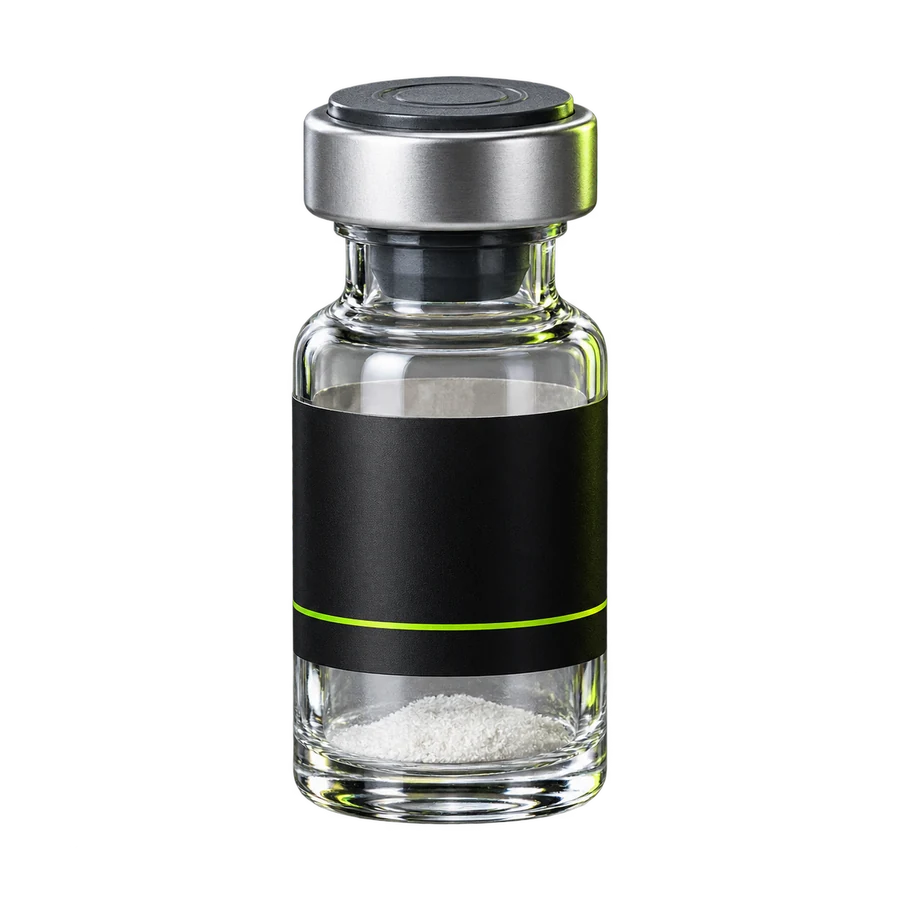
Lyophilised MOTS-c (Human) is most stable as a sealed, dry, dark, cold powder. Its two methionines and single tryptophan make oxidation the characteristic failure route rather than hydrolysis. Once dissolved, treat the solution as a days-scale material, aliquot it once, and date every container at preparation.
- MOTS-c (Human) is a 16-residue linear peptide, MRWQEMGYIFYPRKLR, with an average mass near 2174.6 Da and no cysteine or disulfide.
- Oxidation of Met1, Met6 and Trp3 is the characteristic degradation route, which makes light and oxygen exclusion the controls that matter most.
- The sequence contains no asparagine, so the fast classical deamidation route is absent and only Gln4 is a slow deamidation candidate.
- A net charge of roughly plus four drives adsorption onto glass, so dilute working stocks belong in low-binding polypropylene.
- Letting a sealed vial reach room temperature before opening prevents the condensation uptake that is the most common avoidable handling error.
- No MOTS-c medicine is approved anywhere and no compendial monograph exists, so the lot certificate of analysis is the only specification available.
The sequence tells you where the risk sits
MOTS-c (Human) is a short linear peptide, sixteen residues, sequence MRWQEMGYIFYPRKLR. It was described by Lee and colleagues in Cell Metabolism in 2015 as a mitochondrial-derived peptide encoded within an open reading frame in the 12S rRNA region of mitochondrial DNA. Average mass calculated from the sequence is close to 2174.6 Da for the unmodified free-acid form, which is what most research-grade material is.
Read the sequence before reading any storage advice. Position by position: Met1, Arg2, Trp3, Gln4, Glu5, Met6, Gly7, Tyr8, Ile9, Phe10, Tyr11, Pro12, Arg13, Lys14, Leu15, Arg16. Four things follow from that list, and they set the whole handling picture.
There is no cysteine, so there is no disulfide to scramble and no thiol to oxidise into a dimer. There is no asparagine, so the fast classical deamidation route that dominates so many peptide stability discussions is simply absent; Gln4 can deamidate, but glutamine does so an order of magnitude more slowly than asparagine in most sequence contexts. There are two methionines and a tryptophan, which makes oxidation the characteristic degradation route for this molecule. And with three arginines plus a lysine against a single glutamate, the peptide carries a strong net positive charge at neutral pH, which matters for how it behaves on glass and on chromatography columns.
The molecule is also unlipidated and short. That makes it far less interface-active than the fatty-acylated peptides whose handling guidance dominates the field, and correspondingly less prone to the aggregation failures those molecules show. Different chemistry, different worry list.
- Oxygen and light — sulfoxide formation at Met1 and Met6, ring damage at Trp3
- Moisture — condensation into a cold vial opened too soon
- Adsorption — cationic peptide binding to glass at low concentration
- Temperature — a rate modifier for every route above
- Freeze-thaw — cumulative, invisible, avoidable by aliquoting once
Degradation routes, mapped to residues
| Route | Site in this sequence | What drives it | Practical control |
|---|---|---|---|
| Methionine oxidation to sulfoxide | Met1, Met6 | Headspace oxygen, trace metals, peroxide impurities in diluent | Sealed vial, minimal headspace, cold, clean diluent |
| Tryptophan photo-oxidation and ring cleavage | Trp3 | Light, especially near-UV; oxygen | Amber glass or opaque secondary container |
| Tyrosine oxidation | Tyr8, Tyr11 | Light, oxidants, metal ions | Same controls as above; chelating buffer where the protocol allows |
| Deamidation | Gln4 | Water, temperature, pH above roughly 6 | Dry solid storage; mildly acidic solution conditions if compatible |
| Backbone hydrolysis | Any amide bond; Asp-free sequence is comparatively slow | Water activity, temperature, extremes of pH | Keep the solid dry and desiccated |
| Surface adsorption | Whole molecule, via net positive charge | Deprotonated silanols on glass, dilute solutions | Low-binding polypropylene for dilute working stocks; document the container |
The reason to write the table this way rather than copying a generic peptide list is that generic lists lead people to spend their attention on the wrong variable. For a lipidated 39-mer, agitation and interfaces are the story. For MOTS-c, oxygen and light are, and adsorption loss at low concentration is a close second. The review by Butreddy and colleagues on lyophilised protein and peptide instability sets out the mechanisms in more depth and remains a fair map of the territory.
Sealed-vial handling before anything is opened
Most avoidable loss in a peptide laboratory happens in the first minute a vial is open, and it happens because the glass was cold. A vial taken from a −20 °C freezer into a room at 22 °C and 55% relative humidity is far below the dew point. Break the seal at that moment and water condenses onto the cake immediately. Lyophilised material is hygroscopic and takes it up without any visible change.
The control costs twenty to thirty minutes and no money: let the sealed vial equilibrate to room temperature on the bench before the seal is broken, every time. No exceptions for being behind schedule. Then work quickly, reseal, and return the vial to storage with a desiccant.
Two smaller points that belong in the same habit. First, centrifuge or tap the vial down before opening. Fine lyophilisate migrates into the stopper and cap threads in transit, and material lost to the closure is material that never reaches the diluent, which shows up later as a concentration that reads low against the label. Second, inspect the cake and record what you see. A fine white cake or a thin film both look normal for a milligram-scale fill. A collapsed, glassy, or visibly moist cake is a different observation and worth writing down before anything is added, since it is unrecoverable information once the vial is dissolved.
Conditions by physical state
| State | Temperature | Light | Relative horizon | Why |
|---|---|---|---|---|
| Sealed powder, unopened stock | −20 °C or colder, desiccated | Dark | Longest | Oxidation, deamidation and hydrolysis all slowed; water excluded |
| Sealed powder, in-use vial | 2 to 8 °C, desiccated | Dark | Shorter | Acceptable where the vial is consumed inside a defined window |
| Powder in transit | Ambient | Dark, insulated | Days | Dry solid tolerates short excursions far better than solution |
| Prepared aqueous solution | 2 to 8 °C | Dark | Days, not months | Hydrolysis, Gln deamidation and dissolved-oxygen chemistry are running |
| Solution, single-use aliquots | −20 °C or colder; −80 °C where available | Dark | Longer, one thaw each | Removes repeated warming of the same container |
The horizons stay relative on purpose. A specific shelf life belongs to a lot that has been through a stability study in that container under those conditions, which is what ICH Q1A(R2) describes for regulated products and what almost no research-grade peptide has behind it. If a supplier prints a confident month count with no supporting data, they are quoting a convention. The lot's certificate of analysis is the only document entitled to carry a date, and where it carries none, the honest statement in your own record is that the window is unestablished. Our own position on what a certificate should contain is set out in the quality standard.
What changes once a solution is prepared
Adding diluent starts a faster clock and changes which mechanisms dominate. Dissolved oxygen becomes available to the methionines. Light now acts on a tryptophan that is free to move and fully solvated. Water is present for the slow hydrolytic routes. And any microbial contamination introduced at preparation has a medium.
MOTS-c dissolves readily in water at the concentrations laboratories normally prepare, helped by its net positive charge. Sterile water for injection and bacteriostatic water are both common choices; the bacteriostatic water guide covers what the benzyl alcohol content does and does not do for a research solution. Whichever diluent is chosen, record the diluent lot alongside the peptide lot. Trace peroxide in an old bottle of water is a real oxidant source, and a diluent that is not identified in the record cannot be ruled out later.
Adsorption deserves a specific mention because it is the loss that never announces itself. A strongly cationic peptide at low micromolar concentration will bind to deprotonated silanol groups on borosilicate glass, and enough can disappear onto the walls of a tube to shift a result. If a protocol works at dilute concentrations, prepare and store in low-binding polypropylene and write down which container was used. If you must work in glass, higher concentration and a shorter contact time both help. This is the mechanism behind a great many unexplained potency drifts between one bench and another.
Repeated freeze-thaw is the other cumulative cost. Each cycle carries the solution through the concentration and interfacial changes that accompany ice formation, and nothing about a solution on its fifth thaw distinguishes it visually from one on its first. Aliquoting at the moment of preparation makes the question moot, which is why it is worth the rack of tubes. The same reasoning applied to a lipidated peptide is set out in the guide on tirzepatide storage and stability.
Worked example: concentration and aliquot arithmetic
A 5 mg vial brought into 2.5 mL of diluent gives:
5 mg ÷ 2.5 mL = 2 mg/mL
Expressed in molar terms against an average mass of 2174.6 Da, 2 mg/mL is:
2 mg/mL ÷ 2174.6 g/mol ≈ 0.92 mmol/L
Where a protocol draws 0.25 mL per replicate, the container supports:
2.5 mL ÷ 0.25 mL = 10 draws
Held as one tube, the tenth draw comes from material warmed and re-chilled nine times, with nine additional headspace exchanges over the same solution. Split at preparation into ten 0.25 mL aliquots, each is thawed once and opened once. The vial concentration calculator handles other fill weights and diluent volumes.
One correction that catches people: the mass on the label is usually gross peptide, and the material also carries counterion and residual water. A trifluoroacetate or acetate salt with a peptide content in the mid-eighties by percentage means the free-peptide concentration is meaningfully below the nominal figure. Where the certificate reports peptide content by nitrogen or by quantitative amino acid analysis, use that number for any molar calculation and note in the record which basis you used.
Detecting degradation rather than assuming it
Storage discussions tend to stop at prevention. The analytical half matters as much, because a laboratory that cannot see degradation has no way to know whether its handling works.
Reversed-phase HPLC on a C18 column with a water/acetonitrile gradient and 0.1% trifluoroacetic acid resolves MOTS-c comfortably. Detection at 280 nm is available thanks to Trp3 and the two tyrosines, which is convenient: the same chromophores that make the peptide oxidation-prone also make it easy to quantify. Purity by area percentage against a reference injection of the same lot is the routine check. USP general chapter <621> sets the system-suitability expectations any method should meet before its numbers are trusted.
Oxidation has a characteristic chromatographic signature. Methionine sulfoxide is more polar than methionine, so oxidised species elute earlier than the parent peak, typically as one or two shoulders or resolved peaks just ahead of it. Under LC-MS the confirmation is unambiguous:
| Observed shift | Interpretation | Note |
|---|---|---|
| +16 Da | Single methionine sulfoxide | Two sites available, so +32 Da is possible |
| +32 Da | Two sulfoxides, or one sulfone | MS/MS localisation distinguishes them |
| +4, +16, +32 Da on Trp | Tryptophan oxidation products | Kynurenine and hydroxytryptophan among them |
| +0.98 Da | Deamidation | Gln4 is the only candidate here |
| +18 Da fragments | Backbone hydrolysis | Look for lower-mass fragment pairs |
A useful discipline: run the purity check on the first aliquot of a freshly prepared solution and again on the last one before the stock is exhausted. Two data points on the same lot, in your own hands, tell you more about your storage practice than any published shelf life.
What the record should say
Storage discipline that is not written down is not reproducible. For a prepared MOTS-c solution the minimum record is the source lot identifier, the diluent and its lot, the volume added, the resulting concentration and the basis used for it, the container material, the date and time of preparation, and the initials of whoever made it. Aliquots inherit all of that through a shared identifier written on the tube in a marker that survives a freezer.
The reason is diagnostic, not bureaucratic. When an assay comes out wrong, the first question is whether the material was what the protocol assumed. A record that traces the sample back through the aliquot to the solution to the lot to the certificate answers that in a minute. A record that stops at "MOTS-c 2 mg/mL" means repeating the work, and possibly repeating it with the same undiagnosed problem.
Two small conventions earn their keep. Log freezer excursions, including the ordinary ones, so that a suspect result can be checked against a real temperature history rather than against memory. And treat an undated container as unusable regardless of how recently anyone thinks it was made. That rule feels wasteful the first time it discards a tube. It stops being wasteful the first time it prevents a month of chasing a result that was never real.
Regulatory position
MOTS-c is an endogenous mitochondrial-derived peptide that has been studied in cell and animal models since its description in 2015. No medicine containing MOTS-c has been approved by FDA, EMA or any comparable regulator, and we are aware of no USP or Ph. Eur. monograph for the peptide. Two consequences follow for a laboratory. There is no compendial reference standard against which identity and purity can be established, so a supplier's own reference injection and its analytical methods are the whole basis of any purity claim. And there is no regulatory-defined attribute set, which means the certificate of analysis is the only specification in existence for that lot.
Prohibited-substance lists in competitive sport are revised annually and are written in categories as well as by name. Anyone with an obligation under one of them should read the current list text directly rather than rely on a secondary summary, including this one.
Status verified 26 August 2026.
FOR LABORATORY AND IN-VITRO RESEARCH USE ONLY. NOT FOR HUMAN OR ANIMAL CONSUMPTION. NOT FOR PERSONAL, MEDICAL, DIAGNOSTIC, THERAPEUTIC, OR RECREATIONAL USE.
Common questions
Does lyophilised MOTS-c need to be frozen?
Why is oxidation the main concern for this peptide rather than hydrolysis?
How long is a prepared MOTS-c solution usable?
Can I see oxidation in the vial or in the solution?
Why does my measured concentration read lower than the label?
Does the container material really change the result?
More handling guides
Sources
- Lee et al., Cell Metabolism, 2015. Original description of MOTS-c as a 16-residue peptide encoded within the mitochondrial 12S rRNA region; supports the sequence, length and identity statements.
- Butreddy et al., International Journal of Biological Macromolecules, 2020. Review of degradation stresses, stabilisation mechanisms and analytical techniques for lyophilised peptide and protein products; supports the degradation-route table and the primacy of dry solid-state storage.
- USP General Chapter <621>, Chromatography. Establishes system-suitability requirements for the reversed-phase HPLC purity methods that any peptide purity figure should be able to meet.
- ICH Q1A(R2), Stability Testing of New Drug Substances and Products. Defines what a stability study must comprise before a shelf life can be assigned; supports the position that a research-grade lot without such data has an unestablished window.