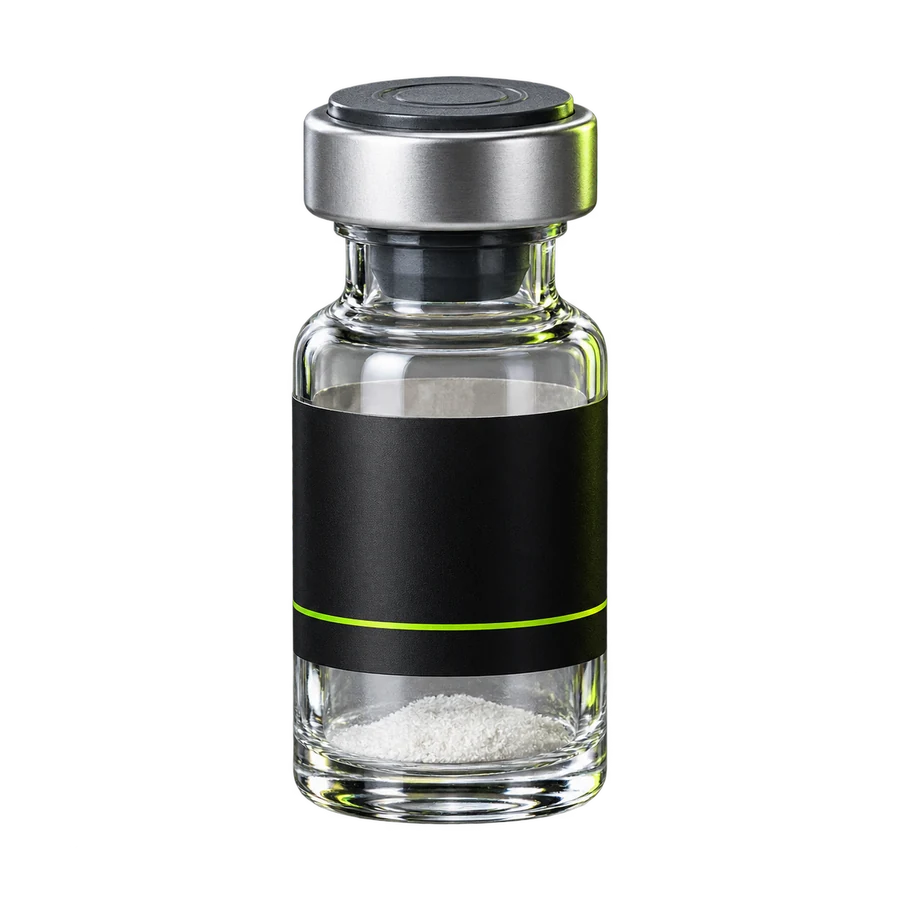
Lyophilised GHK-Cu keeps best sealed, dry, dark and cold, but the variable that separates it from ordinary peptides is chemical rather than thermal: the copper is held by coordination bonds that acidic diluents, chelators and reducing agents can break without changing how the powder looks.
- GHK-Cu is a 1:1 copper(II) complex of the tripeptide glycyl-L-histidyl-L-lysine, with copper accounting for roughly 16% of the mass of an idealised salt-free complex.
- Copper coordination depends on a deprotonated amide nitrogen, so acidic diluents dissociate the complex without any change in the appearance of the powder.
- Chelators, phosphate buffers and reducing agents such as ascorbate, DTT and TCEP all disrupt the complex and should be excluded from stock solutions.
- The blue colour and its visible absorption band near 620 nm give a fast in-process check on complex integrity that peptide chromatography cannot provide.
- Peptide purity by RP-HPLC says nothing about copper stoichiometry, which requires a separate elemental assay.
- Letting a sealed vial reach room temperature before opening prevents condensation uptake into a hygroscopic cake.
What is actually in the vial
GHK is glycyl-L-histidyl-L-lysine, a tripeptide with a molecular formula of C14H24N6O4 and a monoisotopic mass near 340.2. GHK-Cu is that tripeptide holding a single copper(II) ion, which brings the formula weight of the 1:1 complex to roughly 402. Copper therefore accounts for about 16% of the mass of an idealised, salt-free, dry complex.
That number matters because the material sold under one name comes in more than one physical form. Some lots are the isolated complex, lyophilised as a blue to blue-violet cake. Some are GHK acetate supplied alongside a copper salt, with complexation intended to happen when the operator adds diluent. Some are the peptide alone, mislabelled. The three behave differently in storage and they are not interchangeable in a protocol.
The first check costs nothing. Uncomplexed GHK is a white to off-white solid. The copper complex is blue. A vial labelled GHK-Cu containing a white powder is either not the complex or has lost its copper, and that observation belongs in the receiving record before anything else happens. The GHK-Cu product record states which form a given lot is supplied as.
The coordination chemistry that sets the handling rules
Copper(II) in GHK-Cu is not loosely associated with the peptide. It sits in a defined equatorial binding set: the terminal amine nitrogen of glycine, the deprotonated amide nitrogen of the Gly-His bond, and the imidazole nitrogen of histidine, forming two fused chelate rings. The fourth equatorial position is occupied by water, by a carboxylate, or in some conditions by a donor from a second molecule of the complex. Sigel and Martin's review of amide coordination in Chemical Reviews laid out why a peptide amide nitrogen becomes a competent copper donor only after it loses its proton, and that single fact explains most of what follows.
Because one of the three donors is a deprotonated amide, the complex is a creature of near-neutral pH. Acidify the solution and the amide reprotonates, the chelate opens, and you are left with protonated peptide and aquated copper ions sharing a tube. Push the pH high and hydroxide competes for the metal, with basic copper species dropping out of solution. The working window is narrow compared with what an ordinary tripeptide would tolerate.
Three classes of additive will strip or reorganise the metal regardless of pH. Chelators such as EDTA bind copper more tightly than the peptide does. Phosphate buffers can precipitate sparingly soluble copper phosphates, which is why a phosphate-buffered stock is a poor default here. Reducing agents including ascorbate, DTT and TCEP convert copper(II) to copper(I), which the GHK binding set does not accommodate, and which in the presence of oxygen sets off exactly the radical chemistry you do not want running in a stock vial.
Degradation routes and what drives each
| Route | What drives it | How it shows | Practical control |
|---|---|---|---|
| Complex dissociation | pH below roughly 5, chelators, competing metals | Colour fades toward pale blue or colourless | Diluent chosen and pH-checked before preparation |
| Metal-catalysed oxidation | Copper redox cycling with oxygen and any reductant present | Histidine oxidation products on LC-MS, no visual cue | Minimal headspace, dark, cold, no reducing additives |
| Backbone hydrolysis | Water activity, temperature, extremes of pH | Fragment peaks by RP-HPLC | Keep the solid dry and sealed against desiccant |
| Copper hydroxide or phosphate precipitation | Alkaline drift, phosphate buffers | Faint blue haze or fine sediment | Avoid phosphate stocks; inspect against a dark field |
| Photoreduction | Light, particularly in solution | Colour change, then oxidation products | Amber glass or opaque secondary container |
| Moisture uptake | Hygroscopic cake, condensation on cold glass | Cake slumps, darkens or goes glassy | Equilibrate sealed vials to room temperature before opening |
Aggregation, which dominates the stability picture for larger and lipidated peptides, is barely relevant to a tripeptide. Surface adsorption is a smaller concern too, though at very dilute working concentrations copper will still find its way onto glass and onto some plastics. The compensating problem is redox chemistry, which a plain peptide does not have to think about at all. Copper is a competent single-electron catalyst, and the same coordination that defines the molecule keeps that catalyst sitting next to an oxidisable histidine.
Storage conditions by physical state
| State | Temperature | Light | Relative horizon | Why |
|---|---|---|---|---|
| Sealed powder, unopened | Minus 20 °C or below, desiccated | Dark | Longest | Hydrolysis and oxidation both slowed; water excluded |
| Sealed powder, working stock | 2 to 8 °C, desiccated | Dark | Shorter | Acceptable where the vial is consumed within a defined window |
| Powder in transit | Ambient | Dark, insulated | Days | The dry complex tolerates short excursions; solution does not |
| Prepared aqueous solution | 2 to 8 °C | Dark, amber or foiled | Days | Dissociation and oxidation are now running |
| Solution, single-use aliquots | Minus 20 °C or below | Dark | Longer | Removes repeated warming and repeated air exposure |
The horizons stay relative on purpose. A specific shelf life for a specific lot requires a stability study on that lot, in that closure, under those conditions, of the kind ICH Q1A(R2) describes for regulated products. Research suppliers rarely run one. Where a certificate carries a retest date without a supporting study, treat it as a convention rather than a measurement, and say so in the record.
Freezer temperature is the easy control to obsess over and not the one doing the heaviest work. Moisture and diluent chemistry account for most of the material that quietly stops being GHK-Cu.
Colour is a crude assay, and it is free
The blue of GHK-Cu comes from a copper d-d absorption band in the visible region, centred somewhere near 620 nm depending on the fourth ligand and the solvent. There is also charge-transfer absorption in the ultraviolet. Neither band belongs to the peptide; they belong to the metal in that particular donor environment. Change the environment and the spectrum moves.
This gives a bench check that takes two minutes on any UV-visible instrument. Read a freshly prepared solution, record the wavelength of the visible maximum and the absorbance, and keep that reading as the reference for the lot. A later aliquot that has shifted position, lost intensity or picked up a green cast has undergone a speciation change, whatever the label says. It is not a purity assay and should never be reported as one, but it detects the specific failure that RP-HPLC of the peptide component will miss entirely, because dissociated GHK still chromatographs perfectly well as GHK.
Visual inspection catches the coarse version of the same problem. Hold the vial against a dark background and look for haze or fine sediment. Pale, colourless or precipitate-bearing solutions get discarded rather than salvaged.
Once it is in solution
Adding diluent changes the question from storage to speciation control. Water quality matters more than it does for an ordinary peptide, since trace transition metals and trace chelators both interfere. Deionised water of documented resistivity, or a mildly buffered near-neutral solution free of phosphate and free of EDTA, is the usual starting point. Some laboratories work in acetate or HEPES; both are workable, and both should be recorded, because the buffer is part of the material description now.
Bacteriostatic water is a common diluent and carries roughly 0.9% benzyl alcohol as preservative. Benzyl alcohol does not chelate copper and is not a reducing agent, so it is chemically unobjectionable here, but bacteriostatic water is not pH-controlled to any tight specification. If the complex is going to sit for more than a day, check the pH of the prepared solution rather than assuming it. The guide to bacteriostatic water for peptides covers what that diluent does and does not do.
Split the solution into single-use aliquots at preparation. For a tripeptide the freeze-thaw penalty is modest compared with a large peptide, so the argument for aliquoting is different: every reopening admits oxygen and humid air to a redox-active solution, and every warming cycle is time spent in a faster regime. Ten aliquots made once beat one container opened ten times. Date each at the moment it is filled, in ink that survives a freezer.
Worked example: concentration and copper content
A 50 mg vial brought into 5 mL of diluent gives:
50 mg ÷ 5 mL = 10 mg/mL
Converting to molar terms against a formula weight of about 402 g/mol:
10 mg/mL ÷ 402 g/mol ≈ 24.9 mM
And the copper carried in that vial, assuming a 1:1 salt-free complex:
50 mg × 0.158 ≈ 7.9 mg Cu
That last figure is documentation arithmetic, not a specification. Real lots carry counterions, residual solvent and water, so the measured copper fraction from an elemental assay will sit below the ideal value. How far below is itself information: a large shortfall points to underloaded complex or a peptide-plus-salt mixture, and a substantial excess points to free copper in the material. The vial concentration calculator handles other vial sizes and volumes. It covers laboratory measurement only.
Reading the certificate, and what the record should say
A certificate of analysis for GHK-Cu that reports only peptide purity by RP-HPLC has answered half the question. Chromatographic purity describes the organic component. It says nothing about whether the copper is present, whether it is present at 1:1, or whether it is coordinated rather than sitting free in the powder. Acidic mobile phases containing trifluoroacetic acid will dissociate the complex on-column anyway, so most GHK-Cu chromatography is effectively an assay of GHK.
The documentation that closes the gap looks like this:
- Identity by mass spectrometry, where the copper isotope signature is diagnostic: 63Cu and 65Cu occur at roughly 69% and 31%, giving a two-peak pattern that free peptide cannot produce.
- Copper content by ICP-MS, ICP-OES or atomic absorption, reported as a percentage against the theoretical value. USP General Chapter <233> describes the validation expectations for these elemental procedures.
- Water content by Karl Fischer, since a hygroscopic cake makes every mass-based calculation approximate.
- Counterion identity and content, and residual solvents where synthesis warrants it.
For a prepared solution, the internal record should carry the source lot, the diluent and its lot, volume added, resulting concentration, measured pH, the reference visible-band reading if one was taken, date and time, and initials. Aliquots inherit that through a shared identifier. When a result later looks wrong, this is the record that separates a chemistry problem from a material problem in about a minute. What a supplier is expected to provide is set out in the quality standard.
Regulatory position
GHK is a naturally occurring tripeptide first characterised in human plasma in the 1970s, and its copper complex has been studied extensively since. There is no FDA-approved drug product containing GHK-Cu. The complex appears in cosmetic ingredient listings under the INCI name Copper Tripeptide-1; cosmetic ingredients in the United States are not subject to pre-market approval, and a cosmetic listing is not evidence of pharmaceutical quality, sterility or identity for any given lot.
Material supplied for laboratory work is characterised for identity and purity and nothing more. It is not manufactured under the quality systems that govern medicines, and no certificate of analysis for a research chemical constitutes a claim of fitness for any use in humans or animals.
Status verified 26 August 2026.
FOR LABORATORY AND IN-VITRO RESEARCH USE ONLY. NOT FOR HUMAN OR ANIMAL CONSUMPTION. NOT FOR PERSONAL, MEDICAL, DIAGNOSTIC, THERAPEUTIC, OR RECREATIONAL USE.
What is GHK-Cu studied for?
Published research on GHK-Cu investigates the areas below, which is a different question from what GHK-Cu will do for anyone, a claim about a living system that nothing on this site is sold for.
What it is. A three-building-block peptide (glycine, histidine, lysine) joined to copper.
What the research looks at. A substantial body of cell-culture work on copper-peptide chemistry and the material that holds skin tissue together.
How it is thought to work. The peptide grips copper tightly, and the copper-carrying form is what the research is about. Its blue colour comes from that copper, not from the peptide. Published work covers the copper chemistry and the biology of the material between skin cells, in culture.
What is not established. No approved drug product. The copper-carrying form and the bare peptide are different chemicals with different stability, and a certificate should make clear which one is in the vial.
The full record, including the certificate for the lot in stock, is on the GHK-Cu product page.
Common questions
Why does the diluent matter more for GHK-Cu than for other peptides?
The cake in my vial is white rather than blue. What does that mean?
Can a prepared solution be refrozen?
Does HPLC purity on the certificate tell me the copper is there?
How long does lyophilised GHK-Cu last?
Is a visible-spectrum reading a substitute for a purity assay?
More handling guides
Sources
- Sigel and Martin, Chemical Reviews, 1982. Review of the coordinating properties of the amide bond; establishes that peptide amide nitrogen binds copper(II) only after deprotonation, which underlies the pH sensitivity described here.
- Pickart and Margolina, International Journal of Molecular Sciences, 2018. Review of GHK and its copper complex; supports the composition, the 1:1 copper stoichiometry and the general chemistry of the complex.
- USP General Chapter <233>, Elemental Impurities — Procedures. Defines validated ICP-MS and ICP-OES approaches for elemental determination; the reference standard for how a copper content figure on a certificate should have been generated.
- ICH Q1A(R2), Stability Testing of New Drug Substances and Products. Establishes what a defensible shelf life or retest date requires, and by extension why an unsupported storage figure on a research certificate is a convention rather than a measurement.