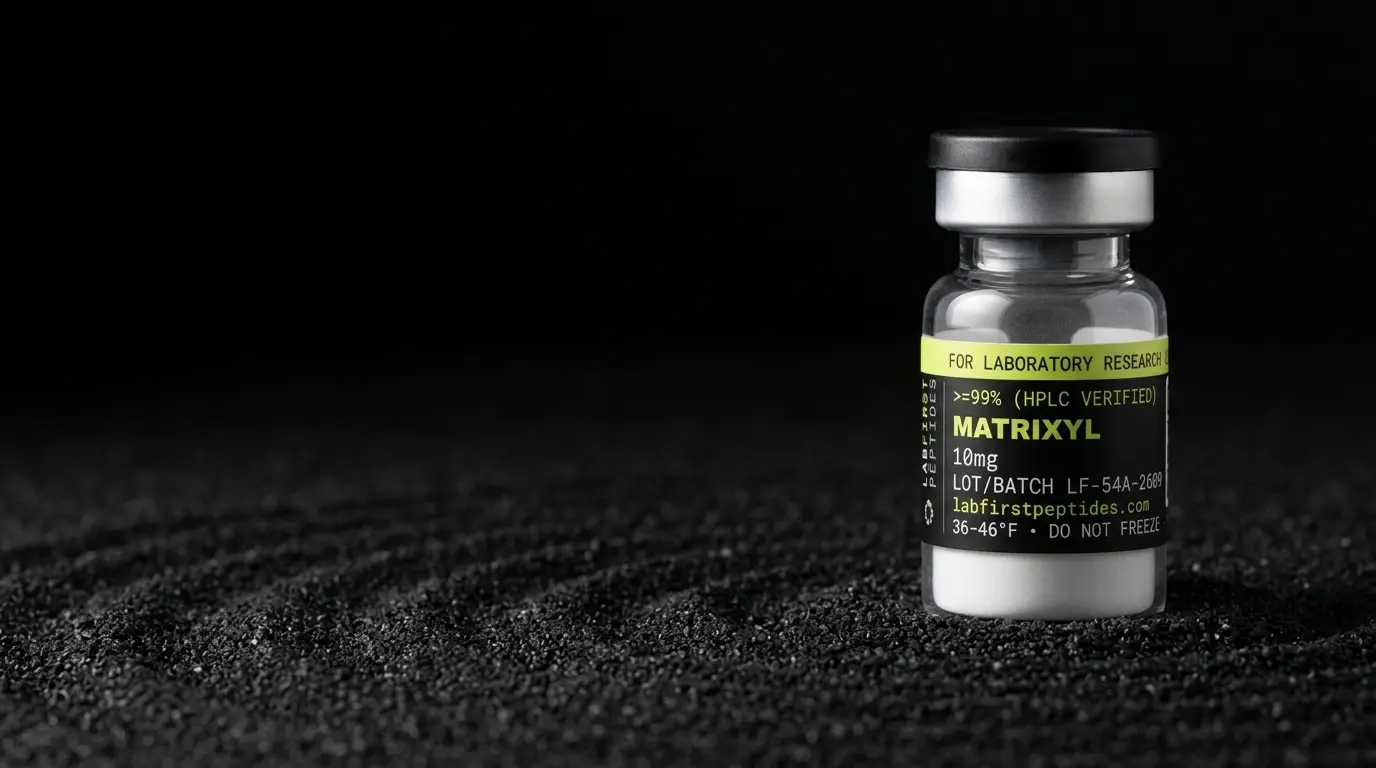
Matrixyl storage and stability are best when the freeze-dried pal-KTTKS stays sealed, dry, dark and cold. Let the vial warm to room temperature before you open it. Once dissolved, the fatty palmitoyl tail makes the peptide stick to surfaces and clump, so make single-use aliquots, use one container type, and date every tube.
- Matrixyl here is palmitoyl pentapeptide-4 (pal-KTTKS), PubChem CID 9897237.
- The sequence has no Asn, Gln, Met, Cys or Trp, so deamidation and oxidation are minor routes.
- Moisture, delivered mostly by condensation, is the main threat to the powder.
- The palmitoyl tail makes the molecule an amphiphile prone to surface loss in solution.
- ICH Q1A(R2) treats storage periods as outputs of stability data under defined conditions.
What keeps Matrixyl stable, and what spoils it?
Dry, cold, dark storage keeps it stable, and moisture spoils it first. Leave a bag of sugar open in a steamy kitchen and it turns into a hard lump by morning. Dry peptide powder behaves the same way. It pulls water out of the air, and water is what lets the slow chemical damage get started. Most of Matrixyl storage comes down to keeping water out.
Matrixyl here means palmitoyl pentapeptide-4, pal-KTTKS: the peptide Lys-Thr-Thr-Lys-Ser with a sixteen-carbon palmitoyl chain on its N-terminus. PubChem lists it as CID 9897237, formula C39H75N7O10, molecular weight 802.1. It ships as a lyophilized powder in a 10 mg vial.
Two parts of that structure set the storage rules. The peptide head, with two free lysine amines, is polar and attracts water. The palmitoyl tail is a long hydrocarbon chain that avoids water. That combination makes the molecule an amphiphile, and amphiphiles have habits in solution that a plain short peptide does not.
- Moisture from condensation at opening
- Temperature as a rate modifier
- Surface loss of the amphiphile in solution
- Freeze-thaw cycling of solutions
- Oxidation and deamidation: minor for KTTKS
What the sequence rules in and out
Reading the sequence tells you which degradation routes to worry about. The table below works from the structure alone.
| Route | Needs | Present in pal-KTTKS? | Control |
|---|---|---|---|
| Backbone hydrolysis | Water, heat, pH extremes | Yes, any amide bond | Keep the solid dry and sealed |
| Deamidation | Asparagine or glutamine | No; neither residue is present | Not applicable |
| Oxidation | Met, Cys or Trp | No; none present | Dark storage costs nothing |
| Disulfide scrambling | Cysteine | No | Not applicable |
| Surface adsorption | Interface-active molecule | Yes; amphiphile, cationic head | Fix container type; avoid foaming |
| Self-association | Hydrophobic tail | Yes | Consistent preparation and solvent |
That is a fairly short list of real risks. The absence of asparagine, glutamine, methionine, cysteine and tryptophan removes routes that dominate many other peptides. What remains is water-driven hydrolysis in the solid, and physical loss in solution: molecules sticking to walls, gathering at air-water interfaces, or clustering with each other.
Cold slows all of it. It does not replace dryness. Temperature changes the rate of a reaction; water decides whether the reaction can run at all.
The sealed lyophilized vial
| State | Temperature | Light | Relative horizon |
|---|---|---|---|
| Sealed powder, unopened | -20 C or below, desiccated | Dark | Longest |
| Sealed powder, working stock | 2 to 8 C, desiccated | Dark | Shorter than frozen |
| Powder in transit | Ambient | Dark, insulated | Days |
| Laboratory solution | 2 to 8 C | Dark | Days, not months |
| Solution, single-use aliquots | -20 C or below | Dark | Longer, at a cost per thaw |
The horizons are relative on purpose. ICH Q1A(R2) defines a re-test period as the time a substance is expected to stay within its specification under defined storage conditions, and it treats that period as the output of stability data. For freezer storage it sets long-term testing at -20 C plus or minus 5 C. For storage below -20 C it says conditions are handled case by case.
No one has run that study on a research lot in your particular vial. If a certificate carries a retest date backed by stability data, use it. If it carries none, the honest record says the window is not established and the material is judged by its handling history.
Why is opening a cold vial risky?
Opening a cold vial is where most avoidable damage happens. A vial straight from a -20 C freezer is far below the dew point of room air. Open it at once and water condenses on the inside of the glass and on the powder. The powder takes it up immediately and looks no different.
The vial then goes back in the freezer with water inside it, and the next opening adds more. Weeks later a purity result comes back lower than the certificate and nobody can say why.
The fix is dull and reliable. Let the sealed vial reach room temperature before breaking the seal, every time. Twenty to thirty minutes on the bench suits a small vial. Work quickly once it is open, reseal against fresh desiccant, and note the opening in the log if your protocol tracks them. The general guide on storing lyophilized peptides covers the same habit for any powder.
Shipping and receiving
A dry lyophilized solid tolerates a few days at ambient temperature far better than any solution does, which is why powder can travel without a freezer pack. What it does not tolerate is water. A vial that arrives sealed, with the cake intact and dry-looking, has had an easy journey.
At receiving, look before you store. Note whether the cake is fluffy and whole, or shrunken, glassy or collapsed, since the latter usually means water got in. Check the seal and the cap. Match the lot number on the vial with the lot on the certificate, then log the date, the observation and where the vial went.
Then move it to cold, dark, desiccated storage without opening it. There is no reason to open a vial on arrival, and every opening is a chance for condensation.
Laboratory solutions of an amphiphile
Once pal-KTTKS is dissolved for a laboratory assay, its amphiphilic shape starts to matter. Molecules with a hydrocarbon tail and a charged head tend to gather at interfaces, including the air-water surface and the walls of the container. At low working concentrations, that loss can be a real share of what you think is in the tube, and you cannot see it.
Three habits keep it under control. Choose the container material and keep it fixed across a series; a switch from polypropylene to glass midway can create a trend that has nothing to do with the experiment. Swirl rather than vortex, because foam is air-water interface. And prepare solutions the same way each time, in the same solvent system, so any self-association is at least consistent between runs.
Hydrolysis has water to work with now, and any microbe introduced during preparation has a medium. Keep solutions cold and dark, and treat days rather than months as the working horizon unless your own data say otherwise.
Aliquots, labels and the record
Split a laboratory solution into single-use aliquots at the moment it is made. Each freeze-thaw cycle drives losses that build up rather than reverse, and a tube on its fifth thaw is not the same sample as one on its first. Aliquoting removes the question.
Label each aliquot then, not later, with an identifier that traces back to the parent solution. The record for that solution should give the source lot, solvent and its lot, volume, the net peptide content used in the concentration arithmetic, date and time, storage location and initials. Undated tubes are thrown out, not guessed at.
Net peptide content matters here because a 10 mg vial is not 10 mg of peptide. Water and counterions make up part of the mass, and the Matrixyl certificate of analysis guide explains how to read that figure. Identity questions belong in the Matrixyl identity guide. The Matrixyl product page shows current availability, and lot results appear there only once the certificate for that lot is published.
Worked example: concentration arithmetic
Say a 10 mg vial is brought into 2 mL of solvent for a laboratory assay. The nominal concentration is
10 mg / 2 mL = 5 mg/mL
At a molecular weight of 802.1 g/mol, that works out to about 6.2 mM. Both numbers assume the vial holds 10 mg of peptide, which it does not quite, because water and counterions take up part of the fill. If the certificate reports net peptide content, multiply by it first. At a hypothetical 80 percent net content the solution is 4 mg/mL, near 5.0 mM.
If the protocol draws 0.2 mL per run, the 2 mL supports ten draws. Held in one tube, the last draw comes from material thawed nine times. Split into ten 0.2 mL aliquots at preparation, each tube is thawed once.
Research-use status
Palmitoyl pentapeptide-4 in this catalog is sold as a laboratory reagent. Its naming and its separate life as a cosmetic ingredient are covered in the palmitoyl pentapeptide-4 guide. Nothing on this page concerns use outside the laboratory.
FOR LABORATORY AND IN-VITRO RESEARCH USE ONLY. NOT FOR HUMAN OR ANIMAL CONSUMPTION.
What is Matrixyl studied for?
Published research on Matrixyl investigates the areas below, which is a different question from what Matrixyl will do for anyone, a claim about a living system that nothing on this site is sold for.
What it is. Palmitoyl pentapeptide-4, palmitoyl-Lys-Thr-Thr-Lys-Ser (pal-KTTKS) — a lipidated fragment of type I procollagen.
What the research looks at. Topical cosmetic use on photoaged facial skin. One of very few compounds on this catalogue with a published randomised placebo-controlled human trial of the actual marketed form.
How it is thought to work. KTTKS is a subfragment of the C-terminal propeptide of type I collagen, proposed to act as a feedback signal stimulating collagen synthesis. The palmitoyl group is added to make an otherwise hydrophilic pentapeptide able to cross the stratum corneum.
What is not established. Mechanism at the molecular level. The collagen-feedback hypothesis is plausible and has not been demonstrated as the operative pathway in human skin.
The full record, including the certificate for the lot in stock, is on the Matrixyl product page.
Common questions
Should lyophilized Matrixyl be kept frozen?
Does pal-KTTKS oxidize or deamidate?
Why does container material matter for Matrixyl solutions?
How long does a Matrixyl laboratory solution last?
More handling guides
Sources
- PubChem compound record: Palmitoyl pentapeptide-4 (CID 9897237). Formula C39H75N7O10, molecular weight 802.1, monoisotopic mass 801.5575, and the IUPAC name showing a hexadecanoyl group on the alpha-amine of the N-terminal lysine of Lys-Thr-Thr-Lys-Ser, with a free C-terminal acid.
- ICH Q1A(R2), Stability Testing of New Drug Substances and Products. Defines the re-test period as the time a substance is expected to stay within specification under defined storage conditions; sets freezer long-term testing at -20 C plus or minus 5 C and treats storage below -20 C case by case.