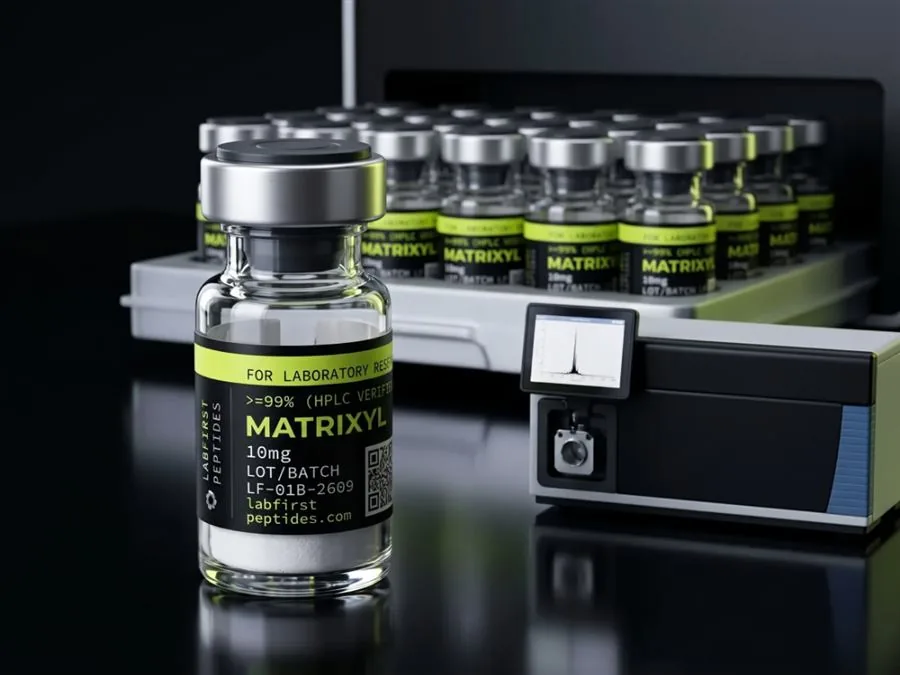
Palmitoyl pentapeptide-4 is a synthetic lipopeptide: the five-residue sequence Lys-Thr-Thr-Lys-Ser with a C16 palmitoyl group amide-bonded to its N-terminus. The sequence derives from the C-terminal propeptide of type I procollagen, and the compound is best known under the trade name Matrixyl. Formula C39H75N7O10, average mass 802.1 g/mol.
- Palmitoyl pentapeptide-4 is pal-KTTKS: the pentapeptide Lys-Thr-Thr-Lys-Ser with palmitic acid amide-bonded to its N-terminal α-amine.
- The INCI serial changed from -3 to -4 in the mid-2000s with no change to the structure; older labels describe the same molecule.
- Molecular formula C39H75N7O10, average mass 802.1 g/mol, monoisotopic mass 801.56 Da.
- The sequence has no aromatic residues, so purity chromatography is read at low wavelength, around 214 nm, never at 280 nm.
- Matrixyl 3000 and Matrixyl Synthe'6 are different molecules, and their documentation cannot support a pal-KTTKS listing.
- KTTKS derives from the carboxy-terminal propeptide of type I procollagen, identified in fibroblast culture work published in 1993.
Four names for one molecule
The compound behind this query is one defined molecule: the pentapeptide lysine-threonine-threonine-lysine-serine, written KTTKS in one-letter code, with a palmitoyl group fixed to its N-terminus. Everything else is labeling. The research literature writes pal-KTTKS. The INCI dictionary, which names cosmetic ingredients, lists it as Palmitoyl Pentapeptide-4. The trade name, held by Sederma, is Matrixyl.
The numeral misleads twice. Older labels and papers call the same molecule palmitoyl pentapeptide-3; the INCI dictionary renumbered a block of peptide entries in the mid-2000s and this compound moved from -3 to -4 with no change to its structure. And the -4 is a registry serial, not chemistry. It counts nothing about the molecule. The penta- prefix carries the structural information; the number is bookkeeping.
| Name | Kind of name | Refers to |
|---|---|---|
| pal-KTTKS | Literature shorthand | This exact molecule |
| Palmitoyl Pentapeptide-4 | INCI name, current | This exact molecule |
| Palmitoyl Pentapeptide-3 | INCI name, superseded | The same molecule, before renumbering |
| Matrixyl | Trade name | This molecule as a supplied ingredient |
| Matrixyl 3000 | Trade name | A different material: a blend of palmitoyl tripeptide-1 and palmitoyl tetrapeptide-7 |
| Matrixyl Synthe'6 | Trade name | A different material: palmitoyl tripeptide-38 |
The last two rows cause real procurement errors. An unqualified Matrixyl listing normally means pal-KTTKS, but Matrixyl 3000 and Matrixyl Synthe'6 are different molecules with different masses, and a certificate of analysis written for one cannot support a listing for another.
- Sequence Lys-Thr-Thr-Lys-Ser, palmitoylated at the N-terminus
- Formula C39H75N7O10, average mass 802.1 g/mol
- Net cation near neutral pH: two free ε-amines against one carboxylate
- No aromatic residues, so the HPLC trace is read near 214 nm, never 280
- Same molecule as the superseded name palmitoyl pentapeptide-3
Structure and bonding
Start with the peptide. KTTKS is a linear pentapeptide: five residues joined by four amide bonds, ending in a free carboxylic acid at the serine C-terminus. Two of the five residues are lysine, and each contributes an ε-amine on its side chain in addition to its backbone nitrogen. The threonines and the serine carry hydroxyl groups. There are no aromatic residues and no cysteine, which matters for the analytical section below.
The palmitoyl group is the acyl residue of hexadecanoic acid, a fully saturated sixteen-carbon fatty acid, condensed onto the α-amine of the N-terminal lysine through a fifth amide bond. The two ε-amines stay free. Acylation removes the N-terminal positive charge while leaving the side chains protonatable, so near neutral pH the molecule carries roughly +2 from the ε-amines against −1 from the C-terminal carboxylate, a net cation.
Registry records, including the PubChem compound entry, give the molecular formula C39H75N7O10, an average mass of 802.1 g/mol and a monoisotopic mass of 801.56 Da. The construction is a textbook peptide amphiphile: a hydrocarbon tail with no polar character on one end, a small cationic hydrogen-bond-rich headgroup on the other. That is why the compound behaves like a surfactant in water, concentrates at interfaces, and self-assembles into extended nanostructures above a critical aggregation concentration, behavior reported for pal-KTTKS specifically in the peptide-amphiphile literature.
Where the sequence comes from
KTTKS is a discovered sequence. Type I procollagen is secreted with propeptides at both ends, cleaved during fibril assembly, and the released carboxy-terminal propeptide has long been studied as a signalling fragment in its own right. Katayama and colleagues, working in fibroblast culture, reported in the Journal of Biological Chemistry in 1993 that the KTTKS subfragment of that propeptide promoted extracellular matrix production in vitro. That cell-culture observation is the entire scientific pedigree of the sequence, and it is an in-vitro finding about fibroblasts in a dish, which is how this page treats it.
The palmitoyl group arrived later, in cosmetic-ingredient development, for a mundane physical reason: a small hydrophilic pentapeptide partitions poorly into lipid phases, and N-terminal acylation raises lipophilicity by orders of magnitude. For documentation purposes that history has one practical consequence. Data generated on free KTTKS does not transfer to pal-KTTKS. The acyl chain changes solubility, aggregation state, chromatographic retention and mass, which is to say it changes nearly everything a certificate measures.
How a laboratory measures it
Identity and purity for pal-KTTKS run through the same two instruments as any research peptide, with adjustments the acyl chain forces.
Mass spectrometry settles identity. With a monoisotopic mass of 801.56 Da, electrospray ionisation should show the protonated molecule near m/z 802.6, and the free ε-amines make a doubly charged species near 401.8 routine. A certificate states the found mass against the theoretical one; agreement within instrument tolerance is the identity claim. A document showing only a chromatogram, with no mass anywhere on it, has not established identity at all.
Reversed-phase HPLC settles purity, reported as the main peak's share of total integrated area. Two features are specific to this molecule. The C16 chain makes it far more retained than the free pentapeptide, so gradients run to high organic content and peak shape often improves with column temperature. And because the sequence contains no tryptophan, tyrosine or phenylalanine, there is nothing to detect at 280 nm; the trace is recorded at low wavelength, conventionally around 214 nm, where backbone amides absorb. A purity figure quoted at 280 nm is a warning in itself, because the molecule is close to invisible there.
| Attribute | Method | What the certificate states |
|---|---|---|
| Identity | ESI-MS or LC-MS | Found mass against the theoretical 801.56 Da monoisotopic value |
| Chromatographic purity | RP-HPLC at low wavelength | Main-peak area percentage, with column, gradient and wavelength identified |
| Peptide content | Nitrogen or amino acid analysis | The fraction of gross solid that is actually peptide |
| Residual moisture | Karl Fischer titration | Water content of the lyophilizate |
| Counterion | Ion chromatography, or stated by process | Trifluoroacetate or acetate, since salt form changes net content |
Peptide content deserves a sentence of its own. Lyophilized peptides are weighed as gross solid, and gross solid includes residual water and the counterion left behind by purification. A 10 mg fill at 80 percent peptide content holds 8 mg of the lipopeptide. Certificates that state content, moisture and salt form make that arithmetic possible; certificates that state only a purity percentage do not.
Powder or solution: reading a listing
Most commerce in this ingredient is not the neat compound. Cosmetic supply sells palmitoyl pentapeptide-4 predominantly as a dilute solution in a water and glycerin carrier, at concentrations in the parts-per-million range, because formulators weigh it in as a solution. Research supply sells the lyophilized lipopeptide itself. Both are correctly called by the same INCI name, and the difference in actual peptide content between them can be three orders of magnitude.
So the first question to put to any listing is what the stated quantity refers to. A milligram figure should mean milligrams of lipopeptide, gross or net, and the listing should say which. A purity claim made for a carrier solution is not comparable to one made for a powder. A competent research listing states the fill mass, the salt form or peptide content, and ties the vial to a lot and a certificate; the quality standard page sets out the documentation this catalog treats as the floor, and the Matrixyl product record is where that documentation attaches for the material sold here.
Red flags follow from the naming history: listings that treat Matrixyl and Matrixyl 3000 as interchangeable; masses with no statement of gross versus peptide weight; chromatograms with no wavelength recorded; a quoted molecular mass that does not round to 802. None of these requires an instrument to check. They are all visible in the listing before any money moves.
Solution preparation and handling
As a dry lyophilizate, pal-KTTKS follows standard peptide practice: sealed, cold, dark and desiccated, and warmed to room temperature before the vial is opened so condensation stays on the outside. The acyl chain changes none of that. No compendial monograph exists for this compound, so where a supplier states a storage window, the figure comes from that supplier's own stability program and should be read that way.
Water is where the amphiphilicity shows. The compound disperses as a surfactant rather than dissolving like a small polar peptide, and above its aggregation threshold a solution contains assembled structures in place of free monomer. The documentation arithmetic is unchanged: a 10 mg vial brought into 2 mL of diluent gives
10 mg ÷ 2 mL = 5 mg/mL
which at 802.1 g/mol is about 6.2 mM. The vial concentration calculator handles other fills and volumes. Diluent selection follows the same single-entry versus multiple-entry logic as any peptide, set out in the bacteriostatic water guide. Swirl gently and never shake: an interface-active molecule is exactly the kind that foams, and foam is an air–water interface degrading material.
FOR LABORATORY AND IN-VITRO RESEARCH USE ONLY. NOT FOR HUMAN OR ANIMAL CONSUMPTION. NOT FOR PERSONAL, MEDICAL, DIAGNOSTIC, THERAPEUTIC, OR RECREATIONAL USE.
Regulatory position
Palmitoyl pentapeptide-4 sits in the cosmetic-ingredient regime. In the United States, cosmetic ingredients other than color additives receive no premarket approval; the Modernization of Cosmetics Regulation Act, enacted in December 2022, added facility registration and product listing obligations for finished cosmetics without creating an ingredient approval pathway. The compound is not an approved drug in any jurisdiction, and the United States Pharmacopeia carries no monograph for it, so the analytical expectations described above are industry practice, with no pharmacopeial standard behind them.
Status described as of 25 August 2026. Research-grade pal-KTTKS is supplied as a laboratory reagent, and its parallel life as a cosmetic raw material changes nothing about that boundary.
Common questions
Is Matrixyl the same as palmitoyl pentapeptide-4?
Why do older papers call it palmitoyl pentapeptide-3?
What should a certificate of analysis show for this compound?
Why is purity measured at 214 nm instead of 280 nm?
Does palmitoyl pentapeptide-4 dissolve in water?
Related guides: peptide chemistry basics
Sources
- Katayama et al., Journal of Biological Chemistry, 1993. Identification of the KTTKS subfragment of the type I procollagen carboxy-terminal propeptide as a promoter of extracellular matrix production in fibroblast culture.
- PubChem compound record for palmitoyl pentapeptide-4. Registry identity: molecular formula C39H75N7O10, average mass 802.1 g/mol and monoisotopic mass 801.56 Da.
- International Cosmetic Ingredient Dictionary (INCI), Personal Care Products Council. Naming authority for the Palmitoyl Pentapeptide-4 designation and the renumbering from the superseded Palmitoyl Pentapeptide-3 entry.
- FDA, Modernization of Cosmetics Regulation Act of 2022. US regulatory framework for cosmetic ingredients; enacted December 2022, adding registration and listing obligations without an ingredient approval pathway.