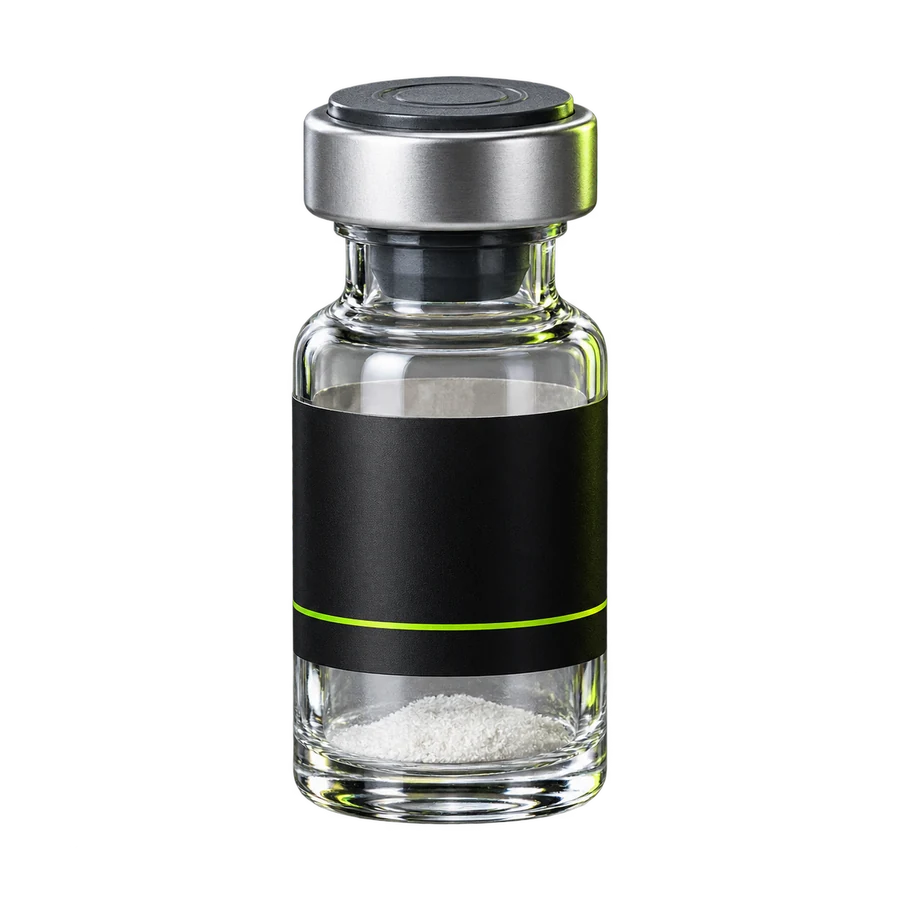
Lyophilised SS-31 stores best as a sealed, desiccated powder held cold and dark. Because the salt form is hygroscopic and the dimethyltyrosine residue oxidises, moisture and light do more damage than freezer temperature. Once dissolved, hydrolysis begins and the container surface itself becomes a route of loss.
- SS-31 is the tetrapeptide D-Arg-Dmt-Lys-Phe-NH2, also known as elamipretide, MTP-131 and Bendavia.
- The salt form is hygroscopic, so cold-vial condensation and humid weighing rooms do more damage than freezer setting.
- The dimethyltyrosine phenol is the oxidation-susceptible site; there is no methionine, tryptophan or cysteine in the sequence.
- No asparagine or glutamine is present, so the deamidation route that dominates most peptide stability advice does not apply.
- As a cationic peptide, SS-31 adsorbs to bare glass at low concentration, and the container choice belongs in the protocol.
- Concentration arithmetic must use the certificate peptide content figure, not the labelled gross fill weight.
Why SS-31 does not inherit the usual peptide storage advice
Most handling guidance circulating for research peptides was written with large lipidated analogues in mind. Those molecules are interface-active, they aggregate, and the advice reflects that: do not foam the solution, keep headspace small, mind the air-water boundary. SS-31 is a different animal. It is a tetrapeptide of roughly 640 daltons in its free-base form, freely water soluble, and carrying substantial positive charge near neutral pH. Aggregation is a minor concern for a molecule of that description.
Two other things matter more. The first is water, which the material takes up readily because it is normally supplied as a hygroscopic salt of a highly basic peptide. The second is oxidation, because the second residue is a phenol and phenols oxidise in the presence of light, oxygen and trace metal ions. Neither of these announces itself visually.
A note on names before anything else. The same molecule appears in the literature and on supplier labels as SS-31, elamipretide, MTP-131 and Bendavia. The research-chemical designation and the clinical development names refer to one structure with four different documentation lineages behind them, and confusing the lineages is how people end up quoting a shelf life derived from a formulated sterile product for a vial of powder.
- Moisture — taken up fast by a hygroscopic peptide salt
- Light and oxygen — oxidation at the dimethyltyrosine phenol
- Water in solution — backbone and C-terminal amide hydrolysis
- Glass surfaces — adsorption of a cationic peptide at low concentration
- Temperature — a rate modifier across all of the above
Structure, and what it predicts
SS-31 is D-Arg-Dmt-Lys-Phe-NH2, where Dmt is 2',6'-dimethyltyrosine. The C-terminus is a primary amide. The free base corresponds to C32H49N9O5 with a monoisotopic mass near 639.4 and an average mass near 639.8; PubChem carries the record under elamipretide and is the reference worth checking against a supplier's stated formula. Commercial material is almost always an acetate or trifluoroacetate salt, and the salt contributes mass that the label may or may not have subtracted.
Each structural feature points at a specific handling consequence.
- The D-arginine at position one resists aminopeptidase cleavage. That is enzymatic resistance and nothing more. It does not slow chemical hydrolysis, and treating protease stability as general stability is the most common misreading of this sequence.
- The dimethyltyrosine phenol is the oxidisable site. There is no methionine, tryptophan or cysteine in the molecule, so the classic oxidation targets are absent and this residue carries the risk instead.
- Lysine and arginine side chains give a net charge around +3 at neutral pH. That explains the high aqueous solubility and it also explains adsorption to bare borosilicate glass, whose surface silanols are negatively charged.
- The C-terminal amide can hydrolyse to the free acid. The mass difference is about +1 Da, which LC-MS resolves comfortably and reversed-phase HPLC often does not, since the acid can elute very close to the parent.
- There is no asparagine or glutamine, so the deamidation route that dominates many peptide stability discussions does not apply here.
Degradation routes and what controls each
| Route | Driver | Site | Control |
|---|---|---|---|
| Phenol oxidation | Light, headspace oxygen, trace Fe and Cu, alkaline pH | Dmt residue | Amber or boxed storage, cold, minimal headspace, low-metal diluent |
| C-terminal amide hydrolysis | Water activity, heat, acidic conditions | C-terminal amide | Keep the solid dry and sealed; avoid warm acidic solutions |
| Backbone hydrolysis | Water, temperature, pH extremes | Any amide bond | Dry storage against desiccant; cold once in solution |
| N-terminal cyclisation | Heat and moisture in short sequences generally | First two residues | Dry, cold storage. Whether this route is significant for this specific sequence is not established in published work |
| Water uptake by the salt | Ambient humidity, cold-vial condensation | Bulk solid | Equilibrate sealed vials to room temperature before opening; reseal with desiccant |
| Surface adsorption | Cationic peptide on negatively charged glass; low concentration | Container wall | Low-binding polypropylene, adequate ionic strength, container documented in the protocol |
Freezer temperature is absent from the driver column on purpose. Cold slows every route in the table, which is why cold storage is the default, but temperature modifies rates rather than causing failure. Moisture and light cause failure. A vial kept genuinely dry at 4 °C in a closed box will usually outperform one cycled through a frost-free freezer and opened cold in a humid room.
Conditions by physical state
| State | Temperature | Light | Relative horizon | Why |
|---|---|---|---|---|
| Sealed powder, unopened | Minus 20 °C or below, desiccated | Dark | Longest | Water excluded and every route slowed |
| Sealed powder, in-use stock | 2 to 8 °C, desiccated | Dark | Shorter | Acceptable where the vial is consumed inside a defined window and openings are logged |
| Powder in transit | Ambient | Dark, insulated | Days | A dry solid tolerates short excursions far better than any solution |
| Prepared aqueous solution | 2 to 8 °C | Dark | Days, not months | Hydrolysis and oxidation are both running |
| Single-use frozen aliquots | Minus 20 °C or below, minus 80 °C preferred | Dark | Longer | Removes repeat thaw cycles from the last sample in a series |
The horizons stay relative because assigning months to a research powder requires a stability study on that lot, in that container closure, under those conditions. Very little such data exists in public for research-grade SS-31. ICH Q1A(R2) describes what a real stability programme looks like, and a supplier quoting a confident expiry without one is quoting a convention. Where a certificate of analysis carries a retest date, ask what supports it. Our own position on what a lot record should contain is set out in the quality standard.
Condensation, and the hygroscopic salt problem
Take a vial from a minus twenty freezer into a room at 22 °C and sixty percent relative humidity. The glass sits far below the dew point. Break the seal and water condenses on the inside surfaces and on the cake itself within seconds. An acetate or trifluoroacetate salt of a strongly basic peptide is a good enough desiccant to take that water up immediately and hold it.
Nothing about the result looks wrong. A slightly damp cake looks like a cake. It may go faintly translucent or slump at the edge, and it may not. The vial then returns to the freezer with water inside it, and the next analyst repeats the cycle.
The control is dull and works: let the sealed vial reach room temperature before the seal is broken, every single time. Twenty to thirty minutes on the bench suits a small vial. Work quickly once open, reseal with desiccant, and log the opening if the protocol tracks excursions. Where a vial is opened repeatedly, weighing out the whole contents once into single-use portions under low humidity costs an hour and removes the problem entirely.
One consequence of hygroscopicity worth stating plainly: a gravimetric weighing of hygroscopic powder in an uncontrolled room is not an accurate measurement of peptide. If the arithmetic downstream depends on mass, either weigh in a glove box or work from the full vial contents and the stated fill weight.
Once it is in solution
Adding diluent starts a faster clock and changes which variables matter. Hydrolysis now has water. The phenol now has dissolved oxygen and whatever trace metals came in with the water. Any microbial contamination introduced at preparation has a medium. SS-31 dissolves easily in water and in aqueous buffers, so there is rarely a reason to reach for organic co-solvents; where a protocol calls for bacteriostatic diluent, the composition and its own storage behaviour are covered in the note on bacteriostatic water for peptides.
Three practices do most of the work.
- Aliquot at the moment of preparation into single-use volumes, so no container is thawed twice.
- Choose the container deliberately. A cationic tetrapeptide at low micromolar concentration in unbuffered water will lose measurable material to bare glass. Low-binding polypropylene and adequate ionic strength both reduce it. Whatever is chosen goes in the protocol, because a change of tube is a change of experiment.
- Keep solutions dark and cold, and keep the pH away from the alkaline end where phenol oxidation accelerates.
The analytical corollary: if a stored solution needs to be checked, RP-HPLC with UV detection near 220 nm will show gross loss of parent and the appearance of new peaks, and LC-MS is what distinguishes the +1 Da amide hydrolysis product and the +16 Da oxidation product from the parent. Chromatographic system suitability under USP General Chapter <621> is the reference frame for whether the separation is trustworthy in the first place. A single UV chromatogram with no mass confirmation cannot tell you which of those two things happened.
Worked example: net peptide content and aliquot arithmetic
Suppose a vial is labelled 10 mg and the certificate states peptide content of 84 percent, the balance being counterion and residual water. The peptide present is:
10 mg × 0.84 = 8.4 mg net peptide
Brought into 2 mL of diluent, that gives:
8.4 mg ÷ 2 mL = 4.2 mg/mL
Not the 5 mg/mL the label mass would suggest, a difference of sixteen percent that propagates into every downstream figure. If a protocol draws 0.2 mL per run, one container supports:
2 mL ÷ 0.2 mL = 10 draws
Held as a single container, the tenth draw comes from material warmed and re-chilled nine times. Split into ten portions at preparation, each is thawed once. The vial concentration calculator handles other fill weights and volumes. It covers laboratory measurement only.
Whether the peptide content figure on the certificate was determined by nitrogen analysis, by quantitative HPLC against a reference standard, or simply assumed from a typical salt stoichiometry, is a question worth asking. The three answers carry very different uncertainties.
What the record should say
Storage discipline that is not written down is not reproducible. For a prepared solution the minimum record carries the source lot identifier, the diluent and its lot, the volume added, the peptide content figure used, the resulting concentration, the container type, the preparation date and time, and the initials of whoever made it. Aliquots inherit that record through a shared identifier written on the tube in something that survives a freezer.
The reason is practical. When a result looks wrong, the first question is whether the material was what the protocol assumed. A chain that runs from sample to aliquot to solution to lot to certificate answers that in a minute. A chain with a gap in it means repeating the work. The same logic applied to a different molecule is set out in the note on tirzepatide storage and stability.
Undated aliquots are unusable. That sounds harsh in a small lab where everyone remembers making them. It stops sounding harsh the second time an experiment is repeated because nobody could say whether a tube was three weeks or seven months old.
Regulatory position
SS-31 is the research designation for elamipretide, also seen as MTP-131 and Bendavia, a mitochondrially targeted tetrapeptide developed by Stealth BioTherapeutics and studied in primary mitochondrial myopathy and in Barth syndrome. It received FDA orphan drug designation for Barth syndrome, and an accelerated approval for that indication was granted in September 2025 under the brand name Forzinity. The review history involved several extensions, and accelerated approvals carry confirmatory obligations, so anyone relying on the current status should verify it directly against the FDA approval databases rather than against this page.
A prescription medicine manufactured under pharmaceutical quality systems, with sterility, endotoxin, formulation and lot-release controls, and a research powder supplied with a certificate covering identity and purity are different articles. The certificate makes a narrower claim about a different kind of material. Research-grade SS-31 has never been a lawful route to human use at any point in that development timeline.
Status verified 26 August 2026.
FOR LABORATORY AND IN-VITRO RESEARCH USE ONLY. NOT FOR HUMAN OR ANIMAL CONSUMPTION. NOT FOR PERSONAL, MEDICAL, DIAGNOSTIC, THERAPEUTIC, OR RECREATIONAL USE.
Common questions
Does lyophilised SS-31 have to be kept frozen?
Why does the salt form matter for storage?
What degradation products should an analytical check look for?
How long does a prepared solution last?
Can SS-31 be lost to the container itself?
Is research-grade SS-31 the same thing as elamipretide the medicine?
More handling guides
Sources
- Szeto and colleagues, Journal of Biological Chemistry, 2004. Original description of the cell-permeable SS peptide series, including the SS-31 sequence D-Arg-Dmt-Lys-Phe-NH2; supports the structure and nomenclature used here.
- Birk and colleagues, peer-reviewed nephrology and pharmacology literature, 2013 onward. Characterisation of SS-31 interaction with cardiolipin in mitochondrial membranes; establishes the mechanistic context in which the compound is studied in vitro.
- PubChem compound record for elamipretide. Reference for molecular formula, monoisotopic and average mass, and synonym list; used to check a supplier stated formula and salt correction.
- ICH Q1A(R2) and USP General Chapter <621>. ICH Q1A(R2) defines what a genuine stability programme requires before a retest date can be assigned; USP <621> sets the chromatographic system suitability frame for any purity or degradation check.