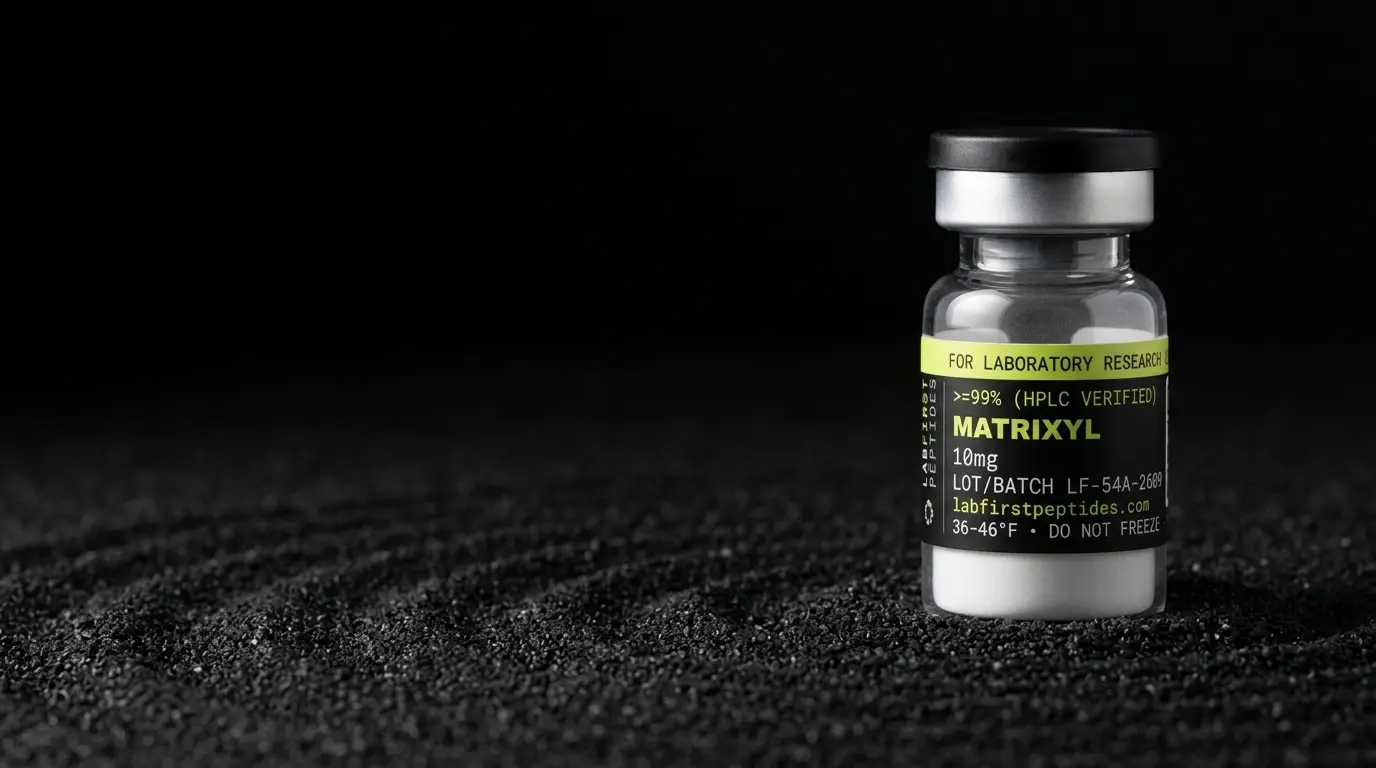
A Matrixyl certificate of analysis should name palmitoyl pentapeptide-4 (pal-KTTKS), not Matrixyl 3000. Its mass line should show an observed mass near 801.56 Da. After that, check the HPLC purity and its wavelength, the net peptide content, the lot number against the vial, the test date and the lab that issued it.
- Matrixyl in this catalog is palmitoyl pentapeptide-4 (pal-KTTKS), not Matrixyl 3000.
- PubChem CID 9897237: C39H75N7O10, 802.1 g/mol, monoisotopic 801.5575 Da.
- Free KTTKS without the palmitoyl group sits near 563.33 Da monoisotopic.
- No aromatic residues, so purity is read near 214 nm.
- The lot number on the certificate must match the vial.
What the document is for
A vial arrives with a sheet of paper. The sheet says what a laboratory found when it tested one batch. Your job is to decide whether that batch is the one in your hand, and whether the tests actually prove anything. That is all a certificate of analysis is.
For Matrixyl, the certificate carries one extra burden. The trade name is used loosely in the market, and a sheet can be perfectly accurate about the wrong molecule. So before any number on the page means anything, the page has to say which substance was tested, in terms precise enough to check.
The useful reading habit is not hunting for a high purity number. It is asking of each line whether it names a method, a result and a basis that someone else could repeat. A line that passes that test is evidence. A bare percentage above a logo is decoration.
This guide goes field by field. The Matrixyl identity guide covers the mass evidence in more depth, and the Matrixyl storage and stability guide covers what happens to the material after the certificate was written.
- Substance: pal-KTTKS, not Matrixyl 3000
- Identity: observed mass near 801.56 Da
- Purity: RP-HPLC near 214 nm
- Net peptide content stated
- Lot number matches the vial
- Issuing lab named and checkable
Which Matrixyl should the certificate name?
In this catalog, Matrixyl means one molecule: palmitoyl pentapeptide-4, written pal-KTTKS in the literature. It is the five-residue peptide Lys-Thr-Thr-Lys-Ser with a sixteen-carbon palmitoyl group on the N-terminal lysine. The PubChem record for it, CID 9897237, gives these reference values.
| Property | Value |
|---|---|
| Sequence | Lys-Thr-Thr-Lys-Ser (KTTKS), free C-terminal acid |
| N-terminal group | Hexadecanoyl (palmitoyl) on the alpha-amine of lysine 1 |
| Molecular formula | C39H75N7O10 |
| Average molecular weight | 802.1 g/mol |
| Monoisotopic mass | 801.5575 Da |
Matrixyl 3000 is a different material. It is a blend of two other palmitoylated peptides, and our palmitoyl pentapeptide-4 guide explains the naming history. A certificate written for one cannot support a listing for the other. If the sheet says Matrixyl 3000, or lists two peptides, or quotes a mass that does not round to 802 on an average basis or 801.56 on a monoisotopic one, it describes something other than pal-KTTKS.
The first field to read, then, is the substance name and its structure or sequence. A certificate that names the trade name alone and nothing else has not said what it tested.
The fields, in order
A certificate worth keeping carries the fields below. ICH Q6B, the international guideline on specifications for biotechnological products, treats identity, purity and quantity as separate attributes with separate tests, and a good research certificate follows the same split.
| Field | What it should state | Why it matters |
|---|---|---|
| Substance | Palmitoyl pentapeptide-4, sequence KTTKS, palmitoyl on the N-terminus | Rules out Matrixyl 3000 and free KTTKS |
| Identity | Method (ESI-MS or MALDI-TOF), theoretical mass, observed mass | The only line that says which molecule is present |
| Purity | RP-HPLC, detection wavelength, main-peak area percent | Says how much of the detected material is one species |
| Net peptide content | Percent of gross mass that is peptide, with method | Separates peptide from water and counterion |
| Lot and dates | Lot number, test date, retest date if one was set | Ties the sheet to your vial and to time |
| Issuer | Laboratory name and a way to verify the report | Makes the document checkable |
Missing fields are not always fraud. They are always a gap. Read what is present, note what is absent, and weigh the sheet by how much of it you could check yourself.
Identity: the mass line
The identity line should show two numbers side by side. The theoretical mass comes from the formula C39H75N7O10: 801.5575 Da monoisotopic, or 802.1 on an average basis. The observed mass is what the instrument saw for this lot. Agreement within the tolerance the laboratory states is the identity claim.
In electrospray, the two free lysine side-chain amines pick up protons readily, so the spectrum usually shows the singly protonated ion near m/z 802.57 and a doubly charged ion near m/z 401.79. You can do that arithmetic yourself: add the mass of one proton, about 1.007, for the first ion; add two and halve the total for the second.
One mismatch is worth knowing by heart. If the palmitoyl group is missing, the mass drops by the mass of the C16H30O acyl unit, about 238.23 Da, leaving free KTTKS near 563.33 Da monoisotopic. A certificate whose observed mass sits there describes the unacylated pentapeptide, whatever the label says.
The word conforms, standing alone, is a claim rather than a record. A certificate that asserts identity without printing the observed value is asking to be taken on trust.
Purity: area percent, at one wavelength
Purity by reversed-phase HPLC is the main peak area divided by the total area of everything the detector saw. It says nothing about which molecule the main peak is, which is why it cannot replace the mass line. The HPLC purity versus identity guide explains that split.
Two features of pal-KTTKS show up on a good chromatogram report. The sequence has no tryptophan, tyrosine or phenylalanine, so there is almost nothing to see at 280 nm. The trace should be recorded at a low wavelength, conventionally near 214 nm, where the backbone amide bonds absorb. A purity figure quoted at 280 nm for this molecule is a warning.
The palmitoyl chain also makes the molecule strongly retained on a reversed-phase column. Expect the method to run to high organic solvent content. A report that gives the gradient, column and retention time lets you compare one lot against another. One that gives only a percentage does not.
Why isn’t 10 mg of powder 10 mg of peptide?
A 10 mg vial of powder is not 10 mg of peptide. In plain terms, the powder is part peptide and part water and salt. Lyophilized peptides hold residual water, and the two lysine amines mean the peptide is usually supplied as a salt with counterions from purification, such as acetate or trifluoroacetate. None of that shows up as a peak at 214 nm, so the purity figure cannot see it.
Net peptide content is the separate measurement that answers how much of the gross mass is peptide. It is typically made by amino acid analysis or nitrogen determination. A lot can report high chromatographic purity and a noticeably lower net content, and both figures can be correct at the same time.
If a laboratory protocol needs a known molar concentration, the arithmetic starts from net content, not from the fill weight on the label. The net peptide content guide covers the methods. Our Matrixyl product page lists the 10 mg vial, SKU MX10.
Lot, dates and verification
The lot number on the certificate must match the lot number on the vial. A certificate without a lot number proves nothing about any particular vial, because it could have been written for any batch at any time.
The test date tells you how old the evidence is. ICH Q1A(R2) defines a re-test period as the time a substance is expected to stay within its specification under defined storage conditions, after which it should be tested again. Where a certificate carries a retest date derived from real stability data, use it. Where it carries none, the honest record says the window is unestablished.
Finally, the issuing laboratory. A certificate should name the laboratory that ran the tests and give a way to confirm the report with that laboratory directly. Our certificate standard page lists the fields this catalog requires. Results for a Matrixyl lot appear on the product page only once the certificate for that lot is published.
Using the certificate at receiving
The certificate is most useful in the first ten minutes after a vial arrives. Put the vial beside the sheet. Compare lot numbers character by character. Confirm the sheet names palmitoyl pentapeptide-4 and shows an observed mass. Note the test date and any retest date in your log, together with the date received.
File the certificate where anyone reading your results later can find it. If an assay goes wrong months from now, the first question will be whether the starting material was what the protocol assumed. A certificate filed against the lot answers that quickly. One lost in an inbox means repeating work.
What are the red flags on a Matrixyl certificate?
The main red flags can be spotted without an instrument. A sheet that names Matrixyl 3000, or two peptides, for a product sold as plain Matrixyl. A mass that does not round to 802 average or 801.56 monoisotopic. A purity figure with no wavelength, or one at 280 nm. No lot number, or a lot number that differs from the vial.
Others take a second look. Certificate artwork that repeats exactly across different lots, down to the chromatogram noise, is a template. A test date years before the product was listed invites a question about which batch it describes. None of these proves a problem alone, and each one is a reason to ask before relying on the sheet.
FOR LABORATORY AND IN-VITRO RESEARCH USE ONLY. NOT FOR HUMAN OR ANIMAL CONSUMPTION.
Common questions
What mass should a Matrixyl certificate show?
Can a Matrixyl 3000 certificate support a Matrixyl listing?
Why is purity measured at 214 nm for Matrixyl?
Why is net peptide content lower than purity?
More documentation guides
Sources
- PubChem compound record: Palmitoyl pentapeptide-4 (CID 9897237). Formula C39H75N7O10, molecular weight 802.1, monoisotopic mass 801.5575, and the IUPAC name showing a hexadecanoyl group on the alpha-amine of the N-terminal lysine of Lys-Thr-Thr-Lys-Ser, with a free C-terminal acid.
- ICH Q6B, Specifications: Test Procedures and Acceptance Criteria for Biotechnological/Biological Products. Identity tests should be highly specific and based on unique aspects of molecular structure; more than one test may be needed to establish identity; purity and quantity are separate specification attributes.
- ICH Q1A(R2), Stability Testing of New Drug Substances and Products. Defines the re-test period as the time a substance is expected to stay within specification under defined storage conditions; sets freezer long-term testing at -20 C plus or minus 5 C and treats storage below -20 C case by case.