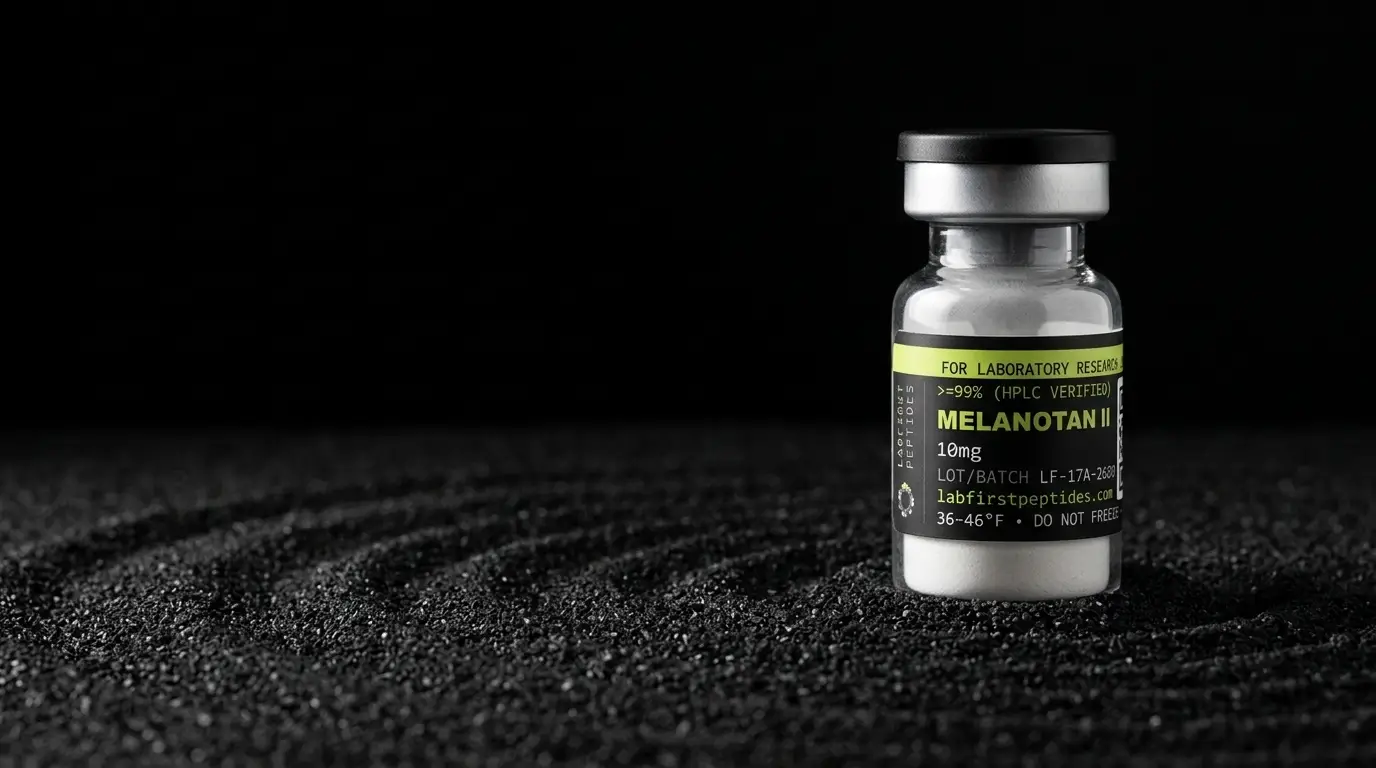
Melanotan II identity is confirmed mainly by mass spectrometry near 1024.2. The tricky part is very specific. Its own carbon-13 isotope peak sits one dalton higher, right where the deamidated compound would show up. So telling the two apart needs the full isotope pattern, not a single peak.
- Melanotan II is C50H69N15O9, average mass near 1024.2, PubChem CID 92432.
- Its own carbon-13 isotope peak sits one dalton higher, where the deamidated form would be.
- With fifty carbons that companion peak is large, so its presence proves nothing alone.
- The distinction is quantitative: compare the observed isotope ratio against the calculated one.
- High-resolution measurement separates them, because the two changes differ in exact mass.
- The lactam ring question is 18 daltons and trivial by comparison.
What is the identity question for this compound?
In plain terms, it is like telling twins apart by one small mark. Melanotan II and the compound it can turn into differ by one mass unit. The lab has to read the whole pattern of peaks to see which one is really there.
Whether the vial holds Melanotan II rather than the compound it becomes when its terminal amide is lost. Melanotan II is C50H69N15O9, average mass near 1024.2, cataloged as PubChem CID 92432.
Hydrolysing that amide gives C50H68N14O10, which is exactly the formula of PT-141, near 1025.2. One dalton, and a different product.
So the identity work here is not about excluding some exotic contaminant. It is about resolving a one-unit difference between two things this catalog sells separately, and that turns out to be harder than one dalton sounds.
- Observed mass near 1024.2, to at least one decimal place
- A peak one dalton higher is expected: carbon-13 across fifty carbons
- Compare the observed isotope ratio against the calculated one
- High resolution separates the isotope from the deamidated form
- A separation can resolve them, because amide and acid differ in charge
- The lactam ring question is 18 daltons and needs none of this
- Accession number confirmed at the issuing laboratory
Why is one dalton harder than it sounds?
Because the molecule already produces a signal one dalton above its own. Carbon exists in nature as two stable forms, and roughly one carbon atom in a hundred is the heavier carbon-13.
Melanotan II contains fifty carbon atoms. With fifty chances, a substantial fraction of any real sample contains one heavy carbon somewhere in the molecule, and that fraction weighs one dalton more than the rest.
So a mass spectrum of pure Melanotan II shows a main peak and a large companion peak one unit higher. That companion sits precisely where a peak from the deamidated compound would appear.
What does that mean in practice?
That seeing a peak one dalton above the expected mass proves nothing on its own. It is exactly what a pure sample looks like.
The question becomes quantitative rather than qualitative. For a molecule with this many carbons the size of that isotope peak relative to the main one is predictable, so the analyst compares the observed ratio against the calculated one.
A companion peak of the expected size is the isotope. A companion peak larger than expected means something else is contributing at that mass, and the deamidated compound is the obvious candidate. That is a real measurement rather than an impression, and it requires the analyst to have thought about it.
It also explains a pattern worth recognizing on certificates generally. A report that shows a spectrum lets a reader see the isotope envelope and judge it. A report that states a single number has already made the judgement on your behalf, and for this compound that judgement is the entire identity question rather than a formatting preference.
Does high-resolution measurement help?
Considerably, because the two species are not identical in exact mass even though both sit near the same nominal value.
The isotope peak differs from the parent by one carbon-13 substitution. The deamidated compound differs by swapping an NH for an O. Those two changes have slightly different exact masses, so an instrument with enough resolving power separates them.
That is the technically correct answer, and it depends entirely on the instrument used. A routine unit-resolution measurement cannot make the distinction, which is why the certificate should state what instrument produced the number rather than just the number.
Does the separation help?
It can, and it is the more accessible route for most laboratories. The deamidated compound differs from the parent by charge as well as by mass: an amide is neutral and a carboxylic acid can ionise.
That charge difference affects retention, so on a reversed-phase separation with an appropriate mobile phase the two frequently resolve.
Frequently is not always. Whether they separate depends on the gradient and the pH, and a method developed to give a purity number for one compound was not necessarily built to resolve it from the other. Running an authentic sample of the related compound alongside is the way to know rather than assume.
How is the lactam ring confirmed?
By the same mass measurement, and this part is straightforward. Forming the ring releases a molecule of water, so a linear precursor that never cyclised weighs about 18 more.
Eighteen daltons is unmissable, well outside any isotope pattern and far beyond the resolution of even a basic instrument.
The contrast within one molecule is instructive. The ring question is answered by any competent measurement; the amide question needs either high resolution or a separation developed for it. Two structural facts, one instrument, very different demands.
What about stereochemistry?
Invisible, as always, to every mass-based approach. Melanotan II contains a residue in the D configuration, and a D-amino acid and its L counterpart are mirror images with identical atoms in identical order.
They weigh exactly the same, so no mass measurement at any resolution separates them, and no isotope reasoning helps either.
Chiral analysis is the only route, usually by hydrolysing the peptide and separating the freed amino acids on a handed stationary phase. It is absent from most research certificates, which is a limit worth knowing rather than a scandal.
What does the tryptophan add?
A second detection wavelength that is genuinely useful. Tryptophan absorbs strongly at 280 nanometres, where most peptides in this catalog absorb almost nothing.
Reading purity at both 214 and 280 gives two views of one separation. A peak visible at 214 but absent at 280 lacks a tryptophan, so it is not a variant of the whole molecule but something missing that residue.
The deamidated compound retains the tryptophan, so it appears at both wavelengths. That is a useful negative: the second wavelength does not solve this particular problem, and knowing which questions a measurement cannot answer is as valuable as knowing which it can.
How is Melanotan I excluded?
Easily, which is worth stating because the names invite confusion. Melanotan I is a longer linear peptide rather than a cyclic heptapeptide, so the two differ by a large mass rather than a subtle one.
Any competent measurement separates them without ambiguity, and no isotope reasoning or high resolution is required.
So the similar names are a labeling hazard rather than an analytical one. If a certificate's mass is consistent with one and the vial is labeled the other, the discrepancy is in the paperwork or the packing and should be resolved as such.
How do you check the report describes your vial?
Confirm the accession or verification number at the issuing laboratory rather than with the seller. The laboratory holds the record; a seller holds a copy of a document. If the number resolves to a different lot, a different product, or nothing, the analysis is not evidence about your material.
Then match the lot number on the report to the vial. Rigorous analysis attached to the wrong batch is not rigour, and that mismatch is more common than falsified results.
Reports for material supplied here resolve through the certificate verification page, and the sizes carried appear on the Melanotan II product record.
What should you ask a supplier about identity?
Three questions, and the second is unusually specific for a reason. What was the observed mass, to at least one decimal place. What instrument produced it, and was the isotope pattern assessed. And did the separation resolve the deamidated form.
A laboratory that has thought about this compound will find the second question ordinary. One that has not may not understand why it is being asked, and that answer is itself informative.
How to read the rest of the document is covered in the certificate guide.
What is the regulatory position?
International guidance on analytical validation defines what makes an identity method fit for purpose: specificity, accuracy, precision, and a demonstration that the method distinguishes the target from what else might plausibly be present. Here the plausible alternative sits one dalton away, underneath the compound's own isotope peak.
There is no FDA-approved product containing Melanotan II and no United States pharmacopeial monograph, so no official standard specifies how the two must be distinguished or what limit applies.
What a research certificate can honestly establish is what a named laboratory measured, on a named lot, by named methods, on named instruments.
FOR LABORATORY AND IN-VITRO RESEARCH USE ONLY. NOT FOR HUMAN OR ANIMAL CONSUMPTION. NOT FOR PERSONAL, MEDICAL, DIAGNOSTIC, THERAPEUTIC, OR RECREATIONAL USE.
What is Melanotan II studied for?
Published research on Melanotan II investigates the areas below, which is a different question from what Melanotan II will do for anyone, a claim about a living system that nothing on this site is sold for.
What it is. A man-made ring-shaped peptide seven building blocks long that switches on melanocortin receptors indiscriminately.
What the research looks at. It appears in melanocortin receptor research about binding and selectivity.
How it is thought to work. A ring-shaped relative of alpha-MSH that acts across several melanocortin receptor types rather than picking one. That lack of selectivity is its defining feature and the reason it is studied as a broad melanocortin activator.
What is not established. No approved drug product. Regulators in several countries have issued public warnings about unapproved products sold under this name. This record covers how it behaves at its receptors and does not describe use in a person.
The full record, including the certificate for the lot in stock, is on the Melanotan II product page.
Common questions
Why is a peak one dalton above the expected mass not evidence of degradation?
How do you tell the isotope peak from the deamidated compound?
Does high-resolution mass spectrometry settle it?
Can the separation distinguish them instead?
Does the 280 nanometre wavelength help here?
Published certificates for Melanotan II
Every figure below is read from a report the laboratory issued for that lot; each page carries the PDF and the lab's own verification link.
More documentation guides
Sources
- PubChem Compound Summary for CID 92432, Melanotan II. The openable record giving the molecular formula C50H69N15O9, whose fifty carbon atoms are the reason the isotope peak is large enough to matter here.
- PubChem Compound Summary for CID 9941379, Bremelanotide. The openable record for PT-141 at C50H68N14O10, the compound whose peak position coincides with Melanotan II's own carbon-13 isotope peak.
- ICH Q2(R2), Validation of Analytical Procedures . Defines specificity, including that a method must distinguish the target from closely related substances, which here means a compound hidden under the target's own isotope envelope.
- Finnrick independent verification portal. Third-party lookup used to confirm a certificate resolves to the lot it claims to describe, rather than confirming a document with the seller who supplied it.