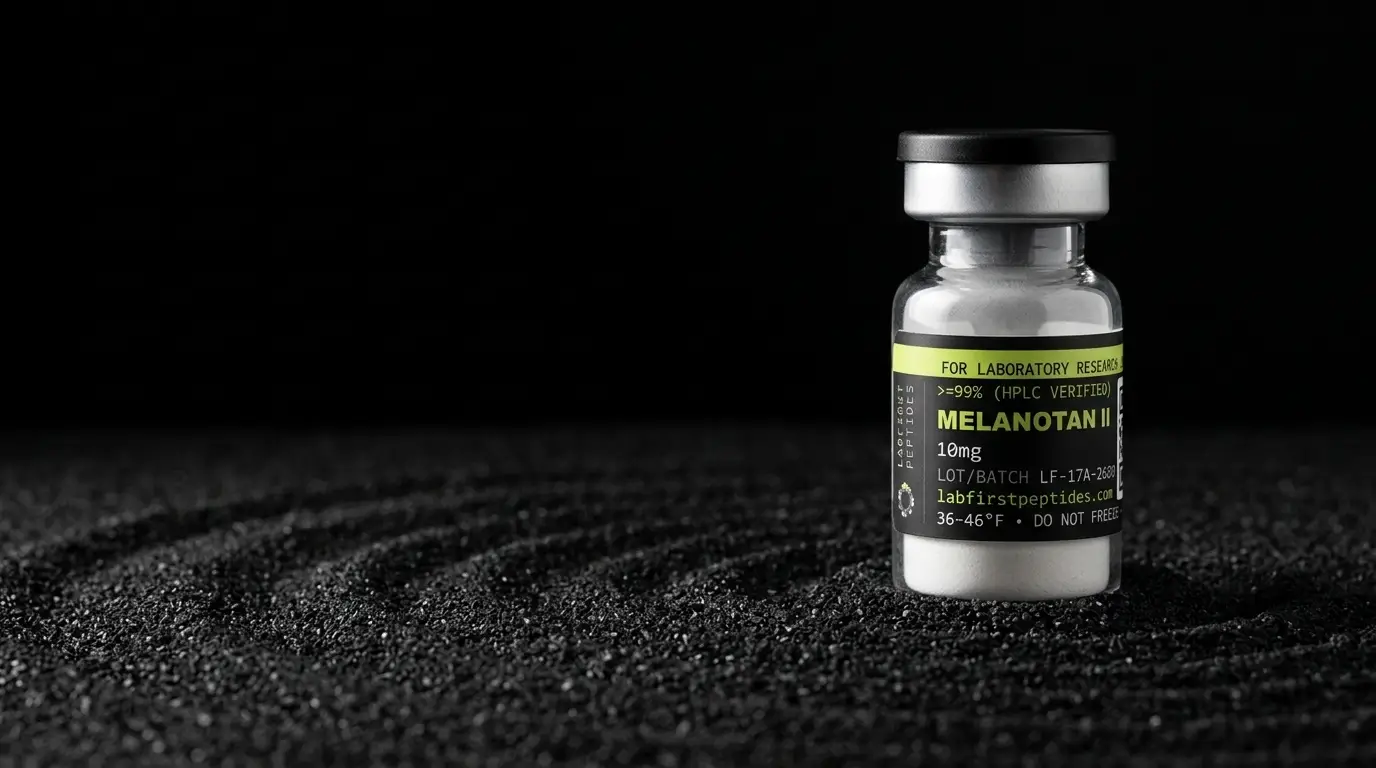
Melanotan II storage and stability come down to three things. Keep the dry powder sealed and frozen, keep any solution in the fridge, and keep both fully dark. Its terminal amide can break down, which turns the molecule into PT-141, a different product. Its tryptophan also makes it one of the more light-sensitive compounds in the catalog.
- Sealed and frozen as powder, refrigerated in solution, genuinely dark.
- Amide hydrolysis converts the molecule into PT-141, a different catalog product.
- That change produces no color, no haze and only a one-dalton mass shift.
- Tryptophan makes this among the most light-sensitive compounds in the catalog.
- The lactam ring is more robust than the terminal amide, and fails at 18 daltons not one.
- D and unnatural residues resist enzymes, which a sealed vial does not contain.
How should Melanotan II be stored?
A match kept in a dry box will still light years later. Put simply, this peptide behaves that way too: dry and cold, it stays as it is, and water, warmth or light start slow changes that cannot be undone.
Sealed and frozen as lyophilized powder, refrigerated once a solution exists, and genuinely dark rather than nominally dark.
The dry form is the stable one. Freeze-drying removes the water that this compound's main chemical route requires, and a sealed vial below freezing is the condition every retest date assumes.
Two features of the molecule set the priorities: a terminal amide that can hydrolyse, and a tryptophan that makes light a real variable rather than a precaution. Both are described below.
- Sealed and frozen as lyophilized powder, genuinely dark
- The terminal amide can hydrolyse, and the product is PT-141
- That change shows only as one dalton: no color, no haze
- Tryptophan makes light a real variable, not a precaution
- Open the vial at room temperature, because water is the trigger
- Caked or yellowing powder ends the vial; the amide loss stays invisible
Why is amide hydrolysis the route that matters most?
Because of what it produces. Melanotan II terminates in an amide, and hydrolysing that group to a free acid gives a molecule with the formula C50H68N14O10.
That is exactly the formula of PT-141, which is a separate product in this catalog. So degradation here does not produce a nameless impurity; it produces a different compound sold on its own page.
The transformation needs water and is favored by warmth and by conditions away from mildly acidic. Which is to say it needs precisely the conditions a carelessly stored vial provides, and it leaves the powder looking exactly as it did before.
Does that mean degraded material is still useful?
No, and it is worth being explicit rather than letting the coincidence suggest otherwise. A vial sold as Melanotan II that has partly converted is not a vial of PT-141. It is a mixture of two compounds in unknown proportion.
Neither the label nor the certificate describes a mixture. Any calculation based on the stated contents is wrong in a way that no measurement on the outside of the vial reveals.
The useful consequence of the relationship is diagnostic rather than practical. It tells you what to look for, at what mass, and why a one-decimal-place figure on a certificate is worth insisting on.
Why does light matter more here than for most peptides?
Because of the tryptophan. Of the common amino acids it is the one most readily degraded by light, and Melanotan II carries one inside its ring.
The indole side chain absorbs ultraviolet strongly, which is what gives the peptide a usable signal at 280 nanometres and equally what makes photochemistry possible. The property that helps the analyst is the one that damages the material.
Tryptophan photodegradation yields several products rather than one, so it appears as a scatter of small peaks rather than a single named impurity. Amber glass or the original carton removes the variable entirely and costs nothing at all.
How stable is the lactam ring itself?
More stable than the terminal amide, which is a useful asymmetry to understand. The ring is closed by a lactam bridge, an amide bond formed within the molecule.
Chemically that bond is the same kind of linkage as the terminal amide, so in principle it can hydrolyse too. In practice a ring is harder to open than a chain end, because opening it requires breaking a constrained structure and the two halves stay tethered together afterwards.
So the failure to expect is loss of the terminal group rather than collapse of the ring. Both would show on a mass measurement, one at about a single dalton and the other at about 18.
Do the unusual residues help?
Against enzymes, yes. Against chemistry, no, and the distinction matters because listings routinely blur them.
Melanotan II contains a residue in the D configuration and a residue that is not one of the standard protein amino acids. Both make the molecule a poor substrate for ordinary peptidases, which is meaningful in a biological matrix.
A sealed vial contains no enzymes at all. Hydrolysis by water, oxidation and photochemistry work identically on unusual residues and standard ones, so none of that structural cleverness contributes anything to shelf stability.
What does a retest date actually mean?
It describes an unopened container held under the conditions printed beside it, derived from stability data: units stored at defined temperature and humidity, pulled on a schedule, tested against the release specification.
The date is conditional on those conditions being met. A vial that spent a week on a warm bench is no longer described by it, and nothing about it looks different.
It is also not a cliff. Material past a retest date is not established as failing, it is outside the evidence, and the honest response is to test rather than assume in either direction. A pharmaceutical expiry is a stronger claim made under rules research-grade material is not made under.
What happens once the vial is opened?
The moisture clock starts and the certificate stops describing the contents. Lyophilized peptide is hygroscopic, and opening a cold vial in a warm room draws condensation straight onto the powder.
Letting the vial reach room temperature before opening costs nothing and removes the problem. Here the payoff is direct: water is what drives the amide hydrolysis, so condensation is not a general nuisance but the specific trigger for this compound's characteristic change.
Light exposure also begins at first entry, since a vial open on a lit bench is a vial being illuminated. That is a second argument for working quickly and closing the carton.
What does stability testing not capture?
Everything after dispatch. A stability study tests unopened units under controlled conditions, so its results describe an ideal a working vial stops matching at first entry.
Transit is the least documented stretch. A parcel can sit in a hot vehicle for a day or freeze overnight, and none of it appears on any paperwork that arrives with it.
Ambient light during handling is the gap specific to this compound, and no protocol describes it. A vial that spent an afternoon on a bright bench has had an exposure that the study never simulated and that nothing on the certificate accounts for.
What should make you stop using a vial?
Powder that has caked hard, or shifted noticeably in color. Color deserves particular attention here because tryptophan degradation products are frequently colored, so a yellowing powder is a real signal rather than a cosmetic one.
In solution, cloudiness or visible particulate. A clear solution that has hazed has something in it that was not there before.
What none of these will show is the amide hydrolysis, which produces no color, no haze and a one-dalton mass shift. That is exactly why storage conditions matter more than inspection for this compound.
A look before every use is the proportionate habit: powder texture and color, the closure sitting flush, the solution clear. Seconds, no equipment, and it catches the visible half of what can go wrong here.
How does storage relate to the certificate?
They split the timeline and neither covers the other half. A certificate reports what was measured on a sample drawn at one moment, and the certificate guide covers how to read one field by field. Storage evidence covers what happened afterwards.
The split is unusually consequential here. A lot correct at release can carry a real proportion of the deamidated compound months later, and since that compound is a different catalog product, what the vial contains has genuinely changed rather than merely degraded.
Lot reports for material supplied here resolve through the certificate verification page, and the sizes carried are on the Melanotan II product record.
What is the regulatory position?
Stability expectations for finished pharmaceutical products are set out in international guidance defining storage conditions, sampling intervals and the testing that supports a shelf-life claim. That framework governs drug products made for human use.
There is no FDA-approved product containing Melanotan II and no United States pharmacopeial monograph defining an acceptable batch, so no official standard sets a limit for the deamidated form or requires that it be measured.
A supplier can honestly report the conditions a lot was held under and what was measured. The useful question stays narrow: what conditions, what measurement, what date, and to how many decimal places.
FOR LABORATORY AND IN-VITRO RESEARCH USE ONLY. NOT FOR HUMAN OR ANIMAL CONSUMPTION. NOT FOR PERSONAL, MEDICAL, DIAGNOSTIC, THERAPEUTIC, OR RECREATIONAL USE.
What is Melanotan II studied for?
Published research on Melanotan II investigates the areas below, which is a different question from what Melanotan II will do for anyone, a claim about a living system that nothing on this site is sold for.
What it is. A man-made ring-shaped peptide seven building blocks long that switches on melanocortin receptors indiscriminately.
What the research looks at. It appears in melanocortin receptor research about binding and selectivity.
How it is thought to work. A ring-shaped relative of alpha-MSH that acts across several melanocortin receptor types rather than picking one. That lack of selectivity is its defining feature and the reason it is studied as a broad melanocortin activator.
What is not established. No approved drug product. Regulators in several countries have issued public warnings about unapproved products sold under this name. This record covers how it behaves at its receptors and does not describe use in a person.
The full record, including the certificate for the lot in stock, is on the Melanotan II product page.
Common questions
What does Melanotan II turn into if it degrades?
Is partly degraded Melanotan II usable as PT-141?
Why does Melanotan II need to be kept dark?
Is the lactam ring as fragile as the terminal amide?
Do the D-amino acid and unnatural residue improve shelf life?
Published certificates for Melanotan II
Every figure below is read from a report the laboratory issued for that lot; each page carries the PDF and the lab's own verification link.
More documentation guides
Sources
- PubChem Compound Summary for CID 92432, Melanotan II. The openable record giving the molecular formula C50H69N15O9, showing the terminal amide whose hydrolysis is described above and the tryptophan that makes light a variable.
- PubChem Compound Summary for CID 9941379, Bremelanotide. The openable record for PT-141, whose formula C50H68N14O10 is exactly what Melanotan II becomes when its terminal amide hydrolyses to an acid.
- ICH Q2(R2), Validation of Analytical Procedures . Defines what makes an analytical result valid and reproducible, and is the basis for treating a stability figure without a named method and stated conditions as unverifiable.