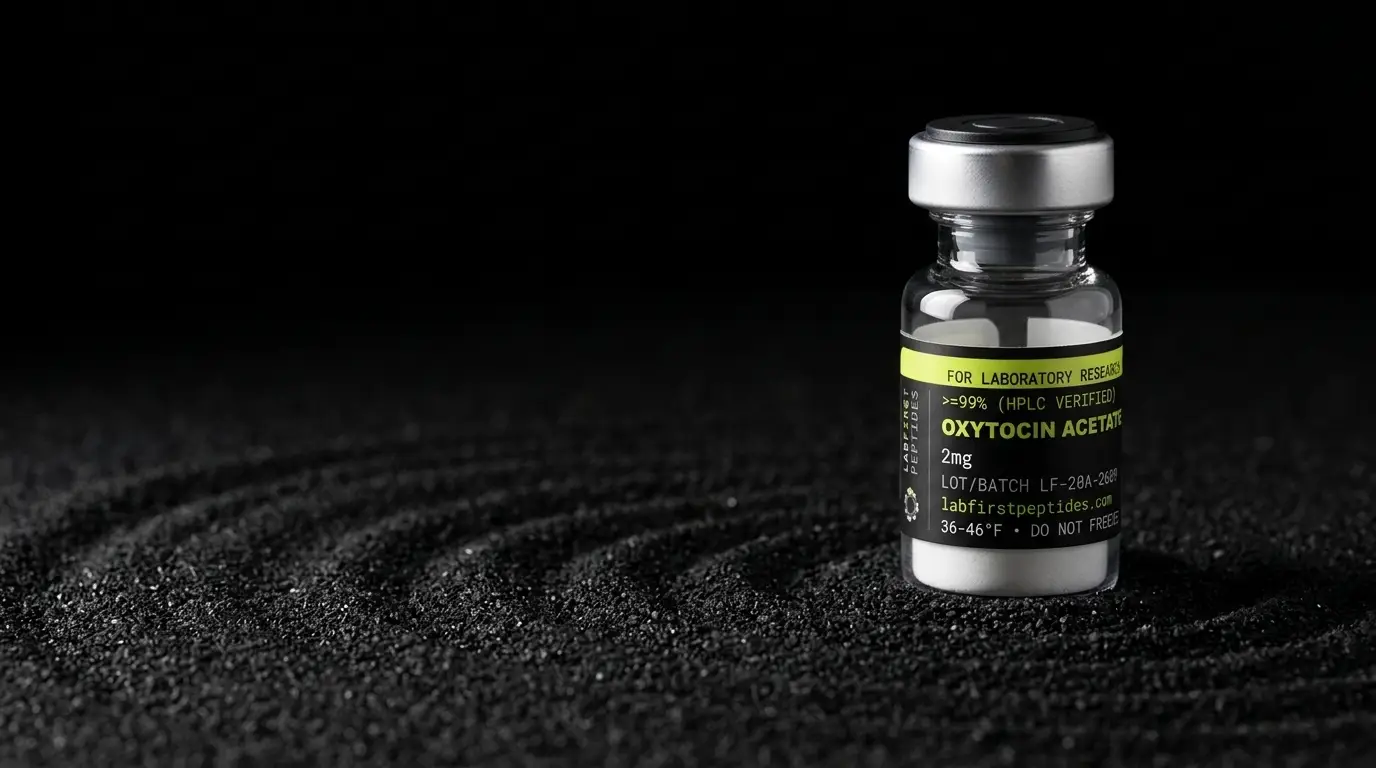
An oxytocin acetate certificate of analysis is a test report for one lot. Read it in order: the lot number against the vial, then the test date. Next comes identity by mass near 1007.2 for the free base, and the disulfide check. Then purity by RP-HPLC, acetate content, water, and the lab that issued it.
- Oxytocin is C43H66N12O12S2, average mass near 1007.2, PubChem CID 439302.
- That record is the FREE BASE; the product is the acetate salt and reports differently.
- The ring is closed by a disulfide, so the reduced form is about two daltons heavier.
- A lactam-closed peptide differs by 18; a disulfide-closed one by only 2.
- Vasopressin is the related substance: also a disulfide nonapeptide, two residues different.
- A compendial monograph exists, which is true of almost nothing else in this catalog.
What makes this certificate unusual in this catalog?
A certificate of analysis is a report card for one batch. In other words, it lists what a lab checked on a sample from that lot, and on what date, and it speaks for that sample rather than every vial.
A pharmacopeial standard exists for the substance. Almost every other compound in this catalog has no monograph at all, so the specification a lot is released against is whatever the supplier decided.
Oxytocin is different. It is an established drug substance with an approved finished product and a published compendial standard, which means there is an external, public definition of what the material should be and how it should be tested.
That does not make research-grade material into the approved product. It does mean a buyer has something authoritative to compare a certificate against, and that is a genuine advantage available on very few pages in this library.
- Lot number on the report against the lot number on the vial
- Identity: observed mass, compared against 1007.2 for the free base
- Salt form stated, because the product is the acetate
- Disulfide closed: the reduced form is about two daltons heavier
- Related substances, including vasopressin and the reduced form
- Acetate content, net peptide content and water by Karl Fischer
- Accession number confirmed at the issuing laboratory
What mass should the identity result show?
Oxytocin is a nonapeptide, molecular formula C43H66N12O12S2 with an average mass near 1007.2, cataloged as PubChem CID 439302.
Read what that record describes. It is oxytocin as the free base. The product supplied here is the acetate salt, so a lot certificate reports the salt and the two figures differ.
A buyer comparing a certificate against a database entry will notice the discrepancy and may read it as a fault. It is not. It is the counterion, and a certificate naming the salt form removes the confusion entirely.
What do the two sulfurs mean?
They are cysteines, and in the finished molecule they are joined to each other by a disulfide bond that closes part of the chain into a ring.
So oxytocin is a cyclic peptide, but cyclised in a different way from the lactam-bridged compounds elsewhere in this catalog. A lactam ring is formed between an amine and an acid, releasing water. A disulfide is formed between two sulfurs, releasing two hydrogens.
The analytical consequence differs accordingly. A failed lactam closure reads as about 18 daltons heavy. A failed disulfide closure reads as about two daltons heavy, which is a much finer distinction on a molecule of this size.
How does the certificate confirm the ring is closed?
By the observed mass, if it prints one. The reduced open form carries two more hydrogen atoms than the closed form, so it weighs about two daltons more.
Two daltons on a 1,007-dalton molecule is comfortably within the resolving power of a modern instrument and completely invisible to a reader given only the words identity confirmed.
This is the recurring theme of these guides and it applies with particular force to a molecule whose ring is held by so small a mass difference. The number is checkable; the verdict is not.
Which related substance matters most?
Vasopressin. It is also a nonapeptide, also closed by a disulfide between two cysteines, and it differs from oxytocin at only two positions in the sequence.
The two molecules are structurally similar enough that a separation must be developed with the distinction in mind rather than assumed to handle it. Their masses differ by more than a couple of daltons, so a mass measurement distinguishes them, but a purity method that does not resolve them chromatographically would count one inside the other's peak.
This is exactly the sort of related-substance question a compendial method is written to address, which is another reason the existence of a published standard matters here.
There is a second, blunter reason to care. Both peptides are sold in research supply, both are white lyophilized powder, and neither can be identified by looking at it. As with several compounds in this catalog, the label and the certificate are the only things distinguishing two vials that appear identical.
What does the acetate content field tell you?
That the salt form was measured rather than assumed. Oxytocin is supplied as an acetate, so acetate is part of the product rather than a contaminant left over from purification.
It is also weight you paid for that is not peptide. Acetate content of ten percent means a tenth of the powder is counterion before water is counted at all.
It distinguishes a properly finished product too. Peptides leave preparative chromatography as trifluoroacetate salts and converting to acetate takes an extra exchange step, so a certificate reporting trifluoroacetate on a product labeled as an acetate is a contradiction worth raising.
How do you read the certificate field by field?
Lot number first, against the vial. Then dates, where a test date should follow the fill date and a print date carries no analytical meaning.
Then identity by mass, stated as a number. Disulfide status. Purity by reversed-phase HPLC with the chromatogram attached. Related substances, including vasopressin and the reduced form. Acetate content. Net peptide content. Water. Appearance last.
Each result needs its method beside it, and where a compendial method was used the certificate should say so, because that is a stronger statement than an in-house procedure with no external reference.
What does the purity figure leave out?
Anything that does not absorb at the detection wavelength or does not elute. Reversed-phase purity is an area percentage of what the detector saw.
Peptides are read at 214 nanometres, which responds to the peptide bond. Oxytocin also contains a tyrosine, which gives it genuine absorbance at 280 nanometres, so a second wavelength is available and informative.
What area purity cannot see is anything the separation did not separate. An unresolved reduced form or an unresolved related peptide is counted inside the main peak, which is why the method and its resolution matter as much as the number.
What is net peptide content, and why does it change the price?
It states what fraction of the powder is actually peptide, the rest being acetate, residual water and any inorganic content.
The consequence is arithmetic. A vial labeled 10 milligrams may hold 10 milligrams of powder of which a real fraction is salt and water. Net peptide content of 80 percent means 8 milligrams of peptide, and two suppliers quoting the same price for the same nominal size are not selling the same amount.
Ask which basis the label uses. The cost per milligram comparison ranks the catalog on one basis so two quotes can be compared honestly.
What does the certificate not cover?
Everything after the sample was drawn. Storage temperature, light, how long the vial has been open and how it has been handled are all outside it.
The disulfide is the specific vulnerability that develops afterwards. Disulfides exchange in solution, faster at higher pH, producing reduced and dimeric species that were not present at release.
Moisture ingress also quietly makes the net content figure optimistic, because the powder now weighs more per unit of peptide than it did at test.
How do you verify the document is genuine?
Confirm the report at the issuing laboratory rather than with the seller. An independent laboratory issues each certificate against an accession number that resolves on its own site. If the number resolves to a different product, a different lot, or nothing, the document does not describe your material.
Certificates with the verification key removed deserve particular suspicion, and this is not hypothetical in this market. A PDF is easy to edit; a third-party lookup is not.
Lot reports for material supplied here resolve through the certificate verification page, and the sizes carried appear on the oxytocin acetate product record.
What is the regulatory position?
Oxytocin exists as an approved drug substance in finished pharmaceutical products made under drug manufacturing rules, and a compendial monograph defines the standard for that substance.
Research-grade material supplied here is not that product. A certificate for laboratory material does not confer the status of an approved medicine, and no research supplier should present it as though it did.
What the monograph does give a buyer is a public reference point. A certificate that reports the tests a compendial standard specifies is making a stronger, checkable claim than one built entirely in-house, and that comparison is available for this compound in a way it is not for most of the catalog.
FOR LABORATORY AND IN-VITRO RESEARCH USE ONLY. NOT FOR HUMAN OR ANIMAL CONSUMPTION. NOT FOR PERSONAL, MEDICAL, DIAGNOSTIC, THERAPEUTIC, OR RECREATIONAL USE.
What is Oxytocin Acetate studied for?
Published research on Oxytocin Acetate investigates the areas below, which is a different question from what Oxytocin Acetate will do for anyone, a claim about a living system that nothing on this site is sold for.
What it is. A hormone nine building blocks long, supplied as the acetate salt.
What the research looks at. A very large body of basic and clinical research on oxytocin exists. Approved medicines containing oxytocin exist for specific uses.
How it is thought to work. It works on the oxytocin receptor. The peptide has a sulphur-to-sulphur bridge holding its shape, and that bridge is the part most easily damaged in handling.
What is not established. What is sold here is a research chemical and not a drug product. The sulphur bridge makes the molecule sensitive to conditions that break it, so identity paperwork matters more than usual.
The full record, including the certificate for the lot in stock, is on the Oxytocin Acetate product page.
Common questions
What mass should an oxytocin certificate show?
How is the disulfide ring confirmed?
Why is vasopressin the related substance to watch?
Why does a monograph existing matter?
Does the acetate need its own line on the certificate?
More documentation guides
Sources
- PubChem Compound Summary for CID 439302, Oxytocin. The openable record for the free base, giving the molecular formula C43H66N12O12S2 and average mass near 1007.2 that a certificate for the acetate salt is compared against.
- UniProt P01178, Oxytocin-neurophysin 1. The reference protein record for the human precursor from which oxytocin is processed, giving the native sequence the synthetic peptide reproduces.
- ICH Q2(R2), Validation of Analytical Procedures . Defines specificity, including that a method must separate the target from closely related substances, which for this compound means vasopressin and the reduced form.
- Finnrick independent verification portal. Third-party lookup used to confirm a certificate resolves to the lot it claims to describe, rather than confirming a document with the seller who supplied it.