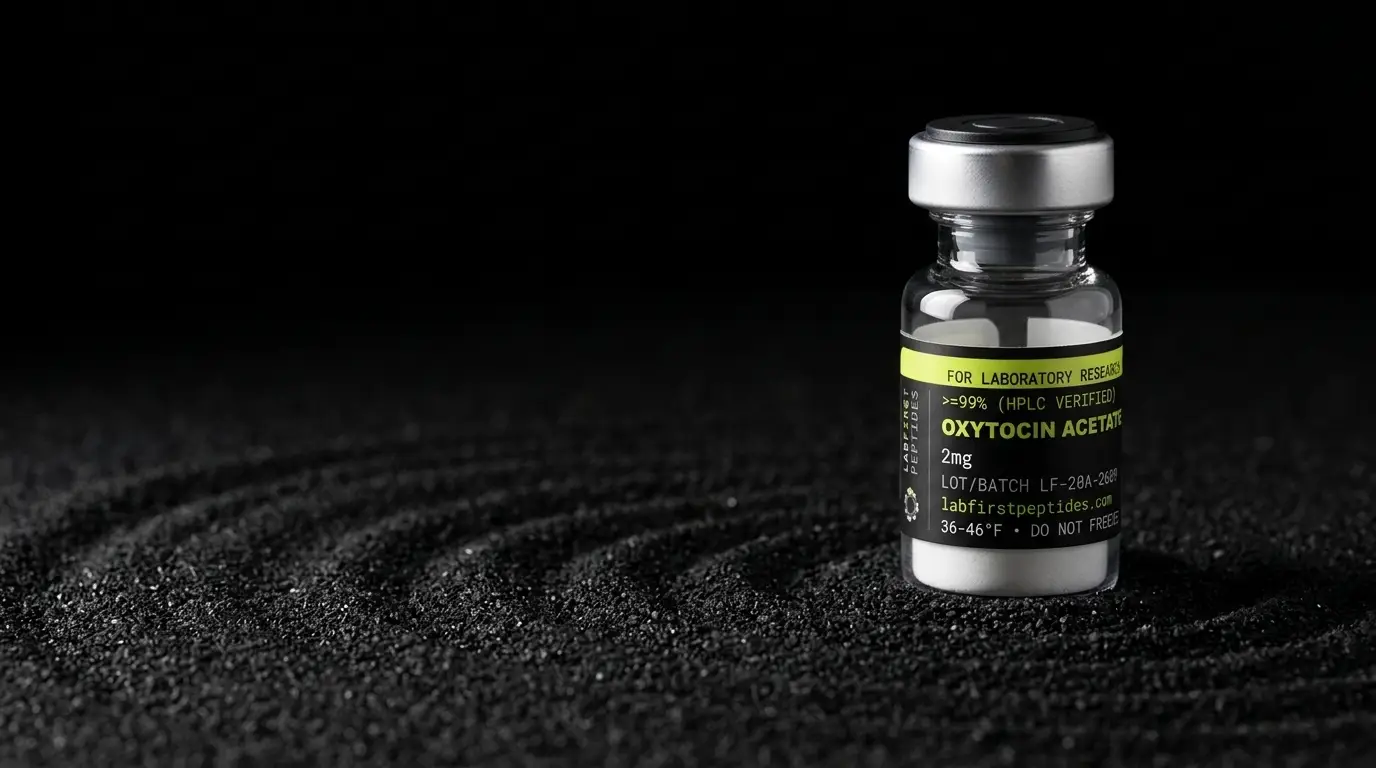
Oxytocin acetate identity is confirmed in three steps. Mass spectrometry should read near 1007.2 for the free base. A two-dalton check shows the disulfide is closed. A separation must be able to tell it apart from vasopressin. Unusually for this catalog, an authentic reference standard exists to compare against.
- Oxytocin is C43H66N12O12S2, average mass near 1007.2, PubChem CID 439302, as the free base.
- The disulfide check is two daltons; a lactam-closed peptide would show eighteen.
- Vasopressin is the related nonapeptide: same disulfide closure, two residues different.
- An authentic reference standard exists, which is true of almost nothing else here.
- Tyrosine gives a real 280 nm signal and a response-ratio consistency check.
- Cysteine is partly destroyed by acid hydrolysis, so composition often omits it.
What does identity mean for this peptide?
In plain terms, it is like checking a key three ways. Does it weigh right, is its loop closed, and does it differ from its closest lookalike? Oxytocin also has an official reference sample to compare against, which most compounds here lack.
That the molecule in the vial is the one the label names, that its disulfide ring is closed, and that it is not a closely related nonapeptide. Oxytocin has the molecular formula C43H66N12O12S2, average mass near 1007.2, cataloged as PubChem CID 439302.
That record describes the free base. The product supplied here is the acetate salt, so a certificate reports the salt and the two figures differ for that reason rather than because something is wrong.
Three questions, then, and one further advantage this compound has that almost nothing else in the catalog does.
- Observed mass, compared against 1007.2 for the free base
- Salt form stated, because the product is the acetate
- Disulfide closed: the reduced form is about two daltons heavier
- Vasopressin excluded by mass, and by a separation built to resolve it
- Run against an authentic reference standard where one is available
- Purity at 214 nm with 280 nm as a second view, thanks to the tyrosine
- Accession number confirmed at the issuing laboratory
What advantage does an established substance have?
An authentic reference standard exists. Oxytocin is a long-established drug substance with a compendial monograph, and that means a physical reference material of known identity and assigned content can be obtained.
The difference this makes is concrete. Most identity work in this catalog compares a measurement against a calculated expectation. Here a laboratory can run the sample and a genuine standard side by side under identical conditions.
Matching retention time against a real standard on the same run is far stronger evidence than matching it against a number in a method file, because everything that could shift retention shifts both equally.
What does the mass result confirm?
The sequence and the ring, in one number. At 1,007 daltons the measurement is comfortable, with a simple charge pattern and no meaningful scatter.
A missing residue, an extra one or a truncated chain all shift the mass by amounts the instrument resolves immediately.
The disulfide adds a second reading. Closing that bond removes one hydrogen from each cysteine, so the closed form weighs about two daltons less than the reduced open form. That is a fine distinction and a resolvable one, and it is only checkable if the certificate prints the observed figure rather than a verdict.
Why is a two-dalton ring check finer than an eighteen-dalton one?
Because the two ways of closing a peptide ring release different things. A lactam bridge forms between an amine and an acid and releases a molecule of water, so an uncyclised chain weighs about 18 more.
A disulfide forms between two sulfurs and releases two hydrogen atoms, so an unclosed chain weighs about two more.
Eighteen daltons is unmissable on any instrument. Two daltons is comfortably resolvable and much easier to overlook on a report that rounds or summarises. Both compounds in this catalog that use each mechanism are worth comparing on exactly this point.
How is vasopressin excluded?
By mass and by separation, and both should be used. Vasopressin is also a nonapeptide closed by a disulfide, differing from oxytocin at two sequence positions.
Their masses differ by more than a couple of daltons, so a mass measurement distinguishes them without difficulty. That is the reliable half of the answer.
Chromatographic resolution is the half that depends on the method. Two structurally similar nonapeptides do not automatically separate on a gradient developed for one of them, and a purity figure from such a method would count an unresolved contaminant inside the main peak. This is exactly the related-substance problem a compendial method is written to handle.
What does the tyrosine contribute?
A second detection wavelength that is genuinely useful. Oxytocin contains a tyrosine, which absorbs at 280 nanometres, where most peptides in this catalog absorb almost nothing.
Reading purity at both 214 and 280 gives two views of one separation. A peak visible at 214 but absent at 280 lacks a tyrosine, which is real structural information about what that impurity is rather than a bare percentage.
It also provides a rough internal consistency check. The ratio of response at the two wavelengths is a property of the molecule, so a peak with the wrong ratio is worth a second look even if it sits where the target should.
What does the salt form change?
The quantity answer, not the identity one. A mass spectrometer reports the peptide rather than the salt, so the identity result is unaffected by which counterion is present.
The balance weighs everything, so the powder is peptide plus acetate plus whatever water it has absorbed. That is why net peptide content exists as a figure separate from purity.
It also creates the discrepancy a careful buyer will notice: the certificate's figure and the database entry for the free base do not match, and the counterion is the entire explanation. A certificate naming the salt form prevents that confusion rather than leaving it to be worked out.
What related substances should the method resolve?
Four, and they arrive from different directions. Vasopressin as a closely related sequence. The reduced open form of oxytocin itself. Dimeric material formed when disulfides link two molecules. And the deamidated form, about one dalton heavier.
The dimer is the easiest, weighing roughly twice the monomer. The reduced form and the deamidated form are both small mass shifts that a routine method may or may not resolve chromatographically.
Knowing the list is the useful part. A certificate reporting related substances without saying which were looked for has reported a number with no scope attached to it.
What does composition analysis add?
An independent check on the residue inventory and a peptide content figure by weight, derived by hydrolysing the peptide and quantifying the freed residues.
There is a known limitation worth expecting. Cysteine is partly destroyed by standard acid hydrolysis, so it is typically either omitted or measured after a separate oxidation step that converts it to a stable derivative.
A composition report that leaves cysteine out has hit that limitation rather than failed. For a peptide whose defining feature is a disulfide between two cysteines, knowing that in advance prevents a reasonable reader from drawing the wrong conclusion.
How do you check the report describes your vial?
Confirm the accession or verification number at the issuing laboratory rather than with the seller. The laboratory holds the record; a seller holds a copy of a document. If the number resolves to a different lot, a different product, or nothing, the analysis is not evidence about your material.
Then match the lot number on the report to the vial. Rigorous analysis attached to the wrong batch is not rigour, and that mismatch is more common than falsified results.
Reports for material supplied here resolve through the certificate verification page, and the sizes carried appear on the oxytocin acetate product record.
What should you ask a supplier about identity?
Three questions. What was the observed mass, as a number. Was the analysis run against an authentic reference standard. And which related substances did the method actually resolve.
The second is the one specific to this compound and the one most worth asking. For almost everything else in this catalog a reference standard does not exist to run against, so the question would be unfair. Here it is not, and the answer says a great deal about how seriously the laboratory treated the material.
How to read the rest of the document is covered in the certificate guide.
What is the regulatory position?
International guidance on analytical validation defines what makes an identity method fit for purpose: specificity, accuracy, precision, and a demonstration that the method distinguishes the target from what else might plausibly be present. Vasopressin, the reduced form, dimers and the deamidated form are what is plausibly present here.
Oxytocin exists as an approved drug substance with a compendial monograph. Research-grade material is not that product and its certificate does not carry pharmacopeial weight, but the monograph gives a public reference point that most compounds here simply do not have.
What a research certificate can honestly establish is what a named laboratory measured, on a named lot, by named methods.
FOR LABORATORY AND IN-VITRO RESEARCH USE ONLY. NOT FOR HUMAN OR ANIMAL CONSUMPTION. NOT FOR PERSONAL, MEDICAL, DIAGNOSTIC, THERAPEUTIC, OR RECREATIONAL USE.
What is Oxytocin Acetate studied for?
Published research on Oxytocin Acetate investigates the areas below, which is a different question from what Oxytocin Acetate will do for anyone, a claim about a living system that nothing on this site is sold for.
What it is. A hormone nine building blocks long, supplied as the acetate salt.
What the research looks at. A very large body of basic and clinical research on oxytocin exists. Approved medicines containing oxytocin exist for specific uses.
How it is thought to work. It works on the oxytocin receptor. The peptide has a sulphur-to-sulphur bridge holding its shape, and that bridge is the part most easily damaged in handling.
What is not established. What is sold here is a research chemical and not a drug product. The sulphur bridge makes the molecule sensitive to conditions that break it, so identity paperwork matters more than usual.
The full record, including the certificate for the lot in stock, is on the Oxytocin Acetate product page.
Common questions
What mass should oxytocin show on a certificate?
Why is the disulfide check only two daltons?
How is vasopressin told apart from oxytocin?
Why does an authentic reference standard matter?
Why might cysteine be missing from composition analysis?
More documentation guides
Sources
- PubChem Compound Summary for CID 439302, Oxytocin. The openable record for the free base, giving the molecular formula C43H66N12O12S2 and average mass near 1007.2 that a certificate for the acetate salt is compared against.
- UniProt P01178, Oxytocin-neurophysin 1. The reference protein record for the human precursor from which oxytocin is processed, giving the native sequence a synthetic peptide reproduces.
- ICH Q2(R2), Validation of Analytical Procedures . Defines specificity and the role of a reference standard in identity testing, which is the practice this compound uniquely allows within this catalog.
- FDA guidance, Q6B Specifications: Test Procedures and Acceptance Criteria. Sets out how identity, related substances and disulfide structure are specified as separate attributes, and the role of a reference material in establishing them.