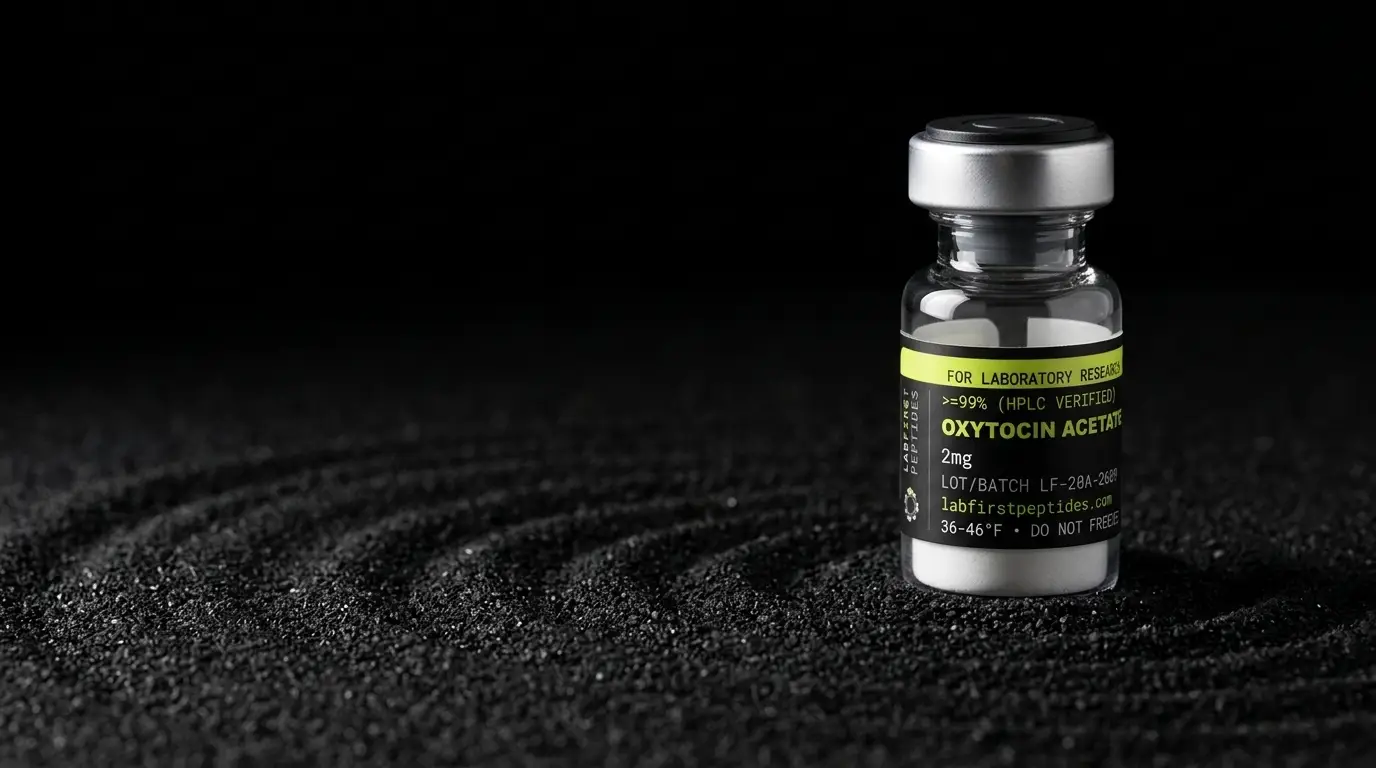
Oxytocin acetate storage and stability depend on three rules. Keep the dry powder sealed and frozen, keep any solution in the fridge, and keep both dark. Two routes break it down: deamidation at its asparagine and glutamine, and disulfide exchange that forms dimers. Both run faster in solution and at higher pH than in a dry sealed vial.
- Sealed and frozen as powder, refrigerated in solution, dark in both states.
- Oxytocin carries both an asparagine and a glutamine, so deamidation genuinely applies.
- Deamidation adds about one dalton and elutes close to the parent, so it can hide.
- The disulfide can exchange between molecules, producing dimers of twice the mass.
- Higher pH accelerates deamidation, disulfide exchange and hydrolysis alike.
- The acetate salt is hygroscopic, and water activates both main routes.
How should oxytocin be stored?
If you leave bread wet and warm, changes start fast; keep it dry and frozen and it lasts a long time. This peptide works the same way, and in solution it changes faster than many.
Sealed and frozen as lyophilized powder, refrigerated once a solution exists, and dark in both states.
The dry form is the stable one. Freeze-drying removes the water that the main degradation routes need, and a sealed vial below freezing is the condition every retest date assumes.
This peptide has a reputation for being less forgiving in solution than many, and that reputation is earned rather than folklore. It carries two distinct chemical liabilities, and both of them are activated by water.
- Sealed and frozen as lyophilized powder, in the dark
- Two liabilities, not one: deamidation and disulfide exchange
- Both are activated by water and both accelerate as pH rises
- Mildly acidic solution is considerably kinder than alkaline
- The acetate salt draws moisture; open the vial at room temperature
- A dimer shows plainly; deamidation shifts the mass by only one
What is deamidation and why does it apply here?
The conversion of an amide side chain into an acid, releasing ammonia. Two amino acids carry those amide side chains: asparagine and glutamine. Oxytocin contains one of each.
The reaction adds about one dalton, because an amide nitrogen is replaced by an oxygen. That is a small change chemically and a definite one: the molecule afterwards is a different compound.
Most peptides in this catalog are silent on deamidation because they lack the residues entirely. Selank, KPV and ipamorelin have neither asparagine nor glutamine. Oxytocin has both, which is why this route earns a section of its own here.
What accelerates deamidation?
Higher pH first, then temperature, then time in solution. The reaction proceeds through an intermediate that forms more readily as pH rises, so alkaline conditions are markedly worse than mildly acidic ones.
The identity of the residue after the amide matters too. Where a small residue follows, the reaction is faster, for the same geometric reason that makes an Asp-Gly pair the fastest aspartimide site elsewhere in this library.
In a dry sealed powder at freezer temperature the reaction is effectively arrested, because the molecule lacks both the mobility and the water. That gap between dry and wet is the whole practical argument for how this compound is stored.
How does the disulfide behave in storage?
As a reactive linkage rather than an inert one. The ring is closed by two sulfurs joined together, and that bond can open and re-form.
When it re-forms in the wrong place the result is usually a dimer, two molecules linked through their sulfurs. That is an unusual direction for degradation: the molecule is not broken down, it is joined to another one.
Exchange runs through a thiolate, so higher pH accelerates it, and trace copper or iron catalyse the oxidation chemistry involved. Both arrive from glassware, water and buffer components rather than from the peptide itself.
Why does pH appear in both answers?
Because it is the dominant variable for this molecule. Deamidation speeds up as pH rises. Disulfide exchange speeds up as pH rises. Backbone hydrolysis is also pH-sensitive.
That convergence is worth stating plainly rather than leaving a reader to notice it. For oxytocin in solution, pH control is not one consideration among several; it is the consideration, and mildly acidic conditions are considerably kinder than neutral or alkaline ones.
None of this bears on the sealed dry vial, where there is no solution to have a pH. It becomes the governing factor the moment one exists.
Would a certificate detect either route?
The disulfide route, yes. A dimer weighs roughly twice the monomer, which is unmistakable by mass and usually resolved chromatographically.
Deamidation is harder. The mass shift is about one dalton on a molecule of roughly 1,007, which is resolvable by a good instrument and easy to miss on a routine one. The deamidated form also elutes close to the parent, so a separation may or may not resolve it.
So one liability announces itself and the other whispers. That asymmetry is useful to hold: a clean certificate is stronger evidence against dimerisation than against deamidation.
What does the acetate salt contribute?
Hygroscopicity, mainly. Peptide acetate salts draw moisture from air more readily than the trifluoroacetate form the material starts as before ion exchange.
An opened vial in a humid room therefore takes on water faster than intuition suggests, and water is the thing that activates both of the routes described above.
It also moves the numbers quietly. A vial that has absorbed moisture weighs more per unit of peptide than it did at test, so the certificate's net peptide content figure becomes slightly generous while remaining an accurate record of what was measured.
What does a retest date actually mean?
It describes an unopened container held under the conditions printed beside it, derived from stability data: units stored at defined temperature and humidity, pulled on a schedule, tested against the release specification.
The date is conditional on those conditions. A vial that spent a week on a warm bench is no longer described by it, and nothing about it looks different.
It is also not a cliff. Material past a retest date is not established as failing, it is outside the evidence, and testing is the honest response rather than assuming in either direction. A pharmaceutical expiry is a stronger claim made under rules research-grade material is not made under.
What happens once the vial is opened?
The moisture clock starts and the certificate stops describing the contents. Lyophilized peptide is hygroscopic and the acetate form more so, and opening a cold vial in a warm room draws condensation straight onto the powder.
Letting the vial reach room temperature before opening costs nothing and removes the problem. For this compound the payoff is doubled, because water activates both the deamidation and the disulfide chemistry.
Air matters as well. Oxygen participates in the oxidation that drives disulfide exchange, so headspace is not neutral filler for a peptide with two sulfurs in it.
What should make you stop using a vial?
Powder that has caked hard or gone sticky. For a hygroscopic acetate salt that is unambiguous moisture uptake and it is the clearest signal available without equipment.
In solution, cloudiness or visible particulate. For a peptide that dimerises, haze can be the visible end of a process that began as a small amount of disulfide exchange.
A closure that has lifted or no longer sits flush counts even when the contents look fine. What none of these will reveal is deamidation, which has no color, no haze and only a one-dalton mass shift, and that is precisely why the storage conditions matter more than the inspection.
The proportionate response is a look before every use rather than a test after a surprise. Powder texture, the closure sitting flush, the solution clear. It takes seconds and catches the visible half of what can go wrong, which for this compound is genuinely half rather than all.
How does storage relate to the certificate?
They split the timeline and neither covers the other half. A certificate reports what was measured on a sample drawn at one moment, and the certificate guide covers how to read one field by field. Storage evidence covers what happened afterwards.
For this compound the split has a specific shape. Both of its liabilities develop after release, in solution, so a clean certificate describes material that had not yet had the opportunity to go wrong.
Lot reports for material supplied here resolve through the certificate verification page, and the sizes carried are on the oxytocin acetate product record.
What is the regulatory position?
Stability expectations for finished pharmaceutical products are set out in international guidance defining storage conditions, sampling intervals and the testing that supports a shelf-life claim. That framework governs drug products made for human use.
Oxytocin exists as an approved drug substance and a compendial monograph defines the standard for it, which is unusual in this catalog. Research-grade material is still not that product, and its documentation does not carry pharmacopeial weight simply because a monograph exists elsewhere.
What a supplier can honestly report is the conditions a lot was held under and what was measured. The useful question stays narrow: what conditions, what measurement, what date.
FOR LABORATORY AND IN-VITRO RESEARCH USE ONLY. NOT FOR HUMAN OR ANIMAL CONSUMPTION. NOT FOR PERSONAL, MEDICAL, DIAGNOSTIC, THERAPEUTIC, OR RECREATIONAL USE.
What is Oxytocin Acetate studied for?
Published research on Oxytocin Acetate investigates the areas below, which is a different question from what Oxytocin Acetate will do for anyone, a claim about a living system that nothing on this site is sold for.
What it is. A hormone nine building blocks long, supplied as the acetate salt.
What the research looks at. A very large body of basic and clinical research on oxytocin exists. Approved medicines containing oxytocin exist for specific uses.
How it is thought to work. It works on the oxytocin receptor. The peptide has a sulphur-to-sulphur bridge holding its shape, and that bridge is the part most easily damaged in handling.
What is not established. What is sold here is a research chemical and not a drug product. The sulphur bridge makes the molecule sensitive to conditions that break it, so identity paperwork matters more than usual.
The full record, including the certificate for the lot in stock, is on the Oxytocin Acetate product page.
Common questions
Why is oxytocin less stable in solution than some peptides?
What is deamidation?
Why does pH matter so much for this compound?
Would a certificate catch degraded oxytocin?
Does the acetate salt affect storage?
More documentation guides
Sources
- PubChem Compound Summary for CID 439302, Oxytocin. The openable record for the free base, showing the asparagine and glutamine that make deamidation applicable and the two cysteines whose disulfide can exchange.
- ICH Q2(R2), Validation of Analytical Procedures . Defines what makes an analytical result valid and reproducible, and is the basis for treating a stability figure without a named method and stated conditions as unverifiable.
- FDA guidance, Q6B Specifications: Test Procedures and Acceptance Criteria. Sets out how deamidated forms and aggregates are specified and tested as attributes distinct from total purity, which is the framework these two routes fall under.