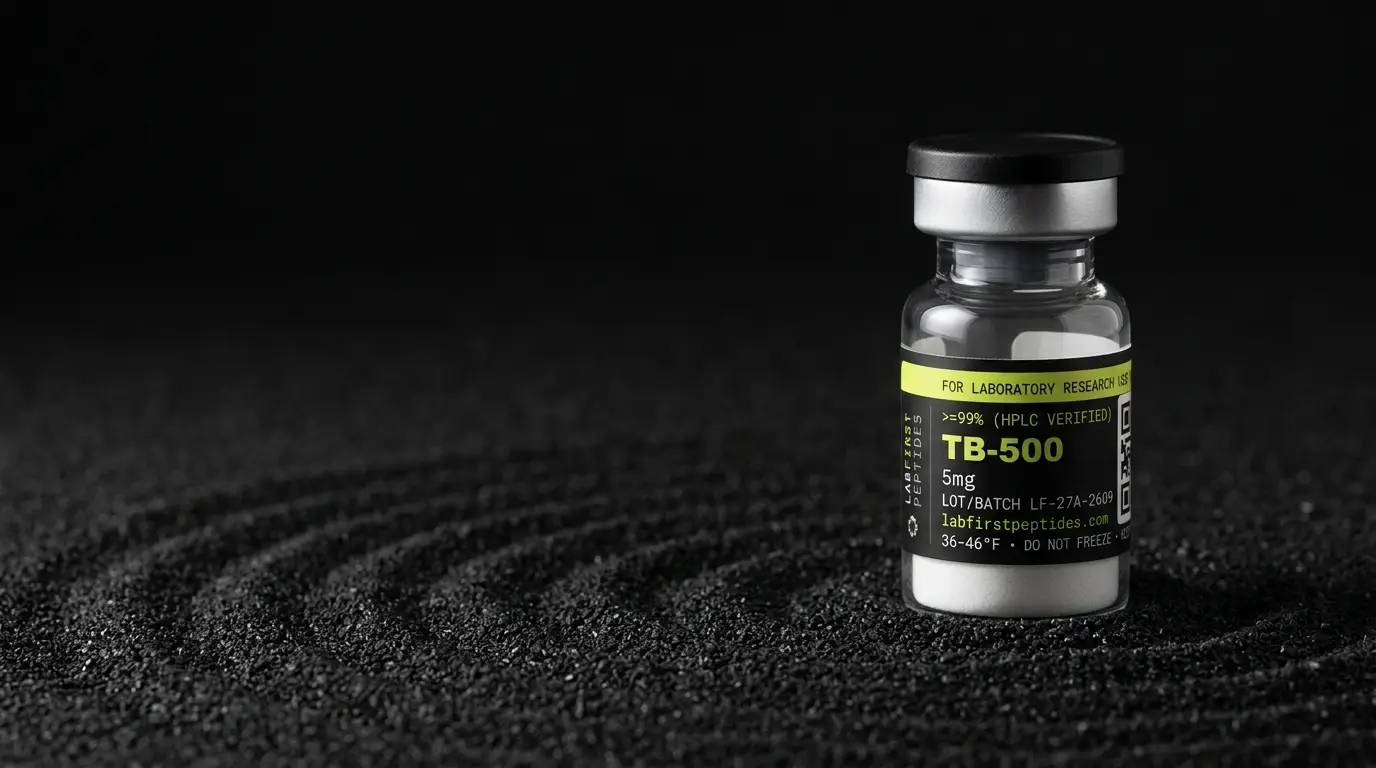
Lyophilised TB-500 is most stable as a sealed, dry, dark, cold powder. Moisture governs the outcome more than freezer temperature does. Once dissolved, hydrolysis and deamidation begin, so aliquot the solution at preparation, date every container, and treat undated material as unusable.
- TB-500 is a trade name covering two different molecules: full-length thymosin β4 near 4,960 Da and the Ac-LKKTETQ fragment near 889 Da.
- Moisture, not freezer temperature, is the dominant degradation driver for a dry hygroscopic peptide.
- Neither form contains cysteine, so disulfide scrambling is not a failure mode; oxidation is limited to Met6 in the full-length peptide.
- Asn26 is followed by proline, which places its deamidation among the slower cases rather than the faster ones.
- Equilibrating a sealed vial to room temperature before opening prevents the condensation uptake that is the most common avoidable handling error.
- Net peptide content, not gross vial mass, is the correct starting point for a concentration calculation.
What is actually in the vial
TB-500 is a supplier name. It has no pharmacopoeial monograph behind it and it does not designate one defined chemical entity, which matters before any storage question can be answered sensibly. Two quite different materials circulate under the label.
The first is full-length thymosin β4: a 43-residue, N-terminally acetylated polypeptide of roughly 4,960 Da, sequence beginning Ac-SDKPDMAEIE and ending in AGES. The second is the acetylated actin-binding fragment Ac-LKKTETQ-OH, corresponding to residues 17 to 23 of that sequence, with a mass near 889 Da. A factor of five in molecular weight is not a subtlety. RP-HPLC retention, mass spectrum, solubility, net charge and adsorption behaviour all differ, and so does the set of degradation routes that applies.
So the first storage control is documentary. Read the certificate of analysis for the observed mass and the stated sequence, not the trade name on the label. If the certificate reports a single deprotonated or protonated species consistent with one of those two masses, you know which molecule you are storing. If it reports only a purity percentage with no mass and no sequence, you are storing something whose identity is asserted rather than shown, and no amount of freezer discipline compensates for that.
Our documentation standard sets out which fields we expect a certificate to carry. The rest of this page assumes you have established which of the two materials is in front of you.
- Moisture — the dominant driver, delivered mostly by condensation
- Temperature — a rate modifier, not the mechanism
- Container surfaces — adsorption of the net-cationic fragment on bare glass
- Freeze-thaw — cumulative, irreversible, invisible
- Light and oxygen — one methionine to lose, and only in the full-length form
Degradation routes and what controls them
Peptides fail along a small and well-characterised set of routes. The review literature on lyophilisate instability is mature; Butreddy and colleagues surveyed the stresses and mechanisms in 2020, and that map applies here with one qualification: TB-500, in either form, is strongly hydrophilic and carries no cysteine, so two of the classic failure modes are simply off the table.
| Route | Driver | Site in this sequence | Control |
|---|---|---|---|
| Backbone hydrolysis | Water activity, temperature, pH extremes | Any amide bond; Asp-Pro linkages are relatively labile | Keep the solid dry and sealed against desiccant |
| Deamidation | Water, temperature, pH above about 6 | Gln23, Gln36, Gln39; Asn26 in the full-length form | Dry storage, cold, mildly acidic solution pH |
| Oxidation | Headspace oxygen, light, trace metals | Met6 in the full-length form only | Dark storage, minimal headspace, cold |
| Surface adsorption | Container chemistry, low concentration | Net-cationic heptapeptide on bare glass | Container material fixed and recorded in the protocol |
| Disulfide scrambling | Free thiols, oxidising conditions | None; no cysteine in the sequence | Not applicable |
| Microbial growth | Aqueous medium, ambient storage | Prepared solutions | Aseptic preparation, cold storage, defined use window |
Freezer temperature does not appear as a mechanism, only as a rate modifier. Cold slows every row in that table, which is why cold storage works. Water is what actually runs the reactions.
Sequence features that bear on storage
Three features of this chemistry change how a vial behaves on the bench.
The full-length peptide has a single methionine at position 6 and no tryptophan or cysteine. That gives it one oxidation-sensitive residue and no more, which is unusually tidy. The heptapeptide fragment has none at all. Oxidative loss is therefore a smaller concern here than it is for sequences carrying several susceptible residues, though light-protected storage still costs nothing.
Asparagine 26 in the full-length sequence is followed by proline. Deamidation proceeds through a cyclic succinimide intermediate, and the residue on the C-terminal side of the asparagine strongly governs how fast that intermediate forms. Robinson and Robinson's pentapeptide work established the ordering: glycine on that side is fast, proline is among the slowest, because the tertiary amide nitrogen cannot make the nucleophilic attack the mechanism requires. Asn-Pro is close to the best case. The glutamines are slower still. This is not a licence to leave a solution on the bench, but it does mean deamidation is unlikely to be the first thing that goes wrong.
Net charge differs between the two materials and shows up in handling. Full-length thymosin β4 is strongly acidic, with many glutamate and aspartate residues and an isoelectric point in the mid-4s. The Ac-LKKTETQ fragment carries two lysines against one glutamate, so it is net cationic at neutral pH. Cationic peptides adsorb to the deprotonated silanol groups on bare glass, and at low working concentrations that loss is real and invisible. Fix the container material in the protocol and keep it fixed across a series. Switching from polypropylene to untreated glass mid-study is a good way to generate a trend that has nothing to do with the experiment.
Both forms are hygroscopic. Highly charged lyophilisates take up atmospheric water quickly, and residual counterion from purification, usually trifluoroacetate or acetate, adds to that tendency. A cake that has gone from fluffy to glassy or shrunken has almost certainly picked up water.
Conditions by physical state
| State | Temperature | Light | Relative horizon | Why |
|---|---|---|---|---|
| Sealed powder, unopened | Minus 20 °C or below, desiccated | Dark | Longest | Water excluded and every rate slowed |
| Sealed powder, working stock | 2 to 8 °C, desiccated | Dark | Shorter than frozen | Adequate where the vial is consumed inside a defined window |
| Powder in transit | Ambient | Dark, insulated | Days | A dry solid tolerates short excursions far better than any solution |
| Prepared aqueous solution | 2 to 8 °C | Dark | Days, not months | Hydrolysis, deamidation and microbial risk are now running |
| Solution, single-use aliquots | Minus 20 °C or below | Dark | Longer, at a cost per thaw | Freeze-thaw cycling drives loss that inspection cannot detect |
The horizons are deliberately relative. ICH Q1A(R2) makes the reasoning explicit for regulated products: a shelf life is the output of a stability study run on that formulation, in that container closure, under defined conditions. Nobody has run that study on a research lot of TB-500 in your vial. A supplier who prints "stable 24 months at minus 20 °C" without a study behind it is quoting a convention. Where the certificate carries a retest date derived from real data, use it. Where it does not, the honest record says the window is unestablished and the material is judged on handling history.
The cold vial in a humid room
This is the failure that does most of the damage and appears in no logbook. Take a vial from a minus 20 °C freezer into a room at 22 °C and 60 percent relative humidity. The glass is far below the dew point. Water condenses on every cold surface, including the inner wall and the cake itself the instant the stopper is lifted, and a charged lyophilisate absorbs it immediately.
Nothing about the appearance changes in a way anyone will notice. The vial goes back into the freezer with water now inside it, the ice sublimes and redeposits, and the cycle repeats on the next working day. Three months later somebody reports a purity result that does not match the certificate and the discussion turns to the supplier.
The control is dull and works. Let the sealed vial equilibrate to room temperature before breaking the seal, every time, with no exception for being in a hurry. Twenty to thirty minutes on the bench suits a small vial. Work quickly once it is open, backfill with dry inert gas if your setup allows, reseal against fresh desiccant, and note the excursion if your protocol tracks openings.
Worth saying plainly: drier is not always better in the abstract. In some lyophilised formulations a small amount of residual water stabilises the solid by substituting for hydrogen bonds the excipient matrix cannot make. That is a formulation finding, not a storage instruction, and for an unformulated research powder the practical rule stands unchanged. Keep water out.
Once it is in solution
Adding diluent starts a faster clock. The hydrolysis and deamidation routes now have the water they need, adsorption has a liquid phase to work through, and any organism introduced at preparation has a medium. Choice of diluent is part of the record: sterile water for injection, a defined buffer, or bacteriostatic water, each with its own lot number. The bacteriostatic water guide covers what the benzyl alcohol content does and does not do for a laboratory stock.
Two practices carry most of the benefit. Split the solution into single-use aliquots at the moment of preparation, so no container is thawed twice. And label each aliquot at that moment, in ink that survives a freezer, with an identifier that ties back to the parent solution.
Freeze-thaw is the cost people discount. Each cycle takes the solution through the concentration gradients and interfacial changes that accompany ice formation, and the resulting losses accumulate rather than reverse. A tube on its ninth thaw is not the same sample as one on its first, and no visual check separates them. Neither does a clear, colourless appearance mean much: a peptide can lose several percent of its assayed content with no change you can see.
Avoid vortexing to dissolve. Swirl, or let the vial stand. Foaming a solution creates air-water interface, and interface is where peptide molecules go to misbehave, even ones as soluble as these.
Worked example: aliquot arithmetic
A 5 mg vial brought into 2.5 mL of diluent gives:
5 mg ÷ 2.5 mL = 2 mg/mL
If the protocol draws 0.25 mL per replicate, the container supports:
2.5 mL ÷ 0.25 mL = 10 draws
Held as one tube, the tenth draw comes from material warmed and re-chilled nine times. Divided into ten 0.25 mL aliquots at preparation, each is thawed once. The cost is a rack of tubes and five minutes of labelling.
One further correction belongs in the arithmetic. Net peptide content is not the same as chromatographic purity. A certificate reporting 98 percent by HPLC and 82 percent net peptide content is describing a lot in which roughly a sixth of the mass is counterion and water. If the protocol needs a known molar concentration, the calculation starts from net peptide content, not from gross vial mass. The vial concentration calculator handles other vial sizes and diluent volumes; it covers laboratory measurement only.
What the record should say
Storage discipline that is not written down is not reproducible. For a prepared solution, the minimum record is the source lot identifier, the diluent and its lot, the volume added, the net peptide content used in the calculation, the resulting concentration, the date and time of preparation, the storage location, and the initials of whoever made it. Aliquots inherit all of that through a shared identifier.
The reason is practical. When a result looks wrong, the first question is whether the material was what the protocol assumed. A record that runs from sample back through aliquot, solution and lot to the certificate answers that in a minute. A record that stops at "TB-500, 2 mg/mL" means repeating the work, and repeating it without knowing what changed.
Two habits are worth adopting outright. Undated containers are discarded, not guessed at. And a physical observation goes in the log at every opening: cake intact, cake collapsed, solution clear, particulates present. Observations recorded at the time are evidence. Observations recalled later are not. The same logic applies to any peptide held on site, and the parallel discussion in storage and stability for a lipidated peptide covers the aggregation-driven cases where the stakes are higher.
Regulatory position
There is no FDA-approved drug product containing thymosin β4 or the Ac-LKKTETQ fragment. Formulations of thymosin β4 have been studied in clinical trials, including ophthalmic preparations, but investigational status is not approval and confers nothing on research-grade powder.
Thymosin β4 has been evaluated by FDA among bulk drug substances nominated for use in compounding and placed in the category flagged for significant safety concerns, which excludes it from lawful compounding under that pathway. The World Anti-Doping Agency prohibits TB-500 and related thymosin β4 peptides at all times under the growth factors class of its Prohibited List; that list is reissued annually and should be checked against the current edition.
Status verified 26 August 2026.
FOR LABORATORY AND IN-VITRO RESEARCH USE ONLY. NOT FOR HUMAN OR ANIMAL CONSUMPTION. NOT FOR PERSONAL, MEDICAL, DIAGNOSTIC, THERAPEUTIC, OR RECREATIONAL USE.
Common questions
Does lyophilised TB-500 have to be kept frozen?
How do I tell whether my vial holds full-length thymosin beta-4 or the heptapeptide fragment?
How long is a prepared solution usable?
Is oxidation a real concern for this peptide?
Why does net peptide content matter for storage records?
Can a thawed aliquot be refrozen?
More handling guides
Sources
- Butreddy et al., International Journal of Biological Macromolecules, 2020. Review of stresses, stabilisation mechanisms and analytical techniques for lyophilised protein and peptide products; supports the degradation-route table and the primacy of solid-state, low-moisture storage.
- Robinson and Robinson, deamidation rate studies in model pentapeptides (PNAS, early 2000s). Establishes the neighbouring-residue effect on asparagine deamidation rate, including the strong retarding effect of a C-terminal-side proline; supports the treatment of Asn26-Pro27 as a slow case.
- ICH Q1A(R2), Stability Testing of New Drug Substances and Products. Defines shelf life as the output of a stability study on a specified formulation and container closure; supports the position that unsupported shelf-life figures for research powders are conventions rather than measurements.
- PubChem record for thymosin β4. Source for sequence, molecular formula and monoisotopic and average mass used in the identity discussion and the mass-based distinction between the full-length peptide and the heptapeptide fragment.