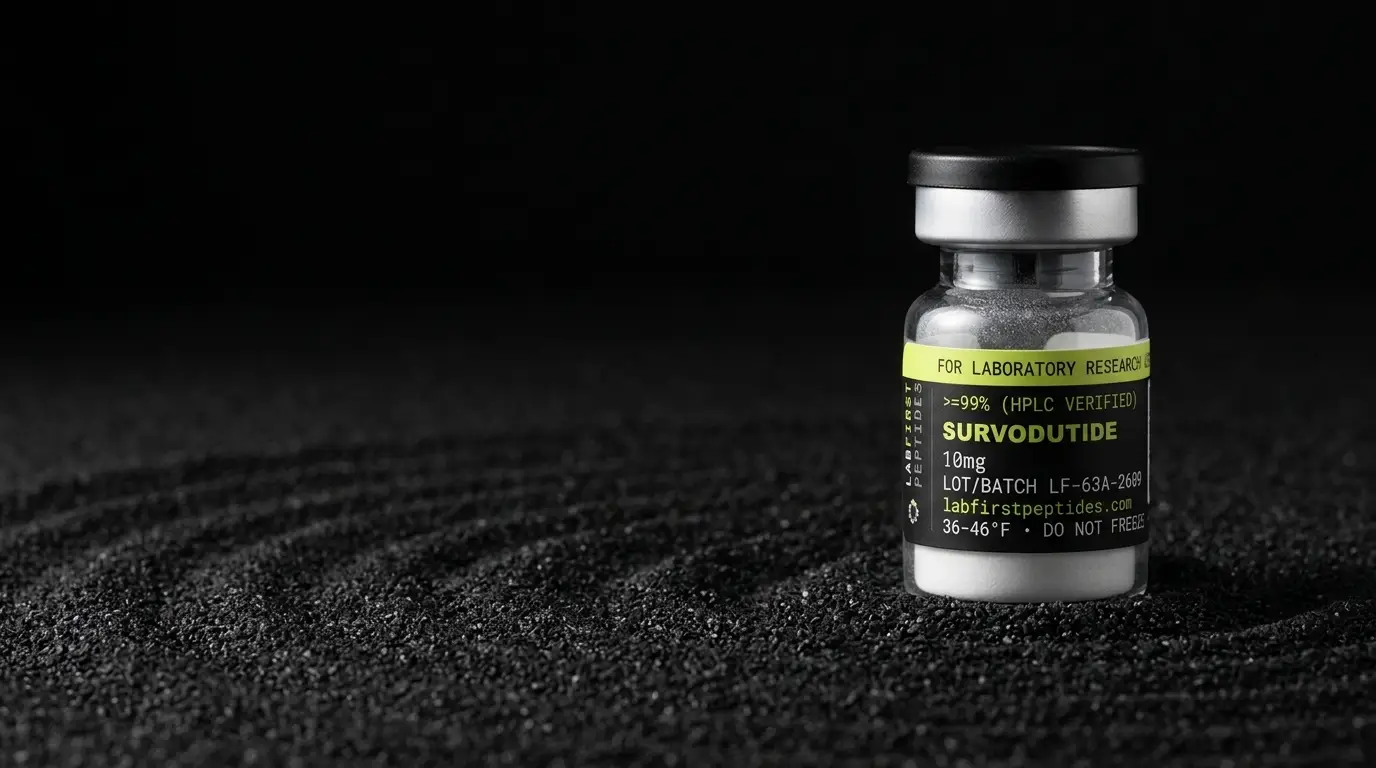
Survodutide is an investigational acylated peptide with no approved label, so no assigned expiry exists. Keep the sealed lyophilised powder cold, dark and dry; water drives most degradation. Adding diluent starts a much faster clock, measured in days, and every aliquot needs a date written at preparation.
- Survodutide has no approved product or labelled expiry anywhere, so storage figures quoted from approved incretin medicines do not apply to a research powder.
- Moisture, not freezer set point, is the dominant degradation driver for a lyophilised peptide.
- Letting a sealed vial reach room temperature before opening prevents condensation uptake, the most common unrecorded handling loss.
- The fatty acid chain that extends circulating half-life also makes the molecule interface-active and prone to adsorption at low concentrations.
- Glucagon-family backbones have a documented fibrillation tendency, so soluble aggregates need a size-exclusion or light-scattering method to detect.
- Freeze-thaw damage to a prepared solution is cumulative, irreversible and invisible on inspection.
There is no approved label to borrow from
Survodutide, indexed in the development literature as BI 456906, is an investigational compound. As of the verification date on this page no approved product containing it exists anywhere, which means there is no package insert, no assigned expiry, and no published stability study a laboratory can point to for a research-grade powder. What circulates in its place are figures lifted from the labelling of approved incretin medicines: refrigerate at 2 to 8 °C, protect from light, discard after twenty-eight days in use.
Those numbers describe sterile aqueous formulations with excipients and a preservative system, filled and released under pharmaceutical quality systems, with a shelf life derived from stability work on that exact composition. They describe a different physical state and a different supply chain. Nothing in them applies to a lyophilised cake sitting in a research vial.
So storage decisions here rest on two things only: general peptide chemistry, and whatever the supplier's certificate documents for the specific lot in hand. That is a weaker footing than working from a licensed product, and it should be recorded as such. A confident month count assigned to a research powder without a stability study behind it is a convention someone repeated, not a measurement.
ICH Q1A(R2) is worth reading once for exactly this reason. It sets out what generating a shelf life actually involves — defined conditions, defined containers, real time points on real lots. Anything short of that produces an estimate, and estimates belong in the record labelled as estimates.
- Moisture — the dominant driver, and condensation delivers it
- Temperature — a rate modifier, not a mechanism
- Oxygen and light — oxidation of susceptible residues
- Interfaces and agitation — aggregation of a lipidated, glucagon-family backbone
- Freeze-thaw — cumulative, irreversible, invisible
- The record — the only stability document an unapproved compound has
Structure, and what it implies for the bench
Survodutide is described in the primary literature as a dual agonist at the glucagon receptor and the GLP-1 receptor. The publicly reported structure is a peptide of the glucagon family carrying α-aminoisobutyric acid substitutions and a fatty acid chain conjugated through a hydrophilic linker to a lysine side chain. Positional details vary in how different secondary sources report them; check the sequence against the certificate for your lot rather than against a summary page.
Two structural features matter for handling. The acylation is there to promote albumin binding and extend circulating half-life. On a bench, that same chemistry makes the molecule amphiphilic, and amphiphilic peptides concentrate at interfaces. The air-water boundary in a half-filled vial is a genuine site of loss, and adsorption to glass and to some plastics is a plausible route for material to go missing at low working concentrations. That kind of loss shows up as a weak result rather than as anything visible.
The second feature is the backbone family. Glucagon itself is a 29-residue peptide with awkward solubility behaviour around neutral pH and a well-documented tendency to form fibrils in solution, which is why glucagon rescue products were historically supplied as a dry powder to be dissolved immediately before use. An engineered analogue is not the parent peptide and Aib substitutions change the conformational picture, so do not assume identical aggregation kinetics. Do assume that aggregation is a live risk worth designing against, because the parent scaffold earned that reputation honestly.
The Aib residues resist enzymatic cleavage. They do nothing about hydrolysis, oxidation or interface-driven aggregation. Treating peptidase resistance as general stability is a common and expensive confusion.
Degradation routes and what controls each
Peptides fail along a small, well-catalogued set of routes. Butreddy and colleagues surveyed the stresses and mechanisms for lyophilised protein and peptide products in 2020, and that survey remains a serviceable map. Which routes dominate for a given sequence depends on the residues present and on how the vial is treated between uses.
| Route | What drives it | Susceptible feature | Practical control |
|---|---|---|---|
| Backbone hydrolysis | Water activity, temperature, pH in solution | Any amide bond, including those in the acyl linker | Keep the solid dry and sealed against desiccant |
| Deamidation | Water, temperature, pH above roughly 6 | Asparagine and glutamine side chains | Dry storage; cold; buffer choice once dissolved |
| Oxidation | Headspace oxygen, light, trace metals | Methionine and tryptophan where present in the sequence | Dark storage, cold, minimal headspace |
| Aggregation and fibrillation | Interfaces, agitation, concentration, pH near the isoelectric point | Glucagon-family backbones and lipidated peptides | Swirl, never vortex; avoid foaming; keep solutions cold |
| Surface adsorption | Contact with glass and some polymers | Amphiphilic peptides at low concentration | Container material chosen, fixed and documented |
Freezer temperature is not on that list as a mechanism. Cold slows every route above, which is why cold storage works, but temperature is a rate modifier. Moisture is the mechanism. A sealed vial held at room temperature and genuinely dry will often outlast one held at minus twenty and opened cold in a humid room every few days.
Conditions by physical state
| State | Temperature | Light | Relative horizon | Why |
|---|---|---|---|---|
| Sealed powder, unopened stock | Minus 20 °C or below, desiccated | Dark | Longest | Water excluded and every route slowed |
| Sealed powder, in-use vial | 2 to 8 °C | Dark | Shorter than frozen | Adequate inside a defined working window |
| Powder in transit | Ambient, insulated | Dark | Days | Dry solids tolerate short excursions far better than solutions |
| Prepared aqueous solution | 2 to 8 °C | Dark | Days, not months | Hydrolysis, deamidation and aggregation are now running |
| Solution, single-use aliquots | Minus 20 °C or below | Dark | Longer, at a cost per thaw | Freeze-thaw cycling drives aggregation |
The horizons are relative on purpose. Assigning months to a specific lot needs stability data generated on that lot, in that closure, under those conditions. Where the certificate carries a retest or re-evaluation date, that date is the only one with any standing. Where it carries none, the honest entry in the record is that the window is unestablished.
The cold vial in a warm room
Take a vial from a minus twenty freezer into a laboratory at 22 °C and sixty percent relative humidity. The glass sits far below the dew point. Water condenses on every cold surface it can reach, and the moment the seal is broken that includes the inside of the vial and the cake itself, which is hygroscopic enough to take the water up immediately.
Nothing about this announces itself. A cake that has picked up a little moisture looks like a cake. The vial goes back to the freezer with water now inside, the next person opens it cold as well, and the loss compounds across a dozen unremarkable working sessions. In my experience this is the single largest avoidable degradation event in a peptide laboratory, and it never appears in a record because nobody knows it happened.
The control is dull. Let the sealed vial reach room temperature before the seal is broken, every time, with no exception for being in a hurry. Twenty to thirty minutes on the bench suits a small vial; touch the glass, and if it is cool it is not ready. Work quickly once open, reseal against desiccant, and return it promptly.
Drier is not automatically better in every system, incidentally. Work on lyophilisate formulations has found cases where raising residual moisture slightly improved stability, through water substituting for hydrogen bonds the excipient matrix could not supply. That is a formulation result, not a storage instruction, and it is a useful reminder that the intuitive rules here are approximations.
Once diluent has been added
Adding water starts a faster clock. Hydrolysis and deamidation need water and now have it. The amphiphilic character of the molecule has an interface to work on. Any microbial contamination introduced during preparation now has a medium. For a glucagon-family backbone there is a further consideration: solution pH sits near the region where solubility is poorest for the parent peptide, so a solution that goes cloudy, forms wisps or leaves a film on the glass should be treated as compromised and documented, not filtered and used.
Two habits do most of the protective work. Split the solution into single-use aliquots at the moment of preparation, and date every container then rather than later.
The arithmetic is trivial and worth writing down anyway. A 5 mg vial brought into 2 mL of diluent gives:
5 mg ÷ 2 mL = 2.5 mg/mL
If a protocol draws 0.25 mL per run, a single container supplies:
2 mL ÷ 0.25 mL = 8 draws
Held as one container, the eighth draw comes from material warmed and re-chilled seven times, and freeze-thaw damage is cumulative, irreversible and invisible on inspection. Divided into eight aliquots at preparation, each is thawed once. The cost is a few minutes and a rack of tubes. The vial concentration calculator handles other vial sizes and volumes; choice of diluent is covered separately in the bacteriostatic water guide.
Dating and documenting a prepared solution
Storage discipline that is not written down is not reproducible, and for an investigational compound with no label the record is the only stability document that exists.
A minimum entry for a prepared solution carries the source lot identifier, the diluent and its lot, the volume added, the calculated concentration, the container type, the date and time of preparation, the storage location, and the initials of whoever prepared it. Aliquots inherit all of that through a shared identifier written on each tube in something that survives a freezer. Cryo labels lift; a solvent-resistant marker on the cap as well as the side costs nothing.
Record the cumulative thaw count on each aliquot if the protocol reuses any container. And record excursions: the vial that sat out for two hours, the freezer that alarmed overnight, the shipment that arrived warm. Excursions that get logged can be reasoned about later. Excursions that get quietly ignored turn into unexplained variance six weeks on.
The reason is practical. When a result comes out wrong, the first question is whether the material was what the protocol assumed. A record that ties the sample through the aliquot to the solution to the lot to the certificate answers that in a minute.
Confirming that storage actually held
Storage claims are testable. The standard pairing is reversed-phase HPLC for purity and related substances, with UV detection in the 210 to 220 nm region where the peptide bond absorbs, plus LC-MS for identity against the expected monoisotopic or average mass. USP general chapters on chromatography and on the validation of compendial procedures set out what a defensible method looks like; a certificate that reports a purity figure without naming the method, the column chemistry and the gradient is reporting a number rather than a measurement.
Two practices make later comparison possible. First, keep the receipt chromatogram. A single reference injection run when the lot arrives gives every subsequent run a baseline, and a new shoulder at a slightly earlier retention time is far easier to spot against your own trace than against a supplier PDF. Second, note the total peak area, not only the purity percentage. Adsorptive loss and precipitation both reduce recovered material while leaving the relative purity looking fine.
Aggregation needs a different tool. Size-exclusion chromatography or a light-scattering method will detect soluble high-molecular-weight species that reversed-phase gradients can miss entirely, and for a glucagon-family sequence that is the failure mode I would most want visibility on. What documentation a competent supplier provides for identity and purity is set out under our quality standard.
Regulatory position
Survodutide (BI 456906) is a dual glucagon receptor and GLP-1 receptor agonist under clinical development by Boehringer Ingelheim in collaboration with Zealand Pharma. It has been studied in phase 3 programmes in obesity and in metabolic dysfunction-associated steatohepatitis, and the developer reported an FDA breakthrough therapy designation in MASH with fibrosis in 2024.
No regulator has authorised a survodutide product for marketing. There is therefore no approved formulation, no approved labelling, no assigned expiry and no lawful route to human use through any supply chain, research-grade or otherwise. Check ClinicalTrials.gov and the developer's own disclosures for current programme status before repeating any status claim, including this one.
Status verified 26 August 2026.
FOR LABORATORY AND IN-VITRO RESEARCH USE ONLY. NOT FOR HUMAN OR ANIMAL CONSUMPTION. NOT FOR PERSONAL, MEDICAL, DIAGNOSTIC, THERAPEUTIC, OR RECREATIONAL USE.
Handling for the closely related lipidated incretin analogues follows the same logic, and the longer worked treatment in the tirzepatide storage guide covers the condensation and freeze-thaw arguments in more depth.
Common questions
Does lyophilised survodutide have to be kept frozen?
Why can I not use the 28-day figure from approved incretin products?
How long is a prepared solution good for?
Is aggregation a particular concern for this compound?
What should the record show for a vial that arrived warm?
Does light exposure matter for a dry powder?
More handling guides
Sources
- Zimmermann and colleagues, Molecular Metabolism, 2022. Preclinical characterisation of BI 456906 as a glucagon receptor and GLP-1 receptor dual agonist; supports the mechanism and the description of the compound as an acylated peptide analogue.
- Butreddy et al., International Journal of Biological Macromolecules, 2020. Review of stresses, stabilisation mechanisms and analytical techniques for lyophilised protein and peptide products; supports the degradation-route table and the primacy of dry solid-state storage.
- ICH Q1A(R2), Stability Testing of New Drug Substances and Products. Defines what generating a shelf life requires in terms of conditions, containers, lots and time points; supports the position that an unstudied research powder has no assignable expiry.
- USP General Chapters <621> Chromatography and <1225> Validation of Compendial Procedures. Establishes the method-reporting expectations that make an RP-HPLC purity figure interpretable on a certificate of analysis.