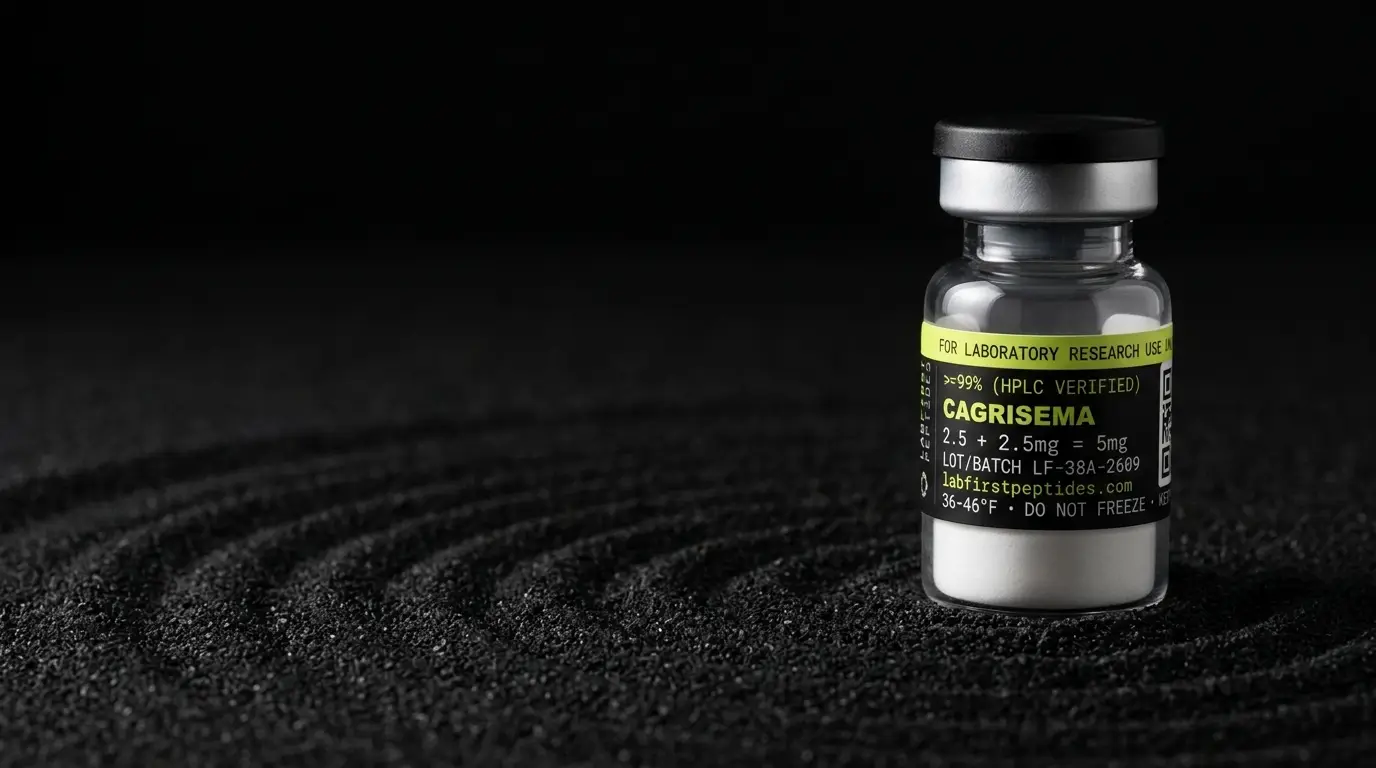
CagriSema storage means keeping two peptides stable in one vial: cagrilintide and semaglutide. Dry, sealed, cold and dark protects both. Moisture does the most damage, usually as condensation on a cold vial. Cagrilintide carries a disulfide loop that semaglutide lacks, so a shifted ratio between the two says more than total purity.
- CagriSema is a co-formulation of cagrilintide and semaglutide, so a single purity figure for the vial cannot describe the material adequately.
- Semaglutide contains no cysteine or methionine; cagrilintide retains an intramolecular disulfide loop, which is a degradation route the other component does not have.
- Moisture rather than freezer temperature is the dominant driver of loss in the dry state, and condensation on a cold vial is the most common avoidable error.
- A shifted peak area ratio between the two actives is a more informative stability signal than a change in total purity.
- Certificates for a blend should resolve both components chromatographically, report purity for each, and state how the ratio was verified.
- Regulatory status of the combination has been changing; check the FDA and EMA registers on the day rather than relying on a secondary page.
Why does a blend change the storage question?
In plain terms, storing this blend is like storing two foods in one container. Each spoils in its own way, so the conditions have to suit both at once.
CagriSema is not a single molecule. It is a co-formulation of two acylated peptides: cagrilintide, a long-acting analog of human amylin, and semaglutide, a GLP-1 receptor agonist analog. A research vial sold under that name therefore contains two chemically distinct actives at some stated ratio, and every question about stability doubles.
That has a practical consequence people miss. When a laboratory asks whether a lot is still good, it is really asking three things: is component A intact, is component B intact, and has the ratio between them moved. A single purity number for the vial answers none of those cleanly. Nor does a single mass, since the two peptides have different masses and the blend has none of its own.
How the blend was made also matters and is rarely disclosed. Material co-lyophilized from a common solution behaves as one cake with one moisture content. Material produced by dry-blending two separately lyophilized powders can be heterogeneous, and a partial sample taken from such a vial is not guaranteed to carry the label ratio. If a supplier cannot say which process was used, that is an unresolved variable in the record rather than a detail.
- Moisture — the dominant driver in the dry state
- The disulfide loop — reduction and scrambling, near-invisible by mass alone
- Interfaces and agitation — aggregation, with an amyloidogenic scaffold in play
- Temperature — a rate modifier for every route above
- The ratio — the number that moves first when one component degrades
How do the two molecules degrade differently?
Semaglutide is a 31-residue linear peptide based on GLP-1, carrying α-aminoisobutyric acid at position 8, an arginine substitution at position 34, and a C18 fatty diacid attached to the lysine at position 26 through a γ-glutamyl and bis-OEG linker. Its formula and mass are documented in PubChem, average molecular weight near 4113.6 Da. The sequence contains no cysteine and no methionine, which removes two of the usual oxidation routes, but it does contain a single tryptophan and two glutamines.
Cagrilintide is the more delicate of the pair. It is an acylated amylin analog, engineered from a parent sequence that retains the N-terminal intramolecular disulfide loop characteriztic of the calcitonin and amylin family, with an amidated C-terminus and a long fatty diacid side chain. I would not quote a molecular weight for it from memory; take the number from the lot's own mass spectrum, which is what a certificate should be showing you anyway.
| Route | Semaglutide | Cagrilintide | Control |
|---|---|---|---|
| Backbone hydrolysis | Yes, any amide bond | Yes, any amide bond | Dry, sealed, desiccated solid |
| Deamidation | Gln side chains, slower than Asn | Sequence-dependent; Asn-containing amylin scaffolds are susceptible | Dry storage; cold |
| Oxidation | Trp; no Met or Cys | Cys residues in the disulfide loop | Dark, cold, minimal headspace |
| Disulfide reduction or scrambling | Not applicable | Yes | Cold, sealed storage |
| Aggregation and fibrillation | Interface-driven, lipid chain contributes | Interface-driven, plus an amyloidogenic parent motif | Cold storage; minimal headspace |
Note the asymmetry. Conditions that leave semaglutide essentially unchanged can still cost you cagrilintide, and a shifted ratio is the signature. If a lot re-assays at a plausible total purity but the peak area ratio has drifted from the certificate, one component has degraded preferentially. That is more informative than the total.
What CagriSema storage conditions suit a sealed vial?
| State | Temperature | Light | Relative horizon | Why |
|---|---|---|---|---|
| Sealed powder, unopened | Minus 20 °C or below, desiccated | Dark | Longest | Water excluded and every chemical route slowed |
| Sealed powder, working stock | 2 to 8 °C | Dark | Shorter | Acceptable where the vial is consumed inside a defined window |
| Powder in transit | Ambient, insulated | Dark | Days | A dry solid tolerates short excursions |
The horizons are relative on purpose. Assigning months to a research blend would require a stability study run on that lot, in that container, under those conditions, in the manner ICH Q1A(R2) sets out for the products it governs. Nobody has run that study for a research-grade blend unless the certificate says so and shows time points. Absent that, the honest entry in the record is that the window is unestablished.
The dominant avoidable loss is not the freezer setting. It is condensation. A vial at minus 20 °C brought into a room at 22 °C and sixty percent humidity is far below the dew point, and a lyophilized cake takes up whatever water reaches it the moment the seal breaks. The cake looks the same afterwards. Let the sealed vial equilibrate on the bench first, every time, twenty to thirty minutes for a small vial, then work quickly and reseal against a desiccant. The same discipline described in the tirzepatide storage guide applies here without modification.
How do you open a cold vial without adding moisture?
- Leave the sealed vial on the bench to equilibrate first, every time. Twenty to thirty minutes covers a small vial.
- Open it and work quickly once it has reached room temperature.
- Reseal against a desiccant.
Why do the disulfide and the amyloid motif matter?
Two features of the amylin component deserve separate attention because they have no counterpart in semaglutide.
First, the disulfide. An intramolecular Cys-Cys bridge holds a defined loop, and reduction or scrambling of that bridge changes the molecule without changing its mass by much. RP-HPLC may resolve the reduced form as a shoulder or a new peak; mass spectrometry alone can miss a 2 Da difference on a peptide of this size if the resolution is not there. Disulfide chemistry accelerates above neutral pH and in the presence of trace thiols.
Second, the aggregation background. Human islet amyloid polypeptide is one of the better-studied amyloidogenic peptides in the literature, and analog design work on this family has been driven in large part by the need to suppress fibrillation. Cagrilintide was engineered against that tendency and is far more tractable than the parent, which is not the same as being indifferent to interfaces. A faint tail in the chromatogram is a finding worth recording.
What should a certificate show for a two-component blend?
A certificate that would be adequate for a single peptide is not adequate here. What a competent supplier provides for a blend:
- An RP-HPLC chromatogram in which both actives are resolved from each other, with retention times stated. Two C18 or C20 acylated peptides both elute late in a reversed-phase gradient, and co-elution is a real risk on a short generic method.
- A purity figure attributable to each component, not one number for the vial.
- Mass spectrometric identity for both species, with observed masses printed rather than referenced.
- The stated ratio and the method used to verify it. A quantitative ratio requires calibration against reference material for each component; peak area percentage is not the same measurement.
- Water content, ideally by Karl Fischer or loss on drying, since moisture is the variable that governs the dry-state horizon.
- Lot identifier and date of analysis matching the vial in your hand.
Analytical method validation expectations for specificity, linearity and precision are set out in ICH Q2(R2); a certificate that names a method and reports figures without any validation basis is asserting rather than demonstrating. Our own documentation expectations are set out under quality standard.
What should the record say?
Minimum entries for a received lot: the source lot identifier, the certificate it maps to, the date received, the storage temperature, and the date each vial was first opened.
The reason is practical. When an assay returns something unexpected, the first thing to rule out is that the material was not what the protocol assumed. A record that traces the vial back to the lot and the certificate settles it in a minute. Add one line specific to blends: which component the anomalous result implicates, if either.
What is the regulatory position?
Cagrilintide is an investigational amylin analog. Semaglutide is the active ingredient in several FDA-approved prescription medicines, manufactured under pharmaceutical quality systems that a research chemical supply chain does not replicate. The combination of the two, developed by Novo Nordisk as CagriSema and studied in the REDEFINE phase 3 program, has been the subject of regulatory submission activity; whether an approval exists in a given jurisdiction on any given day should be checked against the FDA and EMA registers directly, not against a page like this one. I state that plainly because the position has been moving and a stale claim either way is worse than none.
What does not move: research-grade powder supplied for laboratory use is covered by a certificate addressing identity and purity. It carries no sterility, endotoxin or lot-release claim and has never been a lawful route to human use at any point in the compound's history.
Status verified August 26, 2026.
FOR LABORATORY AND IN-VITRO RESEARCH USE ONLY. NOT FOR HUMAN OR ANIMAL CONSUMPTION. NOT FOR PERSONAL, MEDICAL, DIAGNOSTIC, THERAPEUTIC, OR RECREATIONAL USE.
Bottom line
CagriSema is two peptides in one vial, and cagrilintide is the more delicate of the pair. Keep the powder sealed, dry, cold and dark, and let it warm before opening, because condensation is the most common avoidable loss. Judge a lot by both components and the ratio between them, and check the regulatory status against the FDA and EMA registers on the day.
Common questions
How should CagriSema be stored?
Why does a blend need different storage thinking than a single peptide?
Does the vial have to be frozen?
What should the certificate show for the ratio between components?
Related guides: storage and stability
Sources
- PubChem compound record for semaglutide. Establishes molecular formula, average molecular weight near 4113.6 Da, the Aib8 and Arg34 substitutions and the C18 diacid conjugation at Lys26 used in the component description.
- Butreddy et al., International Journal of Biological Macromolecules, 2020. Review of stresses, stabilization mechanisms and analytical techniques for lyophilized protein and peptide products; supports the degradation-route table and the primacy of dry-state storage.
- Akter and colleagues. Islet Amyloid Polypeptide: Structure, Function, and Pathophysiology. Journal of Diabetes Research 2016:2798269 . Basis for the fibrillation cautions: the review covers how human islet amyloid polypeptide aggregates and what shifts that behavior.
- ICH Q1A(R2) and ICH Q2(R2) guidelines. Define what a stability study and a validated analytical procedure consist of; support the position that undocumented shelf-life figures and unvalidated purity methods are assertions.