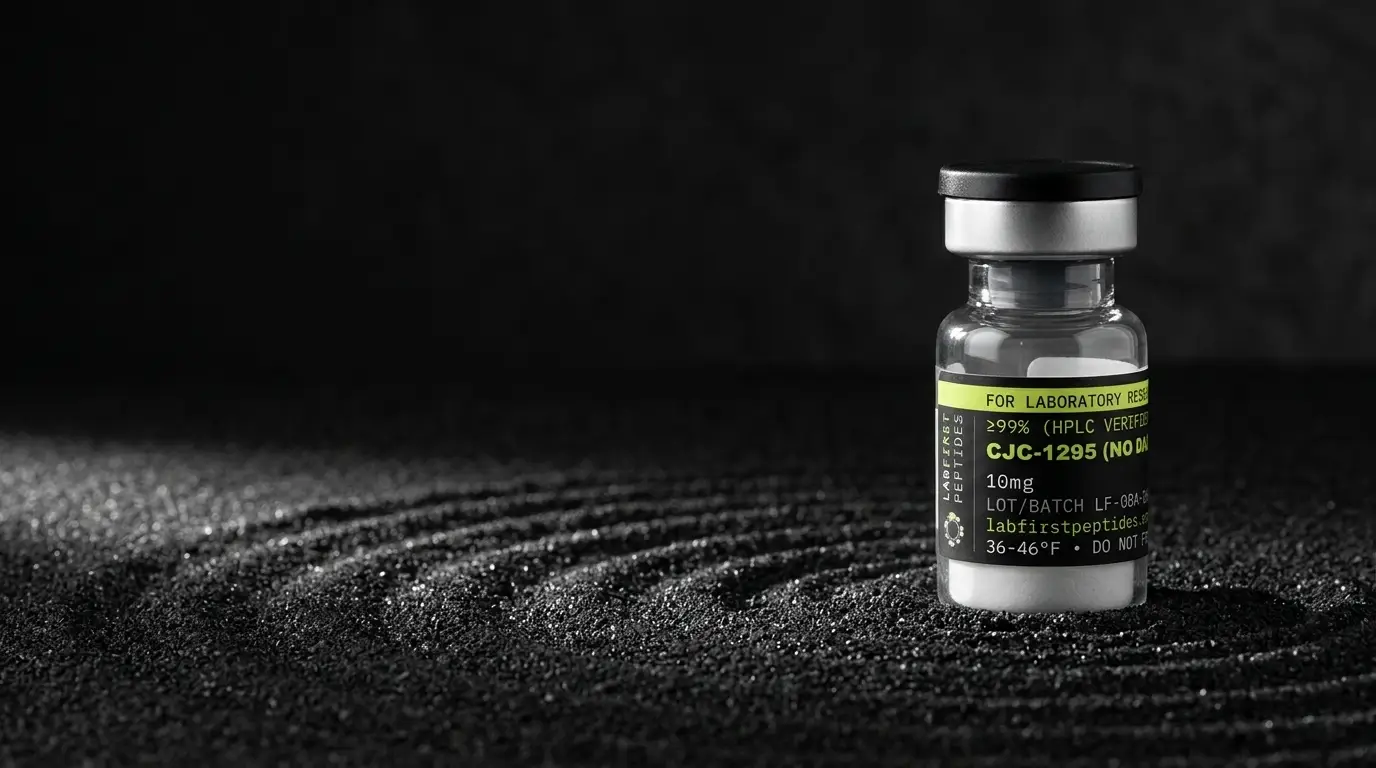
The best CJC-1295/ipamorelin storage temperature for a sealed freeze-dried vial is minus 20 °C, kept dark and dry. A working vial can sit at 2 to 8 °C with a set finish date. In solution, hold it at 2 to 8 °C for days and freeze single-use portions for longer. CJC-1295, the larger and more fragile part, sets the limit.
- A co-lyophilized blend stores to the standard of its more demanding component, and in CJC-1295/ipamorelin that component is CJC-1295.
- Sealed blend powder holds best at minus 20 °C, dark and desiccated; a prepared solution is a refrigerated, dated liquid measured in days.
- Ipamorelin's five-residue sequence contains no methionine, cysteine or asparagine, closing the most common oxidation and deamidation routes.
- Two of CJC-1295's four substitutions against GRF(1-29) exist to repair known degradation sites in the parent sequence.
- A blend certificate should state identity and purity per component, because a single combined purity figure cannot distinguish a clean fill from a skewed one.
- A blend solution ages non-uniformly, so an old solution has drifted from its labeled component ratio in a way no visual inspection detects.
One vial, two molecules
Think of it like storing ground coffee. Sealed and cold, it keeps well; once opened or mixed with water, the clock runs much faster. The blend is only as stable as its weaker part, and here that part is CJC-1295.
The storage question for this blend comes up more often than for either compound alone, because the blend is how the material is usually supplied: CJC-1295 in its no-DAC form and ipamorelin lyophilized together as a single cake in a single vial. That format has one consequence worth stating before any numbers. Two molecules with different structures and different weak points share one seal and one temperature history, so storage cannot be decided per compound. It is decided once, and the more demanding component makes the decision.
The numbers themselves are conventional. Sealed dry powder holds longest at minus 20 °C, dark and desiccated. A refrigerator at 2 to 8 °C is adequate for a working vial that will be finished within a defined window. A prepared solution is a refrigerated liquid with a life measured in days, extended only by freezing single-use aliquots at the moment of preparation. What this page adds is the reasoning, because the reasoning is what a laboratory falls back on when the situation is off-script: a shipment that traveled warm, a vial opened straight from the freezer, a solution that has to stretch across a month of work.
The material described here is the research blend supplied as a lyophilized powder, the format on the CJC-1295/ipamorelin product record.
- Sealed powder, long hold: minus 20 °C, dark, desiccated
- Working vial with a finish date: 2 to 8 °C
- In transit: ambient tolerated for days, as a dry solid
- Prepared solution: 2 to 8 °C in the dark, measured in days
- Anything longer: single-use aliquots, frozen, thawed once
What each component brings to the stability question
Ipamorelin is a pentapeptide of roughly 712 Da with a deliberately defensive design: α-aminoisobutyric acid at the N-terminus, D-configured residues at two internal positions, a naphthylalanine side chain that no coded amino acid carries, and an amidated C-terminus. Raun and colleagues published the original characterization in 1998.
For storage purposes the interesting part is what the sequence lacks. No methionine, no cysteine, no tryptophan, so the residues most vulnerable to oxidation are simply absent. No asparagine, so the classic deamidation route is closed. Short, conformationally constrained and poor in soft targets, ipamorelin is among the more rugged molecules a peptide catalog carries.
CJC-1295 without DAC is a different proposition: a 29-residue analogue of the growth-hormone-releasing factor fragment GRF(1-29), carrying substitutions at positions 2, 8, 15 and 27. The same molecule circulates under the name Mod GRF(1-29), which is worth knowing when comparing certificates. Two of the four substitutions are stability repairs. Glutamine at position 8 replaces an asparagine that is a documented deamidation site in the parent sequence, and leucine at 27 replaces a methionine that oxidises. The design history reads as a candid list of the ways the parent molecule fails.
The repairs help, and they do not make a 29-residue chain the equal of a constrained pentapeptide: the aspartates that remain can isomerise, the backbone offers several times as many bonds to hydrolyse, and an amphipathic helix of this length adsorbs to interfaces far more readily than ipamorelin does. In this vial, CJC-1295 is the limiting component. Store to its standard and ipamorelin is covered automatically.
One nomenclature caution. The catalog lists CJC-1295 with DAC as a separate product, and the difference is chemical rather than cosmetic: the DAC version carries a maleimide-bearing linker designed to couple to a thiol on serum albumin. Maleimides are reactive electrophiles, and in aqueous solution they hydrolyse to an inert ring-opened form. A with-DAC lot therefore has an extra piece of solution-phase chemistry to protect, and its paperwork should be read with that in mind. Everything below describes the no-DAC blend.
Storage conditions by physical state
| State | Temperature | Relative horizon | Why |
|---|---|---|---|
| Sealed powder, long-term hold | Minus 20 °C or below, desiccated | Longest | Every degradation route slows and water stays excluded |
| Sealed powder, working vial | 2 to 8 °C | Weeks, by protocol | Adequate where the vial has a planned finish date |
| Powder in transit | Ambient, insulated, dark | Days | A dry solid tolerates short excursions; a solution would not |
| Prepared solution | 2 to 8 °C, dark | Days, not months | Hydrolysis and isomerisation now have the water they need |
| Solution, single-use aliquots | Minus 20 °C or below | Longer, one thaw each | Freeze-thaw damage accumulates, so no container thaws twice |
The horizons are stated as comparisons rather than month counts on purpose. A specific shelf life belongs to a specific lot, in a specific container, backed by a stability study run on that material, and no compendial monograph exists for either compound or for the blend; supplier figures without a study behind them are conventions. The honest reading of an undated window is that it is unestablished, which argues for the colder state whenever the choice is free.
Blends add one wrinkle to the table. A temperature excursion is never partial. Whatever the freezer, the courier or the bench does, it does to both components at once, so the storage record should describe the vial, never the compound.
Temperature is the setting; moisture is the mechanism
Cold storage works because reaction rates fall with temperature, and it is worth being precise about what that means: temperature is a rate modifier, while the mechanisms doing the damage are hydrolysis, deamidation and isomerisation fed by water, oxidation fed by oxygen and light, and aggregation fed by interfaces and agitation. The survey literature on lyophilized peptide and protein instability, the peer-reviewed lyophilization-stability review literature among it, keeps arriving at the same ranking for a dry solid: moisture control comes first.
The practical consequence is the condensation rule. A vial taken from a minus 20 freezer into ordinary room air sits below the dew point, and the moment its seal is broken, water condenses inside and the hygroscopic cake takes it up. Nothing visible changes, and the vial then returns to the freezer carrying water it did not have before. Let a sealed vial reach room temperature before opening, every time; twenty to thirty minutes on the bench covers a small vial. Work quickly once it is open, reseal against a desiccant, keep it dark, and put it back cold.
The fuller chemistry, including why a slightly damp cake in the freezer can fare worse than a dry one in the refrigerator, is laid out in the storage and stability guide. All of it transfers to this blend unchanged.
In solution, two clocks run at different speeds
Adding diluent starts every water-dependent route at once, and it starts them at different rates for the two components. That is the property peculiar to a blend in solution: it does not age uniformly. If the CJC-1295 fraction loses a few percent to isomerisation and interfacial adsorption while ipamorelin holds steady, the solution drifts away from its labeled ratio, and nothing visible reports the drift. A blend solution that has sat for weeks is not merely weaker; its composition is unknown.
The controls are the standard ones, applied a little more strictly. Refrigerate at 2 to 8 °C in the dark and think in days. Swirl, never shake: a 29-residue amphipathic helix is exactly the sort of molecule that aggregates at a churned air-water interface, and aggregate does not redissolve. Split the solution into single-use aliquots at preparation and freeze them, so each container is thawed once and the freeze-thaw cost is paid per sample rather than accumulating in a communal vial.
Diluent choice follows the same logic as for any multiple-entry preparation. A preserved diluent is what makes repeated entry defensible, and the 28-day discard convention for preserved multiple-entry containers, which comes from USP and CDC practice rather than from anything in peptide chemistry, is a ceiling on the microbiological question only. The bacteriostatic water guide covers the decision, including the cases where plain sterile water and aliquots are the better answer.
Worked example: per-component arithmetic
A blend vial is labeled by combined peptide mass, and the arithmetic has to respect that. Take a 10 mg blend vial whose label states an equal split, brought into 2 mL of diluent:
10 mg ÷ 2 mL = 5 mg/mL combined
5 mg ÷ 2 mL = 2.5 mg/mL of each component
The per-component figure is the one the record should carry, because the concentration of a blend is not a single number. Two compounds are present, each at its own concentration, and any later calculation that treats 5 mg/mL as the concentration of either one is wrong by a factor of two.
Where a label states total mass but no split, the vial cannot support per-component arithmetic at all. The split is a fact about the fill, it lives with the issuing laboratory, and the time to ask is before the record is written rather than after a result needs explaining. The vial concentration calculator handles other vial sizes and volumes; for a blend, run it once per component.
The record and the certificate
Two documents make blend storage auditable: the certificate that arrived with the vial and the log the laboratory keeps afterwards.
Read the certificate per component. A competent certificate for a two-compound blend reports identity and purity for each molecule separately: clearly resolved chromatographic main peaks, and two observed masses from LC-MS, one matching each sequence. A single combined purity number is ambiguous on its face, since it cannot distinguish a clean equal fill from a vial rich in one component and poor in the other. Where the paperwork is unclear, the issuing laboratory can say what was actually measured, and a supplier unable to answer that question has answered a different one.
The storage log is shorter and does more work. Date of receipt and condition on arrival. Freezer location and any excursions. The date the seal was first broken. For a prepared solution: source lot, diluent and its lot, volume added, resulting per-component concentration, date and initials. Aliquots inherit the record through a shared identifier. When a result eventually looks wrong, this chain is the difference between a minute of reading and a repeated experiment.
FOR LABORATORY AND IN-VITRO RESEARCH USE ONLY. NOT FOR HUMAN OR ANIMAL CONSUMPTION. NOT FOR PERSONAL, MEDICAL, DIAGNOSTIC, THERAPEUTIC, OR RECREATIONAL USE.
What is CJC-1295 (no DAC)+IPA studied for?
Published research on CJC-1295 (no DAC)+IPA investigates the areas below, which is a different question from what CJC-1295 (no DAC)+IPA will do for anyone, a claim about a living system that nothing on this site is sold for.
What it is. A GHRH copy and a growth-hormone releaser, freeze-dried together in one vial.
What the research looks at. The ingredients appear separately in hormone research. The blend as sold is a way of packaging them rather than something anyone has studied.
How it is thought to work. Two molecules working on two different receptors: CJC-1295 (no DAC) on the GHRH receptor, ipamorelin on the ghrelin receptor. See each ingredient’s own record. Putting them together does not create a third mechanism.
What is not established. No approved product for either ingredient or for the combination. A vial holding two compounds has to be stored to suit the fussier one, and CJC-1295 is the fussier one here.
The full record, including the certificate for the lot in stock, is on the CJC-1295 (no DAC)+IPA product page.
Common questions
Does a CJC-1295/ipamorelin blend have to be stored frozen?
Which component limits the storage window?
How long does a prepared blend solution keep?
Does the with-DAC version change the storage answer?
Can the blend ship at room temperature?
Published certificates for CJC-1295 (no DAC)+IPA
Every figure below is read from a report the laboratory issued for that lot; each page carries the PDF and the lab's own verification link.
Related guides: storage and stability
Sources
- Raun et al., European Journal of Endocrinology, 1998. Original characterization of ipamorelin; supports the pentapeptide structure and the design features described.
- Wang, W. Lyophilization and development of solid protein pharmaceuticals. International Journal of Pharmaceutics 203(1-2):1-60 . Basis for the storage regimes described here: the review covers the degradation routes that dominate in a lyophilized solid and how temperature and moisture drive them.
- Lahnsteiner and colleagues. Improving the Stability of Maleimide-Thiol Conjugation for Drug Targeting. Chemistry - A European Journal . Basis for the maleimide-thiol discussion: this paper covers the retro-Michael exchange that makes a thiosuccinimide linkage reversible, and the conditions that stabilize it.
- USP and CDC practice for preserved multiple-entry containers. Origin of the 28-day discard convention applied to preserved diluents; a microbiological ceiling, not a peptide stability figure.