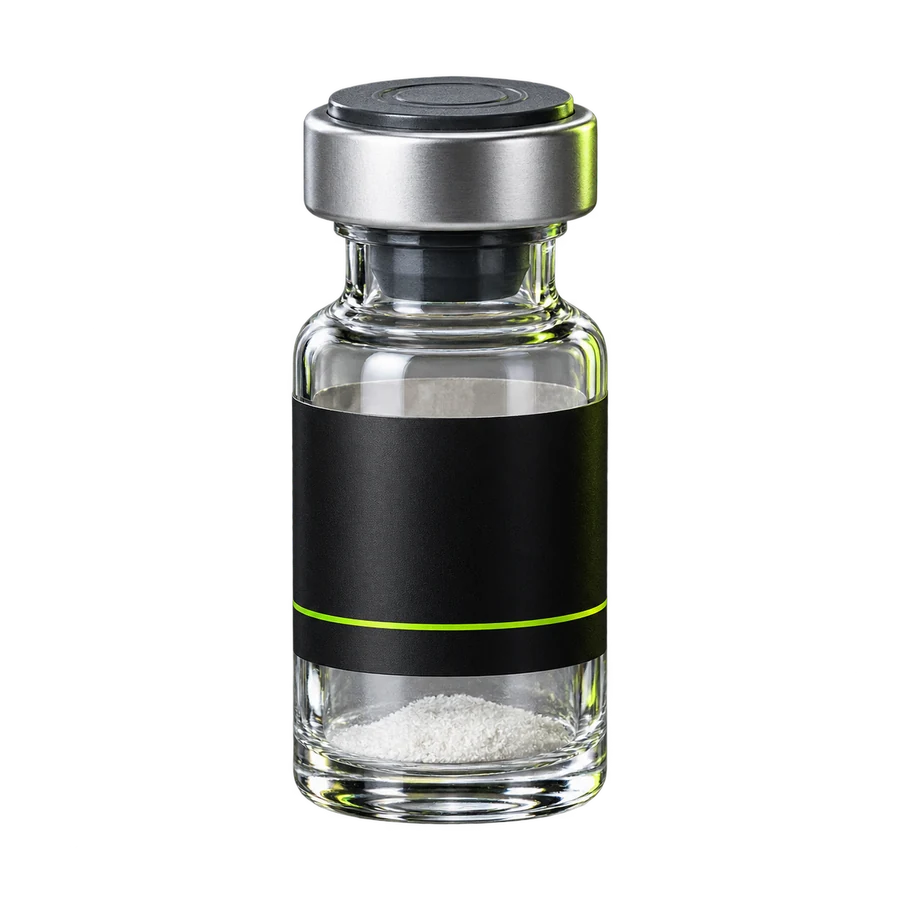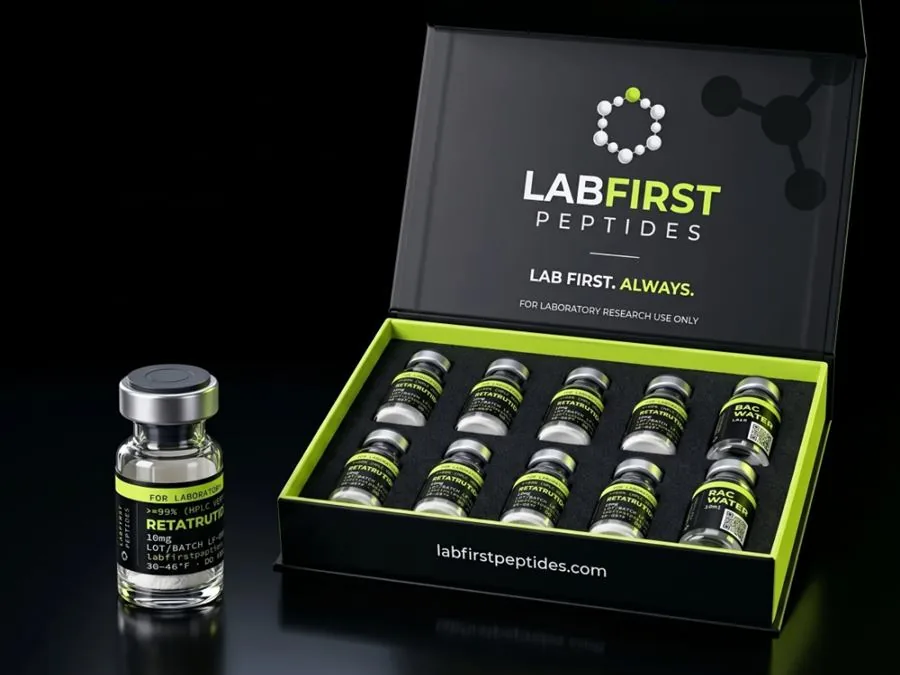
A lyophilized peptide is one dried by freeze-drying: the solution is frozen, then water is removed by sublimation under vacuum, leaving a porous solid cake. The dry state slows hydrolysis and deamidation sharply, which is why research peptides ship as powders and stay that way until a protocol calls for a solution.
- Lyophilization removes water by sublimation under vacuum, drying the peptide without the heat damage of evaporation.
- The solid state starves hydrolysis and deamidation of the water they require, which is why research peptides ship dry.
- Label mass is gross mass: counterion, residual water and salts mean net peptide content commonly runs 70 to 90 percent.
- Peptides purified by RP-HPLC in TFA mobile phases arrive as trifluoroacetate salts unless the supplier states otherwise.
- Concentration arithmetic should apply the certificate's net peptide content rather than the label mass.
- Collapse and meltback in a cake correlate with higher residual moisture and warrant a closer look at the Karl Fischer figure.
Freeze-drying in three stages
Lyophilization is water removal by sublimation. The peptide solution is frozen solid, the chamber is pulled down to a deep vacuum, and the shelf temperature is raised just enough for ice to pass directly from solid to vapor without ever becoming liquid. That stage, primary drying, removes the bulk of the water and is the slow part of the cycle. Secondary drying follows at a somewhat higher temperature to desorb the water still hydrogen-bonded to the peptide and to any excipients present. What remains is the cake: a porous, low-density solid holding the shape of the frozen plug it came from.
The process exists because it dries without heat damage. A peptide evaporated to dryness on a warm surface arrives as a degraded film. A peptide sublimed dry arrives essentially as it left purification, with residual moisture typically in the low single digits by weight. Porosity is the other dividend. A cake that keeps the open structure of the frozen solution dissolves in seconds when diluent returns, where a dense film dried onto glass needs agitation, and agitation is the one thing an interface-active molecule tolerates worst.
Most research peptides reach the freeze-dryer straight from RP-HPLC purification, and the mobile phase leaves something behind in the vial. The label does not usually spell that out. The third section below covers what it means for the arithmetic.
- Freeze — the solution becomes a solid plug
- Primary drying — ice sublimes under deep vacuum
- Secondary drying — bound water desorbs from the solid
- The cake — porous, fast-dissolving, a few percent water
- From here: cold, dark, sealed, desiccated
Why the material ships as a solid
Most of the chemistry that destroys a peptide needs water as a reagent. Hydrolysis cleaves the backbone with a water molecule. Deamidation of asparagine and glutamine runs through hydrolytic steps of its own. Both proceed continuously in solution and barely at all in a dry solid, so freeze-drying takes the fastest degradation routes and starves them of their substrate.
The practical consequences show up in transit and on the shelf. A dry cake tolerates the ambient temperature swings of a shipping box for days, which is why competent suppliers ship solids and why a listing offering research peptide already in solution deserves suspicion: that material's degradation clock started at the fill line, on someone else's bench, under conditions the buyer cannot see. The solid sits in a much slower regime until water is added, and everything after that point runs on solution rules. The storage and stability guide works through the degradation routes and their controls in detail.
Slower is not stopped. Oxidation of methionine, tryptophan and cysteine proceeds in the solid state given oxygen and light. Moisture taken up from humid air puts the fast chemistry back in play without the cake ever looking wet, and an opened vial in a summer laboratory takes up water faster than most people would guess. Cold, dark, sealed and desiccated remains the instruction even for a powder, and the reasoning is mechanism rather than tradition.
The label mass is not the peptide mass
A vial labeled 10 mg contains 10 mg of lyophilized material. It does not contain 10 mg of peptide. The difference is everything else the freeze-dryer faithfully preserved: counterion, residual water, and whatever salts traveled through synthesis and purification.
The counterion is usually the largest share. RP-HPLC mobile phases commonly run with trifluoroacetic acid, so the isolated product comes off the column as a trifluoroacetate salt, with roughly one TFA anion accompanying each basic site: the N-terminus plus lysine, arginine and histidine side chains. For a short sequence carrying several basic residues, the counterion alone can be ten to twenty percent of the gross mass. Add a few percent of water and the peptide fraction of a nominal 10 mg vial plausibly sits anywhere from about 70 to 90 percent, lot by lot.
| Component | Where it comes from | How it is measured |
|---|---|---|
| Peptide, the net peptide content | The sequence itself | Amino acid analysis; nitrogen determination; UV absorbance with stated assumptions |
| Counterion, commonly trifluoroacetate | RP-HPLC mobile phase carried through purification | Ion chromatography or fluorine NMR, where reported |
| Residual water | Incomplete desorption, plus uptake after first opening | Karl Fischer titration |
| Residual salts and buffer components | Synthesis and purification | Rarely reported individually; folded into content by difference |
The number that settles it is net peptide content, stated as a percentage on a competent certificate of analysis. It is a different measurement from purity, and the two are confused constantly. Purity asks: of the peptide material present, how much is the correct sequence? Content asks: of the powder in the vial, how much is peptide at all? A lot can be 99 percent pure and 78 percent peptide, and both figures can be honest at once. A certificate that quotes purity alone has answered half the question the arithmetic needs.
Reading the cake
Appearance is a limited instrument, and still worth using. A well-dried cake is a uniform porous plug, white or slightly off-white, occupying roughly the volume the frozen solution did. Fragmentation in transit is cosmetic; a cake that has broken into pieces is not a rejected vial, and grading lots on how photogenic the plug looks is a habit worth resisting.
Two appearances do earn a line in the record. Collapse, where the cake has slumped or pulled away from the vial walls, happens when the product temperature crossed its collapse temperature during drying, and it correlates with higher residual moisture and slower dissolution. Meltback, a glassy or gummy layer at the base of the vial, points the same way. Neither proves the peptide degraded. Both mean the certificate's Karl Fischer water figure deserves more attention than usual before the lot goes into service.
What appearance cannot do is verify anything positive. A perfect cake says nothing about identity, purity or content; those claims live in the analytical record or nowhere. And a cake that has quietly taken up water from one cold opening looks identical to a dry one afterward, which is why a vial from the freezer equilibrates to room temperature, still sealed, before the septum is touched. The storage and stability guide linked above treats that condensation failure in detail; it is the most common avoidable handling error there is.
Solution preparation as documentation
When a protocol calls for a solution, the diluent goes in slowly, directed down the vial wall rather than jetted into the cake, and the vial is swirled gently until the liquid runs clear. Foam is the thing to avoid. Peptides concentrate at air-water interfaces, a foamed solution multiplies that interface, and aggregate collected at an interface does not redissolve. Whether the liquid should be plain sterile water or a preserved diluent is its own decision, and the bacteriostatic water guide covers it.
The arithmetic belongs in the record, and net peptide content belongs in the arithmetic. A vial of 10 mg gross material at 84 percent content brought into 2 mL gives:
10 mg × 0.84 = 8.4 mg peptide
8.4 mg ÷ 2 mL = 4.2 mg/mL
where a naive reading of the label would have said 5 mg/mL. That is a 16 percent error, silent, and inherited by every downstream figure that trusts the vial. Where the certificate states no content figure, the honest record calls the concentration nominal and says why. The vial concentration calculator handles other masses and volumes; the content correction is one multiplication the laboratory applies from its own certificate, because no calculator knows the lot.
Date the vial at preparation and log the source lot, the diluent and its lot, the volumes, the resulting concentration, and initials. From this point the material is a solution and the solid-state protections are spent.
What the certificate and the log should say
For a lyophilized lot, the certificate of analysis carries the claims appearance cannot. RP-HPLC purity with the chromatogram attached, mass confirmation by LC-MS or MALDI against the calculated mass for the sequence, water by Karl Fischer titration, counterion content where the supplier measures it, and net peptide content with its method named. Amino acid analysis is the reference method for content; ultraviolet absorbance is cheaper and common, and it rests on assumptions about the sequence's chromophores that the certificate should state rather than bury.
USP publishes the compendial method (as of this 2026 review, and subject to revision) behind the water figure, and that is roughly where the pharmacopeia's reach ends here: no compendial monograph exists for the overwhelming majority of research peptides, so a research certificate's figures are the supplier's own program, not a pharmacopeial claim, and should be read with exactly that weight. What a buyer can check before ordering is whether the program exists at all: named methods, lot-specific documents, a supplier that can produce the chromatogram behind the purity number. The quality standard page sets out the documentation this supplier commits to.
The laboratory's half of the record is shorter but has to exist: date received, storage location and condition, date of first opening, appearance at opening, and every solution prepared from the lot with its arithmetic attached. Both halves have to hold for a result to be traceable back to a vial. FOR LABORATORY AND IN-VITRO RESEARCH USE ONLY. NOT FOR HUMAN OR ANIMAL CONSUMPTION. NOT FOR PERSONAL, MEDICAL, DIAGNOSTIC, THERAPEUTIC, OR RECREATIONAL USE.
Common questions
Why are research peptides sold lyophilized instead of in solution?
What is net peptide content, and how is it different from purity?
Why does a peptide vial contain trifluoroacetate?
Is a broken or collapsed cake a rejected vial?
How much water is left in a lyophilized peptide?
Related guides: storage and stability
Sources
- USP, Water Determination (Karl Fischer titrimetry). Compendial method behind the residual-moisture figure a certificate reports for a lyophilized lot.
- Wang, W. Lyophilization and development of solid protein pharmaceuticals. International Journal of Pharmaceutics 203(1-2):1-60 . Primary basis for the degradation routes described here: freezing and drying stresses, residual moisture, and the excipients that mitigate them.
- Determination of residual trifluoroacetate in protein purification buffers and peptide preparations by ion chromatography . Basis for the counterion discussion: a validated method for quantifying residual trifluoroacetate in peptide preparations, which is why net peptide content and gross mass differ.