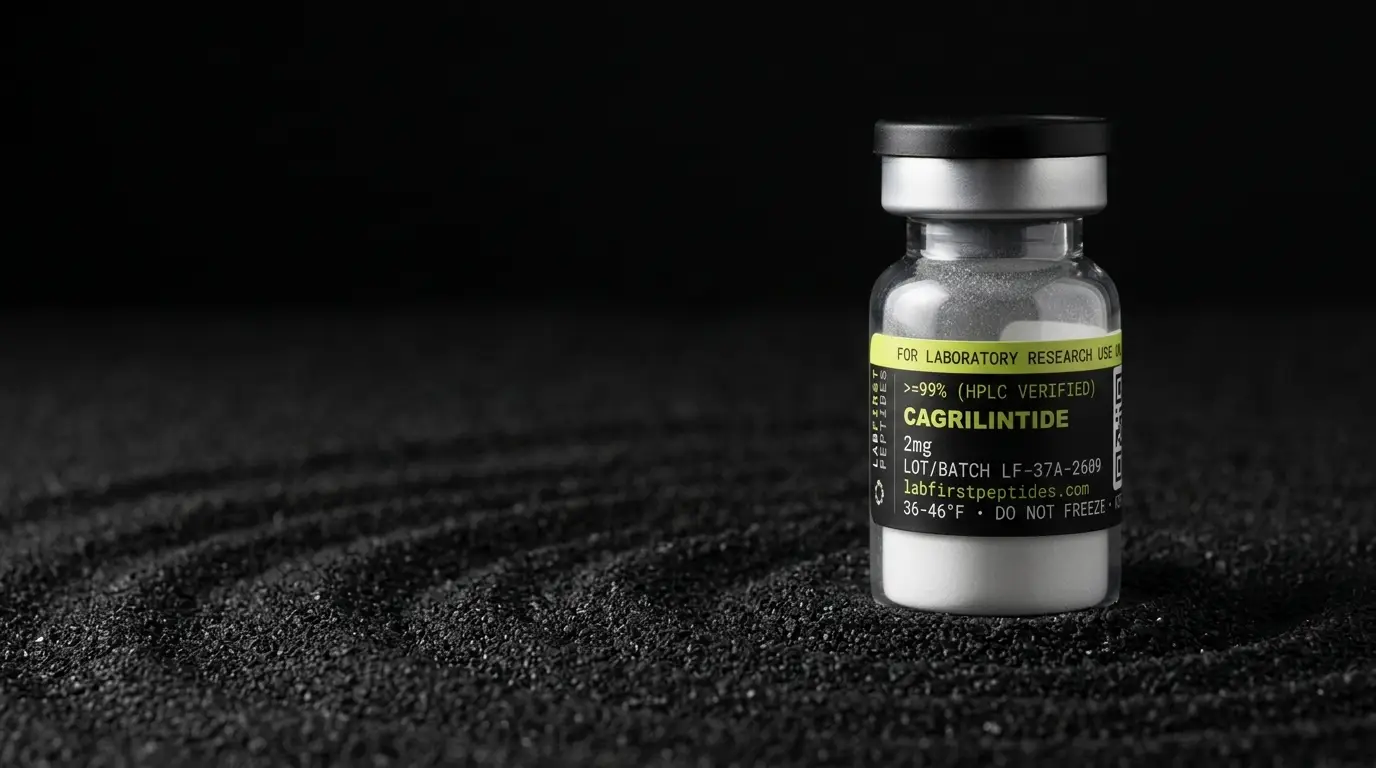
For cagrilintide storage and stability, the dry powder lasts best sealed, dry, cold and dark over desiccant. Moisture is the main threat to the dry solid. Its amylin lineage makes clumping (aggregation) the failure to watch, and it leaves no visible trace.
- Cagrilintide is an acylated amylin analog carrying a fatty diacid chain, an intramolecular disulfide bridge and an amidated C-terminus, and each feature is a distinct handling variable.
- No approved cagrilintide product exists to copy storage figures from, so published month counts for research powder are convention rather than measurement.
- Moisture, not freezer temperature, is the dominant driver of degradation in a dry peptide solid.
- The amylin family is amyloidogenic by inheritance, so interfacial stress matters more here than for simple hydrophilic sequences.
- Net peptide content on the certificate, not gross fill weight, is what mass arithmetic should be based on unless the protocol states otherwise.
- Aggregation in solution is frequently invisible and requires SEC-HPLC or light scattering to detect.
What is the molecule, and what does that mean for handling?
In plain terms, the dry powder is like instant coffee in a sealed jar. Keep it dry and cold and it holds. In water, the peptide can quietly clump together, and you cannot see it happen.
Cagrilintide, identified in the development literature as AM833, is a long-acting analog of human amylin. Human amylin, also called islet amyloid polypeptide or IAPP, is a 37-residue peptide with an intramolecular disulfide bridge near the N-terminus and an amidated C-terminus. Cagrilintide is an engineered, acylated relative of that parent: a fatty diacid chain is attached to a lysine side chain through a short hydrophilic linker, which gives albumin binding and a long circulating half-life.
I am not going to reproduce a residue-by-residue sequence here. The versions circulating on vendor pages disagree with one another, and a sequence you cannot check against a primary reference does more harm than an honest gap. For storage, the exact residue list matters less than the three structural features that every published description agrees on.
A disulfide bond. An amide at the C-terminus. A lipid chain hanging off the backbone. Each one is a handling variable. The disulfide can scramble or reduce, the amide can hydrolyze, and the lipid makes the molecule interface-active in a way that plain hydrophilic peptides are not. Anyone who has worked with an acylated peptide at low concentration in glass will recognize the third one as the reason material sometimes goes missing without degrading.
- Moisture — the switch that starts hydrolysis and deamidation
- Interfaces and agitation — where aggregation nucleates
- Thiols and reducing agents — disulfide scrambling or reduction
- Alkaline pH — deamidation plus disulfide exchange
- Oxygen and light — oxidation of susceptible residues
- Temperature — a rate multiplier, not a mechanism
Why do the usual storage numbers not exist for this compound?
For an approved medicine you can read a storage window off the label, because someone ran a stability program on that exact formulation, in that exact container, and the number is the outcome of a study. Cagrilintide has no such document to copy from. It has been investigated as a single agent and, more prominently, in fixed combination with semaglutide in late-phase trials, but a research vial of lyophilized powder is not that formulation and never was.
So there is nothing to translate. When a supplier page states that lyophilized cagrilintide is stable for twenty-four months at minus twenty degrees, that figure is a convention borrowed from general peptide practice, not a measurement on that lot. It may well be approximately right. It is still not evidence, and treating it as evidence is how a laboratory ends up unable to explain an assay drift six months into a project.
The defensible position is narrower and duller. Dry, sealed, cold and dark is a slow regime for peptides generally, and cagrilintide has no structural feature that exempts it from that generalization. Beyond that, the only date entitled to authority is one on a certificate backed by a study on the lot in front of you. Where the certificate carries a retest date with no method behind it, note the absence in your record and move on.
What are the degradation routes, and what controls each?
Peptide instability is not mysterious. The chemistry has been cataloged for decades, and the review literature on lyophilized protein and peptide products maps the stresses onto the mechanisms reasonably well. Butreddy and colleagues surveyed that territory in 2020 and their framing still holds: the solid state is slow, water is the switch, and everything else is a rate modifier.
| Route | Driver | Structural feature at risk | Practical control |
|---|---|---|---|
| Backbone hydrolysis | Water activity, temperature, pH in solution | Any amide bond, including the C-terminal amide | Keep the solid dry and sealed over desiccant |
| Deamidation | Water, temperature, pH above roughly 6 | Asparagine and glutamine side chains | Dry storage; cold |
| Oxidation | Headspace oxygen, light, trace metals | Methionine, tryptophan, tyrosine, histidine | Dark storage, minimal headspace, no metal contact |
| Disulfide scrambling or reduction | Alkaline pH, free thiols, reducing contaminants | The intramolecular disulfide bridge | Keep thiol reagents and alkaline conditions away from the material |
| Aggregation and fibrillation | Air-water interface, agitation, concentration, temperature | The amylin backbone plus the lipid chain | Keep the solid dry; aggregation needs water and an interface |
| Surface adsorption | Contact with glass and some plastics | The acylated, amphiphilic whole molecule | Container material fixed and recorded by protocol |
Notice that freezer temperature appears nowhere as a mechanism. Cold slows all six routes, which is why cold storage is standard, but temperature is a multiplier on a rate. Moisture is the thing being multiplied. A sealed, dry vial at room temperature routinely outlasts a vial at minus twenty that gets opened cold twice a week.
Alkaline conditions deserve particular caution with this compound, because pH above neutral accelerates both deamidation and thiol-disulfide exchange, and this molecule has a disulfide worth protecting.
Why is aggregation the failure mode of the amylin family?
Human IAPP is one of the most studied amyloidogenic peptides in biology. Its aggregation into fibrils is implicated in islet pathology in type 2 diabetes, and the region around residues 20 to 29 carries most of the responsibility. Every therapeutic analog in this family has been engineered against that behavior. Pramlintide, the earlier analog, substitutes prolines into the amyloidogenic stretch because the native sequence will not stay in solution long enough to be useful.
Cagrilintide is likewise engineered for solution stability, and it is more tractable than the parent by a wide margin. That is a relative statement, not an exemption. Fibrillation is nucleation-dependent: it has a lag phase, it is accelerated by seeds, and a single aggregate can template the rest of the vial. Interfaces are where nucleation happens most readily, and an acylated peptide concentrates at interfaces by design.
Aggregates are frequently invisible. A solution that looks clear can carry soluble oligomers that size-exclusion chromatography would reveal and your eye will not. If a project depends on knowing the aggregation state, the analytical answer is SEC-HPLC or dynamic light scattering, not inspection under a bench lamp.
What are the cagrilintide storage conditions for each physical state?
| State | Temperature | Light | Relative horizon | Reasoning |
|---|---|---|---|---|
| Sealed powder, unopened | Minus 20 °C or colder, desiccated | Dark | Longest | Water excluded and every route slowed |
| Sealed powder, in-use stock | 2 to 8 °C | Dark | Shorter | Acceptable where the vial is consumed inside a defined window |
| Powder in transit | Ambient, insulated | Dark | Days | A dry solid tolerates short excursions that a solution would not |
The horizons are relative on purpose. Putting a month count against a research powder implies a stability study that, for this compound, almost certainly has not been run on your lot in your container. Where a laboratory needs a working window it should set one by protocol, document the reasoning, and requalify by assay rather than by calendar faith. That is more work than reading a number off a webpage, and it is the only version that survives an audit.
Why does condensation cause a loss nobody logs?
A vial coming out of a minus twenty freezer into a room at 22 °C and sixty percent humidity is far below the dew point. Water condenses on every cold surface, including the interior the instant the seal is broken, and a lyophilized cake is hygroscopic enough to absorb it before you have finished reading the label. Nothing about the cake announces this. It looks the same.
Then the vial goes back into the freezer with water inside it, and hydrolysis and deamidation now have a substrate they did not have yesterday. Repeat weekly for two months and the material is no longer what the certificate described, with no single event in the log to point at.
The control is boring and it works:
- Let the sealed vial equilibrate to room temperature before breaking the seal, every time, including when you are in a hurry. Twenty to thirty minutes on the bench suits a small vial.
- Work quickly once it is open.
- Reseal against fresh desiccant.
- Record the excursion if your protocol tracks them.
Drier is not infinitely better, incidentally. Work on lyophilizate formulations has found cases where raising residual moisture modestly improved stability, because water can substitute for hydrogen bonds the excipient matrix fails to supply. That is a formulation result rather than a storage instruction, and the reason to mention it is to make clear that the rule of thumb has edges.
What should the certificate and the record show?
Storage discipline that is not written down cannot be reproduced. For the incoming material, the certificate of analysis is the object under review, and for a compound like this the fields that matter are specific.
| Field | Typical method | What it tells you |
|---|---|---|
| Identity | LC-MS or MALDI | Whether the observed mass matches the acylated species rather than an unacylated precursor |
| Purity | RP-HPLC, 214 nm, gradient stated | Chromatographic purity, provided the trace itself is attached |
| Disulfide status | Free thiol assay, or reduced versus non-reduced comparison | Whether the bridge formed and stayed formed |
| Water content | Karl Fischer or loss on drying | The starting point of the storage clock |
| Counterion and net peptide content | Ion chromatography, amino acid analysis | How much of the fill weight is actually peptide |
For the incoming lot, the record carries the lot number and its certificate, so that when a result comes out wrong the first question, whether the material was what the method assumed, can be answered from a chain that runs sample to lot to certificate in about a minute. The alternative is repeating the experiment.
One further note on net content. If the certificate reports peptide content as, say, 84 percent with the balance as acetate counterion and water, then the mass in the vial is not all peptide. Whether your protocol works from gross or net mass should be a written decision, not an assumption inherited from whoever set the method up.
What is the regulatory position?
Cagrilintide is an amylin receptor agonist investigated by its originator both alone and in fixed combination with semaglutide in late-stage clinical trials. As reviewed for this article, no approved medicine containing cagrilintide had been confirmed by this reviewer in the United States. Approval status for a compound at this stage of development moves, and the FDA drug listings are the only authority worth quoting on any given day.
An unapproved investigational active ingredient is not eligible for pharmacy compounding under section 503A unless it is a component of an approved drug, the subject of an applicable USP monograph, or listed on the FDA bulk drug substances list. Research-grade cagrilintide meets none of those conditions and has never been a lawful route to human use.
Status verified August 26, 2026. Confirm against FDA listings before relying on it.
FOR LABORATORY AND IN-VITRO RESEARCH USE ONLY. NOT FOR HUMAN OR ANIMAL CONSUMPTION. NOT FOR PERSONAL, MEDICAL, DIAGNOSTIC, THERAPEUTIC, OR RECREATIONAL USE.
Laboratories comparing handling practice across acylated peptides may find the tirzepatide storage discussion useful, since the interface behavior of a fatty-diacid conjugate is the same problem in a different sequence. Lot documentation for material supplied here is described under the quality standard.
Bottom line
Cagrilintide storage comes down to water and interfaces. Keep the powder sealed, dry, cold and dark, and let a cold vial reach room temperature before opening it. Its amylin lineage makes aggregation the failure to watch, and it leaves no visible trace. Month counts on vendor pages are convention; only a study on your lot carries authority.
Common questions
How should cagrilintide be stored?
Does lyophilized cagrilintide have to be stored frozen?
Is cagrilintide more aggregation-prone than other research peptides?
Why does pH matter for this compound in particular?
What should a certificate of analysis show for an acylated peptide?
Related guides: storage and stability
Sources
- Butreddy et al., International Journal of Biological Macromolecules, 2020. Review of stresses, stabilization mechanisms and analytical techniques for lyophilized protein products; supports the degradation-route table and the primacy of solid-state, low-moisture storage.
- Akter and colleagues. Islet Amyloid Polypeptide: Structure, Function, and Pathophysiology. Journal of Diabetes Research 2016:2798269 . Basis for the aggregation cautions in this article — the review sets out the fibrillation behavior of human islet amyloid polypeptide and the conditions that accelerate it.
- ICH Q1A(R2) and Q5C stability testing guidelines. Define what a stability-derived shelf life requires: study design, container-closure, storage condition and assay. Supports the position that an unsupported month count on a research vial is not evidence.
- FDA guidance and listings on compounding under sections 503A and 503B. Establishes the eligibility conditions for bulk drug substances in compounding, and therefore that an unapproved investigational peptide is not a lawful compounding ingredient.