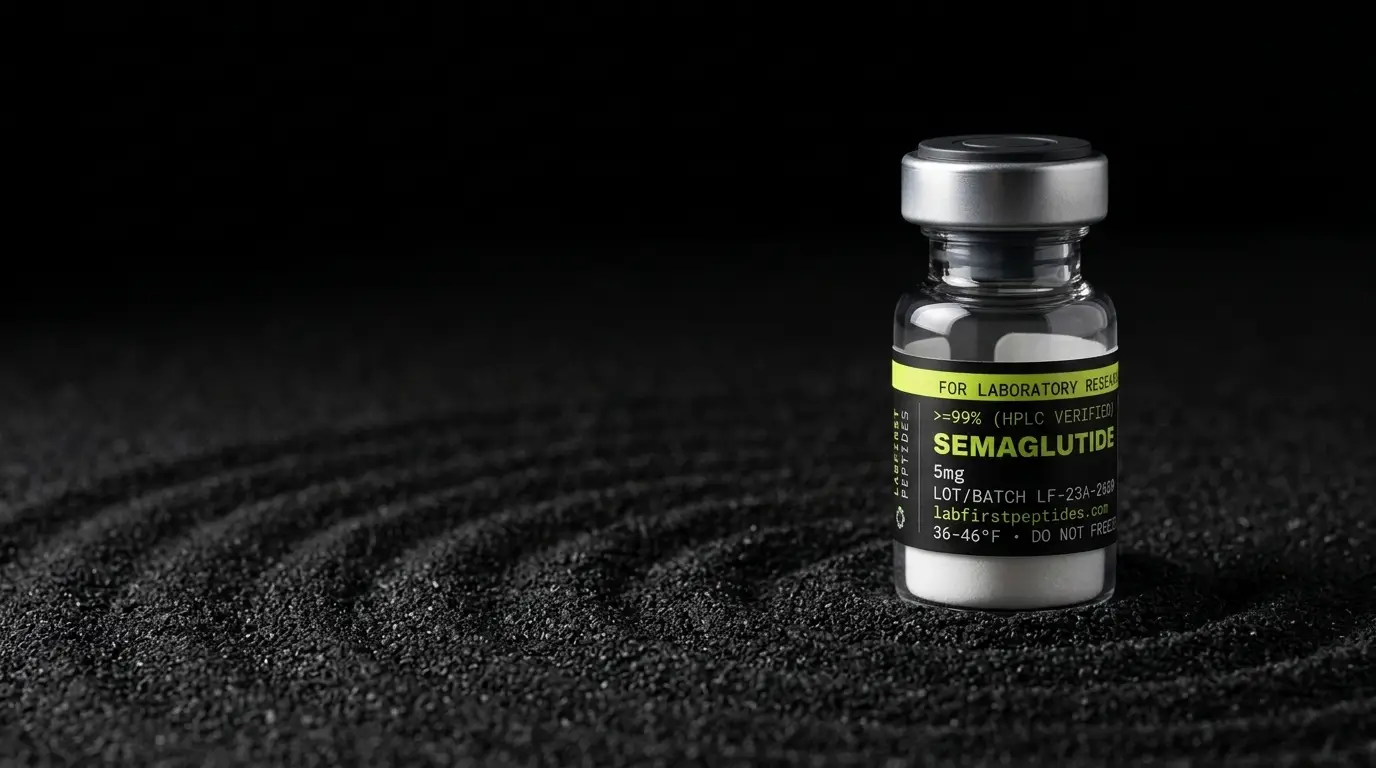
Semaglutide storage and stability depend on keeping the lyophilized powder sealed, dry, cold and dark. Moisture, not temperature, is the main threat. Once water is added, breakdown speeds up. Prepared solutions are refrigerated, split into single-use aliquots and dated when made. Published shelf lives for prescription products describe a different formulation.
- Semaglutide is a 31-residue GLP-1 analogue with Aib at position 8 and a C18 fatty diacid on lysine 26; the lipid chain makes it interface-active.
- Storage windows published for prescription semaglutide describe preserved aqueous formulations and do not transfer to lyophilized research powder.
- Moisture is the dominant threat to the dry powder; temperature modifies the rate but is not the mechanism.
- The sequence contains a single oxidation-prone tryptophan and no methionine or cysteine, so light and headspace oxygen are the oxidation variables that matter.
- A prepared solution is dated at preparation, split into single-use aliquots, and each aliquot is thawed once.
- The FDA declared the semaglutide injection shortage resolved on 21 February 2025, ending compounding enforcement discretion in April and May 2025.
The figures in circulation describe a solution, not a powder
In plain terms, dry semaglutide powder behaves a bit like instant coffee in a jar. Kept sealed and dry it holds up well, but once damp air gets in it starts to change. Adding water is like brewing the cup: the clock runs much faster from that moment.
Search for semaglutide storage and nearly everything you find is derived from prescription labeling. Those documents describe finished medicines: preserved aqueous solutions at controlled pH, or a tablet co-formulated with an absorption enhancer, each assigned a shelf life from stability studies run on that exact formulation in that exact container. Research-grade semaglutide is a different article. It is typically supplied as a lyophilized powder in a crimp-sealed vial, and none of the labeled windows were measured on it.
The difference matters because a solution and a solid sit in different kinetic regimes. The prescription product's degradation clock started at the fill line, and its label manages the remainder of that clock. A dry powder is largely parked until water arrives. Quoting a refrigerated in-use window for a sealed powder borrows a number from a study that never touched the material in question.
No public stability program covers research-grade semaglutide generically. A dated claim on a certificate applies to that lot in that container, and where a lot carries no dated claim at all, the honest reading is that its window is unestablished. What follows is the chemistry that sets those windows, and the handling that respects it.
- Moisture — excluded by seal, desiccant and warm-before-opening discipline
- Light and oxygen — the tryptophan oxidation route
- Temperature — a rate dial; coldest wins if openings are rare
- Interfaces and agitation — fibrillation of a lipidated sequence
- Freeze-thaw — one thaw per aliquot, ever
What the structure tells you before any study does
Semaglutide is a 31-residue analogue of human GLP-1(7-37) with three deliberate modifications: α-aminoisobutyric acid (Aib) replaces alanine at position 8, the lysine at position 34 becomes arginine, and the remaining lysine at position 26 carries a C18 fatty diacid attached through a γ-glutamate and two short ethylene-glycol spacer units. The PubChem record gives the molecular formula C187H291N45O59, a molecular weight just over 4,100 Da, and CAS 910463-68-3. The Semaglutide product record lists the vial formats this guide applies to.
Each modification has a handling consequence. The C18 diacid makes the molecule amphiphilic, so it accumulates at air-water interfaces and container walls; foam in a vial of dissolved semaglutide marks a site of loss. The Aib substitution defeats cleavage by the enzyme DPP-4, and that is all it defeats. Enzymatic resistance is routinely misread as general toughness, and nothing about position 8 protects the backbone from water or the side chains from oxygen.
The sequence narrows the oxidation question usefully. Semaglutide contains no methionine and no cysteine, which removes two of the three classic oxidation targets. It does carry a single tryptophan, and tryptophan oxidation is driven by light and headspace oxygen, which is most of the reason the vial should live in the dark.
Degradation routes and what controls each
| Route | Driver | Where semaglutide is exposed | Control |
|---|---|---|---|
| Backbone hydrolysis | Water activity, temperature | Every amide bond | Sealed, desiccated storage |
| Deamidation and isomerization | Water, temperature, pH once dissolved | Glutamine and aspartate residues | Dry storage; near-neutral buffer in solution |
| Oxidation | Light, headspace oxygen, trace metals | The single tryptophan | Dark storage, minimal headspace, cold |
| Aggregation and fibrillation | Interfaces, agitation, acidic pH | The amphiphilic lipidated chain | Swirl gently, never foam, near-neutral pH |
| Surface adsorption | Container walls at low concentration | The fatty diacid chain | Document container material; avoid serial transfers |
The GLP-1 family has a documented tendency to fibrillate in solution, and acidic conditions generally make it worse, which is one reason the licensed formulations sit near physiological pH. For a research laboratory the practical translation is short: an unexpectedly hazy solution is aggregate, agitation multiplies the interface that produced it, and no amount of mixing recovers fibrillated material. The same interface behavior is described for another lipidated incretin in the tirzepatide storage guide; the lipid chain differs, the argument does not.
Temperature appears nowhere in that table as a mechanism, because it is not one. Cold slows every listed route, which is why freezers earn their keep, and a genuinely dry, dark, sealed vial is doing more of the work than the setpoint is.
Sealed-vial handling: temperature, light, moisture
| State | Condition | Relative horizon | Reasoning |
|---|---|---|---|
| Sealed powder, archive | Minus 20 °C or colder, desiccated, dark | Longest | All routes slowed and water excluded |
| Sealed powder in active use | 2 to 8 °C, dark | Shorter, lot-dependent | Acceptable where the vial will be consumed within a defined window |
| Powder in transit | Ambient, insulated, dark | Days | A dry solid tolerates brief warm excursions far better than any solution |
| Prepared solution | 2 to 8 °C, dark | Days | Hydrolysis and deamidation now have their reagent |
| Frozen single-use aliquots | Minus 20 °C or colder | Longer, one thaw each | Freeze-thaw damage is cumulative |
The handling error that undoes all of this is condensation. A vial pulled from a freezer sits well below the dew point of ordinary room air, and if the seal is broken while the glass is cold, moisture condenses inside and the hygroscopic cake takes it up on the spot. The vial then goes back to the freezer carrying the very water the storage scheme exists to exclude, and nothing about its appearance records the event. Equilibrate every sealed vial to room temperature before opening it, work briskly once it is open, and reseal against desiccant. Twenty minutes on the bench costs less than a compromised lot.
Light discipline is cheaper still. Amber glass or an opaque box removes the photo-oxidation variable entirely, and a closed box has the side benefit of buffering the temperature swings of a frequently opened refrigerator door.
What changes when water goes in
Preparing a solution moves the material onto a faster clock. Hydrolysis and deamidation, throttled in the dry state, now run at solution rates. The amphiphilic chain has a permanent air-water interface to work. Any organism introduced by a draw has a growth medium. From this point storage is an active problem with three controls.
The first is diluent choice, which is really a question about entry count. A container that will be drawn from repeatedly is defensible only with a preserved diluent, while single-session work and frozen aliquots can run on plain sterile water. The trade-offs are set out in the bacteriostatic water guide and are not repeated here.
The second is aliquoting at the moment of preparation, so that no container is ever thawed twice. Freeze-thaw stress concentrates solutes and remakes interfaces on each cycle, aggregation accumulates, and a solution on its fifth thaw is a different material from the same solution on its first, with nothing visible to tell them apart.
The third is restraint in mixing. Swirl until the cake dissolves; never shake. Shear and foam are how an interface-active peptide is converted to aggregate at bench scale.
Worked example: the arithmetic of a prepared solution
A 5 mg vial brought into 2 mL of diluent gives:
5 mg ÷ 2 mL = 2.5 mg/mL
A protocol drawing 0.25 mL per run gets:
2 mL ÷ 0.25 mL = 8 draws
Held as one refrigerated container entered eight times, the last draw comes from a solution that has been warmed, opened and re-chilled seven times more than the first. Split into eight 0.25 mL aliquots at preparation, every draw comes from material with an identical history: one preparation, one freeze, one thaw. The cost is a strip of tubes and five minutes with a pipette.
The vial concentration calculator runs the same arithmetic for any vial size and volume. It covers laboratory measurement only.
Dating and recording prepared solutions
An undated solution is a discarded solution. Semaglutide in water carries no visible indicator of age, so the date written at preparation is the only stability datum the container will ever hold. Write it at the bench, at the moment of preparation, never from memory at the end of the day.
A record that supports later troubleshooting carries six fields: the source lot identifier from the powder vial, the diluent and its lot, the volume added, the resulting concentration, the date and time of preparation, and the initials of the preparer. Aliquots inherit the record through a shared preparation identifier plus a position number, which keeps the label short enough for a small tube. Freezer-rated labels or a solvent-resistant marker are part of the system; a legend that washes off in frost has recorded nothing.
The habit pays off the first time a result looks wrong. The question is always whether the material was what the protocol assumed, and a chain that runs sample to aliquot to preparation record to lot to certificate answers it in minutes. Laboratories that keep this chain notice bad lots. Laboratories that do not repeat experiments.
Regulatory position
Semaglutide is a GLP-1 receptor agonist. FDA-approved medicines containing it have existed since 2017 for the first injectable product, 2019 for the oral formulation and 2021 for a further injectable, all available only on prescription and manufactured under pharmaceutical quality systems that a research supply chain does not replicate.
The FDA declared the semaglutide injection shortage resolved on 21 February 2025. With that determination, the agency's temporary enforcement discretion for compounded semaglutide ended on 22 April 2025 for 503A compounding pharmacies and 22 May 2025 for 503B outsourcing facilities. Research-grade material has never been a lawful route to human use at any point in that history.
Status verified 25 August 2026.
FOR LABORATORY AND IN-VITRO RESEARCH USE ONLY. NOT FOR HUMAN OR ANIMAL CONSUMPTION. NOT FOR PERSONAL, MEDICAL, DIAGNOSTIC, THERAPEUTIC, OR RECREATIONAL USE.
What is Semaglutide studied for?
Published research on Semaglutide investigates the areas below, which is a different question from what Semaglutide will do for anyone, a claim about a living system that nothing on this site is sold for.
What it is. A peptide that works on the GLP-1 receptor.
What the research looks at. One of the most heavily published peptides in metabolic research, with a large registered clinical record. Approved medicines containing it exist under their own brand names.
How it is thought to work. A copy of the body’s own GLP-1, changed so it lasts far longer. Two changes do that: a fatty acid chain that lets it ride on albumin in the blood, and a swapped building block that stops the DPP-4 enzyme cutting it up. Those two edits are why it stays around for days where natural GLP-1 lasts minutes.
What is not established. What is sold here is a research chemical, not a drug product. Listing it is not an approval, and not a claim that it is equivalent to, as safe as, or a fit substitute for any approved medicine.
The full record, including the certificate for the lot in stock, is on the Semaglutide product page.
Common questions
Does lyophilized semaglutide require freezer storage?
The prescription pen label quotes a room-temperature window. Does that apply to research powder?
How long does a prepared semaglutide solution last?
Why did the solution turn hazy, and can it be recovered?
Does the Aib substitution make semaglutide chemically stable?
What belongs on the label of a prepared aliquot?
Published certificates for Semaglutide
Every figure below is read from a report the laboratory issued for that lot; each page carries the PDF and the lab's own verification link.
Related guides: storage and stability
Sources
- PubChem compound record for semaglutide. Molecular identity: formula C187H291N45O59, molecular weight just over 4,100 Da, CAS 910463-68-3, and the modified GLP-1(7-37) sequence.
- Wang, W. Lyophilization and development of solid protein pharmaceuticals. International Journal of Pharmaceutics 203(1-2):1-60 . Basis for the storage standard — lyophilization stresses, residual moisture, and the degradation routes that dominate in a dried peptide solid.
- FDA drug shortage determination for semaglutide injection, 21 February 2025. Supports the shortage-resolution date and the 22 April and 22 May 2025 ends of compounding enforcement discretion for 503A and 503B facilities.
- Manning, Chou, Murphy, Payne and Katayama. Stability of protein pharmaceuticals: an update. Pharmaceutical Research 27(4):544-575 . Basis for the physical-instability discussion. Note this cites the general peptide-stability review rather than a paper on this compound: the literature described as GLP-1 agonist fibrillation is largely about these drugs inhibiting amyloid-beta aggregation, which is a different claim and does not support this one.