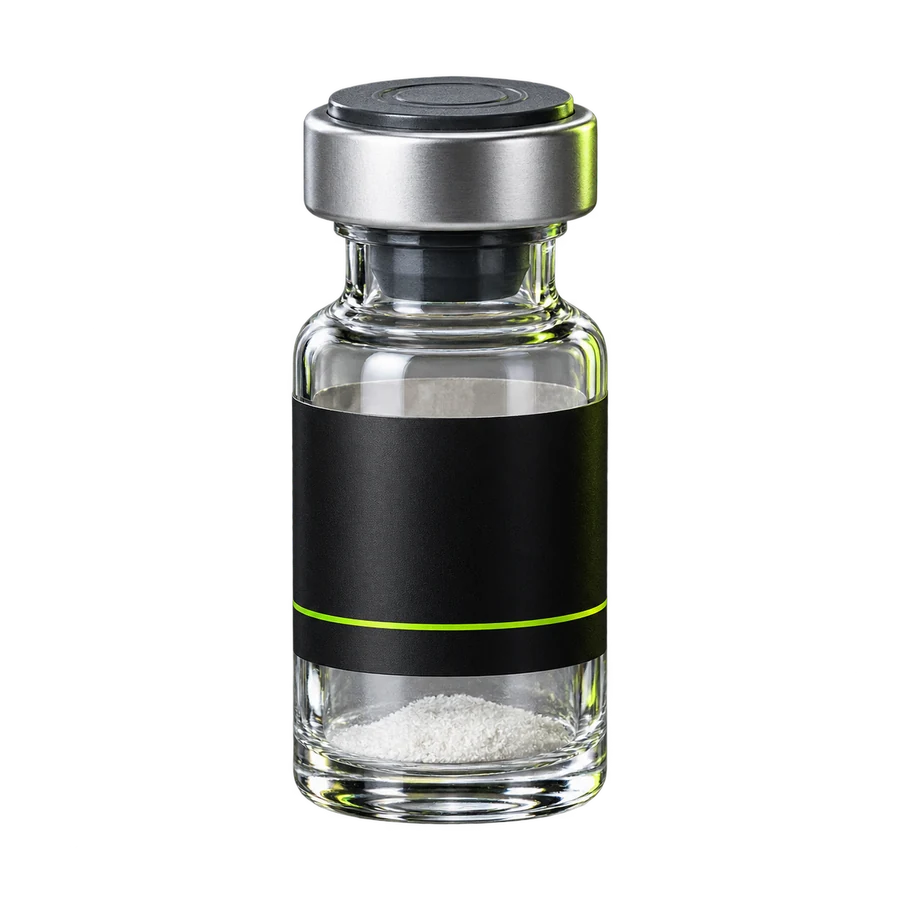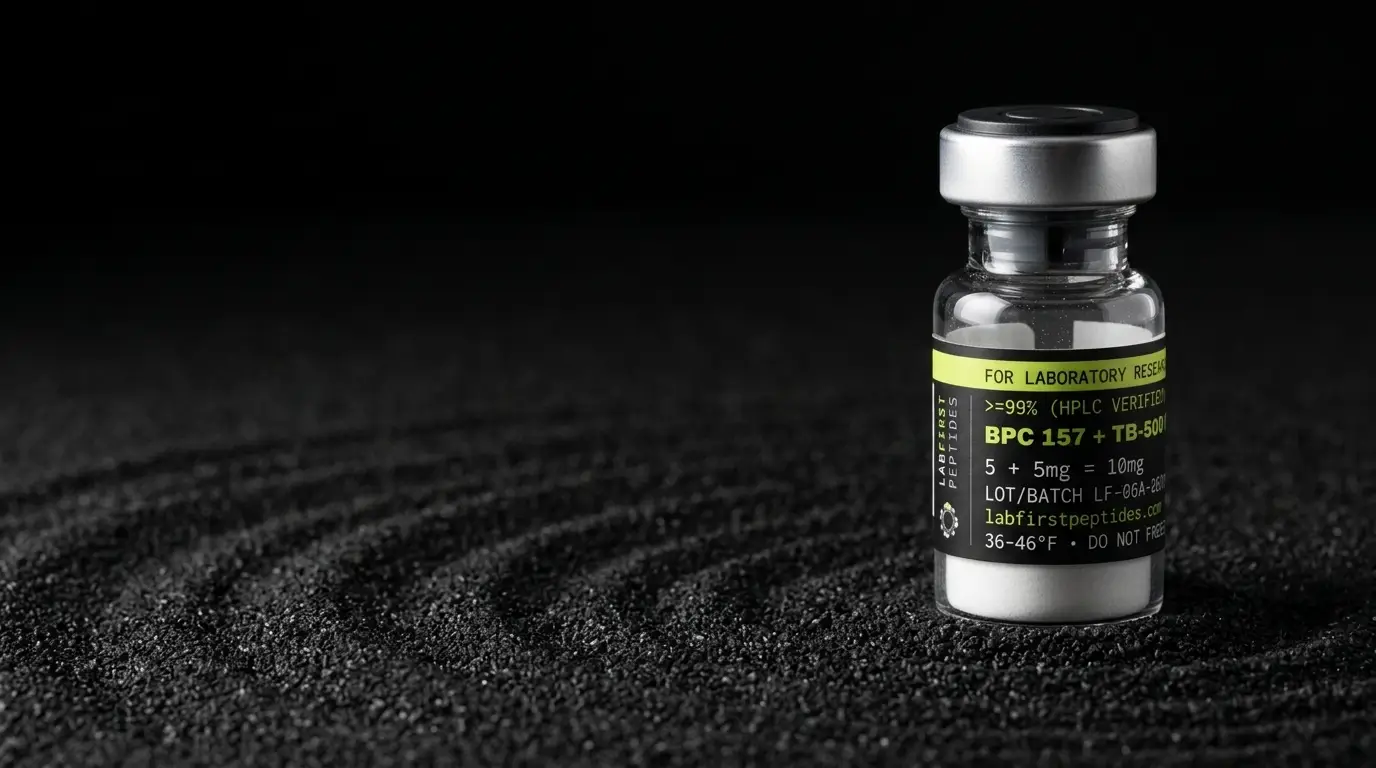
A BPC-157 and TB-500 blend vial holds two separate peptides freeze-dried together: BPC-157, a fifteen-residue peptide of 1419.5 g/mol, and TB-500, an acetylated seven-residue peptide of 889.0 g/mol. It is sold as 5 mg + 5 mg, 10 mg + 10 mg or 15 mg + 15 mg, equal by mass.
- The blend is two separate peptides, BPC-157 and TB-500, freeze-dried together in one vial.
- PubChem gives BPC-157 as C62H98N16O22 at 1419.5 g/mol and TB-500 as C38H68N10O14 at 889.0 g/mol.
- The BPC-157 + TB-500 blend is sold as 5 mg + 5 mg, 10 mg + 10 mg and 15 mg + 15 mg.
- In the BPC-157 + TB-500 blend, equal milligrams hold about 1.6 TB-500 molecules per BPC-157 molecule.
- A blend certificate must report identity, purity and net content for each component.
Two peptides, one vial
A 10 mg + 10 mg vial of this blend is a little like a jar labeled as half rice and half lentils. The label tells you the weight of each. It does not tell you how many grains of each, and it cannot tell you whether the jar really holds what it says unless someone checks.
The BPC-157 and TB-500 blend is two separate peptides freeze-dried together in one vial. They do not bond to each other or form a new compound. Dissolved for a laboratory assay, the solution simply contains both molecules side by side.
That makes the blend a packaging choice. It trades two vials and two lot numbers for one of each. Everything true of each peptide on its own stays true inside the blend, and the paperwork has to report each one separately.
- BPC-157: 15 residues, 1419.5 g/mol
- TB-500: 7 residues, acetylated, 889.0 g/mol
- Sizes: 5+5, 10+10, 15+15 mg
- Equal mass, about 1.6 to 1 by count
- Certificate reports each peptide
The two components
| Component | Sequence | Formula | Average mass | Residues |
|---|---|---|---|---|
| BPC-157 | Gly-Glu-Pro-Pro-Pro-Gly-Lys-Pro-Ala-Asp-Asp-Ala-Gly-Leu-Val | C62H98N16O22 | 1419.5 g/mol | 15 |
| TB-500 | Ac-Leu-Lys-Lys-Thr-Glu-Thr-Gln | C38H68N10O14 | 889.0 g/mol | 7 |
BPC-157 is proline-rich, with three prolines in a row near its start, and it ends in a free acid. TB-500 carries an acetyl cap on its N-terminus and ends in glutamine as a free acid. Its seven residues match a short stretch of thymosin beta-4, a protein whose full sequence is listed on UniProt. The name TB-500 is sometimes applied to the whole protein too, which is a different and much larger molecule, so a certificate should state which one it tested.
What sizes does the blend come in?
The blend is sold in three sizes:
- BB10: 5 mg + 5 mg, 10 mg total
- BB20: 10 mg + 10 mg, 20 mg total
- BB30: 15 mg + 15 mg, 30 mg total
The label states the split rather than only the total, because a total alone would leave the composition unstated. Each figure is a nominal mass of peptide material for that component. The powder in the vial also includes some water and counterion from purification, so the measured peptide content of each part is normally somewhat lower than its nominal figure. That measured figure is the net content, and it belongs on the blend certificate, once per component.
Current prices and stock for each size are on the BPC-157 + TB-500 blend product page.
Equal by mass is not equal by count
A 5 mg + 5 mg label means equal milligrams. Because the molecules differ in size, equal milligrams do not mean equal numbers of molecules.
BPC-157: 5 mg ÷ 1419.5 g/mol = 3.52 µmol
TB-500: 5 mg ÷ 889.0 g/mol = 5.62 µmol
So a label that reads one to one by mass holds about 1.6 TB-500 molecules for every BPC-157 molecule. For laboratory work that reports molar concentrations, that difference matters. It also shifts again once net content is applied, since each component's measured content may differ a little from the other's. The vial concentration calculator handles the solution arithmetic one component at a time.
Why is a blend harder to document?
With one peptide, a certificate reports one identity, one purity and one net content. With two, every one of those becomes two results, and it is easy for a report to merge them without saying so. A single purity percentage for the whole vial, or a single observed mass, is the usual sign.
ICH Q2(R2) describes an identification test as one that picks out the analyte by features of its structure, gives a negative result when it is absent, and does not give a false positive for closely related material. For this vial that means the method has to find and distinguish both peptides. Their masses, about 1418.7 and 888.5 Da, are far enough apart that a mass spectrum shows them clearly. The identity guide for this blend covers the method in detail.
No pharmacopeial monograph or official standard exists for the blend, or for either component. PubChem has records for each peptide and none for the mixture. Each supplier sets its own specification, which is one more reason to read the certificate rather than the label.
Related pages on this blend
This page is about composition. If you are comparing the two peptides as separate compounds, the BPC-157 vs TB-500 comparison sets them side by side. If you are choosing a supplier, where to buy the BPC-157 + TB-500 blend covers the checks to run on any listing. The storage guide for this blend covers keeping a two-peptide vial in the state its certificate describes.
What else is in the powder?
Nothing is added on purpose apart from the two peptides, but a freeze-dried peptide is never pure peptide by weight. Three things share the vial with it.
Water is the first. Lyophilization removes most of it, not all, and the dry cake takes up more from the air every time the vial is opened. Counterion is the second. Peptides are purified with acidic mobile phases, and the charged side chains of lysine and the free N-terminus of BPC-157 hold on to some of that acid as a salt. The third is small amounts of related peptide material from synthesis, such as sequences missing one residue. HPLC purity measures that third group; net content accounts for the first two.
All three are normal. What matters is that the certificate measures them, so the milligrams on the label can be turned into milligrams of each peptide.
Reading the label against the certificate
When a certificate is published for a lot, three quick comparisons connect it to the vial in your hand. First, the lot number on the certificate should match the vial exactly. Second, there should be two identity results, one near 1418.7 Da and one near 888.5 Da. Third, the net content should be given for each peptide, and each should be reasonably close to, and normally a little below, its half of the label.
If the certificate gives a single total instead of a split, it has not confirmed the ratio the label states. If it reports one purity for the vial, ask how the two peaks were handled. The guide to reading a peptide COA covers the general fields; the blend certificate guide covers what changes when there are two.
Why the blend exists
Laboratories that work with both peptides often find two vials awkward: two lot numbers to track, two certificates to file, two sets of storage entries. A blend reduces that to one of each. That is the whole reason for it. It is a way of packaging two catalog items, and the vial itself makes no claim about what the two do together.
The trade-off is flexibility. With separate vials, a lab can set any ratio it wants. With a blend, the ratio is fixed at the fill, by mass, and changing it means adding a single-peptide vial of one component.
Names used for this blend
The same product turns up under several names: BPC-157 and TB-500 blend, BPC/TB-500, BPC TB blend and a handful of nicknames. Spelling varies too, with and without the hyphen in BPC-157. None of these names defines a specification. Two vials sold under the same name by different sellers may differ in ratio, in which form of TB-500 they contain, and in whether they were ever tested as a blend.
The name is a search term. The sizes, the split on the label and the certificate for the lot are what describe the vial.
Our certificates for the blend
Each lot of the blend goes to an independent laboratory for identity, purity and net content, reported for each peptide. The product page shows results only once the certificate for that lot is published at the certificate index. Until then it says the certificate is pending and states no figure. We make no claim about combining the two peptides; the blend exists to put two catalog items in one vial with one lot number.
FOR LABORATORY AND IN-VITRO RESEARCH USE ONLY. NOT FOR HUMAN OR ANIMAL CONSUMPTION.
What is BPC 157 studied for?
Published research on BPC 157 investigates the areas below, which is a different question from what BPC 157 will do for anyone, a claim about a living system that nothing on this site is sold for.
What it is. A man-made fifteen-amino-acid peptide, based on a protein found in stomach juice.
What the research looks at. It appears in animal and cell-culture research on tissue and blood-vessel biology. Almost everything published is animal or cell work.
How it is thought to work. Nobody has settled how it works. Cell and animal studies report effects on blood-vessel growth signals and on several growth-factor pathways, but no single receptor has been pinned down as its target and the studies do not agree on one model.
What is not established. No FDA-approved product contains BPC 157, and no USP or NF standard defines what an acceptable batch is. Human evidence is close to nonexistent. Any figure printed on a research vial is the supplier’s number, not an official one.
The full record, including the certificate for the lot in stock, is on the BPC 157 product page.
Common questions
What is in a BPC-157 and TB-500 blend?
What sizes does the blend come in?
Is the blend one to one?
How is this page different from the BPC-157 vs TB-500 comparison?
Published certificates for BPC 157 + TB-500 Blend
Every figure below is read from a report the laboratory issued for that lot; each page carries the PDF and the lab's own verification link.
More documentation guides
Sources
- PubChem PUG REST, formula and masses for CID 9941957 (BPC-157) and CID 62707662 (TB-500). C62H98N16O22, 1419.5 g/mol, monoisotopic 1418.704 Da for BPC-157; C38H68N10O14, 889.0 g/mol, monoisotopic 888.492 Da for TB-500.
- PubChem PUG REST, IUPAC names for CID 9941957 and CID 62707662. The systematic names encode the residue order of each peptide, including the N-acetyl leucine and C-terminal glutamine free acid of TB-500.
- UniProt P62328, thymosin beta-4 (human). Full parent sequence, removal of the initiator methionine and N-acetylation of the following serine; the LKKTETQ stretch sits inside it.
- ICH Q2(R2), Validation of Analytical Procedures (2023). Section 3.1.2 on identification tests: a positive result against a reference, negative results for samples without the analyte, and a check against closely related materials.